New Horizons completes another course correction before flyby

On December 2 New Horizons successfully completed another engine burn to refine its course for its January 1, 2019 flyby of the Kuiper Belt object Ultima Thule.

The maneuver was designed to keep New Horizons on track toward its ideal arrival time and closest distance to Ultima, just 2,200 miles (3,500 kilometers) at 12:33 a.m. EST on Jan. 1. At the time of the burn New Horizons was 4.03 billon miles (6.48 billion kilometers) from Earth and just 40 million miles (64 million kilometers) from Ultima – less than half the distance between Earth and the Sun. From that far away, the radio signals carrying data from the spacecraft needed six hours, at light speed, to reach home.

The team is analyzing whether to conduct up to three other course-correction maneuvers to home in on Ultima Thule.

The distance to Ultima Thule is still too much to produce detailed images. New Horizons however is going very fast, so in the coming three weeks this will change drastically, and for the better.

Evidence of nitrogen ice glaciers on Pluto

Using data sent back by New Horizons during its fly-by of Pluto scientists now think they have identified land forms created by past nitrogen ice glaciers.

The washboard and fluted terrain … occur at the location on Sputnik Planitia’s perimeter where elevations and slopes leading into the surrounding uplands are lowest, and also where a major tectonic system coincides with the edge of Sputnik Planitia. The low elevation of the area makes it a natural setting for past coverage by nitrogen ice glaciers, as indicated by modeling of volatile behavior on Pluto performed by Dr. Bertrand at Ames.

Through comparison of the washboard and fluted texture with parallel chains of elongated sublimation pits (depressions in the surface formed where ice turns directly into a gas) seen in southern Sputnik Planitia, the ridges are interpreted to represent water ice debris liberated by tectonism of underlying crust. This water ice debris was buoyant in the denser, pitted glacial nitrogen ice that is interpreted to have formerly covered this area, and collected on the floors of the elongated pits. After the nitrogen ice receded via sublimation, the debris was left as the aligned ridges, mimicking the sublimation texture – washboard ridges where deposited on flat terrain, and fluted ridges where deposited on steeper slopes.

This is strange stuff. The solid bedrock here, water ice, will float on the nitrogen ice sitting on top of it. Thus, the material that wants to sublimate away, nitrogen, sometimes has to fight its way past the water ice that has risen to the top of the pile.

To put it mildly, we hardly understand these alien processes. This research is merely a first stab, the first hand-waving.

New Horizons makes final big course correction

New Horizons this week successfully made its final major course correction in preparation for its January 1st fly-by of the Kuiper Belt object the science team has dubbed Ultima Thule.

NASA’s New Horizons spacecraft carried out a short engine burn on Oct. 3 to home in on the location and timing of its New Year’s flyby of the Kuiper Belt object nicknamed Ultima Thule.

Word from the spacecraft that it had successfully performed the 3½-minute maneuver reached mission operations at the Johns Hopkins Applied Physics Laboratory in Laurel, Maryland, at around 10:20 p.m. EDT. The maneuver slightly tweaked the spacecraft’s trajectory and bumped its speed by 2.1 meters per second – just about 4.6 miles per hour – keeping it on track to fly past Ultima (officially named 2014 MU69) at 12:33 am EST on Jan. 1, 2019.

As the spacecraft gets closer they will do more refinements, but right now they are a very precise course. The January 1st fly-by will end a spectacular fall season of planetary mission rendezvous, landings, fly-bys and sample gatherings.

Posted from Chicago.

New Horizons snaps first picture of Ultima

It isn’t much more than a tiny moving dot across a sea of stars, but on August 16, 2018 New Horizons was able to capture its first series of images of its January 1st fly-by target, the Kuiper belt object they have nicknamed Ultima Thule.

This first detection is important because the observations New Horizons makes of Ultima over the next four months will help the mission team refine the spacecraft’s course toward a closest approach to Ultima, at 12:33 a.m. EST on Jan. 1, 2019. That Ultima was where mission scientists expected it to be – in precisely the spot they predicted, using data gathered by the Hubble Space Telescope – indicates the team already has a good idea of Ultima’s orbit.

Ultima was 100 million miles away at the time.

True color images of Pluto and Charon

The New Horizons science team has released mosaic global images of Pluto and Charon, calibrated to capture their true colors as closely as possible.

These natural-color images result from refined calibrations of data gathered by New Horizons’ Multispectral Visible Imaging Camera (MVIC).”That processing creates images that would approximate the colors that the human eye would perceive – bringing them closer to ‘true color’ than the images released near the encounter,” said Alex Parker, a New Horizons science team co-investigator from Southwest Research Institute, Boulder, Colorado.

Because MVIC’s color filters don’t closely match the wavelengths sensed by human vision, mission scientists applied special processing to translate the raw MVIC data into an estimate of the colors that the eye would see. The colors are more subdued than those constructed from the raw MVIC color data, because of the narrower wavelength range sensed by the human eye.

Both images were taken as New Horizons zipped toward closest approach to Pluto and its moons on July 14, 2015; Charon was taken from a range of 46,091 miles (74,176 kilometers) and Pluto from 22,025 miles (35,445 kilometers). Each is a single color MVIC scan, with no data from other New Horizons imagers or instruments added. The striking features on each are clearly visible, from Charon’s reddish north-polar region known as Mordor Macula, to the bright expanse of Pluto’s, nitrogen-and-methane-ice rich “heart,” named Sputnik Planitia.

I must add that these images show only one hemisphere, since the New Horizons flyby did not get a good look at the opposite hemisphere. We won’t know what the other half of both planets look like for many decades.

Global topographic maps of Pluto and Charon

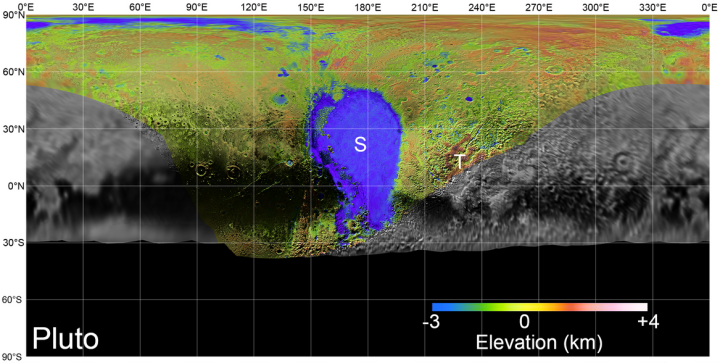
Using data and images from New Horizons scientists have now produced the first global topographic maps of Pluto and Charon.

Obviously, the resolution for the maps of both planets is very uneven, since the spacecraft only saw part of each planet at high resolution during its fly-by. Nonetheless, they note some of the more interesting details revealed:

These maps reveal a rich variety of landforms on both Pluto and Charon. The topographic maps confirm that the highest known mountains on Pluto are the Tenzing Montes range, which formed along the southwestern margins of the frozen nitrogen ice sheet of Sputnik Planitia. These steep-sided icy peaks have slopes of 40° or more and rise several kilometers above the floor of Sputnik Planitia. The highest peak rises approximately 6 kilometers (3.7 miles) above the base of the range, comparable to base-to-crest heights of Denali in Alaska, and Kilimanjaro in Kenya. Pluto’s mountains must be composed of stiff water ice in order to maintain their heights, as the more volatile ices observed on Pluto, including methane and nitrogen ice, would be too weak and the mountains would collapse.

The topographic maps also reveal large-scale features that are not obvious in the global mosaic map. The ice sheet within the 1000-kilometer (625-mile) wide Sputnik Planitia is on average 2.5 kilometers (1.5 miles) deep while the outer edges of the ice sheet lie an even deeper 3.5 km (or 2.2. miles) below Pluto’s mean elevation, or ‘sea level’ surface. While most of the ice sheet is relatively flat, these outer edges of Sputnik Planitia are the lowest known areas on Pluto, all features that are evident only in the stereo images and elevation maps. The topographic maps also reveal the existence of a global-scale deeply eroded ridge-and-trough system more than 3000 kilometers (or 1864 miles) long, trending from north-to-south near the western edge of Sputnik Planitia. This feature is the longest known on Pluto and indicates that extensive fracturing occurred in the distant past. Why such fracturing occurred only along this linear band is not well understood.

On Charon the topographic maps also reveal deep depressions near the north pole that are ~14 kilometers (8.7 miles) deep, deeper than the Marianas Trench on Earth. The equatorial troughs that form the boundary between the northern and southern plains on Charon also feature high relief of ~8 kilometers. The mapping of fractured northern terrains and tilted crustal blocks along this boundary could be due to cryovolcanic resurfacing, perhaps triggered by the foundering of large crustal blocks into the deep interior of Charon. The rugged relief also indicates that Charon retains much of its original topography caused by its history of fracturing and surface disruption.

These maps are obviously only our first stab at mapping both planets. We will need orbiters around both to truly detail their surface features.

New Horizons awakened to begin preparations for January 1 2019 flyby

The New Horizons engineering team has brought the spacecraft out of hibernation to begin preparations for its January 1 2019 flyby of Kuiper Belt object 2014 MU69, which they have dubbed Ultima Thule.

New Horizons will begin its approach phase of the MU69 flyby on August 16, 2018, when it will begin imaging MU69 and the area around it to begin acquiring data about the KBO and its surroundings. Also, New Horizons will look for potential debris that could pose a hazard to itself, such as moons or rings.

Should any potential dangers be found, New Horizons has four planned opportunities to make trajectory changes from early October to early December 2018. The backup trajectory has a distance from MU69 of 10,000 kilometers (around 6,200 miles). Using the backup trajectory would lead to less and/or lower-quality science data gathered due to the probe flying by MU69 further away than planned.

The approach phase will last from August 16 to December 24, 2018, after which the core phase will begin.

The core phase begins just one week before the flyby and continues until two days afterward. It contains the flyby and the majority of the data gathering.

Based on this schedule, we should begin to get some interesting pictures of Ultima Thule by the fall.

Dunes on Pluto?

Dunes on Pluto

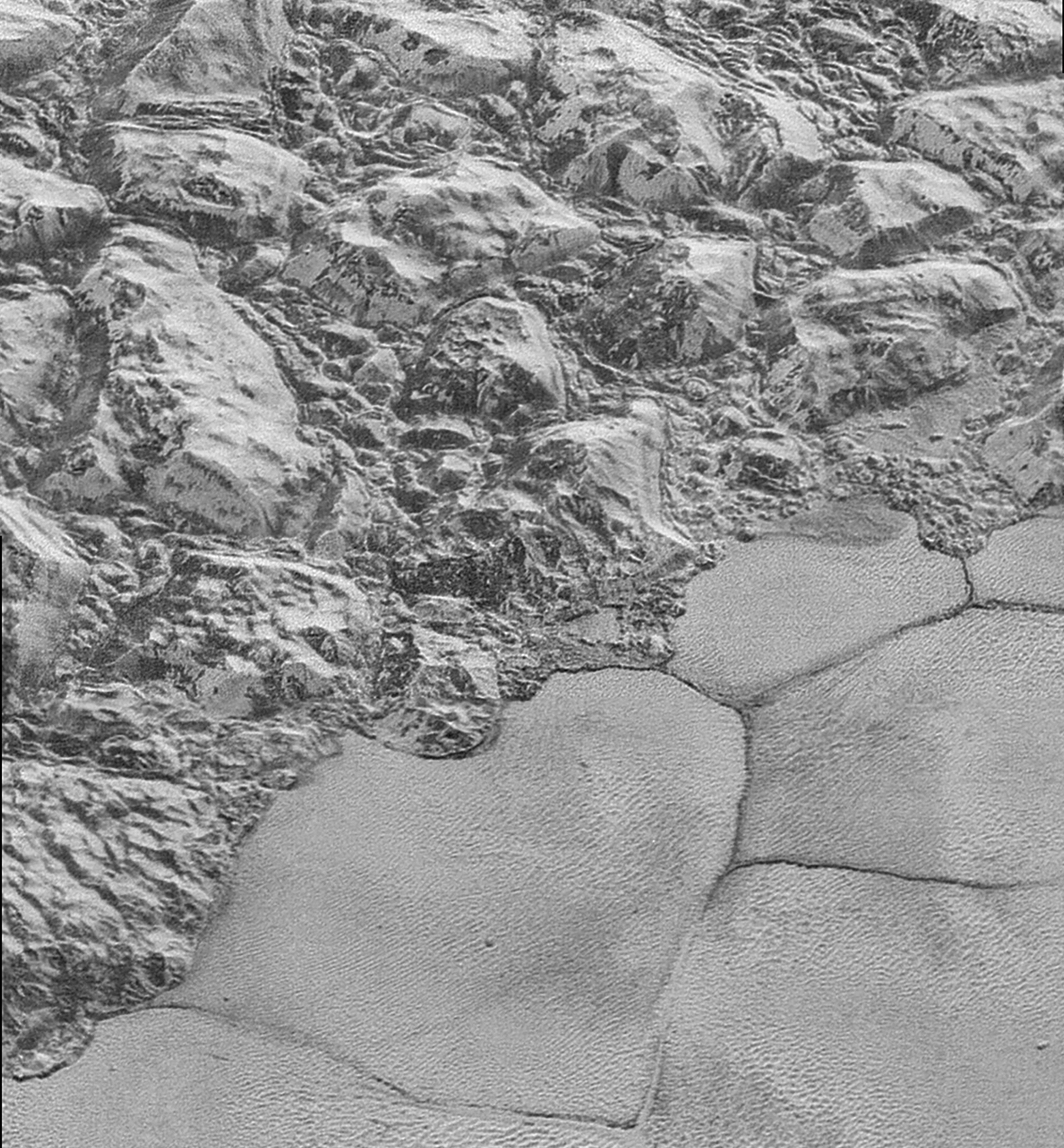
Cool image time! Scientists reviewing images taken by New Horizons when it flew past Pluto in 2015 have discovered what appear to be dunes of methane on the icepack of nitrogen of Sputnik Planitia. The image on the right, cropped to post here, shows these dunes. You can see the full image if you click on it.

Following spatial analysis of the dunes and nearby wind streaks on the planet’s surface, as well as spectral and numerical modelling, scientists believe that sublimation (which converts solid nitrogen directly into a gas) results in sand-sized grains of methane being released into the environment.

These are then transported by Pluto’s moderate winds (which can reach between 30 and 40 kmh), with the border of the ice plain and mountain range providing the perfect location for such regular surface formations to appear.

The scientists also believe the undisturbed morphology of the dunes and their relationship with the underlying glacial ice suggests the features are likely to have been formed within the last 500,000 years, and possibly much more recently.

There remains a lot of uncertainty here. The features do look like dunes in the image, but it is also possible that other phenomenon not yet understood could have caused this pattern on the icepack surface. Also, the resolution of the image is not sufficient to really see detail at this level. A different process on the surface could be fooling our eyes.

Nonetheless, the scientists hypothesis makes sense, and fits the data known. It also demonstrates again that, even billions of miles from the Sun, in as alien an environment we can imagine, the planet Pluto is an active and complex place.

New Horizons team picks Ultima Thule as nickname for 2014 MU69

In their continuing effort to give interesting names to their targets, the New Horizons team has chosen the name Ultima Thule for 2014 MU69, the Kuiper Belt object it will fly past on January 1, 2019.

With substantial public input, the team has chosen “Ultima Thule” (pronounced ultima thoo-lee”) for the Kuiper Belt object the New Horizons spacecraft will explore on Jan. 1, 2019. Officially known as 2014 MU69, the object, which orbits a billion miles beyond Pluto, will be the most primitive world ever observed by spacecraft – in the farthest planetary encounter in history.

Thule was a mythical, far-northern island in medieval literature and cartography. Ultima Thule means “beyond Thule”– beyond the borders of the known world—symbolizing the exploration of the distant Kuiper Belt and Kuiper Belt objects that New Horizons is performing, something never before done.

“MU69 is humanity’s next Ultima Thule,” said Alan Stern, New Horizons principal investigator from Southwest Research Institute in Boulder, Colorado. “Our spacecraft is heading beyond the limits of the known worlds, to what will be this mission’s next achievement. Since this will be the farthest exploration of any object in space in history, I like to call our flyby target Ultima, for short, symbolizing this ultimate exploration by NASA and our team.”

Their spacecraft will be the first to see this object up close. It is their right to name it. And if the International Astronomical Union objects, they can go to hell. I guarantee that future generations of space-farers will know this tiny world by this name, and this name alone.

New Horizons takes the most distant pictures from Earth ever taken

Kuiper Belt Object 2012 HE85

The New Horizons science team has released three images taken by the spacecraft from almost 3.8 billion miles from Earth, the most distant images ever taken.

The routine calibration frame of the “Wishing Well” galactic open star cluster, made by the Long Range Reconnaissance Imager (LORRI) on Dec. 5, was taken when New Horizons was 3.79 billion miles (6.12 billion kilometers, or 40.9 astronomical units) from Earth – making it, for a time, the farthest image ever made from Earth.

…LORRI broke its own record just two hours later with images of Kuiper Belt objects 2012 HZ84 and 2012 HE85 – further demonstrating how nothing stands still when you’re covering more than 700,000 miles (1.1 million kilometers) of space each day.

The images themselves are not spectacular to look at, though the two images of two different Kuiper Belt objects are the best ever taken of such objects, and certainly contain data that scientists will be able to use. The image on the right is one of these objects, 2012 HE85. For example, note how it does not appear to be round.

This exercise is in preparation for the January 1, 2019 fly-by of 2014 MU69, where the images will be sharp and detailed, and provide us a good look at such a distant object.

MU69 might have a moon

Worlds without end: Observations of stellar occultations this past summer of 2014 MU69, New Horizons’ Kuiper belt target for a January 1, 2019 fly-by, suggest that the object is not only very elongated or two objects practically touching as they orbit around each other, but it might have a moon orbiting it.

The data that led to these hints at MU69’s nature were gathered over six weeks in June and July, when the team made three attempts to place telescopes in the narrow shadow of MU69 as it passed in front of a star. The most valuable recon came on July 17, when five telescopes deployed by the New Horizons team in Argentina were in the right place at the right time to catch this fleeting shadow — an event known as an occultation – and capture important data on MU69’s size, shape and orbit. That data raised the possibility that MU69 might be two like-sized objects, or what’s known as a binary.

The prospect that MU69 might have a moon arose from data collected during a different occultation on July 10, by NASA’s airborne Stratospheric Observatory for Infrared Astronomy (SOFIA). Focused on MU69’s expected location while flying over the Pacific Ocean, SOFIA detected what appeared to be a very short drop-out in the star’s light. Buie said further analysis of that data, including syncing it with MU69 orbit calculations provided by the European Space Agency’s Gaia mission, opens the possibility that the “blip” SOFIA detected could be another object around MU69. “A binary with a smaller moon might also help explain the shifts we see in the position of MU69 during these various occultations,” Buie added. “It’s all very suggestive, but another step in our work to get a clear picture of MU69 before New Horizons flies by, just over a year from now.”

All of this is somewhat speculative. We really won’t know until New Horizons arrives next year.

New Horizons successfully does course correction

New Horizons yesterday successfully fired its engines for 2.5 minutes to refine its course and January 1, 2019 fly-by of Kuiper belt object 2014 MU69.

The maneuver both refined the course toward and optimized the flyby arrival time at MU69, by setting closest approach to 12:33 a.m. EST (5:33 UTC) on Jan. 1, 2019. The prime flyby distance is set at 2,175 miles (3,500 kilometers); the timing provides better visibility for DSN’s powerful antennas to reflect radar waves off the surface of MU69 for New Horizons to receive – a difficult experiment that, if it succeeds, will help scientists determine the reflectivity and roughness of MU69’s surface.

The spacecraft will next be put in hibernation on December 21, and stay in that state until June.

Haze on Pluto lowers its global climate temperature 54º F

Using data collected during New Horizons’ fly-by, scientists have found that the planet’s atmosphere is 54º F colder than predicted, and from this they theorize that the presence of haze in that atmosphere is what cools it.

Pluto’s atmosphere is made mostly of nitrogen, with smaller amounts of compounds such as methane. High in the atmosphere — between 500 and 1,000 kilometres above the surface — sunlight triggers chemical reactions that transform some of these gases into solid hydrocarbon particles.

The particles then drift downward and, at around 350 kilometres above Pluto’s surface, clump with others to form long chemical chains. By the time they reach 200 kilometres’ altitude, the particles have transformed into thick layers of haze, which the New Horizons spacecraft saw dramatically blanketing Pluto.

Zhang and his colleagues compared the heating and cooling effects of the atmosphere’s gas molecules to those of its haze particles. Earlier studies have suggested that the presence of gas molecules, such as hydrogen cyanide, could help explain why Pluto’s atmosphere is so cold. But Zhang’s team found that including haze was the only way to get their model to match the temperatures that New Horizons measured as it flew by the dwarf planet.

This theory remains unproven. Moreover, there are other explanations proposed for the cold atmosphere by other scientists. It will take new instruments and future probes to resolve the question.

The post has been corrected. My math in calculating the conversion from Celsius to Fahrenheit was initially faulty. Thanks to reader Kirk for spotting the error.

New Horizons wants the public to help pick a nickname for its next target

The New Horizons science team is asking the public to submit suggestions for a good nickname for 2014 MU69, the Kuiper Belt object that the spacecraft will fly past on January 1, 2019.

The naming campaign is hosted by the SETI Institute of Mountain View, California, and led by Mark Showalter, an institute fellow and member of the New Horizons science team. The website includes names currently under consideration; site visitors can vote for their favorites or nominate names they think should be added to the ballot. “The campaign is open to everyone,” Showalter said. “We are hoping that somebody out there proposes the perfect, inspiring name for MU69.”

The campaign will close at 3 p.m. EST/noon PST on Dec. 1. NASA and the New Horizons team will review the top vote-getters and announce their selection in early January.

The press release says that a more formal name for the object will be submitted to the IAU after the fly-by.

New Horizons team looks for second flyby in Kuiper Belt

The New Horizons science team is hoping to send their probe past a second more distant Kuiper Belt object after its January 1, 2019 flyby of 2014 MU69, if they can find an object that the spacecraft can reach.

They haven’t found any candidates yet, NASA has not agreed to a mission extension anyway, and their focus now remains the 2019 flyby. Still, if they are lucky and can get another target, this would be a nice bonus for the mission.

Plan of New Horizons’ fly-by of 2014 MU69 announced

The New Horizons science team has announced its detailed plan for the January 1, 2019 fly-by of Kuiper Belt object 2014 MU69.

If all goes as planned, New Horizons will come to within just 2,175 miles (3,500 kilometers) of MU69 at closest approach, peering down on it from celestial north. The alternate plan, to be employed in certain contingency situations such as the discovery of debris near MU69, would take New Horizons within 6,000 miles (10,000 kilometers) — still closer than the 7,800-mile (12,500-kilometer) flyby distance to Pluto.

…If the closer approach is executed, the highest-resolution camera on New Horizons, the telescopic Long Range Reconnaissance Imager (LORRI) should be able to spot details as small as 230 feet (70 meters) across, for example, compared to nearly 600 feet (183 meters) on Pluto.

MU69 is thought to either be two objects orbiting very close to each other or an object similar to Comet 67P/C-G, two objects in contact but barely so.

In a related New Horizons story, the International Astronautical Union (IAU) has officially accepted 14 names chosen by the New Horizons team for features on Pluto.

MU69 is not round

New data about 2014 MU69, the Kuiper Belt object that New Horizons plans to fly past on January 1, 2019, suggests that it is either elongated or made of two objects almost touching.

Recent observations suggest that the rock is no more than 20 miles long, and its shape is not round or elliptical, like most space rocks. Instead, the icy body is either shaped like a stretched football, called an “extreme prolate spheroid,” or like two rocks joined together. That creates a rubber ducky shape similar to the comet that the European Space Agency landed on two years ago.

It’s even possible that the object is, in fact, two objects — like a pair of rocks that are orbiting around each other, or are so close that they’re touching. If 2014 MU69 does turn out to be two objects, then each one is probably between nine and 12 miles in diameter, according to the New Horizons team.

I predict that this object will be even weirder in shape that predicted. The low gravity in the Kuiper Belt almost guarantees it.

New Horizons team spots stellar eclipse by 2014 MU69

In an effort to learn as much as possible about New Horizons’ next target, Kuiper belt object 2014 MU69, the science team has successfully observed on July 17 a 0.2-second-long eclipse of a star by that object.

This was the third occultation by 2014 MU69 that the science team attempted to catch. With the first, on the ground, they saw nothing. The second, using the flying observatory SOFIA, was more successful, as was the third attempt last week.

Though they haven’t yet released their findings, they say the data from the last two observations has allowed them to determine the rough shape and size of 2014 MU69. This is crucial information needed for planning the observations of it during New Horizons January 1, 2019 fly-by.

A map of Pluto

Our best map of Pluto for many decades to come

The New Horizons science team has released the best maps of both Pluto and Charon possible from the images taken during the spacecraft’s fly-by of the ninth planet last year.

The new maps include global mosaics of Pluto and Charon, assembled from nearly all of the highest-resolution images obtained by New Horizons’ Long-Range Reconnaissance Imager (LORRI) and the Multispectral Visible Imaging Camera (MVIC). These mosaics are the most detailed and comprehensive global views yet of the Pluto and Charon surfaces using New Horizons data.

The new collection also includes topography maps of the hemispheres of Pluto and Charon visible to New Horizons during the spacecraft’s closest approach. The topography is derived from digital stereo-image mapping tools that measure the parallax – or the difference in the apparent relative positions – of features on the surface obtained at different viewing angles during the encounter. Scientists use these parallax displacements of high and low terrain to estimate landform heights.

You will also notice large areas of both Pluto and Charon that remain very fuzzy and unclear. What exactly is there will remain a mystery for many decades to come.

New Horizons’ next target might be smaller than predicted

The uncertainty of science: Because all attempts to observe an occultation of a star on June 3 by New Horizons’ next target failed, astronomers now think Kuiper Belt object 2014 MU69 is much smaller than previously believed.

The discovery observations using Hubble and other ground-based telescopes had estimated its size as between 12 to 25 miles in diameter. The null result from the June 3 event suggests it is smaller than that.

More occultations are upcoming, so stay tuned.

New Horizons goes back to sleep

The New Horizons science and engineering team has placed the spacecraft back in hibernation mode for the first time since prior to its fly-by of Pluto in 2014.

During hibernation mode, much of the New Horizons spacecraft is unpowered. The onboard flight computer monitors system health and broadcasts a weekly beacon-status tone back to Earth, and about once a month sends home data on spacecraft health and safety. Onboard sequences sent in advance by mission controllers will eventually wake New Horizons to check out critical systems, gather new Kuiper Belt science data, and perform course corrections (if necessary).

This hibernation period will last until September, when they will wake the spacecraft so that they can make a mid-course correction in preparation for the January 1, 2019 flyby of Kuiper Belt Object 2014 MU69.

Scientists propose new planet definition that reinstates Pluto

Unhappy since 2006 with the definition of “planet” imposed by the International Astronomical Union (IAU) that demoted Pluto, planetary scientists, including New Horizons principal investigator Alan Stern, have now proposed a new definition that they think is more appropriate and would reinstate Pluto.

The scientists suggest planets should constitute as “round objects in space that are smaller than stars,” thus excluding white dwarfs, neutron stars, and black holes from the planetary status. “A planet is a sub-stellar mass body that has never undergone nuclear fusion and that has sufficient self-gravitation to assume a spheroidal shape adequately described by a triaxial ellipsoid regardless of its orbital parameters,” the proposal elaborates, noting that the Earth’s moon would constitute as a planet under the new definition.

Stern and his colleagues note that the IAU’s definition of a planet is too narrow and recognizes planets only as objects that orbit our sun and “requires zone clearing, which no planet in our solar system can satisfy since new small bodies are constantly injected into planet-crossing orbits.”

Make sense to me as well as a lot of people. The definition created in 2006 was never very satisfactory, and I know many planetary scientists who have never accepted it.

New conclusions about Pluto from New Horizons data

Based on New Horizons data scientists have proposed that Pluto’s equatorial tilt has been shifted because of a seasonal pile-up of nitrogen that literally causes the planet to tip over.

Over the course of a Pluto year, nitrogen and other exotic gases condense on the permanently shadowed regions, and eventually, as Pluto goes around the sun, those frozen gases heat up, become gaseous again and re-condense on the other side of the planet, resulting in seasonal “snowfall” on Sputnik Planitia. “Each time Pluto goes around the sun, a bit of nitrogen accumulates in the heart,” Keane said. “And once enough ice has piled up, maybe a hundred meters thick, it starts to overwhelm the planet’s shape, which dictates the planet’s orientation. And if you have an excess of mass in one spot on the planet, it wants to go to the equator. Eventually, over millions of years, it will drag the whole planet over.”

The theory also requires there to be a subsurface ocean as well.

New Horizons returns the last data from Pluto fly-by

The New Horizons science team announced today that they have finally received the last bit of data obtained by the spacecraft during its July 14, 2015 fly-by of Pluto.

Having traveled from the New Horizons spacecraft over 3.1 billion miles (five hours, eight minutes at light speed), the final item – a segment of a Pluto-Charon observation sequence taken by the Ralph/LEISA imager – arrived at mission operations at the Johns Hopkins Applied Physics Laboratory (APL) in Laurel, Maryland, at 5:48 a.m. EDT on Oct. 25. The downlink came via NASA’s Deep Space Network station in Canberra, Australia. It was the last of the 50-plus total gigabits of Pluto system data transmitted to Earth by New Horizons over the past 15 months.

Once they have checked this data, they will wipe the spacecraft’s onboard hard drives to prepare for the January 1, 2019 fly-by of Kuiper Belt object 2014 MU69.

Landslides on Charon

Landslide on Charon

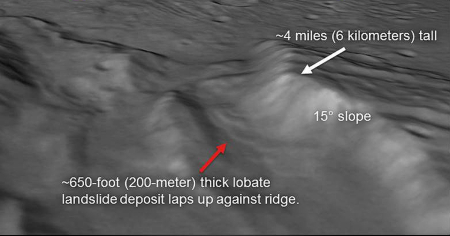
Images from New Horizons have detected evidence of past avalanches on Pluto’s largest moon, Charon. The image on the right is a reduced version of a perspective view created using data from various instruments.

This perspective view of Charon’s informally named “Serenity Chasm” consists of topography generated from stereo reconstruction of images taken by New Horizons’ Long Range Reconnaissance Imager (LORRI) and Multispectral Visible Imaging Camera (MVIC), supplemented by a “shape-from-shading” algorithm. The topography is then overlain with the PIA21128 image mosaic and the perspective view is rendered. The MVIC image was taken from a distance of 45,458 miles (73,159 kilometers) while the LORRI picture was taken from 19,511 miles (31,401 kilometers) away, both on July 14, 2015.

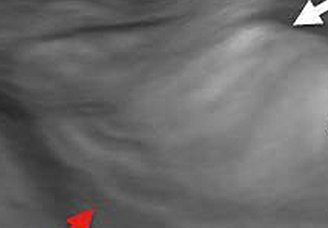
close-up of landslide

To the left is a close-up taken from the annotated image. You can see the slump materials at the base of the mountain left behind after the material slide down the mountain. It is not clear whether it is Charon’s lower gravity and alien composition and environment (very very very cold) that makes this look more muddy than one would expect, or whether it is because of the limited resolution of the original image and the modeling to create the oblique version.

New Horizons looks back at Pluto

One year after New Horizons’ breath-taking fly-by of Pluto, the science team has written a review of what they have learned.

They list what they consider the mission’s top ten discoveries, which I think can be summed up in one phrase: the uncertainty of science. Pluto was more active geologically and atmospherically than predicted by all models. It was also more complex. Other surprises: Both Pluto and Charon show evidence of sub-surface liquid oceans of water. Charon’s dark red polar baffles them. They unexpectedly found no additional moons, and also discovered that as far as they can tell by the available data, the moons were all formed when Pluto formed, something they also did not expect.

The one thing that I expected that did happen? We got close, and discovered things we had not expected. Be prepared for further surprises when New Horizons flies past Kuiper Belt object 2014 MU69 on January 1, 2019.

1 2 3 4 6