IPCC needs reform
Better late than never. An independent academic panel has concluded that the IPCC needs reform.
Better late than never. An independent academic panel has concluded that the IPCC needs reform.
Better late than never. An independent academic panel has concluded that the IPCC needs reform.
This guy is thinking ahead: a paper extolling the scientific benefits of interstellar space travel (published in a 2009 issue of the Journal of the British Interplanetary Society) was made available today on the Los Alamos astro-ph website. Fun quote from the abstract:
Significant benefits are identified in the fields of interstellar medium studies, stellar astrophysics, planetary science and astrobiology. In the latter three areas the benefits would be considerably enhanced if the interstellar vehicle is able to decelerate from its interstellar cruise velocity to rest relative to the target system. Although this will greatly complicate the mission architecture, and extend the overall travel time, the scientific benefits are such that this option should be considered seriously in future studies.
Evidence continues to build that volcanic activity on Venus has occurred in the very recent past, and might even be going on today.
India announced today the scientific instruments it plans for its second lunar probe, scheduled for launch in 2013. India is building the orbiter and Russia is building the lander/rover.
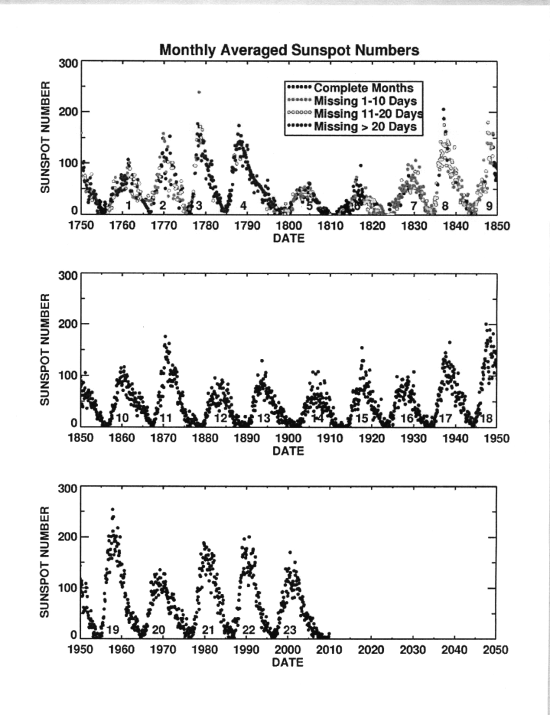
Scientists have confirmed that the just ending low solar minimum had considerable influence in shrinking the Earth’s outer atmosphere. Key quote:
[The scientist] says the research indicates that the Sun could be going through a period of relatively low activity, similar to periods in the early 19th and 20th centuries. This could mean that solar output may remain at a low level for the near future. “If it is indeed similar to certain patterns in the past, then we expect to have low solar cycles for the next 10 to 30 years.”
Kepler had found a solar system with two Saturn-sized planets, plus a possible third planet 1.5 times the diameter of the Earth, with a mass three to four times as big.
After a short four day stretch with no sunspots — the first time in months — two new sunspots appeared today. It is very possible that this will be the last time the Sun will be blank for years as it continues to ramp up to its next solar maximum.
The publication of the results of the material found within the Hayabusa capsule has been delayed until December. The researchers have found that the particles in the capsule are smaller than expected, and they need more time to study them properly.
Exoplanet news! Scientists today announced the discovery of a host of planets, all orbiting a single star similar to the Sun. Though five are Neptune-sized, a sixth (not yet confirmed) might be the size of Earth. What makes this even more exciting is that the astronomers made the discovery using a ground-based telescope.
But wait, there’s more! Thursday NASA will hold a press conference about a new discovery by Kepler!
More information on the recently discovered fireball that impacted Jupiter on August 20, including images.
For the third time in the last year, Jupiter has been hit by a large previously unknown object.
Why bother with research when all we need to do is ask our politicians? Scientist Hillary Clinton studies the floods in Pakistan and the forest fires in Russia and declares them both proof that global warming is happening!
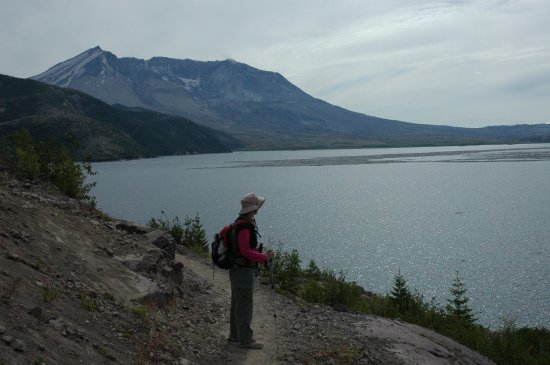
Today we hiked almost ten miles around Mt. St. Helens, walking down to the shore of Spirit Lake (see below) as well as tromping about on the debris field just below the crater. I will have a long post on the experience tomorrow.
For the first time in months, the Sun is blank, with no sunspots. This lull should be very temporary, and might very well be the last time we see the Sun so quiet for a long time, as it ramps up to its next solar maximum (even if that solar maximum is very weak).
Another scientific scandal, this time in the field of animal and human cognitive research: Harvard scientist Marc Hauser has admitted to eight instances of misconduct. Three key quotes:
The university said in a statement last week that Dr. Hauser or a co-author had been directed to correct three published papers for which the original data could not be found. [emphasis mine]
Harvard itself had faced growing criticism for not releasing more details of the inquiry since The Boston Globe reported on Aug. 10 that the university had found evidence of scientific misconduct in Dr. Hauser’s lab. On Friday, Michael D. Smith, dean of the Harvard faculty of arts and sciences, issued a letter to the faculty confirming the inquiry and saying the eight instances of scientific misconduct involved problems of “data acquisition, data analysis, data retention, and the reporting of research methodologies and results.” No further details were given.
Harvard’s findings against him, if sustained, may cast a shadow over the broad field of scientific research that depended on the particular research technique often used in his experiments.
Gee, this sure sounds a lot like the Phil Jones/East Anglia University climategate scandal, where both the researcher and his university provided cover for each other, thereby leaving a cloud over a vast amount of climate research that depends on Jones’s data.
Want to see what the Earth-Moon double planet looks like from 114 million miles away? Take a look at this image taken recently by the Messenger spacecraft on its long journey to Mercury.
Images from Lunar Reconnaissance Orbiter have proven that as the Moon cooled and solidified, it shrunk, leaving behind a network of cliffs, called thrust faults, across its entire face.
Astronomers have discovered the first star/neutron star binary system where the normal star is eclipsing the neutron star several times each week.
Despite increasing use by humans, the plastic pollution floating in the North Atlantic ocean has not increased over the last two decades,and scientists don’t know why. From the Science press notice:
The authors propose a handful of possible explanations for why more discarded plastic is not appearing out in the open Atlantic Ocean. It may break up into pieces too small to be collected by the nets, or it might be sinking beneath the surface. Or, it might be consumed by marine organisms. More research will be necessary to determine the likelihood of each scenario.
Mud volcanoes on Mars.
Though this only confirms what the Russians learned on Mir, scientists have determined that long periods in weightlessness cause a significant loss in muscle strength. More research like this — to both study the problem as well as possibly solve it — is exactly what we need to do on ISS. Key quote:
Damage caused to the tissue is such that it is equivalent to a 30- to 50-year-old crew member’s muscles deteriorating to that of an 80-year-old. Despite in-flight exercise, the report warns that the destructive effects of extended weightlessness to skeletal muscle poses a significant safety risk for future manned missions to Mars and further afield.
European scientists, using the Very Large Telescope at the European Southern Observatory, have determined that a magnetar (a neutron star pulsar with an extremely strong magnetic field) was formed from a star with a mass 40 times that of the Sun. This is a significant discovery, as most theories say that any star this heavy should instead become a black hole when it dies. That this particular star instead became a neutron star challenges present astronomical theory.
News you can use! Eating chocolate in reasonable quantities lowers your heart risk!
Speaking of the Sun, on August 14 it unleashed the first solar radiation storm of new solar cycle 24.
The New York Times today published an op-ed outlining the serious dangers we face should the Sun unleash a solar flare or coronal mass ejection of sufficient power to knock out our electrical grids. After describing the horrors of Hurricane Katrina, the author then says
We are similarly unready for another potential natural disaster: solar storms, bursts of gas on the sun’s surface that release tremendous energy pulses.
Now this might be interesting, had it been published in 1988. At that time, the electrical grids used in the U.S. and Canada were very much unprepared for a sudden solar storm. Moreover, the Sun at that time was ramping up towards a particularly active solar maximum. The result: On March 13, 1989, the power grid that supplied electricity to Quebec and 200 utility companies in the U.S. came crashing down, overloaded by a power surge caused by a burst of energy sent hurtling towards the Earth, by the Sun.
However, to report this threat today as if it was news is somewhat laughable. Since the 1990 solar maximum, the world’s electrical systems have been very much aware of the problem and have instituted numerous safeguards should the Sun burp at them again. It was for this reason that there were few problems during the next solar maximum in 2001, even though it was almost as powerful as the maximum in 1990.
The real news story concerning the Sun is how inactive it has been, for reasons scientists do not understand. Not only was the recently concluded solar minimum the longest and deepest in almost a hundred years, the subsequent solar activity leading to the next solar maximum has been far weaker than every prediction. At the moment, the Sun appears headed for the weakest solar maximum in two hundred years. And when that last happened, the Earth experienced a period of significantly cold weather, also for reasons that scientist do not yet understand.
It is this story that journalists should be covering.
A new research paper, written by statistical scientists and to be published next month in the Annals of Applied Statistics, has found that Michael Mann’s hockey stick graph, showing a steep increase in global temperature in the last two hundred years, is statistically invalid. Key quote:
Research on multi-proxy temperature reconstructions of the earth’s temperature is now entering its second decade. While the literature is large, there has been very little collaboration with university level, professional statisticians (Wegman et al., 2006; Wegman, 2006). Our paper is an effort to apply some modern statistical methods to these problems. While our results agree with the climate scientists findings in some respects, our methods of estimating model uncertainty and accuracy are in sharp disagreement.
[We] conclude unequivocally that the evidence for a ”long-handled” hockey stick (where the shaft of the hockey stick extends to the year 1000 AD) is lacking in the data. The fundamental problem is that there is a limited amount of proxy data which dates back to 1000 AD; what is available is weakly predictive of global annual temperature. Our backcasting methods, which track quite closely the methods applied most recently in Mann (2008) to the same data, are unable to catch the sharp run up in temperatures recorded in the 1990s, even in-sample. [emphasis mine]
In other words, the temperature data going back to 1000 AD is poor, and cannot be reliably used to prove a sudden increase in global temperature in the last two hundred years. More importantly, according to this paper, Michael Mann tried to use statistics to prove his point, without consulting any statisticians.
Though solar scientists have discovered that certain recent solar behavior might help explain the long and deep solar minimum that just ended, this BBC article immediately tries to give that result credit for explaining everything. To quote:
Solar physicists may have discovered why the Sun recently experienced a prolonged period of weak activity.
NOT! The result only observed a change in solar behavior beneath the surface, whereby the meridional flow slowed down as well as lengthened significantly into the high latitudes, and that this change occurred at the same time as the weak solar minimum. The paper made no attempt to explain why this happened, nor did it provide a theoretical explanation for how these changes resulted in a weak solar minimum.
Finally, and far more important, scientists still have no good theory for explaining the solar cycle in the first place. “We think it’s the solar dynamo [that causes the solar cycle],” noted Dean Pesnell of the Goddard Space Flight Center when I interviewed him for my Sky & Telescope article, What’s Wrong with Our Sun? (August 2009). “But we don’t undertand how the dynamo works, as yet.”
The BBC should be more careful in how it reports a story like this.
The continuing cost overruns for the James Webb Space Telescope threaten future space science missions, according to NASA, even as astronomers are about to announce their recommendations for what NASA should do in the next decade. Note that I will be attending the 11 am press conference on the new decadal survey, and hope to post from there.
Scientists think they have discovered at least one cause of the recent long and deep solar minimum: a change in how plasma near the surface of the Sun flows from the equator to the pole, sinks, and then flows back to the equator. In the last minimum, this meridional current flowed much slower, while also flowing much closer to the pole before finally sinking.
An object, initially announced in 1998 to be the first planet ever photographed, then rejected as a planet when data suggested it was too hot, is now being resurrected as a possible planet. Key quote by Adam Burrows of Princeton University:
[If true] this would punctuate one of the strangest episodes in the history of the emerging field of exoplanet research. If false, it would be one more warning that numerous pitfalls await the intrepid astronomer in search of planetary gold beyond the solar system.