NASA makes right decision and delays Artemis-2 launch to do a 2nd dress rehearsal countdown

Artemis Program logo

NASA management announced today that it has decided to postpone the launch of the manned Artemis-2 mission around the Moon until March in order to give it time to do a second wet dress rehearsal countdown of the rocket and fix the hydrogen fuel leaks that occurred in yesterday’s rehearsal.

Engineers pushed through several challenges during the two-day test and met many of the planned objectives. To allow teams to review data and conduct a second wet dress rehearsal, NASA now will target March as the earliest possible launch opportunity for the flight test.

Moving off a February launch window also means the Artemis II astronauts will be released from quarantine, which they entered in Houston on Jan. 21. As a result, they will not travel to NASA’s Kennedy Space Center in Florida Tuesday as tentatively planned. Crew will enter quarantine again about two weeks out from the next targeted launch opportunity.

It should be understood that these hydrogen leaks have been systemic to SLS’s core stage rocket engines, which come from the shuttle era. Shuttle launches were routinely delayed due to similar leaks. This was partly because hydrogen is extremely difficult to control, as its atom is so small and light, and partly because of the engine design. This was the first rocket system ever to use hydrogen as fuel, and was thus cutting edge, in the 1970s. We should not be surprised by such issues.

Newer hydrogen-fueled designs have apparently overcome the problem. For example, Blue Origin uses hydrogen as a fuel in the upper stage of its New Glenn rocket, and though it has only launched twice, it has not had such issues on either launch.

In its announcement NASA also noted a bunch of other issues that occurred during this first rehearsal, all of which suggest that a delay is called for. There was a valve issue in the Orion capsule, some audio communication channels kept dropping out, and the cold weather affected some equipment. Waiting until warmer weather will help alleviate some of this.

10 comments

Fuel leaks cause Artemis-2 dress rehearsal countdown to terminate at T-5:15, several minutes early

Artemis Program logo

Two hydrogen fuel leaks during today’s Artemis-2 dress rehearsal countdown forced an early termination of the count as well as the cancellation of a second practice countdown.

The Artemis II wet dress rehearsal countdown was terminated at the T-5:15 minute mark due to a liquid hydrogen leak at the interface of the tail service mast umbilical, which had experienced high concentrations of liquid hydrogen earlier in the countdown, as well. The launch control team is working to ensure the SLS (Space Launch System) rocket is in a safe configuration and begin draining its tanks.

An earlier leak of hydrogen in the count forced a hold and a recycling of the count, though it did not stop the rehearsal.

The initial plan had been to do two terminal counts. First they would run the countdown down to T-33 seconds, hold for a few minutes, then recycle back to T-10 minutes and do it again. Because of that first leak delay the launch director canceled the second count. And because of the second leak they were unable to run that one count all the way to T-33 seconds.

The wise action would be for NASA to review their data, figure out what caused the leaks, correct it, and then do another dress rehearsal countdown. This being NASA, do not be surprised if they review the data, figure out what caused the leaks, and decide they can go ahead with the launch on February 8, 2026.

Why not? They are already launching this manned 10-day mission around the Moon with an untested life support system and a questionable heat shield. Might as well try a launch when you haven’t worked out all the fueling kinks.

23 comments

NASA delays Artemis-2 wet dress rehearsal countdown due to weather

NASA today announced it is delaying until February 2, 2026 the wet dress rehearsal countdown of its Artemis-2 mission due to weather concerns.

NASA is targeting Monday, Feb. 2, as the tanking day for the upcoming Artemis II wet dress rehearsal at the agency’s Kennedy Space Center in Florida, as a result of weather. With this change, the first potential opportunity to launch is no earlier than Sunday, Feb. 8.

Over the past several days, engineers have been closely monitoring conditions as cold weather and winds move through Florida. Managers have assessed hardware capabilities against the projected forecast given the rare arctic outbreak affecting the state and decided to change the timeline. Teams and preparations at the launch pad remain ready for the wet dress rehearsal. However, adjusting the timeline for the test will position NASA for success during the rehearsal, as the expected weather this weekend would violate launch conditions.

I had previously said this dress rehearsal countdown would include the astronauts inside Orion. This was incorrect. The astronauts are in quarantine in preparation for the actual mission. Orion will be unmanned during the rehearsal countdown.

6 comments

Artemis-2 proves NASA learned nothing from the Challenger and Columbia failures

NASA: an agency still avoiding reality
NASA: an agency that still avoids reality

Our bankrupt new media continues to fail us. NASA is about to send four astronauts on a ten-day mission around the Moon in a capsule with questionable engineering, and that media continues to ignore the problem. Mainstream news outlets continue to describe the mission in glowing terms, consistently ignoring that questionable engineering. In some cases the stories even make believe NASA has fixed the problem, when it has not.

The most ridiculous example is an article yesterday from an Orlando outlet, Spectrum New 13: “How the lessons learned from the Challenger disaster apply to Artemis rockets”. It focuses entirely on the O-ring problem that destroyed Challenger, noting repeatedly that NASA has fixed this issue in its SLS rocket.

Of course it has. That’s the last war, long over. Engineers fixed this issue almost four decades ago. The article however dismisses entirely the new engineering concern of today, Orion’s heat shield, which did not work as expected during its own test flight in space in 2022. It covers this issue with this single two-sentence paragraph:

However, during re-entry, it broke up into chunks instead of burning away. This issue pushed back the Artemis II and III missions, but NASA has stated it has resolved the problem.

NASA however has not resolved the problem. It is using the same heat shield now on this manned mission, and really has no reason to assume it will work any better, even if the agency has changed the re-entry flight path in an effort to mitigate the heat shield’s questionable design.

You see, NASA with Artemis-2 is doing the exact same thing it did prior to both the Challenger and Columbia accidents. » Read more

40 comments

NASA targeting January 31, 2026 for Artemis-2 dress rehearsal countdown

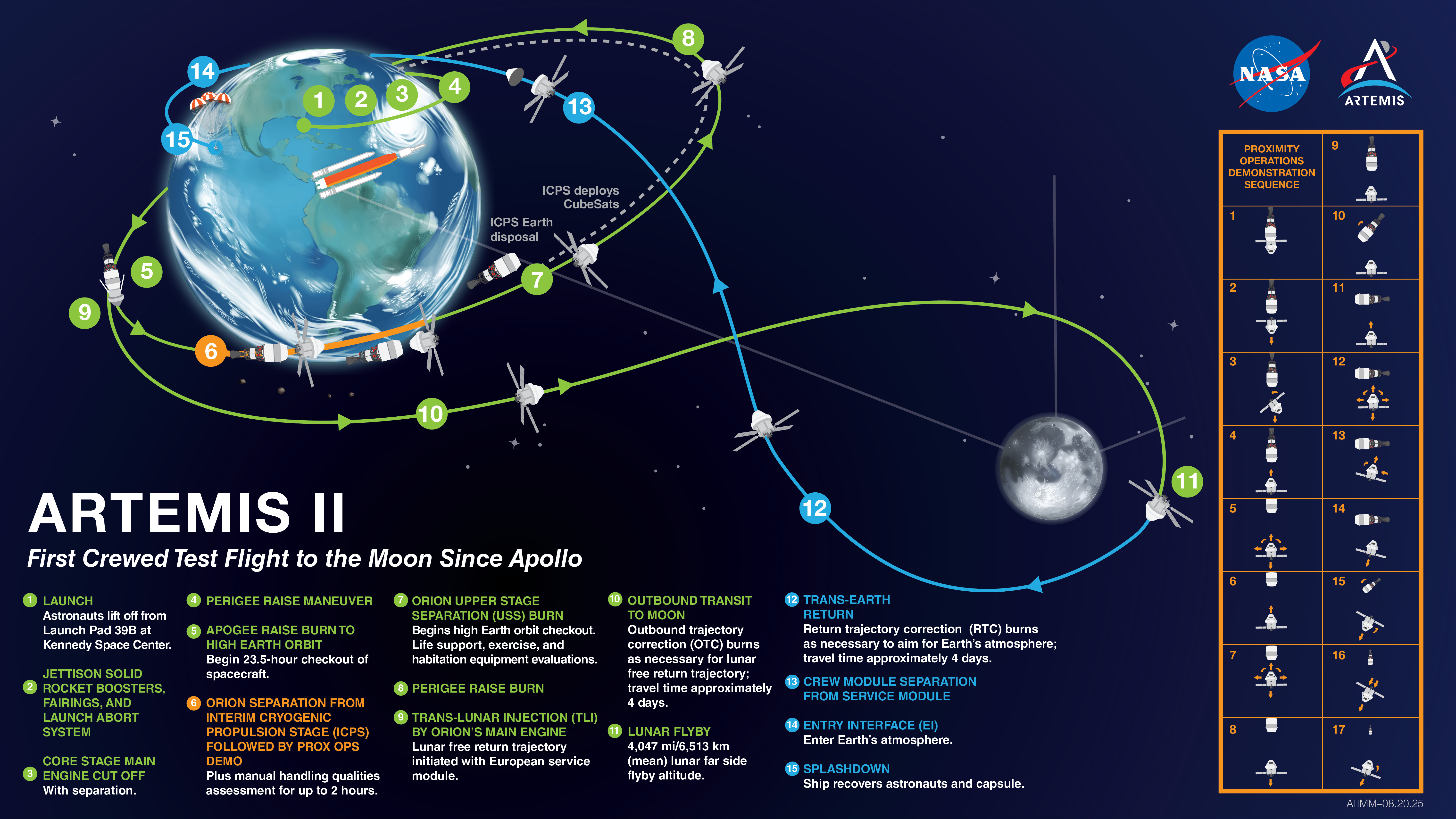
The flight plan for the Artemis-2 mission around the Moon
The flight plan for the Artemis-2 mission around the Moon. Click for original.

NASA engineers are now targeting January 31, 2026 for the manned dress rehearsal countdown of the Artemis-2 SLS rocket and Orion capsule.

The upcoming wet dress rehearsal is a prelaunch test to fuel the rocket. During the rehearsal, teams demonstrate the ability to load more than 700,000 gallons of cryogenic propellants into the rocket, conduct a launch countdown, and practice safely removing propellant from the rocket without astronauts inside the spacecraft.

During several “runs,” the wet dress rehearsal will test the launch team’s ability to hold, resume, and recycle to several different times in the final 10 minutes of the countdown, known as terminal count. The rehearsal will count down to a simulated launch at 9 p.m. EST, but could run to approximately 1 a.m. if needed.

This rehearsal will include the four-person crew inside the Orion capsule, which will once launched take them in a wide ten-day Earth orbit that will swing them past the Moon and then back to Earth. The crew entered quarantine at the end of last week to reduce the chance they will catch any illnesses prior to launch.

This mission carries great risk, as the capsule’s life support system has never been used in space before, while the viability of its heat shield remains questionable.

5 comments

Isaacman makes it official: Artemis-2 will fly manned around the Moon, despite Orion’s heat shield concerns

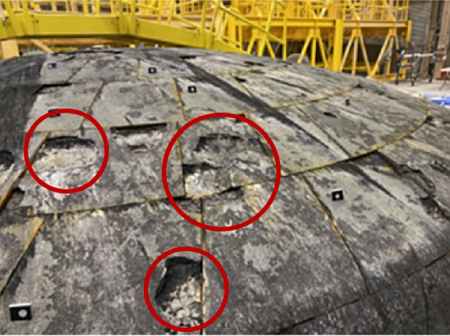
Orion's damage heat shield
Damage to Orion heat shield caused during re-entry in 2022,
including “cavities resulting from the loss of large chunks”

In a tweet yesterday afternoon, NASA administration Isaacman essentially endorsed the decision of the NASA managers and engineers in its Artemis program who decided they could live with the engineering issues of Orion’s heat shield (as shown in the image to the right) and fly the upcoming Artemis-2 mission around the Moon carrying four astronauts with that same heat shield design.

Isaacman’s statement however suggests to me that he is not looking at this issue as closely as he should.

Human spaceflight will always involve uncertainty. NASA’s standard engineering process is to identify it early, bound the risk through rigorous analysis and testing, and apply operational mitigations that preserve margin and protect the crew. That process works best when concerns are raised early and debated transparently.

I appreciate the willingness of participants to engage on this subject, including former NASA astronaut Danny Olivas, whose perspective reflects how serious technical questions can be addressed through data, analysis, testing, and decisions grounded in the best engineering judgment available. [emphasis mine]

The highlighted sentence is fundamentally incorrect. » Read more

12 comments

Former astronaut once again blasts NASA decision to fly Artemis-2 manned

Charles Camarda on the shuttle
Charles Camarda on the first shuttle flight
after the Columbia failure.

The opposition to NASA’s decision to fly humans in the Orion capsule around the Moon with a questionable heat shield continues. Charles Camarda, an engineer and former NASA astronaut who has repeatedly expressed concerns about that heat shield and had been invited to attend the review meeting that NASA administrator Isaacman had arranged to ease his concerns, has now revealed his concerns were not eased in the slightest by that meeting, and that the Ars Technica article by Eric Berger that suggested otherwise was wrong, and that he is still “outraged” at NASA’s bad engineering decisions.

The rage you witnessed was my observing the exact behaviors used to construct risk and flight rationale which caused both Challenger and Columbia Accidents. Using “tools” inappropriately and then claiming results to be “Conservative.” Not to mention the reliance on Monte Carlo simulations to predict failure probabilities which were also proven to be inaccurate by orders of magnitude in my book “Mission Out of Control” which you claim to have read.

I suggest, in the spirit of transparency, you should ask NASA to release just the “Findings” of NESC Report TI-23-01849 Volume I. Finding 1 states the analysis cannot accurately predict crack initiation and propagation at flight conditions. And there was so much more which was conveniently not presented.

In other words, he finds NASA’s engineering claims that Orion’s heat shield will work using a different less stressful return trajectory as it dives back into the atmosphere about 25,000 mph to be false and untrustworthy. Worse, he sees it as proof that this is a continuation of the same culture at NASA that resulted in the Columbia failure.

Some of the exact same people responsible for failing to understand the shortcomings of the Crater Analysis tool (used tiny pieces of foam impacts to Shuttle tiles to predict a strike from a piece of foam which was 6000 larger and which caused the Columbia Accident) were on the Artemis Tiger Team now claiming they could predict the outcome of the Orion heatshield using a tool (similar to CRATER) called the Crack Identification Tool (CIT) which was also not physics based and relied on predictions of the key paramenter, permeability, which they claim to be the “root” cause, pressure, to vary by three orders of magnitude (that’s over 1000x).

In defense of NASA, those engineers had also presented data that showed Orion’s hull was strong enough to survive re-entry, even if the heat shield failed entirely. It is unclear if Camarda’s objections here apply to that data as well.

Regardless, his strong public disagreement with NASA on this once again raises serious questions about the upcoming manned Artemis-2 mission, set to launch sometime in the February to March time frame.

24 comments

An outline of NASA’s present schedule leading up to the Artemis-2 manned lunar fly-by mission

Link here. The mission will slingshot four astronauts around the Moon and back to Earth. The update includes lots of details about the rollout, the dress rehearsal countdown, the follow-up, and finally the various launch windows and the requirements that determine them.

This paragraph however about those requirements struck me:

The launch day and time must allow SLS to be able to deliver Orion into a high Earth orbit where the crew and ground teams will evaluate the spacecraft’s life support systems before the crew ventures to the Moon.

That life support system will be making its first flight in space, with four humans as the guinea pigs. Though this is another example of NASA putting schedule ahead of safety (the system should have flown at least once unmanned), it does indicate the agency recognizes the risk it is taking, and has added this extra longer orbit to give engineers time to test the system.

There are three launch windows, within which there are only five available launch dates:

January 31 to February 14 (February 6, 7, 8, 10, and 11)
February 28 to March 13 (March 6, 7, 8, 9, 11)
March 27 to April 10 (April 1, 3, 4, 5, 6)

In 2022, once NASA managers chose their first launch window, they were able to get the rocket off on the first attempt. There were no scrubs or aborts, though prior to that attempt the launch date was delayed numerous time over five years. Based on that past history, it is likely the agency will succeed on its first attempt in February, barring weather issues.

2 comments

Isaacman okays flying Artemis-2 manned, despite heat shield questions

According to an article posted today at Ars Technica, after a thorough review NASA administrator Jared Isaacman has decided to allow the Artemis-2 mission — set to launch sometime before April and slingshot around the Moon — to fly manned with four astronauts despite the serious questions that still exist about its heat shield.

The review involved a long meeting at NASA with NASA engineers, several outside but very qualified critics, as well as two reporters (for transparency).

Convened in a ninth-floor conference room at NASA Headquarters known as the Program Review Center, the meeting lasted for more than three hours. Isaacman attended much of it, though he stepped out from time to time to handle an ongoing crisis involving an unwell astronaut on orbit. He was flanked by the agency’s associate administrator, Amit Kshatriya; the agency’s chief of staff, Jackie Jester; and Lori Glaze, the acting associate administrator for NASA’s Exploration Systems Development Mission Directorate. The heat shield experts joined virtually from Houston, along with Orion Program Manager Howard Hu.

Isaacman made it clear at the outset that, after reviewing the data and discussing the matter with NASA engineers, he accepted the agency’s decision to fly Artemis II as planned. The team had his full confidence, and he hoped that by making the same experts available to Camarda and Olivas, it would ease some of their concerns.

My readers know that I have been strongly opposed to flying Artemis-2 manned, an opposition I expressed in an op-ed at PJMedia only yesterday. However, after reading this Ars Technica report, my fears are allayed somewhat by this quote:
» Read more

21 comments

Zimmerman Op-Ed at PJ Media

Orion's damage heat shield
Damage to Orion heat shield caused during re-entry in 2022,
including “cavities resulting from the loss of large chunks”

PJ Media this evening published an op-ed I prepared this week in a last desperate effort to convince both President Trump and NASA administrator Jared Isaacman to rethink the manned nature of the Artemis-2 mission scheduled to launch sometime in the next three months.

President Trump and NASA Administrator Isaacman: Please Take the Crew Off of Artemis II

Nothing I say in this op-ed will be unfamiliar to my readers. I choose to farm it to PJ Media because I wanted it to get as much exposure as possible. As big as my audience is becoming, from 4 to 6 million hits per month, PJ Media has a wider reach.

I also decided in the op-ed to make no general arguments against SLS or Orion. Though my opposition to them is long standing and well known, this is not the time to fight that battle. My goal was simply to get NASA to put engineering ahead of schedule, so as to avoid the possibility of it repeating another Apollo 1 fire or Challenger accident.

I doubt at this point this op-ed will make a difference, but to paraphrase a quote written by Gordon Dickson in his wonderful science fiction book Way of the Pilgrim, there was a hand pushing me from behind, forcing me forward. I had no choice. The image of Orion’s heat shield to the right, after the 2022 return from the Moon, required action.

25 comments

New Trump executive order today guarantees major changes coming to NASA’s Moon program

Change is coming to Artemis!

The White House today released a new executive order that has the typically grand title these type of orders usually have: “Ensuring American Space Superiority”. That it was released one day after Jared Isaacman was confirmed as NASA administrator by the Senate was no accident, as this executive order demands a lot of action by him, with a clear focus on reshaping and better structuring the entire manned exploration program of the space agency.

The order begins about outlining some basic goals. It demands that the U.S. return to the Moon by 2028, establish the “initial elements” a base there by 2030, and do so by “enhancing sustainability and cost-effectiveness of launch and exploration architectures, including enabling commercial launch services and prioritizing lunar exploration.” It also demands this commercial civilian exploration occur in the context of American security concerns.

Above all, the order demands that these goals focus on “growing a vibrant commercial space economy through the power of American free enterprise,” in order to attract “at least $50 billion of additional investment in American space markets by 2028, and increasing launch and reentry cadence through new and upgraded facilities, improved efficiency, and policy reforms.”

To achieve these goals, the order then outlines a number of actions required by the NASA administrator, the secretaries of Commerce, War, and State, as well as the Director of the Office of Management and Budget (OMB) and the Assistant to the President for Domestic Policy (APDP), all coordinated by the assistant to the President for Science and Technology (APST).

All of this is unsurprising. Much of it is not much different than the basic general space goals that every administration has touted for decades. Among this generality however was one very specific item, a demand to complete within 90 days the following review:
» Read more

29 comments

House hearing on Artemis yesterday signals strong doubts about the program in Congress

Artemis logo

The space subcommittee of the House Science, Space, and Technology Committee yesterday held a hearing on space, one day after the Senate held its own hearing on the nomination of Jared Isaacman as NASA administrator.

The House hearing however was not about Isaacman, but was apparently staged to highlight what appears to be strong reservations within Congress about NASA’s Artemis program, as presently structured. Its timing, just after the Isaacman hearing, was clearly aimed at garnering as much publicity as possible.

Video of the hearing can be seen here.

The focus of the hearing was also on China, and how there is real fear in Congress that its space program is outstripping NASA’s. Both the Republican committee chairman and the ranking Democrat stressed these concerns, and the need to beat China to the Moon and beyond.

More important, all four witnesses pushed the same point.

The rallying cry at this hearing as well as yesterday’s is the “race” with China.

…Foushee asked each of the witnesses for one-word answers to the question: is NASA on track to get back to the Moon before Chinese taikonauts arrive?

Not all succeeded with one word, but their sentiment was similar. Cheng replied “no, I am very pessimistic.” Swope: “worried.” Besha: “maybe.” Griffin: “no possible way…with the present plan.”

Former NASA administrator Mike Griffin was the most blunt in his criticism of NASA.
» Read more

21 comments

Yesterday’s Senate nomination hearing for Jared Isaacman was irrelevant; America’s real space “program” is happening elsewhere

Jared Isaacman
Billionaire Jared Isaacman

Nothing that happened at yesterday’s Senate hearing of Jared Isaacman’s nomination to be NASA’s next administrator was a surprise, or very significant, even if most media reports attempted to imply what happened had some importance. Here are just a small sampling:

To be fair, all of these reports focused on simply reporting what happened during the hearing, and the headlines above actually provide a good summary. Isaacman committed to the Artemis program, touted SLS and Orion as the fastest way to get Americans back to the Moon ahead of the Chinese, and dotted all the “i”s and crossed all the “t”s required to convince the senators he will continue the pork projects they so dearly love. He also dodged efforts by several partisan Democrats to imply Isaacman’s past business dealings with Musk and SpaceX posed some sort of conflict of interest.

What none of the news reports did — and I am going to do now — is take a deeper look. Did anything Isaacman promise in connection with NASA and its Artemis program mean anything in the long run? Is the race to get back to the Moon ahead of China of any importance?

I say without fear that all of this is blather, and means nothing in the long run. The American space program is no longer being run by NASA, and all of NASA’s present plans with Artemis, using SLS, Orion, and the Lunar Gateway station, are ephemeral, transitory, and will by history be seen as inconsequential by future space historians.
» Read more

16 comments

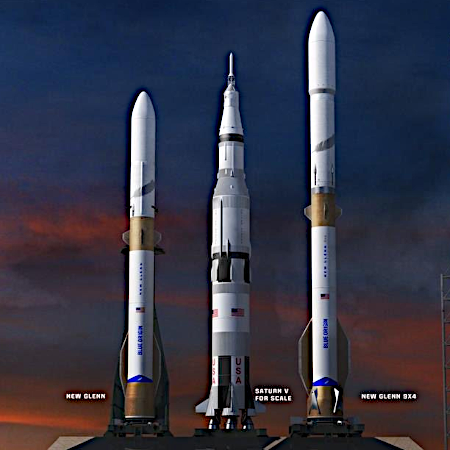
Blue Origin announces plans to upgrade New Glenn to match SLS

New Glenn compared to the Saturn-5
Graphic issued by Blue Origin’s CEO comparing
New Glenn to the Saturn-5. Click for source.

In an update posted today, Blue Origin announced that it is planning to begin upgrades to its New Glenn orbital rocket as soon as its very next launch early in 2026, with those upgrades eventually raising the rocket’s capabilities to that of NASA’s overpriced, cumbersome, and poorly designed SLS rocket.

One of the primary enhancements includes higher-performing engines on both stages. Total thrust for the seven BE-4 booster engines is increasing from 3.9 million lbf (17,219 kN) to 4.5 million lbf (19,928 kN). BE-4 has already demonstrated 625,000 lbf on the test stand at current propellant conditions and will achieve 640,000 lbf later this year, with propellant subcooling increasing the current thrust capability from the existing 550,000 lbf.

The total thrust of the two BE-3Us powering New Glenn’s upper stage is increasing from the original design of 320,000 lbf (1,423 kN) to 400,000 lbf (1,779 kN) thrust over the next few missions. BE-3U has already demonstrated 211,658 lbf on the test stand.

These numbers are a little more than half that put out by the Saturn-5 in the 1960s. New Glenn however has a reusable first stage, so it will cost far less to launch, and will be able to do so frequently. These changes will also make it comparable to SpaceX’s Falcon Heavy.

These engine upgrades however are only a start. Blue Origin also plans to offer a second more powerful version of New Glenn by adding two BE-4 engines to the first stage and two BE-3U engines to the upper stage.
» Read more

45 comments

NASA now targeting a February-to-April launch window for first manned Artemis mission

Orion's damage heat shield
Damage to Orion’s heat shield caused during re-entry in 2022,
including “cavities resulting from the loss of large chunks”.
Nor has this issue been fixed.

According to a NASA official at an event yesterday, the agency is now targeting launch window starting on February 5, 2026 and extending into April for the first manned Artemis mission, dubbed Artemis-2, that will slingshot four astronauts around Moon and back to Earth on a 10-day-flight.

If Artemis 2 does lift off on Feb. 5, it will be at night, NASA officials said. The space agency has about five days apiece in February, March and April to launch the flight. The latest possible date is April 26, according to NASA. NASA will aim to hit the earlier part of that launch window, Hawkins said, but she stressed that crew safety will drive the timeline.

That mission will fly with an Orion capsule that has safety concerns, including a questionable heat shield (see picture above) and an untested environmental system.

Meanwhile, as part of NASA’s never-ending PR effort to sell the mission, it announced today that the mission’s four astronauts have now given their Orion capsule a name, Integrity.

The name Integrity embodies the foundation of trust, respect, candor, and humility across the crew and the many engineers, technicians, scientists, planners, and dreamers required for mission success.

Considering NASA’s level of dishonesty during the entire development of SLS and Orion, the ironies of this name and these claims is quite breath-taking.

6 comments

The word that best describes our present NASA lunar program is “delusional.”

Artemis, a program based on fantasy

Increasingly it appears everyone in Congress, the White House, and NASA, as well as our bankrupt mainstream press, has become utterly divorced from reality in talking about NASA’s Artemis lunar program. The claims are always absurd and never deal with the hard facts on the ground. Instead, it is always “Americans are piorneers! We are great at building things! We are going to beat China to the Moon!”

An interview of interim NASA administration (and Transportation secretary) Sean Duffy yesterday on the Sean Hannity Show made all these delusions very clear. First Hannity introduced Duffy by stating with bald-faced ignorance that “NASA has a brand-new program. It is called Artemis that aims to get astronauts back on the Moon in the next couple of years.”

I emphasize “brand-new” because anyone who has done even two seconds of research on the web will know that Artemis has existed now for more than a decade. Hannity illustrates his incompetence right off the bat.

Duffy then proceeds to insist that the next Artemis mission, dubbed Artemis-2, will fly in April 2026 and send four astronauts around the Moon, followed by the Artemis-3 manned landing one year later.

Being an incompetent member of the propaganda press, Hannity of course accepts these claims without question. He fails to question Duffy about the serious issues with the Orion heat shield, which experienced extensive unexpected damage that is still not understood during its return on the first Artemis mission in 2022.

Nor does either Duffy or Hannity mention the fact that for Artemis to land humans on the Moon SpaceX’s Starship not only has to become operational for human passengers, it needs an in-orbit refueling capability that does not yet exist. I have full confidence that SpaceX will eventually succeed in achieving these benchmarks, but I also doubt it will be able to do it by mid-2027, as claimed by Duffy.

Duffy and Hannity however are not alone in living in this dream world. » Read more

36 comments

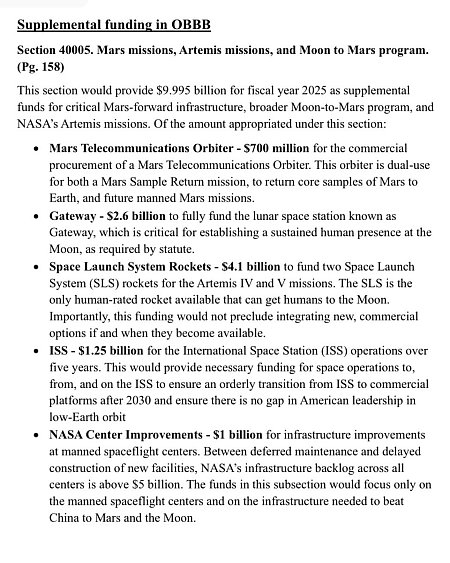
Senate reconciliation budget bill includes Cruz’s big spending additions to NASA

Senate NASA budget increases

According to a tweet yesterday by Representative Marjorie Taylor Greene (R-Georgia), the reconciliation budget bill that was passed by the Senate included the budget additions that Senator Ted Cruz (R-Texas) had proposed to save SLS, Orion, and Lunar Gateway.

The graphic to the right lists these budget numbers. It is not clear whether the launch taxes on payloads that Cruz proposed were also included, though likely not based on the rules under which the reconciliation bill was passed.

This additional money for these projects contradicts directly the NASA 2026 budget proposal put forth by Trump that aimed to cancel Lunar Gateway and end SLS and Orion after only two more flights. Their existence in this passed Senate bill suggests that Congress is cool with the idea of spending this money and continuing these projects, even though they do nothing but waste taxpayer money and get us no where in space.

It also appears from the language in the graphic that the Senate is eager to also spend more money on NASA’s Mars sample return project, even though NASA itself still has no idea how to accomplish the task.

9 comments

Nozzle blows off of Northrop Grumman SLS solid rocket booster during static fire test

During a static fire test of a new upgraded strap-on solid-fueled booster to be used on the second version of NASA’s SLS rocket, it appears the nozzle broke off near the end of the test.

I have embedded the video below.

This failure is not good for getting the upgraded version of SLS built, dubbed Block 2. Block 1 has flown once unmanned, and is planned for the next two manned missions. Block 2 would be for further manned missions beyond that. The Trump administration has proposed cancelling it, ending SLS after those two Block 1 flights. Senator Ted Cruz (R-Texas) has instead introduced a bill that would save it in order to fly two Block 2 SLS manned missions.

This failure is definitely going to delay and add cost to Block 2 development, a program that is already over budget many times over and a decade-plus behind schedule. These additional delays and cost overruns are not going to help it politically. It justifies the Trump administration’s desire to cancel it.

Moreover, this nozzle failure suggests a very fundamental design problem. Northrop Grumman, which built and was testing this booster, also builds the solid-fueled strap-on boosters used on ULA’s Vulcan rocket, which had a similar nozzle failure during Vulcan’s second launch in October last year. Both Northrop Grumman and ULA have said they had identified and fixed the cause of that failure, and the military has certified it for operational launches, but nonetheless Vulcan still remains sidelined, more than eight months later.

I suspect ULA is going to have to do more testing of the Northrop Grumman Vulcan side boosters before its next Vulcan launch, delaying that rocket further.
» Read more

9 comments

Senate schedules vote for confirming Jared Isaacman as NASA administrator

The Senate is now targeting early June for its vote on Jared Isaacman’s nomination as NASA administrator.

Senate Majority Leader John Thune (R-S.D.) filed cloture on Isaacman’s nomination May 22, a procedural move that would set up a vote on the nomination in early June. The Senate is not in session the week of May 26 because of the Memorial Day holiday.

Since his nomination was approved by the Senate Commerce committee in April, Isaacman has been meeting with many other senators. The article at the link does the typical mainstream press thing of pushing back 100% against the proposed NASA cuts put forth by Trump’s 2026 budget proposal, telling us that these senators were generally opposed to those cuts and questioning Isaacman about them, a claim not yet confirmed. It did note something about those senators and those proposed cuts that if true was very startling and possibly very encouraging.

While many of the proposals in the budget, like winding down SLS and Orion, were expected, the scale of the cuts, including a nearly 25% overall reduction in NASA spending, still took many by surprise. [emphasis mine]

In other words, Congress was not surprised by the proposed end of SLS and Orion. It even appears they are ready to give it their stamp of approval.

None of this is confirmed, so take my speculation with a grain of salt. Still, the winds do appear to be blowing against SLS and Orion.

2 comments

Congress: Let’s throw some more astronaut lives away so we can preen for the camera!

Jared Isaacman
Jared Isaacman

Here we go again: As I noted yesterday, the hearing this week of Jared Isaacman, Donald Trump’s nomination to become NASA’s next administrator, revealed almost nothing about what Isaacman plans to do once confirmed by the Senate. He very carefully kept his options open, even while he strongly endorsed getting Americans on the Moon as fast as possible in order to beat the Chinese there. When pressed by senators from both parties to commit to continuing the SLS, Orion, and Lunar Gateway projects to make that happen, Isaacman picked his words most cautiously. He noted that at the moment that plan seemed the best for getting to the Moon first. He also noted repeatedly that this same plan is years behind schedule and overbudget.

Like any smart businessman, Isaacman knows he cannot make any final decisions about SLS, Orion, or Gateway until he takes office and can aggressively dig into the facts, as administrator. He also knew he could not say so directly during this hearing, for to do so would antagonize senators from both parties who want those programs continued because of the money it pours into their states. So he played it coy, and the senators accepted that coyness in order to make believe they were getting what they want.

But what do these senators want? It appears our politicians (including possibly Trump) want NASA to launch humans to the Moon using SLS and Orion and do so as quickly as possible, despite knowing that both have real engineering issues of great concern. Instead, our elected officials want politics to determine the lunar flight schedule, instead of engineering, the same attitude that killed astronauts on Apollo 1 in 1967, on Challenger in 1986, and on Columbia in 2003. The engineering data then said unequivocally that things were not safe and that disaster was almost guaranteed, but NASA and Congress demanded the flights go on anyway, to serve the needs of politics.

With SLS and Orion it is now the same foolishness all over again. » Read more

20 comments
1 2 3 4 23