Axiom raises $350 million in private investment capital

Axiom's space station assembly sequence
The assembly sequence for Axiom’s space station while attached to ISS.
Click for original image.

Axiom announced today that in its most recent round of funding it raised an additional $350 million in private investment capital, almost tripling the private capital it has obtained in total.

Axiom Space announced today that it secured $350 million in its Series-C round of growth funding, lifting the total funds raised to over $505 million from investors and achieving more than $2.2 billion in customer contracts.

To date, Aljazira Capital and Boryung Co., Ltd., have anchored the round, paired with support from an array of diverse backers that include deep-tech venture capital funds and strategic brand partners, positioning Axiom Space as second to SpaceX for the most amount of money raised by a private space company in 2023, based on available pitchbook data.

The press release also reaffirms the company’s planned schedule for its space station project, with the first module launching and attaching to ISS in 2026. The graphic shows the assembly sequence, with the rear docking port the one linked to ISS. When assembly reaches the stage of the fourth image it will then be able to separate from ISS and fly independently in 2031. That last number however is one year later than NASA’s previous predictions for the retirement of ISS, suggesting Axiom knows something NASA has not yet told us.

Hat tip to Jay, BtB’s stringer.

4 comments

A Martian wedding cake surrounded by brain terrain

Brain terrain surrounding a Martian wedding cake
Click for original image.

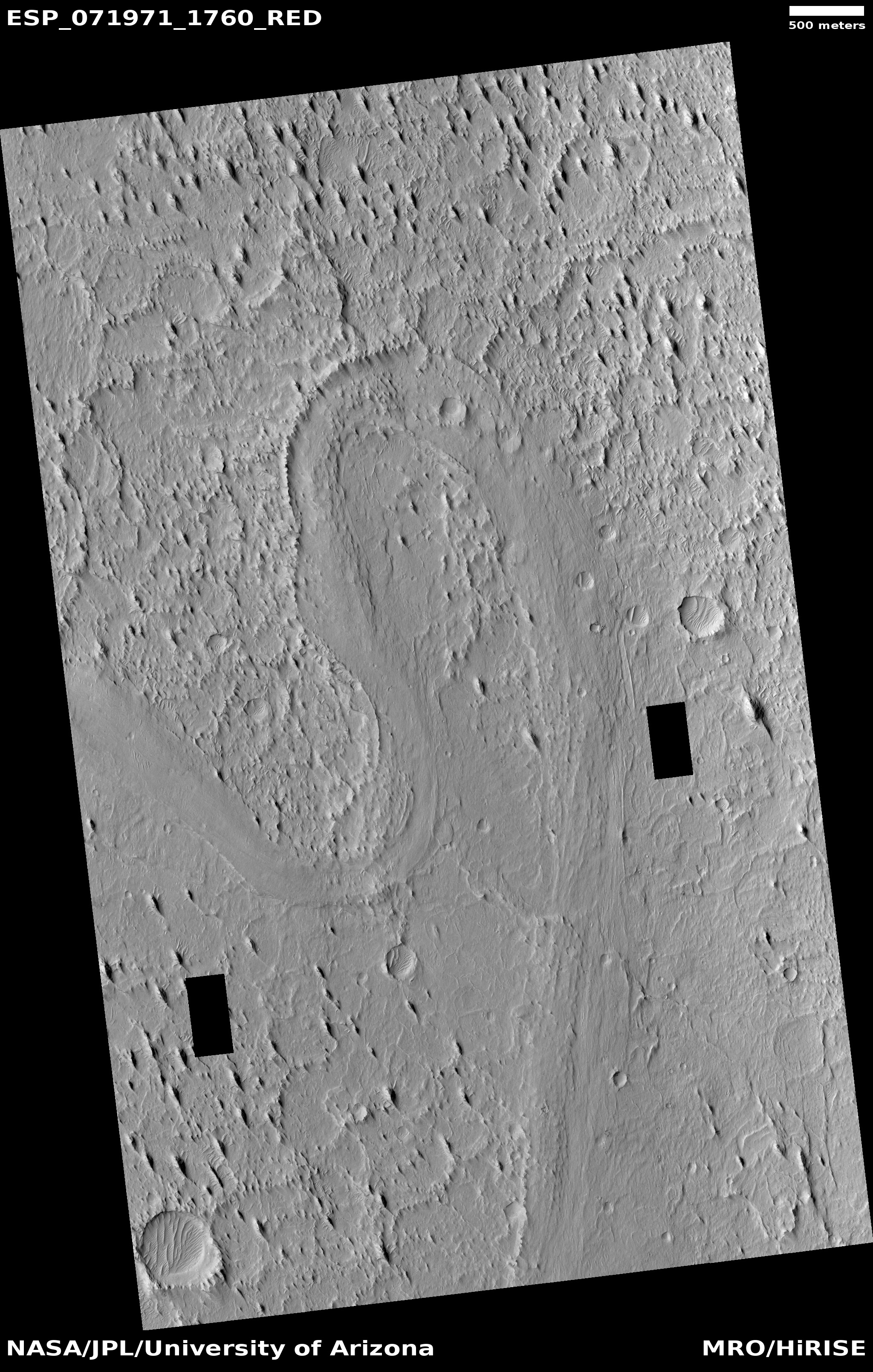
Of all many cool images I’ve posted, today might take the cake (pun intended) for the best illustration of the alien nature of Mars. The picture to the right, cropped, reduced, and sharpened to post here, was taken on June 28, 2023 by the high resolution camera on Mars Reconnaissance Orbiter (MRO), and shows what the scientists simply label as “flow features.”

I personally don’t see any obvious flow features in the full image, unless one wants to call the brain terrain that covers this entire plain a flow feature. Brain terrain is a feature unique to Mars whose origin remains a mystery to geologists. As noted by scientists in captioned MRO image in 2019:

You are staring at one of the unsolved mysteries on Mars. This surface texture of interconnected ridges and troughs, referred to as โ€œbrain terrainโ€ is found throughout the mid-latitude regions of Mars.

…This bizarrely textured terrain may be directly related to the water-ice that lies beneath the surface. One hypothesis is that when the buried water-ice sublimates (changes from a solid to a gas), it forms the troughs in the ice. The formation of these features might be an active process that is slowly occurring since HiRISE [MRO’s high resolution camera] has yet to detect significant changes in these terrains.

The wedding cake inside the small crater to the upper right only adds to the alienness of this terrain.
» Read more

1 comment

Watch the landing attempt of Chandrayaan-3’s Vikram lander on August 23, 2023


Click for interactive map.

After separating from its Chandrayaan-3 propulsion module on August 17, 2023, India’s Vikram lunar lander has been slowly making orbital adjustments in preparation for its landing attempt on August 23rd.

I have embedded the live stream of that landing attempt below. As it is scheduled for 6:04 pm (India time), in India, in the U.S. that landing will occur in the early morning hours of August 23rd.

Following the failed crash on the Moon of Russia’s lunar lander Luna-25 yesterday, this landing attempt is likely to garner a lot more interest. It is also India’s second attempt, having failed in 2019 when its Vikram lander ran out of fuel before landing and crashed.
» Read more

4 comments

China’s Long March 4C rocket places Earth observation satellite into orbit

China yesterday used its Long March 4C rocket to put what that country’s state-run press calls an “Earth observation satellite” into orbit, lifting off from the Jiuquan spaceport in the interior.

No word on whether the rocket’s first stage crash landed near habitable areas, as China’s disposable first stages often do.

The leaders in the 2023 launch race:

56 SpaceX
36 China
11 Russia
6 Rocket Lab
6 India

American private enterprise still leads China in successful launches 64 to 36 in the national rankings, while the entire world combined 64 to 58. SpaceX alone now trails the entire world (excluding American companies) 56 to 58.

0 comments

Luna-25 lost after crashing on Moon

During its last major orbital burn, Luna-25’s engines apparently fired for longer than planned so that, instead of placing it into a lower orbit, the spacecraft was de-orbited and sent crashing onto the lunar surface.

The Russian space agency noted that all measures regarding the location of the spacecraft and establishing communications with it on August 19 and 20 yielded zero results. “Preliminary analysis results suggest that a deviation between the actual and calculated parameters of the propulsion maneuver led the Luna-25 spacecraft to enter an undesignated orbit and it ceased to exist following a collision with the surface of the Moon,” Roscosmos stated.

This is a tragedy for Russia, as this mission hoped to re-establish it as one of the major players in the exploration of the solar system. Instead, we once again have a data point suggesting significant quality control problems within Russia’s aerospace industry. Its misplaced focus on providing government jobs rather than actually building and quickly flying spacecraft and rockets results too often in failure.

23 comments

Luna-25 fails to enter orbit for landing on Moon

Though it is in lunar orbit, Russia’s Luna-25 lander today was unable to perform an engine burn as planned to place it in its final orbit for landing.

“Today, in accordance with the flight program of the Luna-25 probe, at 2:10 p.m. Moscow time, a command was issued to the probe to enter the pre-landing orbit. During the operation an emergency occurred on the space probe that did not allow it to perform the maneuver in accordance with the required parameters,” Roscosmos said.

Engineers are analyzing the issue, but no other information was released.

This issue could simply be the spacecraft’s computer aborted the engine burn because it sensed something not right, and that after some correction another burn can follow later. Under this circumstance the landing attempt would simply be delayed.

It is also possible something happened during that engine burn, and the spacecraft is either in an incorrect orbit, or might even be lost entirely. Stay tuned.

19 comments

Hazegrayart – A visual comparison of the space age’s unbuilt rocket concepts

An evening pause: None of course were ever built. Most were government concepts that would have cost a fortune and never considered profit as a motive. The last concept is the wildest, and uses exploding nuclear bombs to propel it.

Hat tip Alton Blevins.

9 comments

Mars’ endless cycles of glacial activity

Overview map

Mars' endless cycles of glacial activity
Click for original image.

While the images being sent to us from Mars Reconnaissance Orbiter (MRO) repeatedly show features that appear convincingly like glaciers, the data is also beginning to tantalize us with evidence of the endless glacial cycles that have occurred on Mars.

The picture to the right, cropped, reduced, and sharpened to post here, was taken on June 27, 2023 by MRO’s high resolution camera. The red dot in the inset of the overview map above shows the location, the western flanks of an apron that surrounds a 3,800-foot-high mesa in the chaos region Deuteronilus Mensae, the western end of the 2,000-mile-long mid-latitude strip of chaos regions I dub glacier country, because every image seems to show some form of glacial feature.

Today’s picture is no different. The apron shown here drops the last 1,000 feet of the mesa’s total 3,800-foot height, during which it shows dozens of what the scientists label “parallel lines.” These lines likely reveal the layers of glacial ice in this apron, with the older layers larger and more extensive. Apparently, with each growth cycle the glacier obtained less snow from the atmosphere, so the more recent layers grew less.

In other words, the amount of water on Mars has been declining with time.

Untangling these numerous layers will undoubtedly give us a remarkably detailed history of Mars entire geological history. Unfortunately, that untangling cannot happen until we have boots on the ground, on Mars, able to drill core samples from many different places.

0 comments

Commercial spaceport in Australia signs its first launch contract

Australia map showing ELA spaceport location
The red dot marks ELA’s location, on the north coast of Australia.

Australia’s first commercial spaceport, Equatorial Launch Australia (ELA), has signed a multi-launch contract with a South Korean startup rocket company, Innospace, with the first launch targeting April 2025.

Though Innospace successfully launched a suborbital test flight in March, it has not yet launched a rocket to orbit. Meanwhile, ELA is negotiating with a number of other rocket companies, but it also appears it is having problems with the administrative state in the U.S.

The South Korean company is first off the blocks as it is not subject to the strict technological transfer regulations applied by the United States.

[ELA’s CEO Michael] Jones says delays to the signing of a Technological Safeguards Agreement (TSA) between Canberra and Washington is holding up several potential US customers. โ€œWeโ€™re still waiting with bated breath for the TSA, despite a bilateral announcement by Biden and Albanese in Japan in early June that the deal was done and dusted,โ€ he explains. โ€œWe were all expecting it to be released by the end of the financial year and the process of being endorsed by Parliament begunโ€.

A pattern of delay and intransigence in Washington, blocking commercial space, does seem to be developing since Joe Biden took over as president.

1 comment

Luna-25 takes first image of lunar surface

Luna-25's first lunar image
Click for interactive map. Zeeman is located on the lower left.

Russia’s state-run press today issued the first picture taken by Luna-25 after entering lunar orbit two days ago. That picture, to the right and cropped and reoriented to post here, shows part of Zeeman Crater at 75 degrees south latitude and 135 degrees west, on the far side of the Moon. From the TASS announcement:

“The Luna-25 spacecraft, flying in a circular orbit as the Moon’s artificial satellite, has taken pictures of the lunar surface with television cameras of the STS-L system. The image, taken today at 08:23 Moscow time, shows the southern polar crater Zeeman on the far side of the Moon. The coordinates of the crater center are 75 degrees south and 135 degrees west,” the state corporation said. Roscosmos said the Zeeman crater is of great interest to researchers. Its rim rises eight kilometers above its relatively flat floor.

The picture shows Zeeman’s southern rim to the left, with its pockmarked crater floor to the right. The crater the lander is targeting, Broguslawsky Crater, sits in the opposite hemisphere of Zeeman, slightly closer to the south pole but on the Moon’s near side.

3 comments

The inexplicable behavior of Martian dust devils

The inexpicable behavior of Martian dust devils
Click for original image.

Today’s cool image illustrates the puzzling inclination of Martian dust devils to strongly favor specific regions on the Martian surface, for reasons that at present no one can confidently explain.

The picture to the right, rotated, cropped, reduced, and sharpened to post here, was taken on June 28, 2023 by the high resolution camera on Mars Reconnaissance Orbiter (MRO). It shows a plethora of dust devil tracks, almost all of which have an east-west orientation. Moreover, the tracks seem uninfluenced by the surface topography, continuing on their path without deviation, even as they cross cliffs, craters, and mounds. The orientation tells us the direction of the prevailing winds, though I don’t know if those winds blow to the east or to the west.

What makes this image revealing is that a gathering of such dust devil tracks is seen so rarely in other MRO high resolution photographs. I look at a lot of MRO pictures, and though dust devil tracks are not rare, most images don’t show this many. Apparently, there are specific conditions on Mars that cause a lot of tracks to appear in specific locations, either because atmospheric conditions create a lot more dust devils, or the ground conditions allow the tracks to become more visible.
» Read more

6 comments

Ball Aerospace purchased by BAE Systems

BAE Systems today announced it has purchased from Ball Corporation its aerospace division, Ball Aerospace, for $5.6 billion.

It appears that the Ball corporation wants to focus its business plan around its “circular aluminum packaging for global beverage and household brands,” rather than aerospace. This sale essentially concludes the company’s slow transition away from its long time space business, which began just prior to Sputnik in 1956. It is essentially out of that business now, and instead has returned entirely to its packaging roots from the late 1800s.

BAE meanwhile strengthens its focus on space, both in the commercial and defense markets, with the addition of the Ball Aerospace division, which has been in the space business for decades.

4 comments
1 320 321 322 323 324 1,326