Curiosity’s future travels

MRO image of Curiosity's future travels

In the December release of images from the high resolution camera on Mars Reconnaissance Orbiter (MRO), there was one image entitled “Monitor Region Near Curiosity Rover.” To the right is a reduced, cropped, and rotated section of that image, annotated by me to show Curiosity’s future planned route (indicated by the yellow line). If you click on the image you can see the untouched full resolution version.

Curiosity’s journey has not yet brought it onto the terrain shown in this image. (For the overall context of Curiosity’s travels, see Pinpointing Curiosity’s location in Gale Crater.) The rover is right now just off the left edge of the photograph, on the white ridge dubbed Vera Rubin Ridge visible in the uppermost left. This week it completed the last planned drill sampling on that ridge, and it will soon descend off the ridge and begin heading along the yellow route up the mountain. The white dots along its future route are the locations of recurring slope lines, believed to be seasonal seeps of brine coming from below and causing gentle landslides that darken the surface. As you can see, they hope to get very close to the first seep, and will observe the second from across the canyon from a distance of about 1,200 feet.

The peak of Mount Sharp is quite a distance to the south, far beyond the bottom of the photograph. Even in these proposed travels the rover will remain in the mountain’s lowest foothills, though the terrain will be getting considerably more dramatic.

Below is a full resolution section of the image showing the spectacular canyon to the south of that second seep. This is where Curiosity will be going, a deep canyon about 1,500 feet across and probably as deep, its floor a smooth series of curved layers, reminiscent of The Wave in northern Arizona. The canyon appears to show evidence of water flow down its slopes, but that is unproven.
» Read more

0 comments

SpaceX raises a half billion for its Starlink satellite constellation

Capitalism in space: SpaceX has raised $500 million in investment capital to help fund its planned Starlink internet constellation expected to have just under 12,000 satellites in orbit.

I wonder if SpaceX will also be using this money for the development of Super Heavy/Starship. The article implies no, but the article also does not have access to the specific terms of the deal.

I also notice the interesting timing of this story today and yesterday’s story about how the Starlink satellites pose a threat of hitting people when they get de-orbited. Timing like this is rarely an accident. There are a lot of competitors to SpaceX who do not want it to succeed, and it would not surprise me if they are trying to throw a wrench in the operation to stop Starlink. A bad report like yesterday’s might cause big investors to back out.

1 comment

BepiColombo begins first operational engine burn

The European/Japanese mission to Mercury has begun the first operational firing of its four ion engines, set to last for the next two months.

This might seem like a ridiculously long burn, since most conventional rocket engines fire for minutes, not months. These are ion engines, however, far more efficient but producing a very tiny acceleration. It takes a long time for their burns to accumulate a velocity change.

1 comment

NASA approves Dream Chaser design

Capitalism in space? Sierra Nevada has, after several years of work, obtained NASA’s approval of the design of its Dream Chaser mini-shuttle, and will now begin construction.

I put a question mark in the header above because I am no longer sure Sierra Nevada is building a privately designed and privately owned spacecraft for the launch market. It seems that they have been captured entirely by NASA, and will instead be building the spacecraft NASA wants, which might raise costs enough to make this vehicle unaffordable for other customers.

The situation is understandable. Sierra Nevada does not have the independent capital that gives SpaceX its independence. It needs NASA to get this ship built, and thus will do whatever NASA demands. I just worry that NASA, unconcerned about cost (as is every agency in the federal government today), will spoil Dream Chaser’s viability in the commercial market.

2 comments

Today’s launch update

This post will change throughout the day. At the moment, India has successfully finished out the year with its seventh launch, placing an Indian military satellite into orbit with its GSLV rocket.

Seven launches matches India’s previous high from two years ago, but it is also far below their predicted 12 launches. I have a hunch next year will see that jump in launches, especially now that they have now successfully launched their GSLV rocket multiple times.

Meanwhile, Blue Origin is now targeting December 21, in two days, for its suborbital flight of New Shepard, while SpaceX decided to hold off on a launch today of an Air Force GPS satellite while it analyzes more closely the technical issue that scrubbed yesterday’s launch.

An Arianespace Soyuz rocket is set to launch a French military satellite from French Guiana very shortly, while a ULA Delta-4 Heavy is on track for the launch of a National Reconnaissance Office (NRO) spy satellite later today. I will provide updates later today.

UPDATE: Arianespace has successfully launched the French military satellite, using a Soyuz rocket. This was the eleventh launch for Arianespace this year, and its third Soyuz launch. Some might assign these Soyuz launches to Russia, but I consider them European launches because the business comes from Arianespace.

UPDATE: The ULA’s launch today was scrubbed due to the detection of a fuel leak. No word on when they will try again.

5 comments

Dark dunes, wedding cake mesas, and dust-filled gullies

Dark dunes, wedding cake mesas, and dust-filled gullies

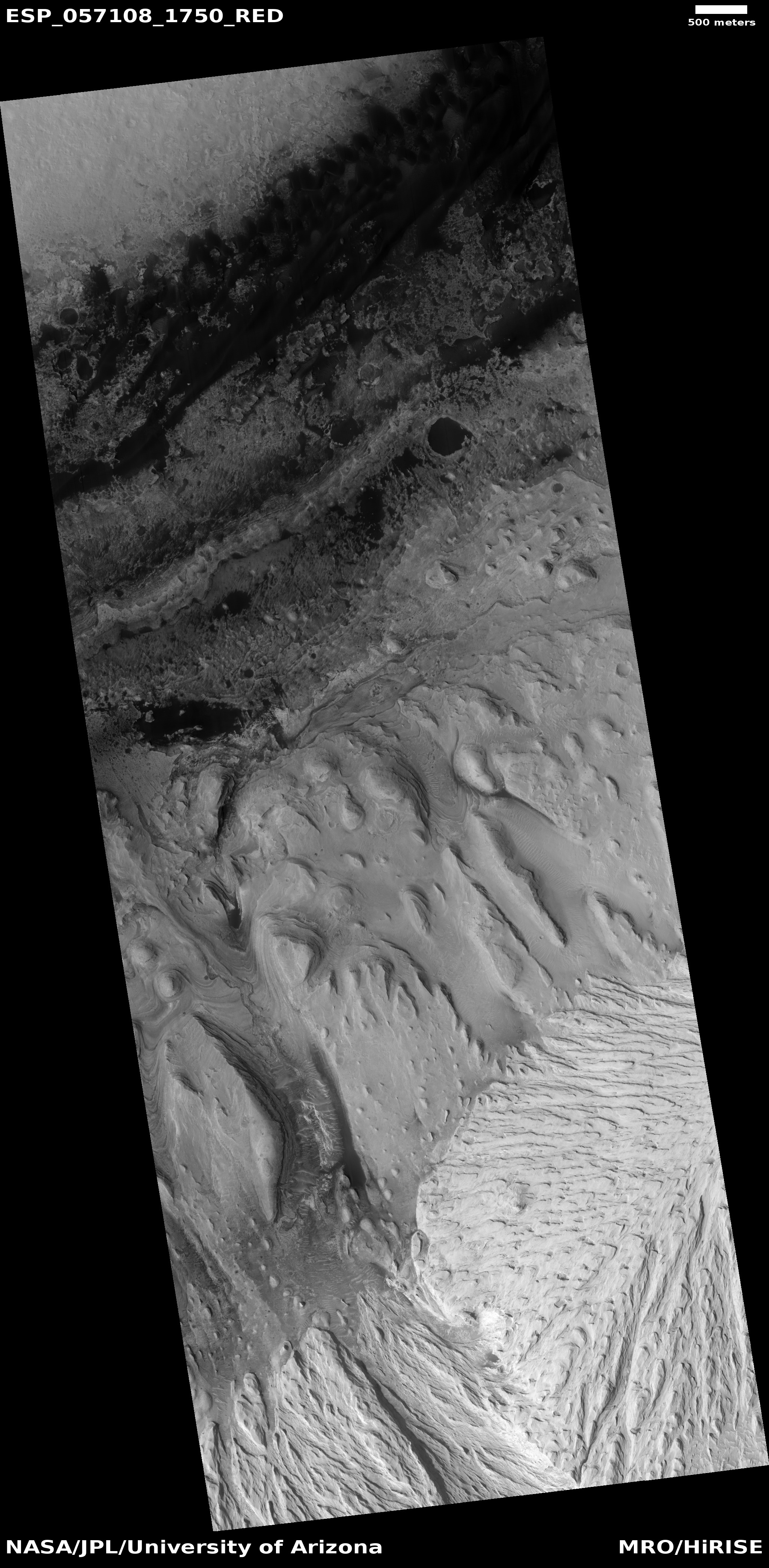
Cool image time! The photo on the right, reduced, rotated, and cropped slightly to post here, was taken by the high resolution camera on Mars Reconnaissance Orbiter (MRO) and issued by the spacecraft science team in its December image release.

They didn’t give this image a caption. The release title, “Arabia Terra with Stair-Stepped Hills and Dark Dunes,” significantly understates the wild variety of strange features throughout this terrain. Normally I crop out one section of the photographs I highlight to focus on the most interesting feature, but I couldn’t do it this time. Click on the image to see the full resolution version. Take a look at the complex wedding cake mesas in the lower left. Look also at the streaks of dust that I think are filling the gullies between these hills. In the image’s upper left are those dark dunes, scattered between dust ripples and small indistinct rises and what appears to be a drainage pattern descending to the north. Interspersed with these dunes near the center of the image are several perched crater floors, indicating that the crater impacts happened so long ago that the surrounding terrain had time to erode away, leaving the crater floor hanging like a small plateau.

On the right the two largest mesas rise in even stair-stepped layers that would do the mesas in the Grand Canyon proud.

This could very well be the coolest image I have ever posted. Everywhere you look you see something different, intriguing, and entirely baffling.

Arabia Terra covers the largest section of the transition zone between Mars’s high cratered south and its low flat northern plains, where some scientists believe an intermittent ocean might have once existed. It lies to the east of Valles Marineris, and is crater-filled with numerous intriguing geology, as this image most decidedly illustrates. In this particular case it shows the floor of one of the region’s mid-sized craters.

2 comments

FCC: SpaceX’s Starlink satellites can kill

The sky is falling! The FCC has calculated that fragments from SpaceX’s planned Starlink constellation of almost 12,000 satellites pose a risk of landing on humans on Earth.

SpaceX estimates that several kilograms of each 386-kilogram Starlink could reach the Earth’s surface with sufficient energy to harm or kill someone. NASA has fixed this figure at 15 joules—about the same wallop as a baseball traveling at 51 kilometers per hour. Depending on the satellite’s configuration, iron thruster components, stainless steel reaction wheels, or silicon carbide mirrors could survive the journey from orbit to your head.

…In March and June 2017, the FCC calculated the aggregate risk to humans from the entire constellation. Assuming the 11,927 satellites are launched on a regular basis, they will fail in the same way. Starting around six years from the first launch, an average of five satellites a day will reenter the Earth’s atmosphere, each with a tiny chance of failing to completely burn up, resulting in a part that could hit someone.

But with more than a thousand satellites falling a year, those tiny risks add up. The FCC figured out that, over their lifetime, satellites in the LEO shells posed a 1 in 5 risk of hurting or killing someone, and the VLEO satellites carried a 1 in 4 risk. IEEE Spectrum’s calculations using SpaceX’s most up-to-date information suggests that the overall risk of debris from the constellation causing an injury or death will be 45 percent.

Rather than demanding that we restrict or change what SpaceX does, I see this as an opportunity for someone designing robot satellites designed to clean up space junk. Offer your services to SpaceX. They get their problem solved easily, and you make some money.

11 comments

Comparing Ryugu and Bennu

Link here. As much as they are alike, which is not surprising as they both come from the same asteroid family, the article notes the surprising differences.


Both asteroids are also liberally strewn with boulders – a challenge to mission planners on each team, who hope to descend close enough to scoop up samples for return to Earth. “It’s certainly more rugged than we had expected,” Lauretta says. 

But while boulders on Ryugu look to be unpleasantly ubiquitous, Bennu’s terrain is more varied, with more-obvious places where a safe touchdown might be possible. And, Lauretta notes, the OSIRIS-REx spacecraft is only recently arrived.

“We have a long time to explore and make the crucial decisions about where to go,” he says.

The biggest difference has to do with water. Even though scientists believe them to be portions of the same parent body, which broke apart between 800 million and one billion years ago, Bennu appears to be water rich, while Ryugu is less so. Within a week of arrival, infrared spectrometers on OSIRIS-REx were finding evidence of water-bearing minerals, and not just in localised patches. “We saw this in every single one of the spectra we have taken to date,” says Amy Simon, of NASA’s Goddard Space Flight Centre in Greenbelt, Maryland. 

One of the reasons Bennu was chosen as OSIRIS-REx’s target, Lauretta says, was the hope it would be rich in water, and possibly in organic compounds.

The similarities and differences in the samples both spacecraft will bring back will be most revealing.

0 comments

Three launches scrubbed

Capitalism in space: Both SpaceX and Blue Origin scrubbed planned launches today due to what appear to be minor technical issues.

SpaceX was launching a GPS satellite for the military, while Blue Origin was going to fly its New Shepard suborbital spacecraft on its third flight. SpaceX will try again tomorrow, while Blue Origin has not yet announced a new launch date.

Meanwhile, ULA’s attempt to launch a National Reconnaissance Office (NRO) spy satellite tonight with its most powerful rocket, the Delta 4 Heavy, faces bad weather, with only a 20% chance of launch.

UPDATE: I missed a third launch scrub today, Arianespace’s attempt to launch a trio of French military satellites using a Soyuz rocket from French Guiana. They will try again tomorrow.

This means there will be three launch attempts tomorrow, since India plans a launch of its GSLV rocket as well.

1 comment

New Horizons sees no hazards, will do closest fly-by of Ultima Thule

After three weeks of intense observations and seeing no significant objects orbiting close to the Kuiper Belt object Ultima Thule, the New Horizons team has decided to go for the closest fly-by on January 1, 2019.

After almost three weeks of sensitive searches for rings, small moons and other potential hazards around the object, New Horizons Principal Investigator Alan Stern gave the “all clear” for the spacecraft to remain on a path that takes it about 2,200 miles (3,500 kilometers) from Ultima, instead of a hazard-avoiding detour that would have pushed it three times farther out. With New Horizons blazing though space at some 31,500 miles (50,700 kilometers) per hour, a particle as small as a grain of rice could be lethal to the piano-sized probe.

We should begin to see more detailed images soon. Because of the speed in which New Horizons is traveling, it will not get very close until it is almost on top of Ultima Thule, so the best images will all occur over a very short span of time.

0 comments

Rocket Lab completes its third successful launch in 2018

Capitalism in space: Rocket Lab today (Sunday) successfully launched thirteen cubesats using its Electron rocket.

With this third launch, Rocket Lab now has more launches than Northrop Grumman (formerly Orbital ATK), a launch operation that has been around since the 1980s.

The leaders in the 2018 launch race remain unchanged:

35 China
20 SpaceX
13 Russia
10 Europe (Arianespace)
8 ULA

China still leads the U.S. 35 to 33 in the national rankings.

1 comment

NASA’s warped measure of safety

In posting an invitation to social media users to attend the launch of the first unmanned test flight of SpaceX’s man-rated Dragon capsule on January 17, 2019, NASA’s public relations department added the following warning:

NASA has a series of reviews before the uncrewed test flight, and the outcome of these reviews, including the Flight Readiness Review, will ultimately determine the Demo-1 launch date.

For months I have reported numerous examples of NASA’s safety panel acting to create fake problems that will force a delay in this launch. First it was the fueling method. Then it was the insulation on the helium tanks. Then there was the need for SpaceX to fill out all the paperwork. Now it is the parachute system and worries about the safety culture at SpaceX.

I might take these concerns seriously, except that NASA’s safety panel seems to be so sanguine about far more serious safety issues with NASA’s SLS rocket and Orion capsule. This double standard is starkly illustrated once again in this NASASpaceflight.com article about NASA’s plans for the very first manned Orion/SLS mission.

On that manned mission, NASA will fly a host of new equipment for the first time. For example, the capsule’s “Environmental Control and Life Support System (ECLSS), crew displays, and other crew systems will be making their debut in Orion.” Anything else that has flown previously will essentially have done so only once, during the first unmanned test flight of SLS/Orion.

It gets worse. While NASA has demanded SpaceX fly the final manned version of its Falcon 9 rocket seven times before it will allow its astronauts on board, the agency plans to launch humans on SLS on only its second launch. More astonishing, that second launch will include a mission taking those astronauts on a loop around the Moon.

During the Apollo missions in the 1960s, NASA had a policy that no mission would head to the Moon without carrying a lunar module (LM). The logic was that the LM would act as a lifeboat should something go wrong with the Apollo capsule, a logic that was actually proven during Apollo 13.

NASA did send Apollo 8 to the Moon without the LM, but it did so in the context of a Cold War space race and an end-of-the-decade commitment by an assassinated president. The agency then knew the risks were high, but it decided the situation justified those risks.

NASA is not faced with a Cold War space race today. Instead, it has a grossly over-budget and long delayed boondoggle called SLS/Orion, increasingly embarrassed by the quick and efficient achievements of private space companies. In a desperate effort to keep that boondoggle alive, the agency is apparently pushing it to fly it too soon and with inadequate development. In fact, it appears to me that the safety culture at NASA that caused both shuttle accidents (a desire to favor frequent launches while ignoring safety analysis) has returned at NASA, and it has done so with a vengeance.

Meanwhile, the contrast with how the agency’s safety panel treats SpaceX versus SLS/Orion demonstrates how corrupt and unreliable that safety panel has become. They no longer really work to reduce risk. Their goal appears to promote government-built rocket systems over those manufactured by the private sector.

Hat tip to Kirk Hilliard for pointing out the language in the NASA pr invite to the SpaceX launch.

10 comments

Trace Gas Orbiter finds no methane on Mars

The uncertainty of science: Europe’s Trace Gas Orbiter (TGO) has failed to detect any methane in Mars’ atmosphere, even though data from Mars Express in 2004 had said it should see some.

The Mars Express orbiter first detected hints of methane in the martian atmosphere in 2004. But some scientists said the orbiter’s instruments that found it—at a level of 10 parts per billion (ppb)—weren’t sensitive enough to produce reliable results. Ten years later, NASA’s Curiosity rover detected a methane spike of 7 ppb from its base in Gale crater, which lasted several months. Several years later, Curiosity’s scientists then discovered a minute seasonal cycle, with methane levels peaking at 0.7 ppb in the late northern summer.

To settle this mystery, the European Space Agency’s Trace Gas Orbiter (TGO), which arrived at Mars in 2016, this year began to scan the atmosphere for methane. Two of the TGO’s spectrometers—a Belgian instrument called NOMAD and a Russian one called ACS—were designed to detect methane in such low concentrations that researchers were sure they would. Both instruments, which analyze horizontal slices of the martian atmosphere backlit by the sun, are working well, scientists on the team said today at a semiannual meeting of the American Geophysical Union in Washington, D.C. There’s still some noise to clean up, said Ann Carine Vandaele, NOMAD’s principal investigator and a planetary scientist at the Royal Belgian Institute for Space Aeronomy in Brussels, in her talk. “But we already know we can’t see any methane.”

The team’s initial results show no detection of methane down to a minute level of 50 parts per trillion, with their observations going down nearly all the way to the martian surface.

The data says that any methane seen on the surface (such as by Curiosity) must be coming from below, not from off world, which in itself is a surprise since the scientists expected some methane to be coming from interplanetary dust. TGO has found none..

There are a lot of uncertainties still, so stay tuned.

0 comments

Why ULA picked Blue Origin’s engine over Aerojet Rocketdyne

In an interview of ULA’s CEO Tory Bruno by Eric Berger of Ars Technica, he subtly revealed why his company in the end favored Blue Origin’s BE-4 rocket engine over Aerojet Rocketdyne’s AR-1 in the design of the Vulcan rocket.

Unlike many of the new entrants that you talk about coming in today, we’re not a startup company living off investor capital; we’re a mature business. We have to close a business case on Vulcan itself. So where our strategic partners [Editor’s note: This is a reference to Blue Origin] brought investment as well as schedule, that was a pretty important factor. It became pretty obvious what the right choice was, and we arrived at it with our stakeholders.

In other words, Blue Origin’s willingness to invest its own capital in engine development was a major factor. Aerojet Rocketdyne was using the old model of big space, whereby all development money came from the government. It had been unwilling to commit any of its own funds to engine development. This reluctance implied it wasn’t really committed to the project. If Air Force funding disappeared, they’d back out, leaving ULA in the lurch.

This tidbit from Bruno also suggests that he and the management at ULA are sincerely working to reshape ULA from an old big space company, totally reliant on the subsidies given by the government, into a modern competitive company focused instead on building an affordable product that customers will want to buy.

This story also tells us a lot about Aerojet Rocketdyne’s future, or lack thereof. The rocket industry is changing, and if that company doesn’t change also, it will soon die.

19 comments

Virgin Galactic finally reaches space, by one definition

Capitalism in space: By one of the definitions of where space begins, Virgin Galactic’s second SpaceShipTwo Unity finally reached space for the first time during a test flight today.

During a flight test today, Virgin Galactic’s SpaceShipTwo burned its engine for 60 seconds and reached an altitude of 271,268 (51.37 miles/82.7 km), which put the vehicle into space for the first time according to one definition of the boundary.

Pilots C.J. Sturkow and Mark Stucky deployed the spacecraft’s feather system — twin tail booms that re-configure the ship for re-entry — after reaching a top speed of Mach 2.9. They glided the vehicle back to a safe landing on Runway 12-30 at the Mojave Air and Space Port in California’s High Desert.

The U.S military initially defined space as beginning at 50 miles altitude. Later the international definition defining space as beginning at 100 kilometers (about 62 miles) became more accepted. In recent years there has been a push to accept the U.S. military’s older definition (partly I think generated by Virgin Galactic itself). Truth is, the U.S. military’s definition actually makes more sense, since it is possible to orbit a satellite at 50 miles, for short periods.

The pressure to change however does suggest that Unity might not be capable of reaching 62 miles.

Regardless, this flight culminates fourteen years of effort at Richard Branson s company to produce a reusable suborbital spaceship that can fly in space. It appears they have finally done it. Whether it will be reliable enough to fly repeatedly, with commercial passengers, remains to be seen. Moreover, the commercial landscape has changed considerably during those fourteen years. Had they flown a decade ago, as Branson repeatedly predicted, they would have been the only game in town. That is no longer the case. They now have a competitor, Blue Origin with its suborbital New Shepard spaceship, and affordable commercial orbital flights are just around the corner.

Still, Virgin Galactic’s achievement here is significant. They have built a spaceship that has taken humans to space (and can do it again), and they have done it with private funds.

17 comments

Syria wants its own space program

The new colonial movement: The head of Syria’s ministry of communications and technology said during a visit to that country’s satellite remote sensing facility that their nation should organize a space program, beginning with the construction of an entirely home-built satellite.

I’m not sure how much of this will be possible considering how badly ripped apart Syria presently is because of its civil war. To me, it looks more like a some somewhat ignorant brasshat, while visiting a space facility, sounding off with what he would like done.

5 comments

A detailed look at Chang’e-4

Link here. Lots of nice information, including the fact that Chang’e-3 seems to still be functioning in a limited manner, and that Chang’e-4 is depending not on solar panels but a radioactive thermal electric system, similar I think to the RPGs that NASA uses on its deep space missions. (I am uncertain however about this, based on looking at the video at the link, which seems to show solar panels on Chang’e-4. They could be instead panels to protect the spacecraft from the sun’s heat.)

They enter lunar orbit on December 12, and will likely land in the first week of January.

3 comments
1 489 490 491 492 493 805