Maritime Launch Services touts a second non-orbital launch from Spaceport Nova Scotia

Proposed Canadian spaceports

The competition between Canada’s two proposed spaceports heated up yesterday when the owner of Spaceport Nova Scotia, Maritime Launch Services, announced that the second launch had taken place there, this time by a rocket startup named T-Minus Engineering.

The launch took place at 11:54 AM, and the mission marked an important milestone in advancing the operational readiness of Spaceport Nova Scotia, critical infrastructure that will provide Canada with sovereign launch capability. The launch was conducted from Spaceport Nova Scotia under approved regulatory and safety frameworks. The demonstration strengthened coordination among launch site teams and stakeholder partners, while refining launch operational procedures and the safety and security systems that govern all activities at the spaceport.

The press release provided no details about the launch itself, though this report noted that the rocket failed to reach its goal of 100 kilometers, the altitude considered by most as the edge of space. The rocket, dubbed Barracuda, is solid-fueled and was apparently designed by T-Minus to demonstrate its capability for hypersonic testing.

This was the second suborbital launch from this spaceport. The first, in 2023, was a student test flight. In both cases, the launches were mostly a PR effort to sell the spaceport, which was first proposed in 2016 but has been unable so far to draw any launch customers. Maritime now also faces competition from the Atlantic Spaceport being proposed by a different company, Nordspace.

Canada’s Nova Scotia spaceport schedules a suborbital launch for November

Proposed Canadian spaceports

The competition heats up: Maritime Launch Services, the startup that has been trying to establish Spaceport Nova Scotia since 2016, has now issued a “notice to airman” (NOTAM) outlining the range restrictions for a suborbital launch window from November 18 to November 24.

The launch is being conducted by the Netherlands rocket startup T-Minus, which signed a deal with Maritime in June 2025 to do two such launches of its Barracuda rocket before the end of this year.

The T-Minus Engineering Barracuda hypersonic test platform “is a single-stage, solid-fuel suborbital vehicle that stands approximately 4 metres tall. It features a booster with a diameter of 200 millimetres and a payload compartment measuring 1000 millimetres. Barracuda can carry payloads of up to 40 kilograms to altitudes reaching 120 kilometres.”

The only launch that has previously taken place at this spaceport was in 2023, when students from York University did a short 8-mile-high suborbital launch of a student-built rocket.

Maritime is now in a tight competition with another spaceport startup, Nordspace, which is pushing hard to initiate launches from its Newfoundland spaceport to the north. It remains unknown whether either can be made profitable.

MDA invests $7 million to become part owner of proposed Nova Scotia spaceport

Proposed Canadian spaceports

The Canadian space company MDA Space has now purchased for $10 million ($7 million in U.S. dollars) a part ownership in the proposed Spaceport Nova Scotia that the startup Maritime Launch Services (MLS) has been trying to establish since 2016, with little success.

The transaction includes an Investor Rights Agreement, entered into between MDA Space and Maritime Launch, providing MDA Space with certain rights, including the right to nominate one individual to sit on the board of Maritime Launch and pro-rata participatory rights in future financings of the Spaceport. The investment will be used for applicable research and development initiatives relating to the ongoing development of Spaceport Nova Scotia and will trigger the retirement of convertible debentures.

The history of this spaceport has been a frustrating one. Originally it had partnered with a Ukrainian rocket company, proposing to offer satellite companies both the launch facilities and the rocket. That plan died in 2022, when Russia invaded the Ukraine and the rocket company switched from making rockets to making drones.

MLS then opened up Spaceport Nova Scotia to all rocket companies, hoping the new launch startups building portable small rockets that could be set up anywhere would buy in. Though it periodically announced deals, none were with established orbital companies. Some were startups that after years have yet to launch, such as the British company Skyrora. Other contracts were with startups that weren’t even rocket companies, such as the space station startup Voyager Space.

Meanwhile, a second spaceport startup, Nordspace, appeared in 2022, proposing a spaceport in Newfoundland dubbed The Atlantic Spaceport. While it has not launched anything either, it has quickly signed contracts for ground stations and a mission control center, and even attempted (though scrubbed) a launch of its own rocket.

Whether this new deal can finally get Spaceport Nova Scotia off the ground remains very uncertain. MDA is not a launch company. It is a long established satellite company that also builds the robot arms used on ISS.

New developments at Canada’s two competing spaceport projects

Proposed Canadian spaceports

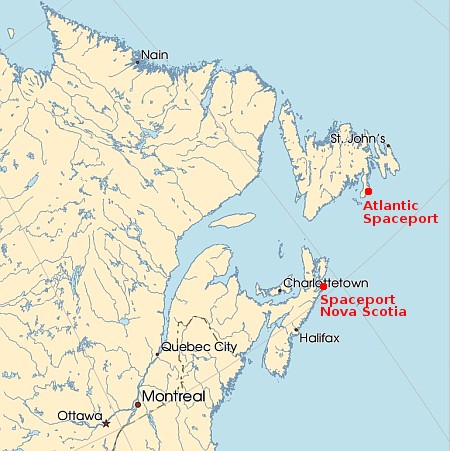
It appears things are beginning to happen at the two proposed Canadian spaceports, as shown on the map to the right.

First, the long struggling Nova Scotia spaceport project by Maritime Launch Services, first proposed in 2016, has finally sealed its $1.7 million deal with the Canadian rocket startup Reaction Dynamics. That deal was first announced in October 2024, but apparently was not finalized until now. Reaction will not only do a suborbital launch from the spaceport, it will invest about $1 million in the spaceport itself.

Whether this Nova Scotia spaceport finally begins operating remains to be seen. It has been promising orbital launches since 2016, without any actually happening.

Second, the Canadian rocket startup Nordspace announced that it has begun construction of its own launch site, dubbed the Atlantic Spaceport Complex, in Newfoundland.

The Atlantic Spaceport Complex (ASX) is a cornerstone of NordSpace’s mission to deliver sovereign and assured space access for Canada through an end-to-end space missions capability. The initial $10M phase of development for the Atlantic Spaceport Complex will feature two sites. SLC-01 will feature two launch pads for orbital missions including NordSpace’s Tundra vehicle and international launch partners from the U.S. and Europe. SLC-02 will consist of at least one smaller launch pad for suborbital missions, radar systems for vehicle tracking and space domain awareness, and other ground support equipment to enable all launch operations at the ASX.

The company hopes to complete a suborbital launch with what it calls its Taiga rocket later this month.

Nordspace only announced its existence in July 2024, almost a decade after the Nova Scotia project. Yet it appears it will be first to complete a commercial suborbital launch. Nova Scotia did have a suborbital launch in 2023, but it was a student project, not a commercial rocket.

Proposed commercial spaceport in Nova Scotia teams up with Voyager Space

The proposed commercial spaceport in Nova Scotia that was first proposed by the company Maritime Launch Services in 2017 has now signed a partnership deal with the space station company Voyager Space.

Voyager, through its Exploration Segment, will provide comprehensive engineering, design and fabrication support to Maritime Launch, leveraging more than six decades of combined aerospace and defense technology experience. Voyager will bring its decades of commercial spaceflight engineering, manufacturing, and operations capabilities to provide engineering design and development and buildup of select portions of the launch site on behalf of Maritime Launch. Voyager will work alongside Maritime Launch to analyze launch client requirements and integrate them into the current site layout.

Maritime’s original plan had been to provide a launch location and rocket (produced by a Ukrainian company). Satellite companies would sign with both for launch services. The invasion of the Ukraine by Russia in 2022 killed that arrangement. So did red tape, as the Canadian government only passed a law allowing spaceports to make deals with international partners at the start of August.

It appears Maritime has realized that without that rocket partner, it needs another experienced partner to help build the spaceport itself and make sure launches by many different rocket companies are done safely. It has now hired Voyager to do this, since that company is leading the Starlab space station consortium that includes many very experienced companies, including Lockheed Martin, Northrop Grumman, Airbus, Mitsubishi, and the European Space Agency.

Nova Scotia spaceport approved for new government grants

The proposed Nova Scotia spaceport run by the company Maritime Services has now been approved to apply for new government grants for its proposed satellite processing facility.

The Nova Scotia CITC is an annualized reimbursement program designed by the Government of Nova Scotia to drive economic growth and incentivize development within Nova Scotia. The program provides significant financial advantages to eligible corporations that invest in infrastructure and capital equipment for approved projects located in Nova Scotia.

Maritime Launch has received approval for an initial qualification of up to $7.5M in reimbursements under the CITC for the satellite processing facility project. Reimbursement is eligible to begin at the start of the construction of the satellite processing facility, planned for late 2024 and follows approval of a separate application in September 2023 for a project at Spaceport Nova Scotia.

Maritime Launch has been around since 2016 but as of this moment it is unclear when the first orbital launch from the spaceport will occur. Initially the plan had been to provide both spaceport and a Ukrainian rocket for satellite makers, but the Ukraine war ended that plan. Now the spaceport offers its facility to any rocket company, but so far no launch company has yet signed a launch deal.

Nova Scotia spaceport signs deal with British rocket startup

Capitalism in space: Maritime Launch Services, the company that is building a spaceport in Nova Scotia, has signed an agreement with the British rocket startup Skyrora, naming its Skyrora-XL rocket as one of the launch providers for that spaceport.

As part of the agreement, Maritime Launch will purchase the vehicles and vehicle support staff from Skyrora for their satellite clients. Spaceport Nova Scotia will provide Skyrora a launch pad, ground and operations support, public safety services, regulatory approvals and mission integration facilities and staff. Skyrora will supply the launch vehicle, mobile launch complex, and launch operations support team to Maritime Launch.

Unlike other new spaceports, Maritime is running Spaceport Nova Scotia a bit differently. Most new spaceports simply provide a launch site for rocket companies. Maritime instead wants to offer satellite companies a full service spaceport, including the rocket. Initially the plan was to use a Ukrainian-built rocket, Cyclone-4M, as part of the service, but the Russian invasion of the Ukraine has made its availability uncertain.

This deal gives Maritime a new option to offer satellite companies. However, the Cyclone-4M was already somewhat tested, as it was an upgrade of the Ukrainian Tsiklon-4 rocket, which has already launched. Skyrora is only a startup, and has not yet flown.

Maritime Launch Services signs land lease for its Nova Scotia spaceport

Capitalism in space: Maritime Launch Services yesterday obtained a 20-year land lease for its Nova Scotia spaceport from the province of Nova Scotia.

The lease covers 334.5 acres, and is renewable for an additional 20 years.

Unlike other spaceports, Maritime isn’t merely providing a launch site for rocket companies. Instead the company will also launch smallsats itself, using a Ukrainian-built rocket dubbed the Cyclone-4M. Initially the plan was to fly all launches in this manner, but the invasion of the Ukraine by Russia has caused Maritime to look for other launch providers as well.

Nanoracks signs deal to be first customer for Canadian spaceport

Capitalism in space: Nanoracks announced yesterday that it has signed a deal with Maritime Launch Services, the Canadian company managing a proposed spaceport in Nova Scotia as well as the launch services of a Ukrainian-built rocket, the Cyclone-4M.

The company and spaceport are targeting 2023 for launch.

Spaceport Nova Scotia is being operated a little differently than most of the new commercial spaceports. Instead of offering its facilities to all rocket companies, its manager, Maritime, has partnered with the two Ukrainian companies, Yuzhnoye and Yuzhmash, that build the Cyclone-4M. They then offer the spaceport and rocket, as a unit, directly to satellite companies like Nanoracks.