
House hearing on Artemis yesterday signals strong doubts about the program in Congress

The space subcommittee of the House Science, Space, and Technology Committee yesterday held a hearing on space, one day after the Senate held its own hearing on the nomination of Jared Isaacman as NASA administrator.
The House hearing however was not about Isaacman, but was apparently staged to highlight what appears to be strong reservations within Congress about NASA’s Artemis program, as presently structured. Its timing, just after the Isaacman hearing, was clearly aimed at garnering as much publicity as possible.
Video of the hearing can be seen here.
The focus of the hearing was also on China, and how there is real fear in Congress that its space program is outstripping NASA’s. Both the Republican committee chairman and the ranking Democrat stressed these concerns, and the need to beat China to the Moon and beyond.
More important, all four witnesses pushed the same point.
The rallying cry at this hearing as well as yesterday’s is the “race” with China.
…Foushee asked each of the witnesses for one-word answers to the question: is NASA on track to get back to the Moon before Chinese taikonauts arrive?
Not all succeeded with one word, but their sentiment was similar. Cheng replied “no, I am very pessimistic.” Swope: “worried.” Besha: “maybe.” Griffin: “no possible way…with the present plan.”
Former NASA administrator Mike Griffin was the most blunt in his criticism of NASA.
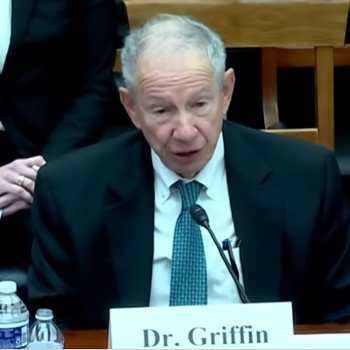
Former NASA administrator Mike Griffin
speaking at the hearing
He agreed on the need for U.S. leadership and sustainable presence, but is convinced NASA is headed in the wrong direction. “We have squandered a 60-year head start because Artemis won’t work” largely because the Human Landing Systems (HLSs) needed to get astronauts down to and back from the lunar surface require in-space refueling of cryogenic propellants.
Both HLS landers NASA has under contract — SpaceX’s Starship and Blue Origin’s Blue Moon Mark II — rely on in-space cryogenic refueling even though it has never been demonstrated. Cryogenic propellants need to be constantly replenished due to boil-off, a distinct challenge in orbit around Earth or the Moon.
Griffin doesn’t see a way to overcome that with current technology and insists NASA should “only stick to a plan if it makes sense” and Artemis doesn’t. “We should start again.”
Griffin’s technical concerns shouldn’t be taken too seriously. In fact, I think he is fundamentally wrong, since eventually it is going to be necessary to develop this refueling technology if we are going to colonize the solar system.
The bottom line however is the nature of the hearing itself. Congressional hearings like this are never an accident. They are planned photo-ops designed to push a polticial agenda. Each witness was chosen by the committee knowing essentially what each would say, and that includes Griffin. The committee wanted these opinions aired, in a manner that would be noticed by the press.
In other words, both parties in Congress were making it clear they want the U.S. to succeed in space, and from both parties in the House there is growing hostility to Artemis as presently designed.
These facts do not speak well for the future of SLS and Orion.

On Christmas Eve 1968 three Americans became the first humans to visit another world. What they did to celebrate was unexpected and profound, and will be remembered throughout all human history. Genesis: the Story of Apollo 8, Robert Zimmerman's classic history of humanity's first journey to another world, tells that story, and it is now available as both an ebook and an audiobook, both with a foreword by Valerie Anders and a new introduction by Robert Zimmerman.
The print edition can be purchased at Amazon or from any other book seller. If you want an autographed copy the price is $60 for the hardback and $45 for the paperback, plus $8 shipping for each. Go here for purchasing details. The ebook is available everywhere for $5.99 (before discount) at amazon, or direct from my ebook publisher, ebookit. If you buy it from ebookit you don't support the big tech companies and the author gets a bigger cut much sooner.
The audiobook is also available at all these vendors, and is also free with a 30-day trial membership to Audible.
"Not simply about one mission, [Genesis] is also the history of America's quest for the moon... Zimmerman has done a masterful job of tying disparate events together into a solid account of one of America's greatest human triumphs."--San Antonio Express-News
“Griffin’s technical concerns shouldn’t be taken too seriously.”
His concerns need to be taken very seriously—unlike Ayn Rand or economists, Mike literally wrote the book on Space Vehicle Design.
https://www.amazon.com/Space-Vehicle-Design-AIAA-Education/dp/0930403908
Libertarian ideology has made you blind on this subject once again. How many times have we seen engineers overridden by bean counters, as Bob Lutz wrote about.
We are about to see humans go Beyond Earth Orbit with a program made during flat budgests. Musk and Bezos have well over a trillion bucks, and will fall behind a program that you and others repeated tried to axe.
My only objection is that he wanted ISS dead. He at least saved Hubble, where O’Grief would have let that die.
And with luck, they might even come back alive, though as Mr. Zimmerman keeps reiterating, this is not as certain as NASA would like us to believe.
But it’s underwhelming, Jeff. It’s a free return trajectory around the Moon, not even an orbit, like Apollo 8 did. And we’ll pay nearly $5 billion for the privilege of it.
SLS and Orion had massive advantages of time and money and pre-existing hardware and facilities over SpaceX and Blue Origin, so why should we be surprised or impressed that this humunculous architecture is finally getting some astronauts into cislunar space before SpaceX and Blue Origin?
Dr Peter Hague writes:
https://x.com/peterrhague/status/1996638277458088237
It’s that second suspicion that haunts some of us.
Richard M: He is right on the money.
On a personal note, this is just one of many examples of a pattern in the media world that frustrates me repeatedly. Forgive me if this sounds a bit egotistical, but it always amazes me how I never get mentioned or quoted in these matters. I would say that I am one of only a very few that has been pounding this point home about Orion, and I have also been doing to far longer than anyone else.
Yet I don’t exist in any discussion of this issue, even when that discussion is literally repeating the points I have been making for more than a decade. For me, this is a routine occurrence. For reasons that have always escaped me, I can never be mentioned by others.
Obviously there is what used to be referred to as “ego-boo” (when I was part of comic book fandom) in my desire here. It is nice when others recognize your work.
I have a much more practical reason for this however. If I can’t get mentioned it means my analysis can’t get as wide a distribution. It means my analysis of Orion has been effectively squelched for more than a decade.
This strange pattern has for my entire life limited who sees my work. It has certainly limited sales of my books.
It frustrates me beyond words. But such is life. I forge on.
Comment rules here prevent a proper description of Griffin.
Hi Bob,
It’s hard to say. If I had to hazard a guess — and it is just a guess — it might be your lack of a major footprint in social media (I mean, specifically, X and Youtube). Which, I know, you likely loathe the idea of doing — and it would be a major time sponge, too, and not helpful to your blood pressure (this is an issue for me!). You really have to work it, not just occasional posts without a strategy — Rand is fairly active over on X, for example, but he doesn’t seem to have a strategy or panache for it, and his follower and traffic counts remain low, sadly. He deserves better, too.
Peter Hague is a good egg, and I think he’s come by his ideas thoughtfully; but I think the thing that really blew up his stature was Elon starting to repost, and respond to, his posts on X. That in turn helped blow up his substack– well, “blow up” by the standards of the space community. Then the podcast interviews started coming in…
I didn’t mean to trigger any frustration on your part by mentioning Hague’s post; just the opposite. To reassure us all that these concerns really do have growing purchase out there.
I am grateful that Rand links you regularly. To be honest, that was how I originally discovered you.
Richard M: Your theory about social media is certainly a factor. However, this problem has existed for me long before X, Twitter, Youtube, etc.
No matter. Onward.
“An Iconoclast,” according to Google, “is a person who attacks or criticizes widely accepted beliefs, traditions, or institutions, or one who destroys religious images. The term originated from the historical destruction of religious images, particularly during the Byzantine Iconoclast Controversy. In a modern, figurative sense, an iconoclast challenges the status quo in various fields like art, politics, or technology, even if they do not physically destroy anything.”
“Cassandra,” also according to Google, “most famously refers to the cursed Trojan princess in Greek mythology who could see the future but was doomed never to be believed, a concept now known as the ‘Cassandra Complex,’ describing someone whose valid warnings are ignored.”
https://www.google.com/search?client=firefox-b-1-e&q=cassanddra#fpstate=ive&vhid=Gozr1GKO1yhF_M&vld=cid:10ee5c90,vid:IA-RtAYmD9c,st:23&vssid=_H4gzaeqhHP3Bp84P_KaOiA8_19
In thinking about such people, I am reminded of the lines from Neil Young’s song Campaigner —
I am a lonely visitor
I came too late to cause a stir
Though I campaigned all my life towards that goal
https://www.youtube.com/watch?v=-FlOlTGg0xI
As an insightful person once reminded me, life is not always a search for truth, even — or perhaps particularly — in science, and iconoclasts and Cassandras are definitely marching to their own drummers. On the other hand, as Ralph Ellison reminds us in his essay The Little Man at Chehaw Station, there is always an audience for the truth (and for excellence and integrity), even if it is a selective one.
Jeff Wright,
I listened to Dr. Griffin’s testimony to Congress and I read his alternative architecture paper. No one should take his technical advice seriously.
Griffin states that on-orbit refueling of large-scale spacecraft can never be made to work because it has never been done before and because boil-off is not a solved problem. This is idiocy on steroids.
On-orbit refueling is a process that will take place between two spacecraft that have rendezvoused and docked. This is a process that was proved out in the ’60s and has been done hundreds of times, the majority of which have involved two very large spacecraft – Shuttle and Mir and Shuttle and ISS. SpaceX will be breaking no new ground with refill dockings. The propellant transfers at the scale contemplated will be new, but that is pretty small beer, frankly, given a rendezvous and a docking.
The absurdity of Griffin’s claims is starkly illustrated if one simply contrasts the calm and very predictable process of a rendezvous and a dock in hard vacuum vs. an air-to-air refueling sortie that involves extended close formation flying of two large aircraft in a highly dynamic atmosphere and in which the receiving aircraft is connected via a hose or a telescoping boom instead of a hard docking clamp and is buffeted not only by normal random atmospheric burbles, but by the wake turbulence of the tanker aircraft in front of and above it. And yet, we’ve been doing just that routinely for decades.
The boil-off objection is also silly. Insulation combined with active refrigeration and re-condensation of boiled-off cryogens will allow indefinite storage of cryo propellants on-orbit, or on the lunar surface, with negligible loss. Bezos seems to think Blue has a good enough handle on the problem even though he has the harder chore of doing that with LH2 while SpaceX has only the somewhat less severe problem of doing it with methalox.
And Griffin’s “solution” to what he alleges to be Artemis’s architecture shortcomings, is to – literally – double-down on SLS. His concept of operations involves launching the dinky hypergolic-fueled expendable lander – which he apparently expects to whistle up in jig time from who knows where – on an SLS Block 2 cargo version, then to launch the crew “at a later time” on an SLS Block 2 with a Centaur III subbed in for the ESA Orion service module. That “later time” would be at least two years based on SLS’s sclerotic pace of production. We’ll simply ignore the fact that the boosters mooted for SLS Block 2 don’t exist yet and that NorGrum has been having some pretty significant reliability issues with its SRB upgrades recently. We’ll also ignore the fact that EUS is not scheduled to appear in flyable form for some considerable time yet either.
Nothing about this architecture addresses the concerns of the rest of the Yellow Peril wowsers on the sub-committee, to wit, Beating the Chinese[tm]. Griffin’s proffered alternate architecture would have taken far longer to prepare than the current Artemis one even if work had started in earnest immediately after it was first offered in Jan. 2024. Beating the Chinese[tm] is, emphatically, not a feature incorporated therein.
Griffin tried to hand-wave this issue away during his testimony by expressing doubts that the PRC can actually undertake a manned lunar mission by the notional 2030 date. That is likely the only thing he is actually right about, but even if the PRC is late, Griffin’s architecture, if adopted in place of the current one, would guarantee a US silver medal finish anyway. I was a bit surprised none of his fellow witnesses nor any of the sub-committee members called him on that.
The rest of the questioning and testimony, with a few exceptions, were also wrongheaded and fatuous. The Democrat members uniformly excoriated the Trump administration for the “damage” it was doing to “science” by downsizing non-performing federal “science” bureaucracies. In their minds, it seems, the amount of “science” done is exactly proportional to the headcounts and payrolls of federal “science” agencies.
One of the witnesses, in fact, was exactly such a casualty of Trump administration downsizing at NASA. His testimony can, I think, be ignored on the basis that it comes from a disgruntled former employee.
Across party lines, and on the part of both questioners and witnesses, there was near-uniform recitation of hoary conventional wisdom about the alleged benefits of PRC authoritarianism and its supposedly superior ability to plan and execute for the long term.
There was only a single timorous inquiry about the PRC’s economic situation. The witness who had earlier identified himself as a “China guy” as opposed to a “space guy,” solemnly opined that we should draw no conclusions about PRC longevity based on economic troubles and that we, in particular, should not see any parallels between the current mess in the PRC and the sudden implosion of the Soviet Union.
This is exactly the sort of whistling past the graveyard nonsense we got from the entire academic and governmental “Kremlinologist” cadre right up to, and even past, the point at which the USSR started to disintegrate. So-called “Sinologists” are quite likely to find their own future employment prospects taking a sharp turn for the worse as the PRC suffers its own brittle fracture not many years hence. In the meantime, we can expect to hear more blather about what the PRC will be doing years and even decades hence. What it will be doing is, like the USSR, decomposing in the ground.
All seemed convinced that the PRC either was already exceeding the US technologically or was within striking distance of doing so – a risible proposition.
All of this techno-anxiety was accompanied by a general tendency to pretty much ignore SpaceX except to indict it for alleged sloth or to express fears of future catastrophes should a Starship explode in LEO.
One can only hope that Jared Isaacman, once he is Administrator, can ignore the “counsel” of fools and special-pleaders and try to educate those Congresscritters with any capacity for education in the actual facts of important space-related issues. On that last matter he very much seems to have his work cut out for him.
Robert Zimmerman,
Based on this hearing it is certainly safe to say that both sides of the aisle are, indeed, frothingly eager to Beat the Chinese[tm] to the Moon. And there is considerable skepticism about Artemis as currently planned. But the skepticism seems to be entirely about SpaceX’s part in the plan. Far from auguring poorly for SLS and Orion, there was no pejorative commentary or questions about them at all. Griffin, as I noted in reply to Jeff above, was actually urging still greater reliance on SLS, using two of the beasts for each mission rather than just one. Madness.
Dick Eagleson: When in two years it becomes very obvious that SpaceX’s own private space program is about to dwarf everything NASA has, these congress critters will quickly change their tune. This hearing for them is simply laying the groundwork for them to be able to say (dishonestly): “See! See! I knew this was going to happen and wanted to changes things in 2025!”
They might be idiots, but they are smart enough right now to see that there is a problem with NASA’s Artemis program, and they are doing the typical swamp thing to make it possible for them to claim they are on the right side, and always have been, no matter what happens.
That they held a hearing making clear they see a problem with NASA’s Artemis program is the point. They aren’t afraid to talk about that any more.
Forgive me, but I just cannot get excited about Beating the Chinese to the Moon™. That was done a half-century ago. There are T-shirts for sale. In a sense, this seems like aging Boomers trying to stay relevant. No one of the last two generations really cares. What they do care about is economic opportunity, which the expanding Space industry provides. The Americans have built a robust LEO economy; with much more to come. There are six American Flags (OK, Flag relics) on the Moon. Taikonauts may be second to the Moon, but we’re coming much harder.
Robert Zimmerman,
The one advantage SpaceX has anent all the recent witless criticism of its HLS Starship efforts is that Congress rarely does anything – even the stupid stuff – in a hurry. And once Jared I. is in office, there will be someone with authority and gravitas to fend off the worst proposed idiocies and make the case for staying the course. SpaceX should be able to resume putting consequential points on the scoreboard early in 2026 and keep the ball rolling from there. By the end of next year I expect on-orbit refilling to be a non-issue and an initial flight test article of HLS Starship to be either nearing completion or perhaps even undergoing preliminary ground testing.
The fact that Artemis is being questioned is not a bad thing, per se. But all of the questioning seems aimed at the best parts of the program with all of the worst parts getting a pass. A year hence I expect the chess board to look quite different – in a good way.
Blair Ivey,
I don’t think the Beat the Chinese[tm] thing is particularly generational. The recent House sub-committee hearing had a couple of Boomers on the sub-committee dais and one among the witnesses, but the rest of the room was Gen X through early Millennial in age. And the one Boomer witness, Mike Griffin, seemed the least concerned with Beating the Chinese[tm].
Richard M
“But it’s underwhelming, Jeff. It’s a free return trajectory around the Moon, not even an orbit, like Apollo 8 did. And we’ll pay nearly $5 billion for the privilege of it.”
Which is preferable over the trillion we spent in Iraq. The Apollo program was an example of government that worked. Soft power.
It is bad enough to hear fools like Gil Scott-Heron “dis” Apollo 8+
It is even worse to hear that talk from individuals who purport to be space advocates. That kind of disrespect towards Marshall explains Dr. Hague’s quote about lack of interest.
When my guys in Huntsville came up with the Saturns, we had space advocates behind us. This time, we had nothing but blocks in front of us.
To Mr. Eagleson
“Griffin states that on-orbit refueling of large-scale spacecraft can never be made to work because it has never been done before and because boil-off is not a solved problem. This is idiocy on steroids.”
No–it is caution.
I don’t worry so much about Starlink making a mess of LEO, but a depot rupturing in LEO like SuperHeavy did on the ground? That’s a mess.
I agree with Mike, America should double down on SLS and get those flight rates up which alone means it won’t be a once a year kind of thing. That was the big criticism for many of you–low cadence. Griffin’s plan addresses that—but you don’t like that either.
From John Hare
“Comment rules here prevent a proper description of Griffin.”
Make that Golden and O’Grief–Mike G. saved Hubble—no thanks to you sir.
To Blair
“Forgive me, but I just cannot get excited about Beating the Chinese to the Moon™”
Well I am excited about Arty II. Again, NewSpacers have as much money between them as we spend on Iraq—so where is Lunar Starship?
Unlike Greens, I have no issue with Bezos doing his thing in space. I’d prefer Starship have hypergolics as well.
With all the talk about server farms in space, a good start might be to have a big solar tug, perhaps using solar thermal systems
https://www.secretprojects.co.uk/attachments/page-098-jpg.129134/
https://bigidea.nianet.org/wp-content/uploads/2017/02/2017-BIG-Idea-Finalist-Paper_UMD-Terrapin.pdf
The idea is that a depot of hypergolics would leave Earth orbit with any fueling done well away from Earth.
Cryogenics are best handled on the ground—and you keep it in one tank and you get rid of it as fast as you can.
On orbit propellant transfer is already done. The Prop flows from the tanks to the engines. How much harder to flow it to another tank?
Jeff Wright,
The Apollo program was over a half-century ago – as we ceaselessly remind you. NASA – and Marshall – were both young and vigorous in those days. They are both now aged and infirm. Marshall, in particular, funked out pretty early on, hasn’t been useful in decades and should be in hospice care pending a funeral.
Mike Griffin seems no more inclined to address economic and logistical realities than you are – that doubtless being one of the things you like about him. There is simply no money and no political will to multiply SLS-Orion production. Hand-wave as much as you like, that is not going to change. The current cadence is what we’re stuck with for the duration – however long that turns out to be. I think, at worst, it will be about another three years.
Mike Griffin’s opinions about cryo refilling on-orbit are not cautionary, they are the obdurate and counter-factual refusal of a well-past-his-sell-by-date “expert” to acknowledge anything that would call into question the sorts of antique architectures he has been urging on NASA for decades including, most disastrously, during his generally sorry tenure as its chief.
You worry about a cryo depot making a mess if it ruptures on-orbit. The B18 rupture at Massey’s was confined to the oxygen tank. On-orbit, that would result in a quickly-dispersed gas cloud, a large piece of instant space junk needing tending to later and a modest amount of relatively low-velocity small shrapnel that would de-orbit on its own in a few years time. It would not result in a chemical explosion.
The same would likely also prove true of any single-tank puncture of your preferred hypergol depot alternative. But, by any measure, a hypergol depot has more potentially energetic failure modes than does a cryo depot.
And then there is the fact that hypergol propellants are apparently no longer even manufactured in the US. We apparently buy the stuff in the relatively modest quantities currently needed from foreign suppliers and then just refine it to a suitable level of purity for use.
Going to an all-hypergol Earth-to-cis-lunar logistics architecture would require vast expansion of extant production capacity. It would be very expensive to do this and the stuff would be far more expensive than cryo-prop to produce once the notional production capacity came on-line. Everything about this idea is retrograde.
Dick Eagleson remarked: “I don’t think the Beat the Chinese[tm] thing is particularly generational.”
Perhaps not with those in power; I was referring to my man-on-the-street experience; you know, the Proles. For the great majority of people, commercial Space is something that happens ‘out there’, and something billionaires do. Not until people can buy a product improved through space-manufacturing at Walmart™, will they really pay attention.
™ = alt+0153
Griffin gave us the corn dog launcher, he should not be taken seriously anymore.
Blair Ivey,
If it’s a matter of assessing the attitudes – and knowledge – about space matters of randomly-selected people on the street then, yes, you’ll find a lot of ignorance, superstition, conspiracy theories and general indifference or even hostility. And I don’t think there would be any statistically significant differences across the various generations. Knowledgeable space cadets are a tiny fraction of the general population. Having been one since Sputnik 1 launched when I was six, I have nearly seven decades of personal experience to confirm that fact. Space cadet-ery is a very niche enthusiasm. And, even with that being the case, it is also very fractious and tribal.
Jeff Wright wrote: “Which is preferable over the trillion we spent in Iraq. The Apollo program was an example of government that worked.”
At least we got rid of a terrorist from Iraq. With Artemis II all we get is a repeat, no new progress. The SLS program is an example of government that does not work.
“When my guys in Huntsville came up with the Saturns, we had space advocates behind us. This time, we had nothing but blocks in front of us.”
The Saturns were a great advance in space technology. This time Huntsville is overseeing a great retreat to 1960s technology. Retrograde, the descriptive word from Dick Eagleson. It seems that Marshall has no new ideas for advancement in space.
Once again, Jeff has convinced me that Marshall is obsolete and that we should fund other centers, additional projects, or just save the tax money.
“I don’t worry so much about Starlink making a mess of LEO, but a depot rupturing in LEO like SuperHeavy did on the ground? That’s a mess.”
So, you don’t want any depots in LEO. That severely limits our ability to explore the solar system or to colonize the Moon. Tiny spacecraft it is.
“Well I am excited about Arty II. Again, NewSpacers have as much money between them as we spend on Iraq—so where is Lunar Starship?”
Coming along a whole lot faster than Artemis II did. Plus, Lunar Starship can do so much more, like enter low lunar orbit and land on the Moon.
“I’d prefer Starship have hypergolics as well.”
Which limits Starship’s capabilities.
“The idea is that a depot of hypergolics would leave Earth orbit with any fueling done well away from Earth.”
Of course, then we have to get that far away from Earth. Smaller spacecraft and limited capabilities, again.
Wouldn’t it be so much better if the talent, knowledge, and skills of the Marshall crew were put to better use at NewSpace companies?
On the other hand, Jeff does his best to convince me that the Marshall crew could be counterproductive at these new companies.