
The war-mongers are always those in power
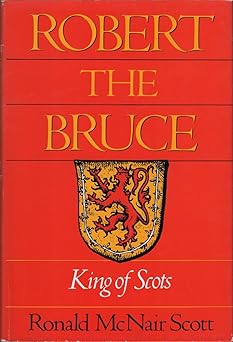
After Diane and I recently watched Mel Gibson’s movie Braveheart I was intrigued to find out the real history behind William Wallace and the war between Scotland and England in the 1200-1300s. Fortunately, I stumbled upon Ronald McNair Scott’s excellent 1982 history, Robert the Bruce, King of Scots.
Not surprisingly, I learned that William Wallace played a relatively minor role in the effort of the Scots to break free from English rule than implied by the movie. The movie was reasonably accurate overall, but the real leader of that long battle was Robert the Bruce, who was descended from previous rulers and fought a long guerilla war against multiple English kings over more than three decades to establish his nation’s independence and his right to rule as king.
That fight began after the death of Scotland’s previous king, Alexander III in 1286. Alexander had for years maintained a peaceful alliance with England, as two separate nations. The problem was that when he died, his heir was still a child. His regents signed a deal with the English king, Edward I, allowing them to rule an independent Scotland as allies with England, but Edward soon realized the power vacuum in Scotland provided him an opportunity. He repudiated the treaty and began a long violent effort to conquer these northern provinces.
The result was thirty years of endless war, ravaging the countryside both in Scotland and northern England. Eventually Robert the Bruce won, getting England to acknowledge the independence of Scotland. Thus Bruce in many ways is seen as Scotland’s own version of George Washington.
What struck me as I read this book however was the plunder and devastation this long war visited upon the ordinary people in both England and Scotland. Edward would invade Scotland, wrecking havoc on local villages and castles. Bruce would respond with repeated raids into northern England, where he would destroy villages and farms, leaving the surviving inhabitants to starve.
And what was the war about?
These local villagers really didn’t care. In this one sense Gibson’s Braveheart was quite accurate. In the movie Wallace was portrayed like those villagers, a simple peasant farmer man in love with his wife and only desiring to build a family and a farm. He cared not for the efforts of Bruce and Edward to control Scotland. In this aspect Braveheart captured the fundamentals of this ugly war quite nicely.
In reality Wallace wasn’t a farmer. He “was the son of a knightly family,” making him part of the Scottish royal class, even if a relatively minor member. He also was also part of Bruce’s rebellion against Edward from the beginning, though the murder of his wife and family by the English served to radicalize him even more.
Nonetheless, I was struck by the evil this war visited upon ordinary people uninvolved in the fight with actually no interest in it at all. Farmers and villagers would be minding their own business when out of nowhere an army of knights would arrive to plunder, kill, rape, and loot. Their goal: Send a message to the leader of the other side, even though the only ones to suffer were these poor villagers.
In essence, this is the nature of almost all wars. They are started by power-hungry political leaders for their own gain, with a remarkably detached and disinterested view of the harm that ambition imposes on innocent third parties. On one side the cry was “I want to unify England and Scotland! Destroy those who oppose me!” while on the other side the chant was “I want a free and independent Scotland! Destroy those who oppose me!” In neither case is this effort productive for either nation, in any way. Instead, it caused death and destruction in both Scotland and England, for decades.
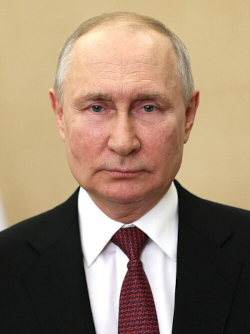
Vladimir Putin
Putin’s invasion of the Ukraine is a wonderful modern example. Before Putin’s invasion the two nations were living in peace, both prospering from the free trade now possible after the fall of the Soviet Union. Ordinary people in both nations were benefiting from this sane and practical situation.
For Putin this wasn’t good enough. For his own aggrandizement he invaded a peaceful neighbor, in the hope he could reconquer it and make it part of a new Russian empire, with him in charge, a hero and the new George Washington of Russia!
In a sense, Putin’s effort is no different than all the political battles by those seeking power, even if those seeking nothing more votes and election victories. Politicians want power, and to win elections they always ramp up the rhetoric to demonize their opponents and make their supporters mad with outrage.
The real problem is when ordinary people ally themselves blindly with those politicians, allowing themselves to be driven by that rhetoric. Rather than put their own lives and concerns first, they let themselves to be manipulated by their leaders to fight for the benefit of those leaders, not for themselves.
And when the public becomes too much enamored and consumed by that rhetoric and the factions they support, elections soon devolve into war.
Washington himself was different, which is why neither Bruce nor Putin could ever be a George Washington. Washington didn’t want power. He intentionally refused a kingship, and after serving two terms as president he voluntarily stepped down, so that power could be peaceable passed on to others.
In his farewell address in 1796 he also quite specifically warned Americans against this emotional factional warfare instigated by power-hungry leaders:
Let me now … warn you in the most solemn manner against the baneful effects of the spirit of party generally.
This spirit, unfortunately, is inseparable from our nature, having its root in the strongest passions of the human mind. It exists under different shapes in all governments, more or less stifled, controlled, or repressed; but, in those of the popular form, it is seen in its greatest rankness, and is truly their worst enemy.
The alternate domination of one faction over another, sharpened by the spirit of revenge, natural to party dissension, which in different ages and countries has perpetrated the most horrid enormities, is itself a frightful despotism. But this leads at length to a more formal and permanent despotism. The disorders and miseries which result gradually incline the minds of men to seek security and repose in the absolute power of an individual; and sooner or later the chief of some prevailing faction, more able or more fortunate than his competitors, turns this disposition to the purposes of his own elevation, on the ruins of public liberty.
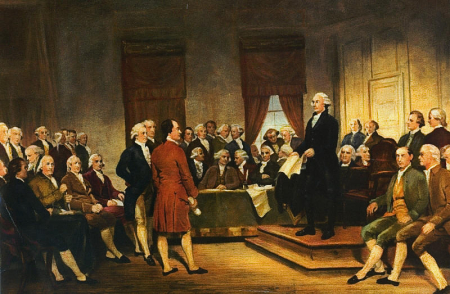
Washington leading the writing of the Constitution,
designed to limit his power
In that last paragraph Washington could have been describing the entire war between Bruce and Edward, as I myself saw it as I read Ronald McNair Scott’s book.
Washington wanted the free sovereign citizens of America to divorce themselves from these factional wars brought on by power-hungry leaders. He wanted us to view these leaders as nothing more than a necessary evil, that we should all view at all times with great skepticism. No matter what they claim or promise or demand, we must question them and repeatedly reject them, so that we don’t end up their pawns used to make them powerful.
Washington’s warning needs to be repeated again and again. It seems to me that too many Americans on both sides of the political aisle have forgotten that warning. Neither Trump nor Biden nor Harris nor Vance nor Newsom nor any other politician should be viewed as your hero. They are always a threat against your own future, and should looked at with great doubt, at all times.

On Christmas Eve 1968 three Americans became the first humans to visit another world. What they did to celebrate was unexpected and profound, and will be remembered throughout all human history. Genesis: the Story of Apollo 8, Robert Zimmerman's classic history of humanity's first journey to another world, tells that story, and it is now available as both an ebook and an audiobook, both with a foreword by Valerie Anders and a new introduction by Robert Zimmerman.
The print edition can be purchased at Amazon or from any other book seller. If you want an autographed copy the price is $60 for the hardback and $45 for the paperback, plus $8 shipping for each. Go here for purchasing details. The ebook is available everywhere for $5.99 (before discount) at amazon, or direct from my ebook publisher, ebookit. If you buy it from ebookit you don't support the big tech companies and the author gets a bigger cut much sooner.
The audiobook is also available at all these vendors, and is also free with a 30-day trial membership to Audible.
"Not simply about one mission, [Genesis] is also the history of America's quest for the moon... Zimmerman has done a masterful job of tying disparate events together into a solid account of one of America's greatest human triumphs."--San Antonio Express-News
An interesting study for the libertarians out there.
https://phys.org/news/2025-12-inequalities-egalitarian-societies-anthropologists.html
I recently watched a history of the back and forth, the desperation and the intrigue between the English and the Scotts, very interesting.
I believe William Wallace happened about in the middle of it and it went on for about a hundred years or so.
Total chaos, double crosses, lies and forgotten promises, blood and guts.
Nothing new under the sun, ask the radical increasingly desperate radical Democrat party leadership in America.
By any means necessary.
I appreciate your analysis, Bob. Although it certainly applies to WWII and Russia vs. Ukraine, I am less confident that it bears on the intra-party lawfare we have at present in the U.S., or on the American stand against Russia and China.
As I see it, the unparalleled decades-long prosperity and strength of the U.S. has allowed a culture of government kleptocracy to grow, without it (yet) attaining the level of dominance found in Russia or China. The “yet” is key… the advent of Trump is timely!
He will have served well if he manages to reverse the steep slide of the electoral process and the pollution of the judiciary.
Then there is, hopefully, the empowerment of Europe against Russia! To anyone who thinks this merely feckless, I ask how many stealth aircraft, aircraft carriers and attack submarines from Germany, France and the UK will show up in the South China Sea if the balloon goes up there? None, that’s how many.
So Europe needs to do what it must do and contain an enervated Russia while the U.S. stares down the Dragon!
Ray Van Dunne: The danger of factions, led by demagogues, always applies to every political situation. No exceptions. If people become emotionally wedded to a leader or party, they become pawns that that leader or party will gladly use to its advantage, almost always to the detriment of the pawn.
Right now too many Americans are emotionally wedded to their party or leader. This might apply more to the left, which tends towards group-think by the very nature of its collective philosophies, but it also applies to those who are relying too much Trump for success. In both cases, these emotions make reasoned debate impossible, and thus the threat of violence continues to rise.
Jeff, read the article. Made a lot of points with which, Ayn Rand , would agree. Men are governed by self interest. That’s why capitalism is the most logical way to organize government. As a survivor of Soviet Communism, she hated the evils and hypocrisy of that system. While there are evils an hypocrisy in. Capitalism, there are avenues to battle them.
I’ve alway wondered, have you read much Ayn Rand. She’s a little melodramatic in some cases and, in other cases, repetitive and obtuse. I’m not sure what you would find grotesquely objectionable.
My main pushback is her atheism. I hope she came to terms with God before the end.
Minor edit in second paragraph before Washington quote: ” neither Bruce nor Putin could ever be a George Washington”
Andi: Thank you. Fixed.
Consider: Our current political turmoil is because of a broken Constitution that is no longer fit to protect and enlarge self-governance. The Founding Fathers believed that only Best Men would be able to run the government effectively. Inasmuch as politicians are usually power-hungry criminals that’s a huge mistake. A Constitution should have a lot of checks and balances to restrain not-Best Men. Ours does not. Hence the turmoil.
Bob, it would be interesting to know how many people would agree with “Trump, right or wrong, but Trump!” I would not, and I don’t honestly know anyone who would!
But I know plenty who would agree with “Trump – always wrong!”
Ray Van Dune: I agree that there are far fewer people on the right who would say “Trump, always right!” At the same time, I can tell you that if I post an essay that is even slightly negative about Trump, I find some aggregate conservative news sites that normally link to my work won’t do it. I also find that on many conservative sites there are many commenters who seem to express this perspective, if you read them closely.
My comment is merely a warning for everyone. Don’t fall in love with any politician, even if he is actually doing a great job. He or she can turn on you in an instant. Be watchful always.
Pink Floyd:
“One of These Days” (1971)
Animation from “Dinner for Few” Nassos Vakalis (2015)
https://youtu.be/YZCqh0beUwM
(5:32)
“Don’t fall in love with any politician”
100%!
Trust NONE of them absolutely.
The saying goes “Trust but verify”, and then verify again.
Politicians as well as government, any government, is not in the truth and morality business, they are in the power and control business.
Ask the Scotts and William Wallace.
Tomy point about politicians and government: https://youtube.com/shorts/QHL6uX1_Ji8?si=SJFCk0ZNytvHEZey
Someone has to take care of business, and who says what that business is?
A general problem with any system of governance is that it attracts individuals who want power and not people who want to serve. You see this in the governments of countries from the towns to the national government. You see this in businesses. You see it in the military. A lot of the people who want power are on the spectrum of sociopathy to psycopathy and will do whatever it takes to gain and stay in power. There are exceptions and they are few. I may be cynical but life has made me that way.
As Cotour said echoing Regan, trust but verify.
https://www.georgewashington.org/farewell-address.jsp
“All obstructions to the execution of the laws, all combinations and associations, under whatever plausible character, with the real design to direct, control, counteract, or awe the regular deliberation and action of the constituted authorities, are destructive of this fundamental principle, and of fatal tendency. They serve to organize faction, to give it an artificial and extraordinary force; to put, in the place of the delegated will of the nation the will of a party, often a small but artful and enterprising minority of the community; and, according to the alternate triumphs of different parties, to make the public administration the mirror of the ill-concerted and incongruous projects of faction, rather than the organ of consistent and wholesome plans digested by common counsels and modified by mutual interests.”
To Gary,
She died on public assistance, and had no trouble with “post birth abortion.”
On the political front
https://m.youtube.com/shorts/TuysQj6cRmw
In terms of history, Frederick II might be one of the best leaders of history. Carlos the Wise, Longshanks, etc.
I meet plenty of people in person that will hear no criticism of Trump. Similar percentage of others that will hear no good. On line it’s skewed towards the later. Same with Musk.
Too many people confuse brilliant and successful with perfect and infallible. Hero worship can be a harmless pastime up to a point. IMO that point is when one quits thinking for oneself.
It is called Sortition. Everybody old enough/or other criteria to hold office gets a number engraved on a marble. The numbers and names are public record. Throw marbles in barrel, churn and then select your representatives by drawing numbers from the barrel. Sure there will be some morons, some smart people, some psychopaths. Will it be any worse than “democratic” snout counting? I doubt it.
Also solves the term limit problem. Half the representatives lose office and new ones randomly selected at each drawing. Choose time period carefully.
Pay determined by last 3 years’ tax returns plus 20%.
I watch C-SPAN to hear what politicians actually say.
MSNBC will only record video of testimony, and have talking heads talking over it. A nasty habit of theirs. They did good work in exposing Gulf War 2, before lionizing Cheney themselves.
Disgusting
Wayne: Thank you for the Pink link. The added video is plainly symbolic but still subject to interpretation. Fat cat titans are really the ones in chains. Kittens and cats are free but difficult to herd. The machine provides sustenance (unequally) by churning through productivity. The one cat grows to a tiger and becomes a brutal populist leader…
Back in 70s it was a debate whether the words were “one of these days I will talk to a human being” or “One of these days I will cut you into little pieces”. In this audio version it sounds clearly like the latter, and fits the script.
Jack Wayne, I don’t see anything particularly broken about the Constitution. I would tweak a couple of things (term limits on both people and laws, in particular), but it is eminently suited for the 21st century in that it sets up a distributed system. The fact that “we” have centralized power is not the Constitution’s fault.
I don’t see “best men” implied anywhere. That’s a post-WWII conceit, not something the country was built upon.
The fact that distributed systems are _nearly_ always superior to centralized systems is both and old idea (see said Constitution) and a new one (see current computer architecture). It seems to be slowly seeping into the zeitgeist. It took a while for centralization to become the default assumption; it was a radical idea (in America) in the mid 18th century (even the Civil War didn’t cement it) and WWII solidified it – that’s two to three generations. It will take a while to reverse it. These are the sorts of attitudes that are inculcated in the young and never change. Centralization is not going away until the last boomer dies. We’ll see what’s next (well, perhaps not “us”, exactly, but the country).
Scots wha have is an anthem of sorts.
Bagpipes on helium
https://m.youtube.com/shorts/qd4BKB2z-Ew
A definite improvement
Allan–
har; back when, if the lyrics weren’t on the album, you did your best!
As far as I know, variously live vs. the studio cut; “..hack you…,” or “…cut you…”
–the animation for that video has a definite political bent (“award-winner”) but was cut down somewhat.
If you want huge amounts of Pink Floyd paired with some really good animation, check these people out:
https://www.youtube.com/@Thinkfloyd61Blogspot/videos
Everybody worships something.
It’s just that too many worship politicians and the government that will pay them, make them equitable, and take care of them. All the things little people can’t do for themselves, but at such a great cost.