
Orion completes short 15-second burn to refine its return-to-Earth
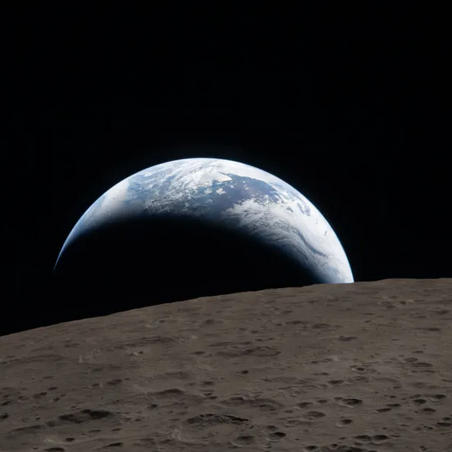
The Earth as seen from Orion just before the capsule swung behind
the Moon yesterday. Click for this and other Artemis-2 lunar images.
The Orion capsule today completed a 15-second engine burn in order to fine-tune its return path for splashdown in the Pacific Ocean on April 10th.
At 8:03 p.m. EDT, the Orion spacecraft, named Integrity, ignited its thrusters for 15 seconds, producing a change in velocity of 1.6 feet-per-second and guiding the Artemis II crew toward Earth. NASA astronaut Christina Koch and CSA (Canadian Space Agency) astronaut Jeremy Hansen reviewed procedures and monitored the spacecraft’s configuration and navigation data.
During today’s mission status briefing, NASA officials shared the first images received from the crew during the lunar flyby and confirmed that the USS John P. Murtha has left port and is headed to the midway point toward the recovery site in the Pacific Ocean.
This was Orion’s second small engine burn since it left Earth orbit on April 2, 2026. Unlike the Apollo missions to the Moon in the 1960s-1970s, which involved entering and leaving lunar orbit and doing complex maneuvers while there, the Artemis-2 mission around the Moon has largely been a passive one. The capsule was sent on this course at the start, and has been coasting since. Today’s burn was merely a small adjustment, not a major burn.
The re-entry on April 10, 2026 remains the key moment of the flight, as it has always been. Will that questionable heat shield do as NASA’s engineers predict and work to protect the four astronauts during re-entry? Or will it do things unexpected, because those engineers really don’t understand the engineering issues involved?
I am hopeful and optimistic. I also know that even if everything turns out fine, this flight will simply be a demonstration that NASA has learned nothing from the Challenger and Columbia accidents, and is still willing to risk human lives in order to win some political kudos and get some good PR. And for that reason I am not confident of the agency’s ability to truly do what it says, safely and competently.
One more note: Though the images being sent back are quite beautiful, they are hardly ground-breaking. Lunar Reconnaissance Orbiter has mapped the entire surface of the Moon at much great resolution, far better than anything seen on this mission. NASA might claim the astronauts are doing science, but most of it is minor and not very significant. When you get down to it, this is simply a very expensive tourist trip for four government employees, paid for at an ungodly cost by the American taxpayer.

On Christmas Eve 1968 three Americans became the first humans to visit another world. What they did to celebrate was unexpected and profound, and will be remembered throughout all human history. Genesis: the Story of Apollo 8, Robert Zimmerman's classic history of humanity's first journey to another world, tells that story, and it is now available as both an ebook and an audiobook, both with a foreword by Valerie Anders and a new introduction by Robert Zimmerman.
The print edition can be purchased at Amazon or from any other book seller. If you want an autographed copy the price is $60 for the hardback and $45 for the paperback, plus $8 shipping for each. Go here for purchasing details. The ebook is available everywhere for $5.99 (before discount) at amazon, or direct from my ebook publisher, ebookit. If you buy it from ebookit you don't support the big tech companies and the author gets a bigger cut much sooner.
The audiobook is also available at all these vendors, and is also free with a 30-day trial membership to Audible.
"Not simply about one mission, [Genesis] is also the history of America's quest for the moon... Zimmerman has done a masterful job of tying disparate events together into a solid account of one of America's greatest human triumphs."--San Antonio Express-News
Having watched all the Apollo missions as an awestruck kid, I thought I’d be more excited about this flight.
Sorry to say I’ve been somewhat underwhelmed.
Probably because it has taken .so. dang. long. and so many billions of dollars to get to this point. The Orion contract was given to Lockheed Martin 20 years ago— 20 YEARS!! That was about the same time it took us to first break the sound barrier and walk on the moon.
Arty 2 really kinda felt more like the Japanese billionaire’s aborted “Dear Moon” joyride program.
All that said, I’m optimistic about Isaacman’s political maneuvering to free us from this SLS/Orion anchor and start moving. Seeing the SpaceX HLS tested (hopefully) next year in LEO will be far more exciting.
It looks like the brought the Earth with them. I suppose an artifact of the imaging system, and a much longer effective focal length: Earth from Lunar-orbit on Apollo appears to be about half the angular diameter.
Similar images of Earth from Apollo 17, and Artemis 2.
https://www.instagram.com/reel/DWvgFuQDjIH/
Hey, Arabic numerals were good enough to be NASA-spec for Apollo. It may be that NASA thought non-Super Bowl numerals would sound too much like a movie sequel (well, actually . . ). I’d wager if you asked twenty people if they’d seen Artemis 2, half would say yes, and some would name the leading actors.
Here, the grey twilight itself has been seen because men dared mighty things.
Some dreams began small
https://saemiller.com/2026/04/02/nasa-sls-in-my-hands/
While some sought fireworks, others stacked stones.
Many toiled, unloved, to see their thoughts fly.
It is in the storm–even in fire-where beauty awaits….even in the “wide carnivorous sky:”
https://m.youtube.com/watch?v=_4-NaPOlkNE&pp=ygUQQm9zY28gcm95IGJlYXV0eQ%3D%3D
Caltech’s terrific video series (+ book(s)) on classical mechanics The Mechanical Universe—hosted by physicist David L. Goodstein, divided in 54 half-hour episodes—is very worthwhile as a whole, but given Artemis II happening now, see especially episode 24: “Navigating in Space”.
Everything our host says is true, of course. And yet: If it is the case that Artemis II has not had anything remotely like the viewership or cultural impact that Apollo 8 (the nearest analogous historical mission) did, I think it’s also true that it’s caught the imagination of more people than I expected. And I think that if it ends with the safe return of the crew, as we all hope and pray, it is shaping up to be not only a shot in the arm for a demoralized agency but also for the political cachet of Jared Isaacman. It’s made Trump very happy, and it’s made a lot of people on the Hill very happy, and this really could give Isaacman more of the clout he needs to complete his reshaping of Artemis into something that vaguely looks like a sensible and sustainable lunar return program. Along with some other changes at the agency as well.
In short, it could well be the case that Artemis II is the price we had to pay to off-ramp all of the dead-weight porktacular legacy hardware from Artemis as soon as possible. And that could end up being Artemis II’s real legacy. That doesn’t make putting human beings on the back of this dodgy heat shield *right*, but perhaps it gets us to a future where such gambles don’t happen again. Stay tuned.
Richard M: What I fear most is exactly what you posit now: That NASA gets a great political boost, which then gives it greater power to establish a “space program” that everyone else has to kow-tow to, as was what happened after the Apollo success. The result was not good, but 50 years of nothing.
And it appears this greater power and control over the private sector is exactly what Isaacman wants. I think he wants this for sincere and naive reasons, but he wants it nonetheless.
Concerned–
Watched all the Apollo stuff as a kid as well. {ABC News- Jules Bergman} And if you didn’t see it live you were out of luck for months until NASA issued their films, and maybe you’d see them as filler on local TV counting as educational content, at 6am, after the Farm Report.
In Elementary school, if a launch was scheduled during the day, they would get the TV out and assemble us in the gym. In High School our science teachers ordered a lot of NASA films and Fridays were always film-day. (it was pretty lazy of them, but it’s what we had, and we were all TV Babies anyway.)
Michael–
Highly recommend The Mechanical Universe series as a good introduction. Free at Youtube.
———————-
I linked this in another post, but very well done & explained:
“Apollo 8, Artemis 1 & 2, Orbit Comparison Visualized”
Overview Effekt (April 4, 2026)
https://youtu.be/PNQ7MoL7erI
(12:10)
He spends the first 3 minute’s explaining the Moon’s orbit, then gets right into it.
I know they only had a short time observing the back side of the moon, but by any chance did they spot the monolith?
Asking for a friend.
Jerry Greenwood: How naive. You actually believe they’d tell us if they did? :)
Hello Bob,
“And it appears this greater power and control over the private sector is exactly what Isaacman wants. I think he wants this for sincere and naive reasons, but he wants it nonetheless.”
Well, maybe, I grok your concern. I really do.
I guess that . . . I am looking at the *concrete* things Jared has done so far, and I am taking some cautious hope from that. Because so much of it is a vast improvement over the mess he took over. He’s killed Gateway, he’s killed EUS, he’s killed Mobile Launcher 2, he’s shifted Artemis III to a LEO test mission, he’s got Starship now handling the transport of Orion to lunar orbit for the next few missions, he’s setting up a program to have commercial providers take over cislunar transport entirely in the not-too-distant future, he’s shifted to what almost looks like a sensible program to set up a lunar base as soon as possible.
Will he do all this in a way that puts NASA too much in the driver’s seat, even so? I mean yes, that’s a real concern. I suppose that I am hoping that the heavy use of commercial partners creates a dynamic where NASA just gets more and more moved to the margins as the companies (starting with SpaceX and its plans for lunar manufacturing) just start doing more and more of their own thing.
I do think that some of what was motivating Isaacman was that he saw the toxic relationship NASA had with Boeing on SLS, EUS, and Starliner, and how Boeing was basically in the driver’s seat. Is the answer he’s coming up with just going to be another wrong answer in a very different way? Or will what he’s attempting just have the favorable unintended consequences I am musing about? Or is he playing 4D chess? I guess we will see. But at the very least I think our future on the Moon is in better shape than it was six months ago.
And meanwhile, Elon is just gonna do what Elon wants to do.
Richard M wrote, “And meanwhile, Elon is just gonna do what Elon wants to do.”
And not just Elon. All the new rocket startups, as well as the orbital tugs, robotic serving spacecasft, private lunar landers, and re-entry capsules now have customers outside of NASA. They will grow regardless of what Isaacman does, though if he does the right things he will help them considerably.
Unlike the 1970s, there is now profit to be made in space, and NASA no longer holds the whip hand squelching independent action.
It is this fact that gives me hope.
Another video from professional photographer Jared Polin discussing the photography of the Artemis II mission:
https://www.youtube.com/watch?v=9WBxgKAfoCY
NASA should get a political boost…the constant NewSpace attacks have resulted in a backlash.
Once again, Hillhouse was proved correct.
The rank and file thrilled to see Artemis II’s launch speed rival that of Atlas V…and they can see that this return to the Moon was literally done no thanks to the Zimmermans of the world who undermined every-little-thing.
Jeff Wright,
[Citation needed]
“The Monolith Monsters” (1957)
Trailer
https://youtu.be/uxohSwDFjxg
2:17
Robert,
“Unlike the 1970s, there is now profit to be made in space, and NASA no longer holds the whip hand squelching independent action.”
Exactly; Artemis my well be the exit ramp or bridge for NASA to shift the heavy lift portion of launching to others businesses. The bureaucratic side needs it’s fanfare and ceremony to congratulate itself but this old Shuttle technology will be set aside for something better. For the moment both technology bases exist side by side.
Early on, the microchip was the bane of rocketry.
Here in the US, launchers were stick built (as it were), and rockets were on more severe diets than models. Satellites exposed to vacuum…circuits that be be this proof, that-hardened.
The lack of warhead/electronic sophistication actually served the Soviets better.
Don’t fuss over shrinking payloads, just make the bloody rocket bigger. Vostok spacecraft are still being made. The spheres were Zenit spysats that went atop Energia strap-ons that took their name.
Put cheap tech in a climate controlled sphere and be done with it.
Chips for surface use evolved faster due to not having to endure space, and before long space circuitry went from the most advanced tech–talking to a handful of big but slow machines on the ground–to obsolete.
The 486 was space rated not that long ago.
The funny thing is that it took big Russian boosters to handle the growth of comsats. Since more people wanted data–microchips actually pushed up the size of comsats.
And now, it might be Big Data that pushes space exploration–even if it undermined it early on.
I still wish microchips had been invented on a Moonbase–forcing us to use bigger boosters the whole time.
Falcon, reusable or no, had the advantage of being more powerful than ballistic missiles on heels with strap-ons, and EELVs that were too late to the game.
Funny how things go.
The Truax/Dandridge Cole vision was pushed aside in favor of balloon tanks and Delta II sounding rockets.
In short, American rocketry suffered from post-Saturn anorexia.
Ask your doctor for….
“In short, American rocketry suffered from post-Saturn anorexia.”
American rocketry suffered from bipartisan U.S. government policy to force a Space Shuttle monopoly on all commercial satellite launching.
Then the Challenger disaster happened.
Richard M,
Not to mention decades of mistakes that tried centralizing control of spaceflight in the hands of the government, rather than taking advantage of the American system of innovation. Who knows what we would’ve had if Kennedy had chosen a different goal.
Jeff Wright,
It isn’t that big of a point in the Soviets’ favor that their electronics were primitive. Going big for the sake of big is a good way to waste resources that could be more effectively spent elsewhere. Had we been smart, Constellation would’ve been replaced with Atlas V and DIVH, propellant depots, and distributed launch, and we’d have already been back on the Moon. That would also build a significant market for competition in launch, lunar operations, supplying propellant, and more, but the obsession with size over thinking ahead gave us the SLS.
I put that on the Air Force.
Look Ma! No solids!
https://www.secretprojects.co.uk/threads/reusable-winged-versions-of-the-saturn-v-first-stage.2174/
“That thar is Army! Can’t have that! Let’s get an outsize glider and sop it on a skid tank with two bottle rockets.”
Just remember—that tech was foisted on America–we did the best we could with it.
Not our choice.
I have sooo many reasons to hate the USAF…..
The Iranians only downed one A-10….not all of them. They should have been Army.
Concerned wrote: “Having watched all the Apollo missions as an awestruck kid, I thought I’d be more excited about this flight. Sorry to say I’ve been somewhat underwhelmed. Probably because it has taken .so. dang. long. and so many billions of dollars to get to this point.”
I think that if we were getting more for our money and long wait time, then we would be more excited. The ennui may be due to the realization that SLS-Orion cannot do even what Apollo did, much less accomplish the stated goal of a continually-manned lunar station. NASA calls it a first step, but it is a step that carries a load that does no good at achieving the goal.
It is a little like after the Lewis & Clark expedition we had waited half a century then supplied the settlers only with hand carts instead of wagons and horses to take the tools and materials needed to found towns and farms in the American west.
“The Orion contract was given to Lockheed Martin 20 years ago— 20 YEARS!! That was about the same time it took us to first break the sound barrier and walk on the moon.”
Orion is not the long pole, here. It’s heat shield was chosen by NASA, not by Lockheed Martin. The choice to fly astronauts with a life support system that had not been tested in space was also NASA’s. The “Wolowitz” toilet? I’m don’t know who made that one.
“Arty 2 really kinda felt more like the Japanese billionaire’s aborted “Dear Moon” joyride program.”
Except Dear Moon was intended to take people who are much more able to express their experience. Instead of pictures, souvenir rocks, and a dry description of “magnificent desolation,” we were expecting a hoard of artwork, poems, books, screenplays, and other expressions to give us the reality rather than fantasy that science fiction has previously brought us.
“All that said, I’m optimistic about Isaacman’s political maneuvering to free us from this SLS/Orion anchor and start moving. Seeing the SpaceX HLS tested (hopefully) next year in LEO will be far more exciting.”
“Anchor” is a good description. An anchor can be a good thing, keeping the ship safe from drifting, but it can also hamper the ship from making progress. SLS/Orion look like they can make progress, but the reality is that they are inadequate for the goals we want to achieve.
__________
Blair Ivey wrote: “Hey, Arabic numerals were good enough to be NASA-spec for Apollo.”
NASA used Roman numerals for the rockets (e.g. Saturn V) and Arabic numerals for the missions. So far, no one has chosen to use runes.
__________
Jeff Wright,
You wrote: “Early on, the microchip was the bane of rocketry.”
You say the funniest things. NASA funded the development of the microchip after the discovery of the semiconductor and the resulting miniature transistor. It was a boon to rocketry and space exploration and utilization. You used the wrong word.
“Don’t fuss over shrinking payloads, just make the bloody rocket bigger.”
America made the rockets bigger because the payloads were growing, not shrinking, doing more because the onboard microchips could do more. NASA was more successful making bigger rockets than the Soviets. Just compare the (now obsolete) Saturn V with the N1 Moon rocket. The Atlases, Deltas, and Titans grew, too.
The Arianes grew, too, taking a mere decade to grow into the Ariane V, which lofted a majority of the geostationary comsats of its time, until the Falcon 9, that is.
“Falcon, reusable or no, had the advantage of being more powerful than ballistic missiles on heels with strap-ons, and EELVs that were too late to the game.”
The American EELVs were not too late, they were too expensive. Way too expensive. Which is what happens when the customer they were designed for was the government, not the companies doing business in space. The Falcon 9 was designed for commercial customers, which is why it is so popular with them. It just happens to also be a good fit for many government satellites and probes, which is why it is so popular with them, too.
“In short, American rocketry suffered from post-Saturn anorexia.”
In truth, American rocketry suffered from government interference, especially the Congressional requirement that the Shuttle launch all the satellites and probes — and that decision almost killed your precious American rocket industry and is probably why Marshall Space Flight Center (MSFC) is practically obsolete.
The Saturn V was inappropriate for almost every post-Skylab launch, because the government had abandoned of the space-utilization business and stayed only with exploration and research. Why do all that exploration and research if it would not be used?
Now, with commercial launchers and modern commercial space companies, that research has a chance of being useful.
“Just remember—that tech was foisted on America–we did the best we could with it.”
Just remember, that tech was foisted on us by Congress, and we Americans could do nothing else, until Congress let us, post Challenger. The first attempt, Pegusus, was too expensive. The next two attempts, VentureStar and Delta Clipper turned into NASA-funded boondoggles. Kistler had funding issue all the way to its demise. Blue Origin makes molasses look swift. It was SpaceX and Rocket Lab that saved the day, and now we have many other commercial launch companies beginning to come online, too. Government, NASA, and MSFC did us few favors.
That might be my biggest gripe with the combined system. In complete isolation I can imagine the SLS and Orion being fine, but when I think of anything genuinely compelling, whether industrializing the Moon, launching megaconstellations, enabling orbital industry, space solar power, fast transits to the outer system, and beyond–the SLS simply can’t support any of them. Even with optimistic improvements it wouldn’t be good enough. It’s not even good enough to support Artemis in any more than a basic way.
I also disagree with Jeff here, but the military was a bigger customer for integrated circuits than NASA was, though that doesn’t make NASA’s contribution irrelevant.
It might have worked if the Shuttle had been intelligently designed rather than being so heavily twisted by political machinations, but that wouldn’t have resulted in the “right” companies and states getting the contracts, which still plagues NASA today, and which MSFC is particularly bad about enabling.
Yes. There is precious little point in doing exploration for its own sake, which appears to have been the dominating ethos of NASA for decades. A real program to use space would have done far more exploration than we have, because we would genuinely need to know, and that demand would incentivize lower-cost probes, rovers, orbiters, etc., and making numerous copies of each, instead of expensive one-offs where lessons from one are rarely rolled into future iterations.
This point is often missed by government boosters. They ask why we assume the private sector is better when government got all the firsts, never accounting for how the government bent industry to its own ends and also blocked private development for quite some time.
The monolith was in (prominent) Tycho crater on the moon’s southern earth-facing side.
An alien could have placed the monolith atop Mt. Piton, making astronauts work for it.
You don’t want it in the center of a crater, except to use it as a dish and the uplift as a feed horn.
The USAF has interfered with space enough. They were the enemy of Marshall and SpaceX both.
They wanted Falcon dead….ABMA’s throat still has LeMay’s fingerprints on it. Falcon was forced off the coast under the aegis of range safety.
The one thing we can all agree on– Falcon really was a threat to EELVs all right …just not in the way they said.
USSF still is under USAF, just like Coast Guard/Marines are still under the thumb of the USN.
Navy and Air Force have gotten most of the bloat. They should be your targets–mostly the fighter jocks.
Submariners keep the peace–and they are better choices for Deep Space missions than hot-heads.
Jeff Wright wrote: “The USAF has interfered with space enough. They were the enemy of Marshall and SpaceX both. They wanted Falcon dead….ABMA’s throat still has LeMay’s fingerprints on it. Falcon was forced off the coast under the aegis of range safety.”
Actually, the USAF had expected to use Falcon 1 for small satellite launches, but because they, the USAF, weren’t ready for it — they didn’t have smallsats, yet. SpaceX was forced to move on to larger launch vehicles that would generate revenue.
This is the difference between the government-minded and the rest of us. The government does not have to worry about making sales to stay in business, but the rest of us do.