
Academia makes its first comprehensive attempt to plan science missions to Mars using Starship
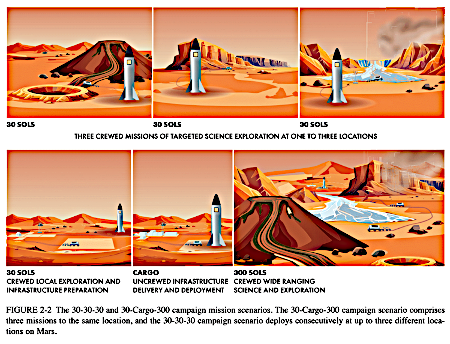
Figure 2-2 from the National Academies
of Science report
A new report released today by the National Academies of Science, entitled “Highest Priority Science for the First Human Missions to Mars,” is essentially the first attempt by the planetary science community to plan its future science missions to Mars using the gigantic capabilities that SpaceX’s Starship is expected to provide them.
You can download the report here.
Even though the report made the search for life on Mars its big priority — a bugaboo that NASA and the science community trots out repeatedly to garner clicks from the ignorant propaganda press — this report is radically different then all previous similar NASA studies proposing future Mars exploration, as indicated by the graphics from figure 2-2 of the report to the right. Unlike those past studies, which were badly limited by the inadequate capabilities of any spacecraft NASA could send to Mars, this new report recognizes how much the game is changed by SpaceX’s Starship.
First, the new panel did not attempt to place any limit on any landing zones. Earlier reports had forbidden landings in the high latitudes or high altitudes because of the risks to NASA’s proposed landers. Starship overcomes much of those risks, giving researchers much greater flexibility.
Second, the focus of the missions will not be solely devoted to scientific or geological research, as had been the case for all previous similar reports by NASA and the academic community. Instead, the proposed research goals includes important engineering and human exploration requirements outside of science, including efforts to use the resources on Mars itself as well as find locations better suited for human habitation. Once again, the vastly greater capabilities of Starship influenced this change.
Even more important, the study doesn’t assume the future missions will be unmanned, as all previous NASA reports have done. In fact, it does the opposite, proposing multiple 30-day manned missions, as shown in the graphic. One set of three missions would go to three different locations, while another set of three missions would focus on one place in particular.
Much of this shift towards manned flight I think stemmed from the presence on the panel of representatives from the private companies SpaceX and The Exploration Company (a French startup), as well as an engineer from the National Academy of Engineering. Previously studies were almost always entirely dominated by planetary scientists, so the goals outlined were always focused on their interests. Now the idea of human exploration has become prevalent.
The panel’s work was clearly also influenced by the realization that SpaceX’s Starship is not only far more capable, its first flights are just around the corner. SpaceX plans sending it numerous times to Mars in the very near future, as shown in the graphic below that Elon Musk released during a presentation in May 2025.
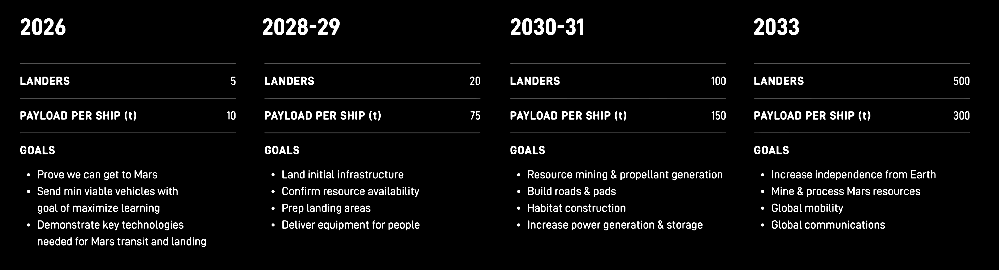
The Musk game plan for Mars exploration over the next few years.
While that plan is probably going to see some delays, it is also probably going to play out more or less as Musk envisions it. NASA and academia had better get its pins in order to take advantage of that capability, or it will miss out. Today’s report is its first stab at doing so.
In this context the panel recommended two things that are quite ambitious. First, a real research laboratory should be sent on Starship to Mars, “consisting of a variety of geologic, astrobiologic, and biomolecular analytical tools and analysis capabilities.” No more robots. Put a real lab on the planet with the scientists there capable of analyzing samples on a daily basis.
Second, the panel recommended that Starship bring fully capable drilling rigs to the planet so that actual deep cores could be obtained from multiple locations. Imagine, we might soon be seeing drilling crews obtaining cores from the polar ice caps, allowing scientists to finally and precisely map the entire geological history of Mars, which in turn will help map the solar system’s own history, and the Earth’s as well.
The report also notes a major political obstacle to this ambitious human Mars exploration, the limitations placed on human activity on other planets due to the planetary protection rules imposed by international interpretations of the Outer Space Treaty. Those interpretations actually forbid much human exploration on Mars out of fear of disturbing or destroying any possible life that might be there, as well as contaminating Earth life with that theorized alien life.
The problem is that there is no evidence any life exists on Mars. In fact, the data so far suggests if it ever was there, it is now long gone. Furthermore, the rules are simply impractical for future generations, as they preclude any real colonization anywhere in the solar system.
Though this report is very diplomatic about the issue, it makes it clear that changes are going to be required. As it notes:
Although today’s planetary protection guidelines are inconsistent with human exploration, the world-class science to be conducted by human explorers of Mars is an impetus for continued investment in the tools and knowledge that address contamination risks and inform these guidelines. By integrating this work early in the mission development process, human Mars exploration campaigns can achieve the required levels of scientific integrity and backward contamination risks.
In other words, the rules are going to have be changed. Humans are going to Mars, whether or not the international globalist bureaucrats in the UN and at NASA like it.
All in all, this report is a refreshing change. It signals the coming revolution in human space exploration, and lays out with courage some of the ambitious things that will now possible due to Starship. And rather than see Elon Musk’s company as an evil villain who must be stopped, the panelists instead viewed his company as a wonderful resource to be mined. For everyone’s mutual benefit.
Or as they say in science fiction: Ad astra!

On Christmas Eve 1968 three Americans became the first humans to visit another world. What they did to celebrate was unexpected and profound, and will be remembered throughout all human history. Genesis: the Story of Apollo 8, Robert Zimmerman's classic history of humanity's first journey to another world, tells that story, and it is now available as both an ebook and an audiobook, both with a foreword by Valerie Anders and a new introduction by Robert Zimmerman.
The print edition can be purchased at Amazon or from any other book seller. If you want an autographed copy the price is $60 for the hardback and $45 for the paperback, plus $8 shipping for each. Go here for purchasing details. The ebook is available everywhere for $5.99 (before discount) at amazon, or direct from my ebook publisher, ebookit. If you buy it from ebookit you don't support the big tech companies and the author gets a bigger cut much sooner.
The audiobook is also available at all these vendors, and is also free with a 30-day trial membership to Audible.
"Not simply about one mission, [Genesis] is also the history of America's quest for the moon... Zimmerman has done a masterful job of tying disparate events together into a solid account of one of America's greatest human triumphs."--San Antonio Express-News
This is truly an exciting time.
Robert, thanks for this summary, and the link to the report! This is going to be a fascinating deep dive.
We certainly are, living in the Future.
I’m still totally unclear on; radiation shielding en-route, atrophied muscles at the surface, and what is the risk of tipping over at landing?
Something along the lines of “the map is not the territory.”
I am pleasantly surprised they didn’t try to limit Starship landing zones…I guess they figure than any Earth cooties could just as easily hitched a ride on China’s probe as easily as Viking, or whatever.
One more reason I am (quietly) glad about China’s space push…it helps keep America’s momentum going.
The Eager Space site has me scratching my head. I expect the usual SLS bashing there as well as here –but he seems to have it out for the ideas of space markets.
“Why Space Reality kills Space Dreams.”
At 15:57 he says there is no space market… orbital server farms alone may open the doors to space Solar –and the energy sector is a whale of a market.
He does get my frustration with VCs at least.
Perhaps the overall nature of this report is due, at least in part, to a dawning appreciation on the part of the legacy planetary science apparat that they are no longer immune in their ivory tower fastnesses from changes in the larger culture. There have been dismissals in plenty at both JPL and Goddard since Trump took office and the prospect is for more. The planetary science grandees can no longer do whatever they like with entirely too much of the public’s money. SpaceX and the US are going to Mars for quite a variety of reasons. Science can certainly be one of them, but it is not going to have unrestricted control of the steering wheel.
I think Peter Hague is likely right in speculating that SpaceX just isn’t going to make the 2026 Mars launch window for that first batch of Starships — they’re moving lightning fast on everything, but it just looks less and less likely that they’ll have nailed down orbital refueling or have enough launch pads in operation in time.
But 2029 looks entirely possible. That won’t get Trump his Mars landing before he leaves office, but the actual launch and Earth departure would happen in his final weeks.
There is, however, the pendulum. Republicans are talking affordability–but no one believes it with stagnant wages. Trump’s tiff with healthcare prices would have gotten him red-baited.
My fear is that NASA gets more cuts–the DNC gets in–and attacks NewSpace but doesn’t really restore NASA funding except for Green nonsense.
That’s the one-two punch AmericaSpace’s Jim Hillhouse warned us about when he called for OldSpace and NewSpace to have each other’s back.
It is easier to destroy than create.
Someone tell Elon:
“Phobos, the larger of Mars’ two moons, is on a collision course with the planet. It is nearing Mars at a rate of six feet (1.8 meters) every hundred years. At that rate, the moon will either crash into Mars in 50 million years or break up into a ring.”
Ad Luna, Ad Ares, Ad Astra!
From Blair Ivey
December 10, 2025 at 12:11 am
I will say it, again. There seem to be an awful lot of plans for a system that has yet to demonstrate a complete flight. Then there is the small detail of orbital refueling. There is not a reason that I am aware of that it can’t be done; we just haven’t actually done it. Projects have to be planned ahead, and Starship will likely work as anticipated. I would just like to see some demonstrated capability before I put resources into a Starship-based project.
From Robert Zimmerman
December 10, 2025 at 12:15 am
Blair Ivey: You points are well taken. However, read the report I link to. It is remarkable lacking in specifics. Its purpose was to outline general goals and concepts, centered around Starship and the new capabilities expected from it.
In other words, this report is simply the first stab at the early design and concept work. Nothing is concrete, and all depends on how Starship evolves. Nonetheless, NOW is the time to begin this, because it would be foolish to bet against SpaceX’s engineering goals.
From Saville
December 10, 2025 at 5:32 am
I find it interesting that the National Academies of Science thinks anything they say is of the slightest interest to Musk.
From Robert Zimmerman
December 10, 2025 at 5:36 am
Saville: You are very very wrong. SpaceX made it a point to put a representative on this committee. It has also worked extensively for years with the scientists who use the orbiters to determine good landing zones for Starship.
Musk is smart (What a revelation!). He ain’t going to reject all scientists just because some are leftwing nutjobs. And most are not, and eager want to work with him to reach and explore Mars. He has therefore been glad to forge alliances with such people.
From Saville
December 10, 2025 at 6:44 am
Robert Z:
Well ok, perhaps you are right. But remember that putting a representative on the committee works both ways: certainly the rep can report back what they are saying and certainly is there to protect and promote SpaceX’s interests. NOT having a rep there would be a foolish mistake. Even if Musk eventually rejected everything they said, it’s good to have an inside rep. And occasionally accepting an NAS recommendation – provided it doesn’t interfere with the Musk Mission – is good politics. So having a rep there isn’t necessarily a statement of obeisance to the NAS. And if they do have any good ideas it is wise to listen to them. I don’t think that left wing nutjobbery would the only – or even “a” – reason for Musk to ignore them.
However I still think that when decisions have to be made, Musk will do what Musk always does…follow Musk.
From Lee S
December 10, 2025 at 11:20 am
While I agree it’s not wise to bet against SpaceX, I have serious doubts about their ability to make the next 3 or 4 launch windows.
So much of the tech required is still very much in development and unproven… Super heavies are still rapidly disassembling on the launchpad. I believe that even a moon landing is still a ways away…
For robotic missions I think red dragon would have been a good stop gap… Starship is still in diapers, all that refuling worries me.. imagine the damage if a starship full of fuel goes boom on the pad… Even worse in orbit.
I can’t help but think that the timelines are WAY overoptimistic. I hope I am proved wrong.
From Ray Van Dune
December 10, 2025 at 11:51 am
In assessing the probabilities of SpaceX achieving Mars goals, I suggest we consider whether SpaceX will apply AI technology to accelerate Starship development. So far I have not seen direct evidence of this (that I noticed), but I wouldn’t be surprised if it rather suddenly begins to emerge!
Or should I say “Gradually, and then suddenly.”
From Edward
December 10, 2025 at 1:58 pm
Saville wrote: “And if they do have any good ideas it is wise to listen to them.”
The tale is that Elon Musk got his start by attending Mars Society meetings, and when he suggested private Mars exploration he learned that the problem was not so much the cost of the probes but the cost of the launches. This is why he is so adamant about reducing the cost of access to space. So much can be done if the cost is low.
Now that his idea has graduated from exploration to colonization, he may be very interested in what can be done to make the colony successful and profitable. Studies such as this one can put ideas into everyone’s heads so that they know what to work toward. It does not benefit only Musk and SpaceX but everyone who wants to explore or otherwise use Mars with a colony in place.
Lee S wrote: So much of the tech required is still very much in development and unproven… Super heavies are still rapidly disassembling on the launchpad. I believe that even a moon landing is still a ways away…”
Super Heavies don’t just explode, they also make it into orbit. What you are seeing is the development of improved launch vehicles, and now is the time to make those innovations. The technologies may seem like they are years or decades away, but look how fast SpaceX made their Starship land after a rapid flip (two, actually). Look how fast they managed to catch a fly with chopsticks. Development of new technologies looks messy, and the best development pushes the envelope to the point of loss of vehicle (and sometimes loss of launch pad or loss of crew, such as the development of the jet fighter in the 1950s).
Advancement in new areas is difficult and dangerous. Air travel learned this the hard way, and spaceflight is also still learning it the hard way. With SpaceX’s development, they are not putting anyone in harms way. The Dragons work fairly well, with early lessons learned during development. For a while it may have looked like Dragon was a deathtrap, but it is better than the competitor’s version, which only showed its problems during multiple flights rather than during development or ground test.
Technology development has several stages, and SpaceX is well along the path with all the technologies that they are developing for Starship. The Russians have been performing low quantity propellant transfer for decades. On one of the recent Starship test flights, SpaceX tested propellant transfer in free fall in the quantity of multiple tons so even that is a concept that has been proven.
There is the technology readiness level concept, and SpaceX seems to have completed the tech demonstration level for most or all of the technologies that we have seen. At this point they are in the system/subsystem development level, which is most of the way to the operational level. It only looks like it does not work, because a few of the subsystems do not yet perform as needed, and in aerospace when something does not perform correctly, then catastrophic results are possible.
I believe that the problem most people have is that they see other rockets go onto the launch pad without as much visible and spectacular testing, but these rockets are mere incremental evolutionary improvements (posigrade) to the old rockets, or in the case of SLS, retrograde* development. When most people see an apparent failure of a Starship development test, they think the worst, that the rocket is a bad idea and is not getting any better than the previous development test. However, just as with the jet development programs of the 1950s, SpaceX is pushing the envelope and determining how far they can go in their new designs. Other rockets do not do that, so they look successful, even though they have not advanced the technology by much. It is one reason why orbital launch vehicles were so expensive for so many decades. American engineers were satisfied with the technology that they had rather than spend resources, that they they would have had to beg for, in order to make revolutionary innovations.
SpaceX developed the Starlink constellation specifically so that they could use its profits on Starship’s revolutionary innovations. Most people think that time is of the essence, but it is innovation that is of the essence. We had been severely limited in our capabilities for Mars exploration. Robert Zubrin came up with an idea for using pre-Falcon tech to get man to Mars for short stays of exploration, with the hope that eventually we could find a way to colonize Mars. Musk is skipping the “hope” part and going straight for developing advanced tech to colonize Mars now, not later.
SpaceX sets aggressive schedules, but that pushes everyone to work with a sense of urgency. SpaceX has been moving faster than most other companies, because the aggressiveness achieves objectives more like aspirational schedules, which are harder to achieve than the optimistic schedules that we usually see in the space industry. SLS had set realistic schedules, rather than optimistic ones, and they could not even meet those schedules.
_______________
* Thanks to Dick Eagleson for using this word, last week.
From Robert Zimmerman
December 10, 2025 at 2:15 pm
Edward: We must also note something that I am certain Musk and Shotwell both know without doubt: The planetary scientist community is one of Starship’s primary future customers. They might not have a lot of money of their own, but they are well positioned to convince governments to allocate funds for Mars missions. SpaceX has the product, they have the need, and from that formula you get all of capitalism.
It behooves SpaceX to do everything it can to sell Starship to them. And that sales job really isn’t that hard, considering the company’s track record.
Edward
December 10, 2025 at 2:19 pm
Robert,
Yup. I forgot to say it was marketing research.
Jeff Wright,
Inflation-adjusted wages are not stagnant, they’re rising.
Trump’s most-favored-nation pricing policy for pharmaceuticals charged to the US government is going to cease the decades-long de facto US consumer subsidy of European “free” healthcare systems via inordinately high prices for on-patent drugs. That’s going to do more for ordinary citizens than anything either Obama or Biden ever did with their ceaseless messing with US healthcare.
Edward,
This point needs underlining. NASA awarded SpaceX a $53.2 million Tipping Point contract in 2020 for a large-scale demonstration of cryogenic propellant transfer in space using the Starship vehicle. That contract was fulfilled by SpaceX on Starship Flight 3, when they successfully transferred 5 tons between tanks.
I don’t think transfer is going to be a problem. What questions there are involve, principally, boiloff rates, I suspect.
Richard M,
“I don’t think transfer is going to be a problem. What questions there are involve, principally, boiloff rates, I suspect.”
Agreed. There are solutions to reduce boiloff, which have been done on some NASA satellites (e.g. Gravity Probe-B), so that problem may not be difficult to solve for short duration propellant storage (e.g. months, rather than years of storage). There are also solutions for re-condensing the boiloff, but I do not know that they have been developed for on-orbit use. On the other hand, a small amount of boiloff can be used for other purposes, such as power generation. Gravity Probe-B used a portion of its boiloff for stationkeeping.
It remains to be seen how they deal with boiloff — in quantity, in recovery, and in auxiliary usage.