
Spherex completes first infrared map of the sky
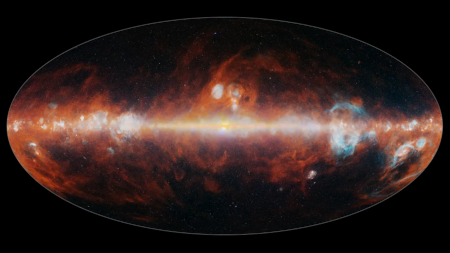
Click for original image.
Astronomers have now released the first all-sky map produced by the new infrared space telescoe Spherex, launched in March.
The map to the right covers only some of the infrared wavelengths mapped, with the stars indicated by blue, green, and white, hot hydrogen gas by blue, and cosmic dust by red. Other false color maps map the universe’s galaxies, star forming regions, and numerous other heavenly phenomenon. From the press release:
Circling Earth about 14½ times a day, SPHEREx (which stands for Spectro-Photometer for the History of the Universe, Epoch of Reionization, and Ices Explorer) travels from north to south, passing over the poles. Each day it takes about 3,600 images along one circular strip of the sky, and as the days pass and the planet moves around the Sun, SPHEREx’s field of view shifts as well. After six months, the observatory has looked out into space in every direction, capturing the entire sky in 360 degrees.
Managed by NASA’s Jet Propulsion Laboratory in Southern California, the mission began mapping the sky in May and completed its first all-sky mosaic in December. It will complete three additional all-sky scans during its two-year primary mission, and merging those maps together will increase the sensitivity of the measurements.
Spherex has a greater resolution across more infrared wavelengths than the previous wide-field infrared space telescope, WIRE. Its wide-field view also differs from Webb, which has a very small field of view to get high resolution infrared images of specific objects.

On Christmas Eve 1968 three Americans became the first humans to visit another world. What they did to celebrate was unexpected and profound, and will be remembered throughout all human history. Genesis: the Story of Apollo 8, Robert Zimmerman's classic history of humanity's first journey to another world, tells that story, and it is now available as both an ebook and an audiobook, both with a foreword by Valerie Anders and a new introduction by Robert Zimmerman.
The print edition can be purchased at Amazon or from any other book seller. If you want an autographed copy the price is $60 for the hardback and $45 for the paperback, plus $8 shipping for each. Go here for purchasing details. The ebook is available everywhere for $5.99 (before discount) at amazon, or direct from my ebook publisher, ebookit. If you buy it from ebookit you don't support the big tech companies and the author gets a bigger cut much sooner.
The audiobook is also available at all these vendors, and is also free with a 30-day trial membership to Audible.
"Not simply about one mission, [Genesis] is also the history of America's quest for the moon... Zimmerman has done a masterful job of tying disparate events together into a solid account of one of America's greatest human triumphs."--San Antonio Express-News