
Orion survives re-entry, crew splashes down safe
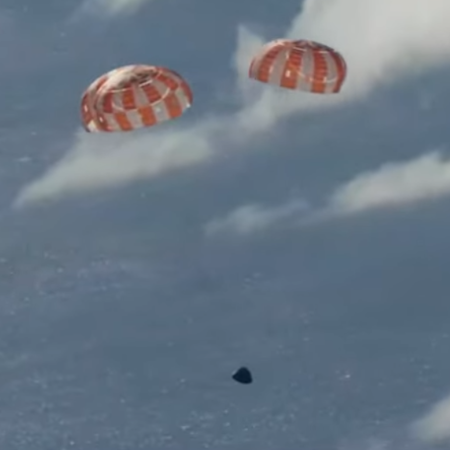
Orion just after main parachute deployment
Orion successfully survived re-entry tonight with its questionable heat shield, with the capsule splashing down off the coast of California at 8:07 pm (Eastern).
All four astronauts are healthy and safe. As of posting they were still in the capsule, floating on the ocean, with recovery crews on their way to it. [Update: those recovery crews, six boats with more than 40 people, are taking an ungodly amount of time to latch onto the capsule and begin recovery. Over an hour after splashdown the crew is still in the capsule.]
The Artemis-2 mission is now over, though the final condition of that heat shield still needs to be analyzed. In addition, engineers need figure out how to fix a bunch of other issues that took place during the mission:
- A leak in an internal helium tank on Europe’s service module
- Communication drop-outs several times
- the endless issues with Orion’s toilet
There were other minor issues that cropped up repeatedly, none significant but all of which should be fixed. And though it will be helpful to determine how this heat shield performed, it should be noted that the data is essentially irrelevant to future missions. The next mission, Artemis-3, will use a completely different design, and test it for the first time on a manned flight. That flight however will be in Earth orbit, so the stress on the shield will be far less than this return, even with the changed re-entry path.
Though many will call this lunar fly-by “historic,” it will likely be little remembered by future generations. It did little to move the settlement of the solar system forward. No truly useful engineering was tested. The rocket and capsule are engineering dead-ends. Neither will be of much use for establishing colonies on the Moon or Mars, as SLS is still too expensive and too difficult to stack and launch and Orion is too small for any interplanetary missions, being nothing more than an overweight and very expensive ascent/descent capsule.
The only plus of this mission is that it will likely give NASA’s administrator, Jared Isaacman, the political clout to institute major changes in the entire Artemis program, changes that could make the American colonization of the solar system more likely. There are strong indications that he wants to make better use of the private sector.
And that private sector is poised to bypass NASA, regardless of what NASA wants or tries to do, with capabilities far better then anything we have seen since the Apollo program.

On Christmas Eve 1968 three Americans became the first humans to visit another world. What they did to celebrate was unexpected and profound, and will be remembered throughout all human history. Genesis: the Story of Apollo 8, Robert Zimmerman's classic history of humanity's first journey to another world, tells that story, and it is now available as both an ebook and an audiobook, both with a foreword by Valerie Anders and a new introduction by Robert Zimmerman.
The print edition can be purchased at Amazon or from any other book seller. If you want an autographed copy the price is $60 for the hardback and $45 for the paperback, plus $8 shipping for each. Go here for purchasing details. The ebook is available everywhere for $5.99 (before discount) at amazon, or direct from my ebook publisher, ebookit. If you buy it from ebookit you don't support the big tech companies and the author gets a bigger cut much sooner.
The audiobook is also available at all these vendors, and is also free with a 30-day trial membership to Audible.
"Not simply about one mission, [Genesis] is also the history of America's quest for the moon... Zimmerman has done a masterful job of tying disparate events together into a solid account of one of America's greatest human triumphs."--San Antonio Express-News
This victory came just after a Raptor and Blue Origin facility both suffered explosions–but New Space brainwashing dies hard.
Now, if you MUST grouse at Uncle Sam…do folks in the Navy not know how to open a bloody door?
Something with a Higgins-boat (LCVP) slanted bow…an old LCT… something.
Has anyone in those zodiacs ever worked around buoys?
Good grief.
“The only plus of this mission is that it will likely give NASA’s administrator, Jared Isaacman, the political clout to institute major changes in the entire Artemis program, changes that could make the American colonization of the solar system more likely. ”
You understate this point, I think.
That will be huge.
All the complaints about the plan that were overpriced, impractical or just plain dead ends, are now being fixed.
Careful attention post “Ignition” showed a lot of skepticism in parts of the media and public.
This may sway a portion of that crowd,
Took some time for your new post to come up so more comments ended up on the previous thread.
I suppose the recovery procedure could be explained as keeping with the philosophy of using “known and tried” hardware and techniques but as others pointed out, it looks really clunky. Over an hour after splashdown and they are still rigging stuff to the capsule.
My memory is fuzzy about the Apollo recoveries – did it take this long?
This has to be putting more people in danger than hoisting up the capsule.
But traditions MUST be maintained… maybe Issacson can bring on some change.
BTW kinda neat that the NASA admin greeting the astronauts has been to space himself.
Navy divers do not work on buoys.
That would be the Coast Guard.
https://en.wikipedia.org/wiki/USCG_seagoing_buoy_tender
Raptors blow up all the time.
They test them to failure constantly.
BlueO, this new for them, but it is going to happen.
Happened to Rocket Lab too.
It is not brainwashing, it is progress.
Having spent sometime on vessels, a hard metal or even wood ramp against the hard shell of the vessel is a bad idea.
Vessels are fragile. And Orion is supposed to be re-usable, so ramming it with a ramp would cause damage.
RIB work boats are the way to go. They have been using inflatable boats since the beginning.
You want a new way? Dare I suggest SpaceX method of just picking it up and setting it on the deck?
Oh wait.. that is “New Space”…
” . . . Though many will call this lunar fly-by “historic,” it will likely be little remembered by future generations . . . ”
Oh, they’ll remember it all right. They’ll remember it as a massive part of a cancerous public debt they must pay. Unless the U.S. defaults first . . .
It has been 90 minutes since splashdown and they are still fumbling with the crew. And then they still need to use air rescue to be hoisted away as if from a sinking ship. I do not remember Apollo taking this long at all.
I think they put the float ring on backwards.
It looks like they have a cut out for the front porch but put it on backwards.
Did I hear them say they would collect the parachutes AFTER the door opened? Couldn’t they interfere with operations and should be the first things recovered?
And the radio problems. Drop back system was a Sat phone and that didn’t work either. Sounds like they ran all the microphones through the same system and that sub system failed.
Just looked it up the USS John P Murtha is an amphibious ship.
They just did this the hard way to look cool.
Agreed on the rocket up and the capsule back as being useless.
I suppose SpaceX and NASA can compare notes on the heat shield.
I thought the toilet was most important to this one, and life support generally. We are going to want shuttles as can get to transfer-orbits to the Moon and to Lagrange points, and to near-earth asteroids.
Let us note, it seemed Integrity was had issues with its SAR beacon as well as was unable to speak directly to the navy over both radio and sat phone. That seems like a big issue to me, and a surprising oversight. I suspect that is why they hit the two hour mark after touch down before the Astronauts were delivered to the ship (spun by NASA as great work).
We have got to develop real means of landing that don’t involve deep bodies of water. Do we have to wait until we fly a crew through space only to drown them back home? At least the bad-luck Boeing could land on land!
And they did end up “scooping” up the craft on the rear deck that is normally used to recover hovercraft.
They tied the craft off to two boats and towed it to the Murtha. No helicopter lift needed.
All the steps after splash down could have been reduced to tow it to the ship in 15 minutes and cable it up the ramp.
They do not care about the heat shield getting banged up. And they could have padded the launch recovery ramp just for this operation.
Starship is going to be even more unwieldy during any unplanned splashdowns–but big enough to bail out of, perhaps.
Apollo was the first, so it will be special. (Bryant)
Starship’s goal to be routine. (Saban)
That will not make Artemis II less special.
One of the sweetest National Championships Alabama had came during the Bryant/Saban interregnum.
Perhaps the most beloved coaches of all time was Gene Stallings…who, like Kim Peek’s father, outlived his son.
https://livebeyond.org/coach-gene-stallings-remembers-johnny-on-world-down-syndrome-day/
Normally we would lament that….but not here.
Both children were spared the shock of losing their fathers.
But I digress.
The U of A went many years between dynasties…a vast chasm between shores. The center column of the bridge was Gene’s unbeaten 1992 season, when the old hand met and defeated the young punks who played for the Miami Hurricanes.
Artemis II is a repeat of 1992….when, to quote Paul Finebaum (my favorite, “sick little hatemonger”):
“Tradition triumphed over the trash.”
Roll Tide.
Having watched from about 1 hr. before splashdown through the post-recovery press conference I must say I was not ready for the ludicrously Rube Goldbergian and vastly overmanned “recovery” process on display. As others have noted, SpaceX manages to get Dragons aboard their recovery vessels in a fraction of the time and then gets the crews out promptly – and entirely dry.
But, as Ray Van Dune also notes, this whole dropping of returning manned spacecraft into the sea thing is an anachronism that has to go. Fortunately, it will. There will be two or three more Orions and some indeterminate number of Crew and Cargo Dragons that will also get their tail feathers wet between now and the early 2030s. That’s pretty much on rails. And perhaps there will be a few additional Orions that launch on non-SLS rockets such as New Glenn. But most human spaceflight missions in the 2030s will be flown on Starships and these will be caught in mid-air upon return, then set aside – on land – for off-loading of crew and cargo in a rational and dignified manner that bears zero resemblance to a rescue from a maritime disaster.
I would suggest that most of the minor (non-life threatening) issues noted are a direct result of low flight rate. When something is done once in a great while, it is by definition not a routine with the edges smoothed out. Low flight rate being a result of the cost of course.
For a once in a while thing, I don’t see the problem with overmanning the recovery. I see it as a variation on the crowded control rooms cheering on a unique flight. For routine operations though, it is critical to hold the manpower used, and thus costs, to a minimum.
A couple of decades back i had a bonus system in my company. There was a dollar amount for each job that was added up over the month per crew. Then the wages of that crew were added up. Half of the difference went to monthly bonuses. The crews figured out that deadweight employees were costing them money and got rid of them. They also developed better procedures and demanded better tools at times. Over a couple of years time the company became focused and very profitable. The recession hit with work stopped and payments high. Went broke. During those years though, I witnessed what motivated teams can do. I think that sort of motivation is the difference between the slick recoveries some expect and the mob scene under discussion here.
Chiming in. Glad they are home safe. Heckuva mission!
Wish I could have followed along with a sequence of events timeline rather than that interactive cartoon at NASA dot gov. We’re all space junkies, we can deal with some technical content.
Dick E has a great description, calling it Rube G-ian. The machinations of that recovery was bizarre, to my sense. A parade of decadent excess ending on the USS John Murtha. The name of that ship a wry punctuation point.
Jared Isaacman has promised a lot more transparency. One way to make good on that would be a prompt release, with absolute minimum ITAR redaction, of the complete report done on the heat shield.
I think having another independent review team get full access to the shield and all the data on it wouldn’t hurt, either.
We shouldn’t have to wait for a NASA OIG report to find out about any of this.
“We have got to develop real means of landing that don’t involve deep bodies of water.”
Starship’s got an answer for you on that!
“As others have noted, SpaceX manages to get Dragons aboard their recovery vessels in a fraction of the time and then gets the crews out promptly – and entirely dry.”
SpaceX is just naturally more efficient at * everything*, of course, but it certainly helps when you’re doing a recovery 5 to 6 times per year instead of once every 3 to 4 years.
I never expected perfection from this flight. But expect better.
The toilet issues. Well that could have been better.
Computer issues. Could have been better.
Radio issues. Not too bad but ended up getting worse as the mission went on.
The whole after splashdown act needed to be practiced a LOT more. Both dry on land and wet in the open ocean.
I watched the navy personnel assembling the float ring. Why are they doing that? It should have been fully assembled long before that day, more than likely either on a full size mach up or on the actual capsule. And instead of a rope “net” around the edge of the ring make a full canvass floor and let the divers pull the ring under the craft. inflate the first side and then inflate the back side. Designed right and it will tighten up around the craft with its own air pressure. And you could still use cinch straps to tighten it up more.
And if you still need to get the people out first just use a flat nosed boat instead of that stupid front porch idea.
As for the passengers needing to get into a new harness to be lifted up to the helicopter. Just add a lift hook to the space suits. Either one each shoulder of on the front or back. They could be straps/cloth.
I completely agree with Dick E. and loved the Rube Goldberg description of the recovery. It’s not surprising the US Navy uses as many people as possible because it’s basically a training opportunity for them and their recruits. If we weren’t in the middle if a shooting war, they’d probably be using a supercarrier like they did in the 60s and 70s. Maybe a bit harsh, but on further reflection, the whole program, heck, much of NASA, is a Rube Goldberg operation. My apologies to the few productive engineers and researchers still there, but there is (still, even after DOGE’s downsizing) so much bloat, DEI employees, and deadweights. In other words, it’s a typical government bureaucracy. The SLS rocket and Orion capsule are design-by-committee throwbacks that are carefully and glacially produced by contractors who are incentivized to go as slow as possible to maximize their cost-plus profit. All paid by US taxpayers and their progeny.
The sooner we leave chemical rockets (a proven technology) to the private sector and revert and downsize NASA to their NACA pure research function, the faster the USA will be able to manifest our destiny in space.
Concerned wrote: “Maybe a bit harsh, but on further reflection, the whole program, heck, much of NASA, is a Rube Goldberg operation.“*
Much of aerospace is Rube Goldbergian, because the industry is very conservative and keeps the Goldbergian methods and hardware that they managed to get to work before.
We have seen several NewSpace companies move away from the traditional ways and try out improvements. The clearest example of a success is Raptor 3, which was so radical that the rocket engine industry thought that it was not a completed engine, that it was displayed in a partially built configuration. The clearest example of a failure was the flat concrete pad used for Starship’s integrated flight test 1. The test may have been integrated, but the pad disintegrated.
NASA, like the rest of aerospace, keeps what works and builds upon it, which results in these Rube Goldberg methods and hardware. It is the result of the most fundamental engineering philosophy: if it works, don’t fix it.
Fortunately for us, businessmen have figured out that if it is too expensive, then it doesn’t work and needs fixing.
_________
* Another hat tip to Dick Eagleson for the analogy
I am glad to see the interest
https://phys.org/news/2026-04-howl-moon-nasa-boost-space.html
The junior-league Adam Savage in the space-suit has itself inspired hope that kids are looking up from screens
“People are wanting to reach out to their inner rocket nerds,” Scoville said. “This is just a glimpse of what’s to come.”
After the parachutes were deployed and the capsule was descending, during the infrared views you could see what looked to be gas discharges from the capsule near where the parachute lines were attached. Was this a fuel dump? Or were attitude rockets still being fired?
Bill Mullins, curious about that too.
And, there is a photo on NSF showing [possible] heat shield damage.
https://forum.nasaspaceflight.com/index.php?topic=58223.msg2779108#msg2779108
Patrick Underwood,
Damn! That’s quite the divot there. If I ever plowed up one that large with a 5-iron I’d never be allowed back in the country club.
Patrick Underwood & Bill Mullins,
I saw that too. I figured it was venting of residual thruster propellant. I was wrong. There was a question about that asked at the post-splashdown press conference. The NASAn who answered said is was the Reaction Control System (RCS) thrusters firing. Apparently there was a need to change the capsule’s orientation even under chutes. I don’t remember the exact reason given.
Strikes me as a tad risky to be lighting off thrusters that close to chute rigging, but the atmosphere does limit the plume spread quite a bit at that low altitude. Adequate design margin I guess. Considering all of the other bits of marginal engineering on Orion I suppose this might not even make the Top Ten.
Richard M – “Starship’s got an answer for you on that.”
I don’t believe that large transport ships like Starship should land (or launch) with crew. Repeatedly lifting the living supplies and accommodations for a crew through the gravity well of Earth is a waste – once such a ship is in orbit it should remain in orbit, and crew should be ferried up and down via capsule, or even better a “Dream Chaser XL” that could be launched by a medium-lift booster and land at any jet-compatible airport.
While we still use have to use capsules, we need to at least use airbags to land on land, and eventually perhaps retros, such as Dragon now uses for emergency backup to failed parachutes. It should be the parachutes that are the backups!
The Mechazilla arms are great for rapid turnaround tankers and freighters, but launch human transports only once, and then use them purely in space until they are scrapped.
My $0.02.
The choppers doing a John Landis was my big worry.
You know how the universe works. Everyone sweats the re-entry….that and splashdown goes fine—then it is Vic Morrow city Johnson…FINAL DESTINATION style.
Some thoughts on a capsule recovery craft:
https://www.therpf.com/forums/threads/1-40-nasa-orion-capsule-aluminium-model.365926/#post-5714324
No divers, no choppers.
Dragon is small enough you can just hork it up and over.
Orion looked like the Jupiter 2 out there in the drink.
It is going to have tankage tweaked anyhow.
Bill/Patrick: They made a callout regarding something about hypergolics shortly before that venting began, so my assumption is that it was an attempt to empty the RCS tanks so that they wouldn’t be a possible safety hazard to the sailors and crew after splashdown.
Dick Eagleson, I hope it’s NOT a divot! In any case, it’s still a Schrodinger’s divot…
Ray van Dune
“Dream Chaser XL”
Didn’t we have something like that previously? They were awfully expensive.
Jeff: I had other comments, but instead will simply say the Vic Morrow reference is very poor taste.
Orion:
Launch mass 22,900 lbs (10,400 kg)
Dry mass 20,500 lbs (9,300 kg)
Dragon 2
Launch mass 27,600 lbs (12,500 kg)
Dry mass 16,976 lbs (7,700 kg )
I assume that the downmass will always be less than launch mass.
(Source is the always reliable and never wrong wikipedia, so take with salt, one or two grains should do).
Based on these numbers, I do not see why a suitably equipped Ocean Support Vessel (OSV), similar to what SpaceX uses, could not do the job of lifting the Orion capsule from the sea.
SpaceX also uses a Rigid Inflatable Boat (RIB) work boat and divers.
I understand why Apollo relied on the Navy aircraft carriers. I think today even an LPD is overkill.
I wonder if the cost to the Navy comes out of the NASA budget for this operation.
It wasn’t meant to be flippant.
Once, I saw an individual stranded on the side of the road.
Out comes my jumper cables.
The individual waves—off he goes.
My car goes dead and won’t start.
My worst encounters with bad luck often happen when I am trying to do something nice.
I know how this bloody planet works.
Ray Van Dune,
That’s an odd belief anent large spacecraft and passenger lift. We don’t do that sort of thing for any other large mode of transport. People get directly aboard large aircraft or cruise ships, settle in, then the vehicle takes them where they need to go. We don’t leave the big airliners out on some distant hardstand and run everyone out to it three or four at a time in golf carts. Analogously, we don’t leave cruise ships anchored just outside the 12-mile limit and send the ticketholders out a few at a time in Zodiacs.
Capsules are a hopelessly inefficient means of sending up large numbers of space travelers with a common destination. The accommodations and life support supplies have to get into space somehow. The most efficient way to do that is to send them up along with the people who will be consuming them on the same vehicle.
If you want to send, say, 100 people to the Moon, one Starship is a much more efficient way to go than 25 4-place capsules sent up once the empty Starship is waiting in orbit. There is no way anyone is going to salvo fire, say 25 Falcon 9s at once – not enough pads and nowhere to build them. Launch cadence is going to be challenging even for large vehicles that carry a lot on each launch. And if you send the capsules up serially, it’s going to take days between the first and last of them. Meanwhile, early arrivals in orbit are needing a lot more of that supply mass you are so worried about while they’re cooling their heels waiting for the last four Tail-End Charlies to show up.
Not to put too fine a point on it, but this is just nuts.
There’s been a lot of buzz online about what looks like a large discolored patch visible on the edge of the Orion heat shield in imagery of the capsule being hoisted out of the water.
Jared Isaacman posted a comment on X about 6 hours ago to address it. Pleased to see him reiterate that he wants to make the results of the heat shield examination public; but let’s see what happens.
https://x.com/i/status/2043172376167256396
From what I understand, they are going back to what the Orion atop the D-IV used anyway, so any investigation, being moot, will be interpreted as Jared just trying to score points via pouring cold water on everything….hoping everyone will conveniently forget that he signed off on this too.
He is thus like the bat from Aesop who would up being ostracized by birds and beasts alike in their war.
Only Fetterman seems be be able to walk that tightrope.
Old Space has no use Jared, and NewSpacers are mad he didn’t just kill Arty so as deny OldSpace to beat them on the field. Helium is the real worry again. Fussing about the TPS with everyone safe on the ground looks petty.
When the D-IV upper stage separated, I expected the ice.
The service module looked a bit more like it was spewing a little something.
“Dream Chaser XL” – Didn’t we have something like that previously? They were awfully expensive.
—-
No, the Shuttle is an example of what I’m arguing AGAINST – hauling a whole living space up and down to and from space.
Dream Chaser XL would be a ferry, so it could haul (say) 10 humans, but only on short runs to / from orbit. In effect a capsule, but able to land on a runway.
Starship is too big to use for everything, so sooner or later, SpaceX is going to have to replace Falcon 9 with a Raptor-powered something to haul a DC-XL, or as my Copilot dubbed it, a “737 to Orbit”. Boeing need not apply, however.
Interestingly, the nominal max seating capacity of STS and Dragon is the same – 7.
Jeff Wright,
No. ‘Bearing NewSpace’ on the field isn’t the point. It’s not even in the same city, to use your metaphor. Killing the SLS isn’t about winning or scoring points, it’s about what is best for the United States over the long term. If we want to be a spacefaring power, not just timidly put our toes into the vast ocean of space, it is paramount that we have cheap, rapid, full reuse as quickly as possible. Our saving grace here is that we are not dependent upon the state, and the American people will develop space no matter how the government is held back by small-minded greed.
Jeff,
In fact, the heat shield which will be employed on Artemis III is *not* exactly the same as the one used in the 2014 test flight. But in any event, that doesn’t mean that there aren’t useful lessons to be learned from how the heat shield on Artemis II fared. It also does not mean, with respect, that it is not important for NASA to start being more transparent about these things.
Nate,
“Killing the SLS isn’t about winning or scoring points, it’s about what is best for the United States over the long term.”
Exactly!
I don’t know that killing SLS is best for America…you just have this religion that the success of Artemis II questioned.
Yes, it was an elaborate production to recover the capsule…but maybe that IS the point….involving so many that spaceflight builds a constituency. Don’t be so quick to call it deadwood. Nate thinks Starship will employ yet more folks–but this isn’t the early 20th Century.
Nate and others got into it over this book at Secret Projects Forum:
https://reactormag.com/the-tech-billionaires-who-want-to-pave-over-the-universe-adam-beckers-more-everything-forever/
Now, you can’t make another person feel what you want them to. SLS, like weapons programs like F-35, IMMEDIATELY employ/ involve individuals such that the jobs silence critics who might be more likely to kill it otherwise.
From a purely economic perspective, all NASA needs to be in Florida. It would be more lean.
And it would be political suicide.
Heck, if Teslabots were now as good as the robots of science fiction, and could build Starships even cheaper–I think ever MORE people would be hostile.
The Moon is close enough for autonomy to come more quickly. I think Elon understands this now. Get a Moonbase running on its own, then you can do what you want up there and no one can bother you.
Bread and circuses do work to stave off revolutions–which rely on idle hands. Get automation off world first, where it cannot be sabotaged.
You are going to have to accept Make-Work at some point just to keep the masses involved rather than be more openly hostile.
Nate doesn’t have the maturity to understand that–but I think some of you do.
Jeff, there is no world where the SLS will be able to manage even five, let alone dozens or hundreds, of flights in a year. To build anything grand in space will take many more launches than that.
The private sector already employs more than ten times NASA’s workforce. Hundreds of new companies have been started since 2016. What about Starship? I think you’re confusing me with someone else. I’ve never said that.
What?
NASA does not need to design and build its own rockets, and critics of the program rarely criticize total employment so much as they criticize how those people’s talents are being thrown away.
From a purely economic perspective NASA shouldn’t exist except as R&D labs akin to the NACA.
But they don’t. They waste resources that could be used for real growth that positively impacts people’s lives, instead of trying to buy them off. Automation in some form has been going on for centuries, and has resulted in better lives than bread and circuses.
The average person on the street doesn’t care all that much. They’re not going to be hostile. I think you’re conflating hostility towards Elon Musk from the political left with hostility to spaceflight from the entire country. That’s far too broad a brush, and weakens your argument.
Ray Van Dune wrote: “I don’t believe that large transport ships like Starship should land (or launch) with crew. Repeatedly lifting the living supplies and accommodations for a crew through the gravity well of Earth is a waste – once such a ship is in orbit it should remain in orbit, and crew should be ferried up and down via capsule, or even better a ‘Dream Chaser XL’ that could be launched by a medium-lift booster and land at any jet-compatible airport.”
Short term, we have what we have. Long term, the industry will figure out how to do transportation efficiently. We have seen that the governments won’t but that industry will, because efficiency matters to the businessmen of the world. We had let government run space for more than half a century, and we didn’t get what We the People thought we were paying for. Now We are running space our own way, and we are beginning to get what investors are paying for and what the rest of us had wanted all along.
“… the Shuttle is an example of what I’m arguing AGAINST”
I envision your argument to be more like the Pan Am shuttle and the spherical ship to the Moon in the movie 2001: A Space Odyssey.
__________
Dick Eagleson wrote: “We don’t leave the big airliners out on some distant hardstand and run everyone out to it three or four at a time in golf carts. Analogously, we don’t leave cruise ships anchored just outside the 12-mile limit and send the ticketholders out a few at a time in Zodiacs.”
We kind of do, sometimes. Some airports park the jetliners out on the tarmac and shuttle the passengers in two or three large vehicles that are a cross between a bus and a jetway. Some ports have had their ocean liners anchor in the bay and shuttle passengers in boats (the passenger pickup at Cherbourg in the movie Titanic, for example).
__________
Richard M wrote: “There’s been a lot of buzz online about what looks like a large discolored patch visible on the edge of the Orion heat shield in imagery of the capsule being hoisted out of the water.”
It is still early to be discussing that discoloration, because it could be a variety of things, and we all see what we want to see in its existence. For me, it is obvious that a space alien had tried to catch a ride back to Earth and ended up as that smudge on the heat shield. Poor space alien. He didn’t realize that we are so primitive that we still use aerobraking for our atmospheric entries.
__________
Jeff Wright wrote: “Fussing about the TPS with everyone safe on the ground looks petty.”
It may look that way, but the reason they flew despite the public’s concerns is that NASA is still willing to take the same unnecessary chances that it took with Challenger and Columbia. There were serious problems with the Space Shuttle that NASA was not adequately addressing, and now there was a serious problem with Orion that NASA chose to address only after taking this risk. Was this risk 1 in 25, like with Challenger, or was it 1 in 100, like with Columbia? We don’t know, but clearly the risk for this heat shield was greater than necessary. NASA culture needs to change to one of more safety.
Can it do that? Political pressure has become another aspect that NASA has had to navigate in the past 12 months. Congress put much pressure on Issacman to get humans to the Moon before the Chinese do. He can now say that we are underway, but would it have been worth the loss of the crew if things had gone badly during reentry?
“The Moon is close enough for autonomy to come more quickly. I think Elon understands this now.”
Musk is not interested in the Moon as a test site for Mars. He is interested in it as a means to his intended ends, because he can make a lunar base profitable sooner. He has accepted that he has yet another two year delay on his Mars plans. Not only will Starlink finance Mars but so will his lunar AI plans.
__________
Nate P wrote: “NASA does not need to design and build its own rockets, and critics of the program rarely criticize total employment so much as they criticize how those people’s talents are being thrown away.”
For years I have criticized the waste of NASA’s employees’ talents, skills, and knowledge. Marshall Space Flight Center is a classic example of people who could have built better rockets over the past many decades, yet they were never given that task. Now we have to wonder whether they still have that ability.
Still soaking it in. 14 years old when Apollo 8 went in orbit around the moon. 18 years old when Apollo 17 launched for the moon. 72 years old when Artemis could, just barely, loop around the moon. I wonder how old I’ll be when we finally go back to the moon?
Like a life, there is always the question of what I/ we could have done differently in those 54 years. Still proud that we finally put together a hodgepodge of hardware created by corporate welfare and political graft into an actual trip somewhere in space. How much more could we do if we actually had goals?
Nate P observation is spot on. If we could do it privately rather than in these political log rolling efforts, I wonder how far and how fast we could go?
Jeff Wright – You seem not to like Starship. OK. Pick any other new space project. But if we are really going to move out in the space, it won’t be riding on top of SLS. Let’s use these last ones up to keep going but let’s not enshrine them into an eternal political log rolling process.
Regarding landing operations. Scott Manley X post says that he timed the various operations of Orion and Crew Dragon, regarding capsule on ship and crew out of capsule. Overall time difference was Orion was 5 minutes slower. Crew Dragon initially planned land landing but NASA didn’t like last minute propulsive burn. Starliner lands on land with heatshield popping off and air bag deploying; requiring a new heatshield each time.
All the landings are getting pretty accurate. Amit Kshatriya said Orion landed within a mile of aim point. Lake Conroe, outside Houston is about 32 square miles. Don’t like that idea?
Texas can always use another lake. Grok says, Orion plunges 5 to 15 feet deep into the ocean on landing. How about the Army Corps of Engineers dredge a new lake 30 feet deep and 10 square miles? Ride out in a motorboat, tow the capsule into the pier, let the astronauts step out onto the pier. Don’t like Texas? Do it in Florida but watch out for alligators.
Like to see a dozen person outpost on the moon before I go.
eff Wright
April 12, 2026 at 11:48 am
“””””You are going to have to accept Make-Work at some point just to keep the masses involved rather than be more openly hostile.”””””
That is a level of EVIL that should never be tolerated. Lying to people about their value is wrong to a level that cannot be overstated. Tying them to a useless job instead of allowing them freedom to do something worthwhile is a form of slavery.
It is not my place to figure out how to utilize people unless it is my company. People need to take responsibility for making something of their own lives. Part of that can be eliminating barriers to them moving forward. Every homeless you see is partly that way because it is illegal to pay them what they are worth or to create profitable housing suitable for their needs.
I am not an engineer so take the below with a grain of salt….
It would be non-trivial to modify dragon to allow reentry from a trip from lunar orbit. It would essentially be a new design. Dragon is designed to handle the heat and structural loads from low earth orbit only. Luner or interplanetary return adds much more speed.
It would also be non-trivial to redesign other hardware to break into earth orbit, in a reasonable timeframe, after returning from the moon. The reason uncrewed spacecraft can do things like aero braking with little aerodynamic stress is because they can take months or years, lowering the orbit gradually. People need more speed. If you want to break into a Dragon accessible orbit fast, you need to ride in something with an aeroshell and a beefed up structure. Or you can take a ton of extra propellant to do so propulsively. These things add mass and take time.
Starship cannot carry people to orbit and back in the way Orion does. It is a launch vehicle with some work on a lander that shares some commonality with it. It is close to being able to replace SLS, but not Orion.
These things being facts, we are stuck with Orion for a long time. The alternatives all involve clean sheet or near-clean sheet designs. SLS is another matter. Hopefully, it will be in 5 years or less, and good riddance.
Agreed. I’ve always been of the opinion that any effort large enough to actually do something on either the Moon or Mars would support activities on the other, and then many more locations besides. Setting up industry on the Moon, building a mass driver, and likely enabling more science on and around the Moon will also benefit SpaceX’s efforts at recruiting talented personnel, invigorating the public, and deflecting criticism.
I’m not sure that they’ve ever been any good at building rockets, once the original NASA workforce largely departed at the end of Apollo. They certainly aren’t doing it now, I know for a fact many of them are still angry they didn’t get to build Ares V.
Yes, and you’re essentially telling them they’re so useless that they can’t contribute in any meaningful way. That is incredibly insulting.
Richard M,
Thanks for the Isaacman link. Good to know God didn’t bury an iron shot off of Orion’s backside. The detailed analysis of the Artemis 2 heat shield should be interesting.
Jeff Wright,
No, the heat shields for upcoming Orions will not be the EFT-1 monolithic design.
There will be an analysis of Artemis 2’s heat shield because at least three more Orions are slated to fly and two of them will be coming back at the same near-Earth-escape velocity as Artemis 2. This is not “petty,” it is necessary prudence. Nor is it Isaacman “pouring cold water” on anything. He has reserved that for things that need it. In the tweet linked by Richard M, Isaacman is, in fact, sticking up for the Artemis 2 heat shield
There will also be investigation and re-engineering of the various radio failures, the toilet low comedy and the helium leak on the European Service Module. The reason all of these things showed up on Artemis 2 is because SLS-Orion is too expensive and production-limited to allow for a proper test campaign in advance of actual crewed missions if we still want to Beat the Chinese[tm]. We’ve explained all of this to you innumerable times and you persist in failing to acknowledge any of it.
Has Fetterman ever said anything about Artemis? I must have missed that.
OldSpace, whether it has any “use” for Isaacman or not, no longer has a willing stooge in the Administrator’s chair. The program is no longer being run exclusively for the financial benefit of the legacy dinosaurs and their NASA-insider sycophants.
NewSpace is, for the most part, delighted with Isaacman. He’s already killed, skinned and hung the hides of Exploration Upper Stage, Gateway and Mobile Launcher 2 up to dry on the barn door and more such killings and skinnings are now on rails for future execution. NewSpace is content to await these in their turn while getting even busier on their successors.
There is also no scheme to “kill Arty so as deny OldSpace to beat them on the field.” The field is now exclusively the lunar surface – a field OldSpace was never going to reach in any case. Far from “killing Arty,” Isaacman is jacking up its radiator cap and driving a brand new car underneath by way of comprehensive repair.
The one with the “religion” is you. You are convinced SLS is the wave of the future when that is physically impossible. You simultaneously dismiss the utility of everything that will make a bright and expansive human future in space possible. The “success” of Artemis 2 was limited. It particular, it does not serve as a model for future lunar spacefaring of any great scale or consequence. That awaits the not-so-distant arrival of entirely new vehicles already well along in development.
“Yes, it was an elaborate production to recover the capsule.”
Hoo, boy, was it! As with MSFC and legacy contractors, though, there is no need for makework “jobs” that contribute nothing real to settling the cosmos. Fortunately, most of those involved in the laughably overstaffed Artemis 2 recovery operation were military folks who have very real jobs when they are not fishing Orions out of the water on a decidedly infrequent basis.
This, in any event, isn’t the way to build a constituency. And “constituencies” are only important for government programs. Artemis missions will continue to be a government program, but non-Artemis lunar missions will quickly outnumber them. The vastly greater number and frequency of the latter will certainly employ more people in both production and operations even if Elon’s Optimus robots start showing up in numbers at Starbase and KSC-Canaveral. And the general public will like what they see – especially when none of their tax money is involved. Pro sports, for example, have large “constituencies” even though much of their infrastructure is taxpayer-supported. One reason for this is because sportsball leagues play a lot of games – many per week during their seasons. Non-governmental lunar and Mars missions will reach such frequency too, but not based on one-and-done rocketry at $4 billion a pop.
“Nate and others got into it over this book at Secret Projects Forum:”
I’m sure they did. Mr. Becker and his admirers are neo-Luddites attacking any vision of the future that dares to do without their hoped-for socialist utopia. They are, in essence, adherents of a failed secular religion that has been demonstrated repeatedly not to lead to a promised land but to Hell on Earth attacking those they accuse of being acolytes of another false secular religion but are, in fact, those who can, and will, build a real future of abundance.
I gather that your sympathies are with the Luddite anti-futurists. Quel surprise.
Using the F-35 – which you usually excoriate – as a positive example of politically effective makework ignores the fact that all weapons production by legacy contractors has been in a condition of profound dysfunction and decadence for decades. Fortunately, there are NewDef entrepreneurs now able to blow past the lumbering dinosaurs of aerospace. It isn’t just space that’s going to see a major reformation in fairly short order. The embarrassments of the Iran War have revealed the gaping holes in current defense weapons development and production practicum. Next come the wholesale reforms.
“Now, you can’t make another person feel what you want them to.”
True. All you can do is try to marginalize those with obdurate, but defective, beliefs so that they are unable to cause more damage. Eternal vigilance and all that.
“Bread and circuses do work to stave off revolutions.”
Not for very long. Space settlement is, in any case, the opposite of bread and circuses. Automation that works in the average person’s favor isn’t going to be sabotaged – except by Marxists who require scarcity as a rallying point. They haven’t had much luck getting away with “sabotage” of Tesla vehicles given their always-on cameras. Optimus bots will be similarly equipped.
“You are going to have to accept Make-Work at some point just to keep the masses involved rather than be more openly hostile.”
That claim has been made at every point since the earliest days of the Industrial Revolution. It wasn’t true then and isn’t now.
“Nate doesn’t have the maturity to understand that.”
Nate doesn’t have the gullibility and lack of imagination to fall for that. There – fixed it for you.
Ray Van Dune,
If Starship costs a user about the same as a Falcon 9, then it won’t matter whether or not Starship is “too big.” Among other things, Starship will be able to support vastly more rideshare clients on a single mission than a Falcon 9 and the Transporter and Bandwagon missions have no problem attracting customers even now.
For human transport, a transit bus-type rideshare arrangement would allow flying many passengers on one mission and dropping them off, a few at a time, at small orbital destinations. The more of the latter that exist, the better the economics become. Launch slots at spaceports will be a comparatively scarce resource before long. Economics will favor combining missions where feasible. Doing several launches of a few people at a time will be squeezed out in favor of single launches of a transit bus-rideshare service.
Edward,
There’s only one airport I know of that ever did what you describe – Dulles outside Washington, DC when it was first built in the 1960s. I believe those combo bus-and-jetway thingies were retired decades ago in favor of actual jetways at conventional boarding gates.
Anent the Titanic at Cherbourg, perhaps there were no docks at Cherbourg in 1912 large enough to berth Titanic. In any case, the passengers boarded there were just a “topping off” of Titanic’s passenger manifest. Most of its passengers were already aboard having walked up gangways at Southampton to board.
Also, we don’t have to wonder whether the MSFC workforce any longer has what it takes to design good rockets. The answer is pretty obviously ‘No.’
Doubting Thomas,
I haven’t watched that particular Scott Manley episode yet so I don’t know what he was measuring. But, on SpaceX Dragon recoveries, the crew are standing on the ship’s deck as soon as they emerge from the capsule – feet dry. For the Artemis 2 crew, there was an additional hour-plus of pointless nonsense involving that kiddie-pool “front porch” thingy and then undignified hoistings into helos, being subjected to copious sea spray and rotor wash the entire time. Ridiculous and completely unnecessary.
Your idea about splashing down future capsules in artificial lakes of modest size is an interesting one, but probably not worth the doing as splashable capsules will be joining spy-sat film capsules captured mid-air by Flying Boxcars in the annals of obsolete space vehicle recovery technologies in only a few more years’ time.
Cloudy,
Dragon 2 was designed to not only be capable of a lunar-return-speed re-entry, but even a Mars-return-speed re-entry. The main change needed was a thicker heat shield.
Starship not only can, but will take people to the Moon and Mars and bring them back like Orion – a straight shot in at terminal speed. At the moment, all that is missing is a specific version of Starship set up to haul crews – very large crews before long – into space directly from Earth’s surface and return them from Earth-orbital, lunar or Mars distances at the corresponding entry speeds. For Mars, this has been the goal from the start of the Starship program. Even for the Moon there was the Dear Moon-class Starship. Both were deferred until basic Starship development work was complete, but that time is now approaching. We should see a Dear Moon- class Starship by 2028 or 2029 in an Earth-orbital test and by 2029 or 2030 for Artemis 6 and beyond plus innumerable SpaceX-only missions to support Elon’s lunar industrialization plans.
So we are most definitely not stuck with Orion for much longer unless Blue Origin wants to take over flying it on New Glenn. Personally, I think Blue would be better off building something mini-Starship-y that is both of a larger scale and with a far longer useful future than dead-end Orion.
The idea that killing SLS results in sunshine is no different than Bernie wanting to stick a fork in Elon. (Gates he can have).
Starship is the inverse of Falcon….instead of just going the logging truck route with extant cores, he has a much harder road.
For years, Left and Right have used the we’ll do our project by killing yours….and that kind of thinking was what kept us from the Moon. Artemis worked in spite of folks doing their best to kill it. For once, look at Artemis as an American victory.
“We don’t leave the big airliners out on some distant hardstand and run everyone out to it three or four at a time in golf carts. Analogously, we don’t leave cruise ships anchored just outside the 12-mile limit and send the ticketholders out a few at a time in Zodiacs.”
1. Flying into Frankfurt, you have better-than-even odds of parking out on the tarmac and taking buses to the terminal building. To a lesser extent this is also true of Amsterdam. Another commenter mentioned Dulles’ outlier of a regrettable experimental technology.
2. Cruise ship lifeboats tender passengers every day into ports of call with too-small docking facilities. But tendering is slow, difficult for elderly passengers, and not done at all with luggage (save for the occasional crew performer shuttling between ships visiting the same port).
2a. OTOH, I have seen tugs deliver late-arriving bags to a departing cruise ship and was thankful it wasn’t any of *my* luggage being thrown across the gap between ship and tug!
Dick Eagleson, good stuff! Richard M, Nate P etc.
Dick, you said “For the Artemis 2 crew, there was an additional hour-plus of pointless nonsense involving that kiddie-pool “front porch” thingy and then undignified hoistings into helos, being subjected to copious sea spray and rotor wash the entire time. Ridiculous and completely unnecessary.”
I did my stuff over on NSF, but would to pile some of that onto your excellent analysis. That recovery drama was not only ridiculous and unnecessary, it was positively dangerous (not to mention hugely expensive). I’m a (has-been) pilot and morbidly keen follower of NTSB reports. Any time you leave the Earth, you’re at greater risk than if you’d stayed put. Same, if not quite as acute, for maritime operations. NASA and the Navy put dozens of people, including the Integrity crew, at mortal risk for absolutely no gain whatsoever. Anyone who saw photos of the capsule sitting peacefully on the dry well deck can understand that. It was actually maddening to watch.
Personally I’m convinced Isaacman feels the same way and isn’t going to allow the same show for subsequent flights.
Jeff Wright,
Let me throw this analogy from Chris Hadfield at you. You can either be a -1, 0, or 1, from a detractor to neutral to contributor. When it comes to moving Americans into the cosmos in a big way, the SLS is at -1. It can never be anything else. When it comes to industrializing space, the SLS is a -1. People like myself don’t write this out of blind tribalism. Rudimentary number-crunching is sufficient to show why the SLS is a holistic failure even if it has individual successes. To use a military analogy, it may win battles, but it’s already lost the war.
I expect all of this will wash over you and is probably wasted-as Dick Eagleson pointed out, you refuse to acknowledge others no matter how polite, reasoned, etc. they are-but it will at least be worth something for any lurkers here.
This shows no awareness of the difficult part and how clustering F9 cores would do nothing to address Starship’s challenges, which will exist for all LVs that intend to recover the second stage. Multiple peolle have already explained to you why clustering is a nonstarter.
Given that we knew before the SLS was created by Congress how to surpass its capabilities, it’s a much stronger argument to say that SLS spending has kept us from the Moon. No matter how often you conflate the SLS and Artemis, Artemis will outlast the SLS, and itself be surpassed by far larger, more ambitious, and more interesting private efforts. Last, you cannot claim that the SLS is a victory for Alabama over NewSpace, and then also claim it’s a victory for the United States. It’s one or the other.
Let’s hope not. Total amateur hour there.
Four helicopters flying around for camera shots. No that is not dangerous at all
6 Boats bouncing into each other, pretty safe.
40 fat NASA guys standing in those boats. safe.
Jeff Wright wrote: “Fussing about the TPS with everyone safe on the ground looks petty.”
Isn’t this the exact attitude that a few months ago Robert Zimmerman had worried would happen if Orion survived reentry? Robert’s premonition has come true. It turned out OK, so there wasn’t a risk after all? The false conclusion that it is acceptable to take risks that would have resulted in Congressional investigations and recriminations, because most of the time it turns out OK.
craig,
I flew in and out of Frankfurt more than once during the two years I worked in Western Europe nearly 50 years ago in the late 1970s. I honestly have no recollection of the mechanics of boarding or de-planing. Perhaps things were also then as you say they are now. Wouldn’t surprise me. It’s not an efficient thing to do in any case and that was my point.
Amsterdam I also went to and from more than once, but by train from Brussels so I never flew in or out of Schipol. With South Moluccans hijacking trains in those days I might have been safer going by plane even with inefficient ground procedures. Perhaps I just lucked out on the train travel.
Was not aware of that “lightering” business with cruise ship passengers in minor ports. One more reason – besides my intestinal health and that of my luggage – to be glad I never took a cruise anywhere I guess. Can’t say I’m any particular student of cruise ship operations, but my familiarity with same is strictly incidental at the Ports of Los Angeles and Long Beach and there is none of that lightering stuff in those places. Everyone boards and disembarks via gangways. That appears to be true at Port Canaveral too.
Patrick Underwood,
Thanks for the kind words and the concurrence. I, too, hope Jared sees to it that there is no repeat of that recovery clownshow going forward.
Dick Eagleson
“It’s not an efficient thing to do in any case and that was my point.”
True. But I think the counterpoint is that sometimes solutions come before the efficiency can be weaved into the system. They may be temporary until the efficiency works its way in (how long does it take to build the first pier in a new port?), or they may be permanent due to other factors. Shallow waters may make long piers difficult to manage, so lightering (if we can en-verb-ulate a noun) becomes the solution that is more efficient in those cases. Bussing passengers to their airplanes made the terminal more efficient, and no need to push-back the airplanes, but this created other costs.
Edward,
The standard for passenger boarding/deplaning in the propeller-driven airliner era was for the aircraft to pull up near a terminal door and park so that it didn’t need to be backed up when passengers were all aboard and the engines were restarted. Passengers would cross the tarmac on foot and climb an external air-stair that was wheeled up to the aircraft boarding door and wheeled away once everyone was inside. I did this sort of thing many times as a child or tween when flying DC-3s, Super Connies and other pre-jet airliners in the mid-to-late 1950s and early 1960s. For a DC-3 at a podunk city airport like the one in my hometown this was a passable approach even in rainy weather – though not pleasant. At bigger airports with bigger airliners, the distance from the terminal exits to the air-stairs was longer and less pleasant in inclement weather. I think the bus thing might have been a way to minimize surface perambulating by passengers.
Then jetways and tugs were invented and one no longer had to subject oneself to the elements at all in order to board or exit an aircraft. Passenger loading and deplaning also got quicker. The advent of widebody jets rendered anything but the jetway approach completely unworkable.