
Blue Origin to reuse first stage on next New Glenn flight
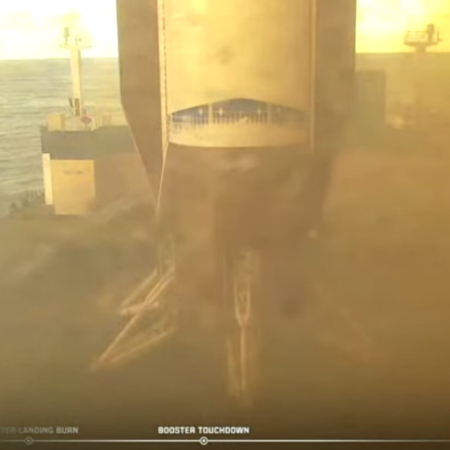
The New Glenn first stage after landing
in November.
In a sign that Blue Origin’s CEO David Limp is beginning to reshape the previously slow culture of the company, it announced yesterday that its next New Glenn launch, set for no earlier than late Feburary, will reuse the first stage that the company successfully landed on the last New Glenn flight in November 2025.
If this launch takes place as scheduled, it will mean Blue Origin was also able to inspect, refurbish as necessary, and prepare that used first stage in a little over three months. While not as fast as SpaceX is now doing with its Falcon 9 first stages, it is still remarkably fast, considering it is the first booster Blue Origin has recovered. SpaceX didn’t attempt its first reuse of a recovered first stage for a little more than a year after its first successful landing.
Of course, SpaceX was breaking new ground, so more caution and engineering work was needed. Blue Origin has the advantage of almost a decade of experience to draw upon. Nonetheless, Blue Origin’s decision to reuse so quickly is still impressive. It suggests its engineering behind New Glenn is very robust.
Limp still has work to do, however, to get Blue Origin operating with the speed matching SpaceX. This third launch of New Glenn will place an AST SpaceMobile Bluebird satellite into orbit, because the original payload, Blue Origin’s unmanned Blue Moon MK1 lunar lander, wasn’t ready as planned, and is still undergoing final ground check-ups.

On Christmas Eve 1968 three Americans became the first humans to visit another world. What they did to celebrate was unexpected and profound, and will be remembered throughout all human history. Genesis: the Story of Apollo 8, Robert Zimmerman's classic history of humanity's first journey to another world, tells that story, and it is now available as both an ebook and an audiobook, both with a foreword by Valerie Anders and a new introduction by Robert Zimmerman.
The print edition can be purchased at Amazon or from any other book seller. If you want an autographed copy the price is $60 for the hardback and $45 for the paperback, plus $8 shipping for each. Go here for purchasing details. The ebook is available everywhere for $5.99 (before discount) at amazon, or direct from my ebook publisher, ebookit. If you buy it from ebookit you don't support the big tech companies and the author gets a bigger cut much sooner.
The audiobook is also available at all these vendors, and is also free with a 30-day trial membership to Audible.
"Not simply about one mission, [Genesis] is also the history of America's quest for the moon... Zimmerman has done a masterful job of tying disparate events together into a solid account of one of America's greatest human triumphs."--San Antonio Express-News
Well, they didn’t have to de-coke it with isopropyl alcohol like SpaceX does with the Merlin’s on Falcon 9. That has to be a time saver.
“SpaceX didn’t attempt its first reuse of a recovered first stage for a little more than a year after its first successful landing.”
Indeed – and that was not the first booster SpaceX recovered, either. (That one was very toasted on the inside.)
So yes, this is certainly impressive, for what it is.
Is this a nearly forced choice in order to increase launch cadence? Does Blue Origin even have other boosters they could fly? I know SpaceX is hardware rich, but I feel like it takes a long time for Blue Origin to build things. Do they have multiple in production?
Regardless it is encouraging to see them taking risks!
Yes, Blue Origin has multiple boosters in production. Source: https://www.blueorigin.com/news/blue-origin-debuts-new-glenn-on-our-launch-pad
I figure it’s a good thing that Blue Origin is attempting to fly a used booster on only their third launch. At the rate they’ve been going, if they waited until their 23rd flight, like SpaceX did, it might not happen until the 22nd century!
To M Puckett,
It shouldn’t matter to rocketry buffs, but a clean vehicle upon return might make or break sales depending on the buyer.
If you superchill propellants, you want the core white—but since they are coked up anyway—maybe Electron black is the way to go.
The announcement did not say whether any of the engines would be reused on this second flight. Swapping out engines could give them time to examine the engines at a more leisurely, less frantic pace. Either way, it looks like Blue Origin is reducing their turnaround time and rapidly ramping up their cadence. This is good for their business model as well as the future of space exploration and utilization.
We all have an easier time knowing what SpaceX is up to, because they don’t have huge swaths of land to keep the movements of the various parts and assemblies private.
This is not Blue Origin’s first reusable booster, so they undoubtedly have taken advantage of the lessons applied from the suborbital New Shepard. This is an advantage of experience, the ability to go faster than would otherwise be wise. As I recall, Blue Origin also reflew their second booster on their third flight, too, after having lost the first booster on landing. There seems to be a pattern, here, but at a faster pace than New Shepard.
Ad astra lucrum
I’ve seen a bit of commentary on-line unfavorably contrasting the time it took SpaceX to actually re-fly a recovered booster for the first time compared to Blue’s notional plans for NG-2’s booster. Such shade-throwing ignores the vast difference in payload provider psychology that has taken place since that time – entirely because of the performance of the Falcons.
In 2016-17, both NASA and the DoD were very reluctant to entrust any payloads to “used” rockets. That attitude was widely shared in the industry. Only a maverick outfit like SES – which had already been a pioneer customer for brand-new Falcon 9s – was willing to risk such a launch. A lot of people thought said launch wouldn’t work and were not bashful about saying so.
Needless to say, that is not the dominant mental paradigm now anent rocket reuse. Blue can now take advantage of a mindset that has undergone a complete 180 in orientation over the near-decade since SpaceX’s first operational reuse of a recovered Falcon 9 booster.