
Windswept Martian volcanic ash?

Click for original image.
Cool image time! The picture to the right, rotated, cropped, reduced, and sharpened to post here, was taken on November 30, 2025 by the high resolution camera on Mars Reconnaissance Orbiter (MRO).
The science team labels this simply as “Features,” the vagueness of which I can understand after digging in to get a better idea of the location and geography.
The location, as shown by the white dot on the overview map below, is inside the Medusa Fossae Formation, the largest volcanic ash field on Mars that is thought to be the source of much of the red planet’s dust. That ash field is large and very deep, and was put down more than a billion years ago when the giant volcanoes of Mars were active and erupting. Thus it is well layered, and many images of that ash field show that layering exposed by the eons of Martian wind scouring its surface.
In this case, that scouring appears to have produced this feathery surface, though the origin of those ridges might have instead come from volcanic flows that are now hardened. Or we could be looking at ancient channels produced by ice or water, though that would have to have been a very long time ago, as this image is located in the Martian dry tropics, where no near surface ice presently exists.
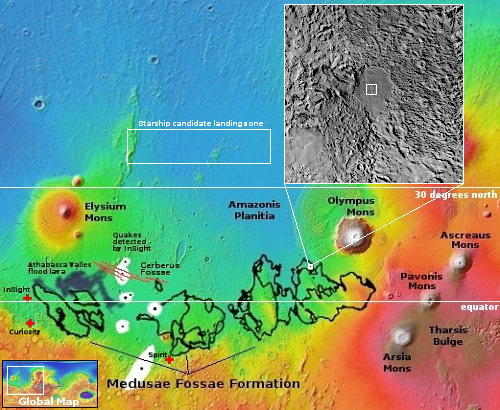
The inset in the overview map to the right provides further information which only makes these “features” more puzzling. The white rectangle marks the area covered by the above picture, in the center of a relatively smooth 10-by13 mile wide bowl that is surrounded by very rough wind-shaped terrain.
The bowl is the mystery. It sits lower than the surrounding terrain, but only by a little. It is also not precisely a bowl, as its western half sits higher than its eastern half, with the fall off quite abrupt.
Why is it smooth? One guess is that wind has blown off all the ash, and what we are looking at is an ancient and eroded surface of frozen flood lava. But if so, it seems strange that the wind would only scour this one area, and not the landscape that surrounds it. At a minimum you would expect the transition from rough to smooth to be more gradual. But it is not.
As I said, it is understandable the scientists merely label this “features,” since any further description would be a guess that is very likely to turn out to be wrong. Better to be vague and dig further before making a commitment.

On Christmas Eve 1968 three Americans became the first humans to visit another world. What they did to celebrate was unexpected and profound, and will be remembered throughout all human history. Genesis: the Story of Apollo 8, Robert Zimmerman's classic history of humanity's first journey to another world, tells that story, and it is now available as both an ebook and an audiobook, both with a foreword by Valerie Anders and a new introduction by Robert Zimmerman.
The print edition can be purchased at Amazon or from any other book seller. If you want an autographed copy the price is $60 for the hardback and $45 for the paperback, plus $8 shipping for each. Go here for purchasing details. The ebook is available everywhere for $5.99 (before discount) at amazon, or direct from my ebook publisher, ebookit. If you buy it from ebookit you don't support the big tech companies and the author gets a bigger cut much sooner.
The audiobook is also available at all these vendors, and is also free with a 30-day trial membership to Audible.
"Not simply about one mission, [Genesis] is also the history of America's quest for the moon... Zimmerman has done a masterful job of tying disparate events together into a solid account of one of America's greatest human triumphs."--San Antonio Express-News