
The dimmest galaxy yet found
Click for original image.
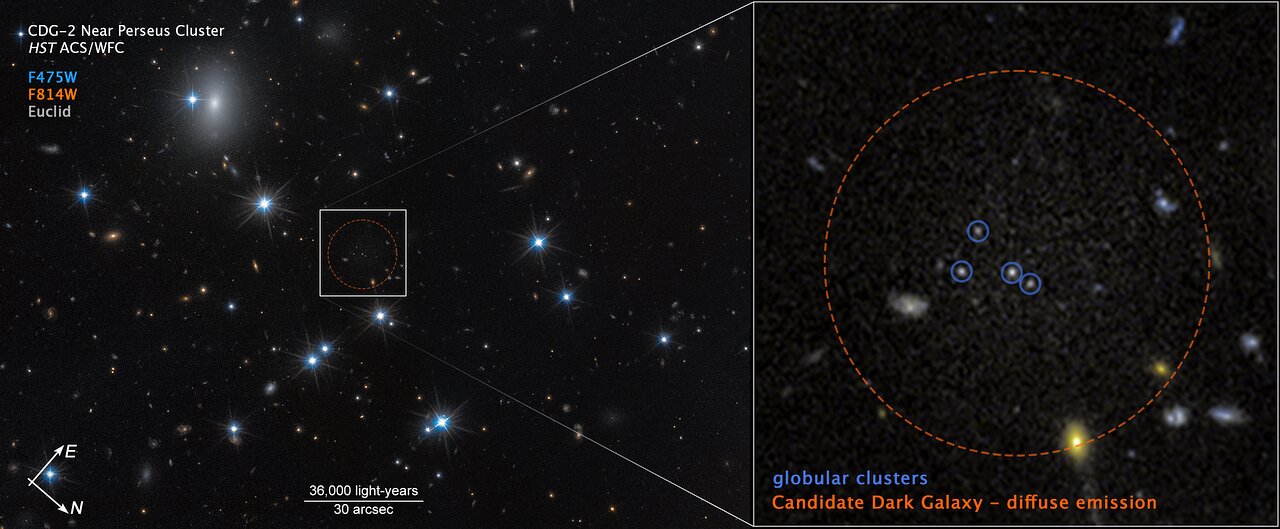
The uncertainty of science: Using ground-based and orbiting telescopes, astronomers think they have identified what might be the dimmest galaxy yet discovered, revealed almost entirely not from its stars but from the four globular clusters that reside within or near it.
The image to the right, cropped and sharpened to post here, shows that galaxy, dubbed CDG-2, along with those four globular clusters. From the press release:
To confirm one of the dark galaxy candidates, astronomers employed a trio of observatories: the NASA/ESA Hubble Space Telescope, ESA’s Euclid space observatory, and the ground-based NAOJ Subaru Telescope in Hawaii. Hubble’s high-resolution imaging revealed a close collection of four globular clusters in the Perseus galaxy cluster, 300 million light-years away. Follow-up studies using Hubble, Euclid, and Subaru data then revealed a faint, diffuse glow surrounding the star clusters – strong evidence of an underlying galaxy.
“This is the first galaxy detected solely through its globular cluster population,” said David. “Under conservative assumptions, the four clusters represent the entire globular cluster population of CDG-2.”
Preliminary analysis suggests CDG-2 has the luminosity of roughly 1 million Sun-like stars, with the globular clusters accounting for 16% of its visible content.
The scientists next claim that 99% of the galaxy’s mass is made up of dark matter, a material no one has yet detected except for the gravitational influence its invisible mass imposes on visible objects. It appears the astronomers don’t believe the mass that has been detected is sufficient to hold this galaxy together, and thus they need dark matter to explain its existence.
I simply wonder if the distances involved simply make the matter hard to see.
No matter. This is a cool discovery, because it tells us there is much out there hidden in the darkness we will always find difficult if not impossible to detect.

On Christmas Eve 1968 three Americans became the first humans to visit another world. What they did to celebrate was unexpected and profound, and will be remembered throughout all human history. Genesis: the Story of Apollo 8, Robert Zimmerman's classic history of humanity's first journey to another world, tells that story, and it is now available as both an ebook and an audiobook, both with a foreword by Valerie Anders and a new introduction by Robert Zimmerman.
The print edition can be purchased at Amazon or from any other book seller. If you want an autographed copy the price is $60 for the hardback and $45 for the paperback, plus $8 shipping for each. Go here for purchasing details. The ebook is available everywhere for $5.99 (before discount) at amazon, or direct from my ebook publisher, ebookit. If you buy it from ebookit you don't support the big tech companies and the author gets a bigger cut much sooner.
The audiobook is also available at all these vendors, and is also free with a 30-day trial membership to Audible.
"Not simply about one mission, [Genesis] is also the history of America's quest for the moon... Zimmerman has done a masterful job of tying disparate events together into a solid account of one of America's greatest human triumphs."--San Antonio Express-News
Could there simply be an unusually high amount of dust surrounding the central galaxy?
Isn’t it true that we can’t see our own galactic core because of all the dust in the way?
We are probably looking at a lot of dust out there, can you imagine what the sky would be like if it wasn’t there.
“Dimmest galaxy”! There’s quite a battle going on within the Scientific Community on NAMING the “Dimmest Galaxy”! Early results show a virtual tie! Now the hard part must take place – WHO will get the HONOR of having the “DIMMEST GALAXY” named for him or her! Right now it’s a massive pileup of “The Joe Biden Galaxy” or “The OAC Galaxy near Black Hole” or “The Mamdani Galaxy” or “The Pelosi Planetary Galaxy” or “The Newsom Hairgel Galaxy”! All candidates will issue statements on why THEIR particular qualifications deserve the “Dimmest Galaxy” Award!