NASA’s safety panel warns of space policy confusion
NASA’s safety panel fears the consequences of the present confusion in space policy.
NASA’s safety panel fears the consequences of the present confusion in space policy.
NASA’s safety panel fears the consequences of the present confusion in space policy.
The confessions of a Greenpeace founder. Key quote:
The truth is Greenpeace and I had divergent evolutions. I became a sensible environmentalist; Greenpeace became increasingly senseless as it adopted an agenda that is anti-science, anti-business, and downright anti-human.
Other quotes of interest:
The collapse of world communism and the fall of the Berlin Wall during the 1980s added to the trend toward extremism. The Cold War was over and the peace movement was largely disbanded. The peace movement had been mainly Western-based and anti-American in its leanings. Many of its members moved into the environmental movement, bringing with them their neo-Marxist, far-left agendas. To a considerable extent the environmental movement was hijacked by political and social activists who learned to use green language to cloak agendas that had more to do with anti-capitalism and anti-globalization than with science or ecology.
And:
There is no cause for alarm about climate change. The climate is always changing. Some of the proposed “solutions” would be far worse than any imaginable consequence of global warming, which will likely be mostly positive. Cooling is what we should fear.
Japanese researchers are going to try to resurrect the extinct mammoth, using cloning technology.
Our government in action: A Boston court has ruled that a cat summoned for jury duty must serve.
A private space shuttle replacement. And it ain’t SpaceX or Orbital Sciences!
Due to a leak from Wikileaks, the head of one of the companies building the European GPS system has been fired. Key quote:
The [Wikileaks] cable, which was published by the Norwegian daily Aftenposten last Thursday, quoted the [chief executive] as saying, “I think Galileo [the European GPS system] is a stupid idea that primarily serves French interests”, and, in particular, French military interests.
Let advertisers pay for a mission to Mars.
An evening pause: All Jack Nicholson wants is some toast. Five Easy Pieces (1970). This scene is probably more famous than the film itself.
2010 sea level: The largest drop ever recorded? Key quote:
2006 was the first year to show a drop in the global sea level. 2010 will be the 2nd year to show a decrease in sea level. That is correct, 2 of the past 5 years are going to show a decrease in sea level. 2010 could likely show a significant drop global sea level. By significant I mean it is possible that it will likely drop between 2-3 mm from 2009.
All IPCC predictions insist that increased carbon dioxide will cause sea level rise. All these predictions are now wrong, as carbon dioxide is still increasing in the atmosphere but the sea level has actually been going down.
Man faces charges for defying TSA agents. Key quote:
“ What’s really at root in this case is whether travel is a right that we have under the Constitution – an ability to move about the country without having to show papers – which has been one of the defining characteristics of American freedom, “ Hasbrouck said.
And NASA thinks it can compete with SpaceX or Orbital Sciences? The agency is asking for billions more to build the Orion capsule.
Keith Cowing is trying to locate a missing spectacular blow-up poster of the Lunar Orbiter “Earthrise” image from 1966, shown here.
The lead spacewalker for the next shuttle mission, the long-delayed last flight of Discovery, has apparently broken his hip in a bike accident. Key quote:
NASA does not train backup crews and a replacement, even a recently flown veteran, would need time to rehearse spacewalk scenarios and receive mission-specific training for Discovery’s flight. How long that might take, if required, and what impact it might have on the shuttle’s launch date is not yet known.
Want to know who is spreading hateful political rhetoric? Check out Climate of Hate.
What does it take to end a political career?
Finally a response: J. Eric Fuller, the Tucson shooting victim (also a Democrat party campaigner) who blamed Sarah Palin, Glenn Beck, and Sharron Angle for the shooting was arrested today at an ABC-TV town hall meeting when he threatened the founder of the Tucson Tea Party. Key quote:
When Tucson Tea Party founder Trent Humphries rose to suggest that any conversation about gun control should be put off until after the funerals for all the victims, witnesses say Fuller became agitated. Two told KGUN9 News that finally, Fuller took a picture of Humphries, and said, “You’re dead.” . . . A Pima County Sheriff’s spokesman told KGUN9 News that the department has charged Fuller with one count of threats and intimidation, and said they plan to charge him with at least one count of disorderly conduct.
For today, and today only, the Sun was blank. This blankness ended, however, when a sunspot rotated into view from the far side.
As I asked the last time the Sun was blank in December, will this be the last blank day of the just-ended but very prolonged solar minimum?
More battles in the space war over NASA:
How the hell is this toning down the rhetoric? One of the Tucson shooting victims today accused Sarah Palin, Glenn Beck, Sharron Angle, of causing the shootings on Saturday.
And why isn’t the press criticizing this Democrat campaign official for this blatant slander?
NASA has named a backup to Endeavour’s commander Mark Kelly for the shuttle’s last flight, now set for launch on April 19. This is “to facilitate training for crew and support teams,” while Kelly focuses on the recovery of his wife, Congresswoman Gabrielle Giffords.
The squealing is getting louder: NPR has launched an offensive against the congressman who wants to cut its funding.
An evening pause: While our politicians fight it out in Congress, let’s watch a different kind of showdown.
The vulture that was arrested by Saudi Arabia for spying was actually the third Israeli bird held since 1975 by Muslim countries.
I wish Congress understood this: Almost three quarters of the public opposes raising the country’s debt limit.
From the American Astronomical Society meeting this week:
A team of astronomers, using the data from the Sloan Digital Sky Survey, calculated the galactic orbits of nearly 40,000 low mass stars. These stars are generally M dwarfs, cool, not very bright, and thus generally somewhat close to the Sun since if they are too far away we would not see them. You can read the abstract here, and download their full poster here [pdf].
For the astronomers, the data told them a great deal about the orbital properties of these stars. Though a majority are in circular orbits between 20 to 30 thousand light years from the galactic center, a small minority are in extremely eccentric orbits that travel far out into the galactic halo, as much 260,000 light years. A few others dive inward, getting within 6000 light years of the galactic center.
What made this poster stand out to me, however, was this quote from the abstract:
In addition, we have identified a number of stars that will pass very close to the Sun within the next [billion years]. These stars form the “Nemesis” family of orbits. Potential encounters with these stars could have a significant impact on orbits of Oort Cloud and Kuiper Belt members as well as the planets. We comment on the probability of a catastrophic encounter within the next [billion years].
All told, they found that 18 low-mass cool M dwarf stars that will eventually pass close to the Sun. One star, SDSS J112612.07+152517.6, an M3 star that is about 2,300 light years away, is in an orbit that has it moving right towards us at about 90,000 miles per hour. Its mass is less than half that of the Sun, about 0.4 solar masses. This figure from the poster roughly illustrates the star’s position relative to our solar system over the next billion years:
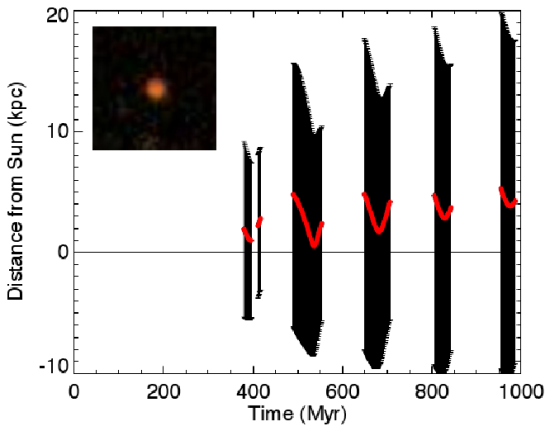
The star itself is shown in the inset. The red curve shows its calculated distance from the Sun over time, with the black area above and below showing the uncertainties of the calculation. As you can see, every hundred million years or so the distance between this star and the Sun shrinks, with the very very very rare possibility that the distance will sometimes shrink to zero!
With 18 stars each doing this every few 100 million years or so, the average time between close approaches is about 5 million years. These results suggest that another star passes close enough to our solar system frequently enough to not only disturb the comets in the Oort cloud, but also possibly affect the orbits of the planets in the outer solar system and Kuiper belt. One wonders, for example, if such an event had some influence on Pluto’s strange orbit.