
Scientists: Saturn’s magnetic field is warped
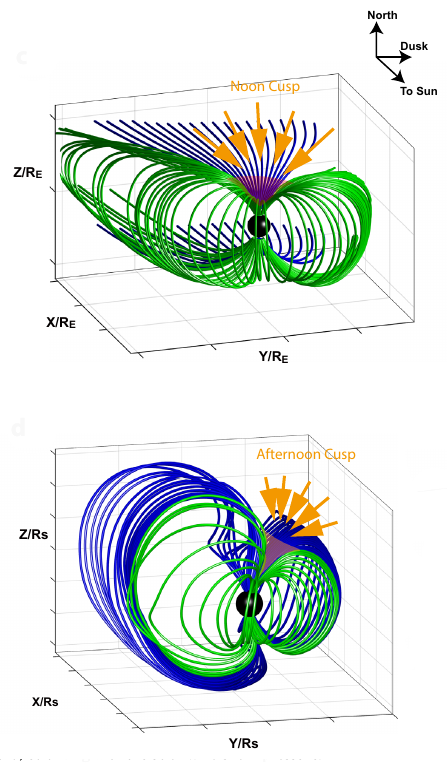
Using six years of archival data from the Cassini Saturn orbiter, scientists now think Saturn’s magnetic field is lopsided, pulled sideways due to the planet’s very fast rotation as well as the material that surrounds the ringed planet.
The graphic to the right, Figure 4 from the research paper [pdf], compares the Earth’s symmetric magnetic field (top) with that of Saturn’s (bottom). From the press release:
The team found that the cusp was dragged to the right as viewed from the Sun, and was located most often between 1:00 and 3:00 (as it might appear on a clockface), compared to 12:00 as it would be on Earth.
The researchers said this was likely because of Saturn’s extremely fast rotation (a Saturn day is 10.7 hours) and the heavy “soup” of plasma (ionised gas) it pulls around it, a product of gases emitted by Saturn’s moons, especially Enceladus. Together, these are thought to drag the magnetic field lines to the right. But more simulations are needed to confirm this interpretation.
When the solar wind hits the Earth’s magnetic field lines at the cusp, that wind is funneled down along those lines to the poles, where it produces the aurora. This new analysis at Saturn will help scientists better understand the behavior of Saturn’s aurora, which is made even more complex by the planet’s many moons.

On Christmas Eve 1968 three Americans became the first humans to visit another world. What they did to celebrate was unexpected and profound, and will be remembered throughout all human history. Genesis: the Story of Apollo 8, Robert Zimmerman's classic history of humanity's first journey to another world, tells that story, and it is now available as both an ebook and an audiobook, both with a foreword by Valerie Anders and a new introduction by Robert Zimmerman.
The print edition can be purchased at Amazon or from any other book seller. If you want an autographed copy the price is $60 for the hardback and $45 for the paperback, plus $8 shipping for each. Go here for purchasing details. The ebook is available everywhere for $5.99 (before discount) at amazon, or direct from my ebook publisher, ebookit. If you buy it from ebookit you don't support the big tech companies and the author gets a bigger cut much sooner.
The audiobook is also available at all these vendors, and is also free with a 30-day trial membership to Audible.
"Not simply about one mission, [Genesis] is also the history of America's quest for the moon... Zimmerman has done a masterful job of tying disparate events together into a solid account of one of America's greatest human triumphs."--San Antonio Express-News
Interesting. I wouldn’t be at all surprised if Saturn’s multiple platoons of moons have a lot to do with this. What is the count now – 275 or something like that? I’m beginning to think the astronomers should ape the economists with their National Debt Meter and put up comparable “odometers” for the counts of Jovian and Saturnian moons. The question of “How many moons do Jupiter and Saturn have?” has already become answerable only by first inquiring of the questioner, “As of what time today did you want to know?” Heckuva change from the days of my long-fled youth when Jupiter had 12 moons and Saturn had 9 – supposedly.
This last observation, by the way, should emphatically not be taken as a complaint. I like living in times when what we think we know about the Solar System – and the Universe in general – keeps changing faster than I can really keep up. Astronomers need to do more time discovering and less time whinging about Starlink et al.
African, or European, swallow?
I don’t know tha—oui!
Now, might that lopsidedness be useful to a Starwisp?