Ice in the Martian equatorial region?

Global overview of ice on Mars

Glacial features in low latitude Martian crater

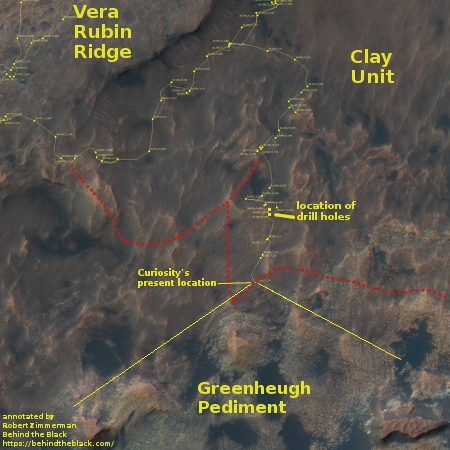
Today’s cool image to the right, rotated, cropped, and reduced to post here, is actually an older captioned image, published in 2017 by the science team for the high resolution camera on Mars Reconnaissance Orbiter (MRO). I missed its significance when it was first released. From the caption by Alfred McEwen of the Lunar & Planetary Laboratory in Arizona:

The material on the floor of this crater appears to have flowed like ice, and contains pits that might result from sublimation of subsurface ice. The surface is entirely dust-covered today. There probably was ice here sometime in the past, but could it persist at some depth?

This crater is at latitude 26 degrees north, and near-surface ice at this latitude (rather than further toward one of the poles) could be a valuable resource for future human exploration.

As shown in the global map of Mars above, this 26-mile-wide unnamed crater, marked by the black cross, is well inside the equatorial region 30 degrees north and south from the equator where almost no evidence of near surface ice has been found. Whenever I look at an image from MRO, if the picture appears to show ice or glacial features, its latitude is always 30 degrees or higher. If it does not, it is almost always in this equatorial region.

This crater however shows evidence of glacial features in its interior, but is far closer to the equator than normal. How could this be? It is possible that its high altitude, sitting in the southern cratered highlands, might have helped preserve its buried but near surface glacial features.

Regardless, as McEwen notes, its location closer to the equator is tantalizing, because it suggests that such ice could exist even in the equatorial regions, though buried and thus not detected by the instruments presently available in Mars orbit.

0 comments

Another blacklisted American sues school board for banning and censoring him

The parents, teachers, and elected officials in Maine
The parents, teachers, and elected officials in Maine, when
challenged about the inclusion of the queer agenda in schools

Bring a gun to a knife fight: Shawn McBreairty, a Maine parent who has been sued by one school district and banned from the property of another because he has publicly criticized their inclusion of the queer agenda in their schools, has filed a lawsuit against the second board for violating his first amendment rights.

Essentially, McBreairty at several different board meetings of Regional School Unit #22 tried during his open comment time to read the text of several pornography books that the school board had approved for children to read in schools, and was silenced by the board, specifically by the board’s chairman, Heath Miller, who claimed their policy forbid the use of obscenity by commenters. When McBreairty would not be silenced, the board then banned him from all school property — including any virtual online meetings — thus blocking his first amendment right to petition his elected officials. From the lawsuit [pdf]:
» Read more

7 comments

China’s Tiangong-3 space station, as seen from the ground

Tiangong-3 in orbit on July 29, 2022

The screen capture to the right was taken by a very short ground-based telescopic movie of China’s Tiangong-3 space station on July 29, 2022. I have labeled it to indicate the various parts of the station, including the new large module, Wentian, that launched to the station on July 24, 2022.

In my original post, I had mislabeled the sections. I have now corrected the image. Thanks to reader Jay for pointing out my error.

Tianhe is the original core module of the station. At present Wentian is in the forward port, so that it and Tianhe lie in a straight line. At some point shortly before the October launch of the next module, Mengtian, they will likely move it 90 degrees to its permanent port to one side, so that Mengtian can dock with the front port where Wentian now sits.

Mengtian will then be shifted 90 degrees to its permanent port on the opposite side of Wentian. At that point the station will form its planned final T-shape configuration.

This dance of spacecraft is necessary to keep the station as balanced as possible to aid in attitude control.

2 comments

Long March 5B stage falls to Earth near Malaysia

New data now suggests that the core stage of China’s Long March 5B rocket that it launched on July 24th has crashed to Earth somewhere off the coast of the island of Borneo, Malaysia.

As of writing, there is no indication that any debris hit land, though this could change.

In violation of the Outer Space Treaty, China very clearly has done nothing to upgrade the Long March 5B since it dumped a core stage uncontrolled last year. It very clearly can do nothing to prevent this from happening in October, when the Long March 5B lifts off again to carry into orbit the last planned module for the Tiangong station.

In other words, China cannot be relied upon to honor any treaty it signs. It signs the treaty, but then willfully ignores it if it thinks that is to its best interest.

12 comments

Space junk thought to be service module of Dragon manned capsule found in Australia

In news that is related to the impending crash of the Long March 5B core stage, Australian farmers have found scattered space junk pieces that some are claiming are the remains of the service module or trunk section that re-entered on May 5th, the day of the splashdown of SpaceX’s Endurance manned spacecraft.

The debris is most likely the unpressurized “trunk” of the spacecraft, astrophysicist Brad Tucker told Space.com. “Having gone out there and looked at the bits myself, there is not a doubt in my mind it is space junk,” he said in an e-mail. The trunk is designed to send unpressurized cargo into space, and also to support the Crew Dragon during its launch, according to SpaceX (opens in new tab). Half of the trunk includes solar panels that power Dragon when the vessel is in flight or docked to the station. The trunk detaches from the spacecraft shortly before re-entry.

The sonic boom, Tucker said, was widely heard at 7:05 a.m. local time on July 9 and the pieces found near Dalgety were “very close to the tracked path of the SpaceX-1 Crew trunk.”

The problem with this claim is that the sonic boom on July 9th matches no SpaceX launch or re-entry. The material however could be from that Endurance capsule, which returned May 5th, if the trunk once detached did not re-enter until two months later.

If confirmed, this story is surprising, as that service module is thought to be too small to survive re-entry through the atmosphere. It is instead expected to burn up before reaching the ground.

7 comments

Long March 5B stage reentry window narrowed to two hours

Long March 5B impact prediction

The Aerospace Corporation has now narrowed the window in which the out-of-control core stage of China’s Long March 5B rocket will crash back to Earth to about two hours, centered over the Pacific west of the United States at in the early morning of July 31st.

China appears to have dodged a bullet once again. The window is now only a little more than one orbit long, so we now know the impact point for the five to nine tons that will survive re-entry is mostly over water.

2 comments

Inverted Martian tadpole

Inverted Martian tadpole
Click for full image.

Cool image time! On Mars it is not unusual to see what scientists call tadpole features, craters with meandering canyons or channels either flowing into or out from the crater’s rim. The photo to the right, rotated, cropped, and reduced to post here, is another example, though with one major difference. The channel and crater are inverted, with the channel instead a ridge and the crater a circular plateau. The picture itself was taken on April 16, 2022 by the high resolution camera on Mars Reconnaissance Orbiter (MRO).

Orbital images have found on Mars a lot of what scientists call pedestal craters, where the impact packed and hardened the ground under the crater so that when the surrounding terrain eroded away the crater remained, as a plateau.

Scientists have also found on Mars a lot of what they call “inverted channels,” places where the channels of a drainage pattern followed the same geological process, becoming more resistant to erosion so that over time it turned from a channel to a ridge.

Here we have a combination of both. The overview map below provides us the larger picture.
» Read more

0 comments

Study: The Moon’s poles might not be the only places to find lunar water

Global map of hydrogen abundances on Moon
Click for full image.

According to a new study published in June in the Journal of Geophysical Research: Planets, while the lunar poles might contain water ice in permanently shadowed craters — based on detected hydrogen abundances — there is an even higher concentration of hydrogen found in the Aristarchus Plateau region in the lower mid-latitudes.

The map to the right is figure 9 from the paper, annotated to post here, showing the Moon’s hydrogen abundances globally, with lighter areas having higher concentrations. The boxes indicate five lunar regions that appear to hold higher levels of hydrogen and thus might contain higher amounts of water. From the paper’s conclusions:

The bulk hydrogen map also led to the first identification of bulk hydrogen enhancements within a pyroclastic deposit (Aristarchus Plateau), an identification that corroborates previous suggestions that hydrogen was among the volatiles involved in the eruption and emplacement of pyroclastic deposits. Further, with the understanding that there are enhanced bulk hydrogen abundances within at least one pyroclastic deposit and not just a surface enhancement, this leads to the implication that the hydrogen contained within just the Aristarchus Plateau may represent a significant fraction of the hydrogen that exists in the Moon’s near-subsurface, including that at both lunar poles. [emphasis mine]

It is important to note that finding high hydrogen abundances does not automatically mean you have found water. For hydrogen to exist on the Moon the atom must be bound in a molecule, and usually water is chosen as the most likely candidate. In the case of Aristarchus, however, the paper instead suggests that hydrogen was placed there as pyroclastic deposits, when active volcanism was occurring a long time ago. While water ice might not be present now in these regions, the data also suggests that water played a major role in its formation.

These hydrogen abundances however also signal the faint possibility of that water ice might be buried here, below the surface, left over from those early volcanic processes. The data also suggests even if the hydrogen is bound in other materials, mining and processing might be able to extract water from it.

0 comments

Pushback: Teacher wins victory against Rhode Island school district that tried to blacklist her

segregation returns to schools!
Providence’s policy of segregating teachers by race.

In October 2021 Romana Bessinger, a teacher for 22 years at a school in Providence, Rhode Island, suddenly discovered she had been suspended without pay and transferred to a no-work desk job because she had publicly criticized the school district’s effort to segregate teachers by race (see graphic to the right) while also making the the history curriculum an anti-white, anti-American diatribe.

Bessinger has now won back her teaching job. Just days before the school district was going to have to defend its position at her grievance hearing, it backed down completely.

I have received notification that coming this fall, I will have a permanent classroom assignment at Classical High. I have been freed from the basement. I’ll be back in the classroom this September sharing literature about the Holocaust, American authors with universal messages to share, historical references and literature that reflects the greatness of America in all her flaws and perfection. I’ll teach universal themes that all children can relate to, my classroom will have characters and poetry free of harmful political activism and full of accuracy. I hope to instill critical thinking, freedom of thought, rigorous activities that promote lively discussion unprompted by curriculum materials filled with propaganda.

Bessinger considers this a victory but I am not so sure. She might be back in the classroom free to teach history properly, but it does not appear the school district’s segregation policy nor its official curriculum promoting hate and bigotry have changed. As Bessinger noted in July 2021:
» Read more

0 comments

Update on status of first orbital Starship/Superheavy

Link here. The main focus of the article is the state of Superheavy prototype #7, which experienced an explosion and some damage during testing earlier this month.

The day after the anomaly, Elon indicated on Twitter that Booster 7 would roll back to the production site to work on repairs to the vehicle and assess the next steps. Rollback occurred on July 14, and in the following days, it’s been observed that several Raptor engines have been taken off from the vehicle, likely for further inspection and testing at SpaceX’s McGregor test facility a few hours drive up north from Starbase.

As of writing, repairs are continuing on Booster 7, and it will likely still be undergoing repairs for the next week or two. So while an early retirement for the vehicle could be expected, the current target by teams is still an orbital flight by Booster 7 and Ship 24 with a notional target date of late August for the flight.

If SpaceX decides to retire #7, it already is prepping #8 and #9, with #8 likely to be put on the launchpad for testing in the next week.

The target date for that first orbital launch is still in August, but that schedule appears increasingly unlikely.

0 comments
1 729 730 731 732 733 2,930