SpaceX pushing to launch 2nd generation Starlink satellites by March

Capitalism in space: In paperwork filed by SpaceX to the FCC, it has announced it is pushing to launch the first second generation Starlink satellites by March, 2022.

While some news reports have suggested that SpaceX intended to launch those upgraded satellites on Starship, this reporting is certainly wrong. As the article at the link correctly notes, SpaceX does not have to state what rocket it plans to use in its paperwork. It could very easily launch these first upgraded satellites on a Falcon 9.

The story however does provide this interesting tidbit about the FCC’s treatment of SpaceX in this licensing process:

SpaceX filed the first unmodified Gen2 Starlink application with the FCC in May 2020, requesting permission to launch an unprecedented 30,000 satellites. While the size of the proposed constellation is extraordinary, the FCC has also been exceptionally slow to process it. Only five months after SpaceX submitted its Starlink Gen2 modification request and nineteen months after its original Gen2 application did the FCC finally accept it for filing, which means that it has taken more than a year and a half to merely start the official review process. [emphasis in original]

In other words, the FCC stalled SpaceX for more than a year and a half. If the DC bureaucracy can play such games with Starlink, this suggests it might very well be doing the same with the approval of the environmental reassessment for SpaceX’s Boca Chica facility, which the FAA has now delayed repeatedly since last year. There are many people in Washington, both in the Biden administration and in the established and permanent bureaucracy, who do not like SpaceX’s success or its independence, and wish to use government power to squelch it. This story provides us some evidence that such misuse of government power in the FAA is very likely occurring.

3 comments

An independent Russian private space company?

Capitalism in space? The Russian company S7 Space announced today that plans to soon begin tests of the fuel tanks of its proposed reusable smallsat rocket, and is in the process of deciding what Russian facility to use.

“We plan to test the rocket’s elements, namely fuel tanks of a smaller size, with a diameter of 1.5 meters. The trials are aimed at proving that the structure is durable. A concrete laboratory is yet to be selected for the purpose. In other words, there has been no firm contract for trials so far,” [explained the head of the company’s technological research department, Arseny Kisarev.]

The official expressed hope that the trials would be carried out by TsNIIMash (Central Research Institute of Machine Building), a main research institution of Russia’s state-run space corporation Roscosmos.

“However, choosing another lab is also possible, if it corresponds to our requirements of the testing procedure,” he said.

This rocket was first announced in 2019. Development was suspended in 2020, however, when the Putin government imposed new much higher fees on the company for storing the ocean launch platform Sea Launch, fees so high that the company was soon negotiating to sell the platform to a Russian state-run corporation.

It is not clear whether that sale ever occurred, but the company itself appears only now to be resuming some operations. Though today’s story suggests it is operating independent of the control of Roscosmos and the Russian government, this is quite doubtful. Russia today functions much like the various Mafia mobs in the U.S. The various different government agencies divide up the work into “territories” that belong to each company. No other independent company can enter that territory and compete for business. Since S7 Space wants to build its own rocket, that makes it a direct competitor with Roscosmos and the government design bureaus within it that build the various Russian rockets.

More likely Roscosmos wants S7 Space to survive, but under its control and only for the purpose of building a smallsat rocket for Roscosmos. S7 Space appears to be struggling to stay independent, with this announcement likely part of that struggle.

2 comments

Strange land forms on the flanks of Mars’ Arsia Mons volcano

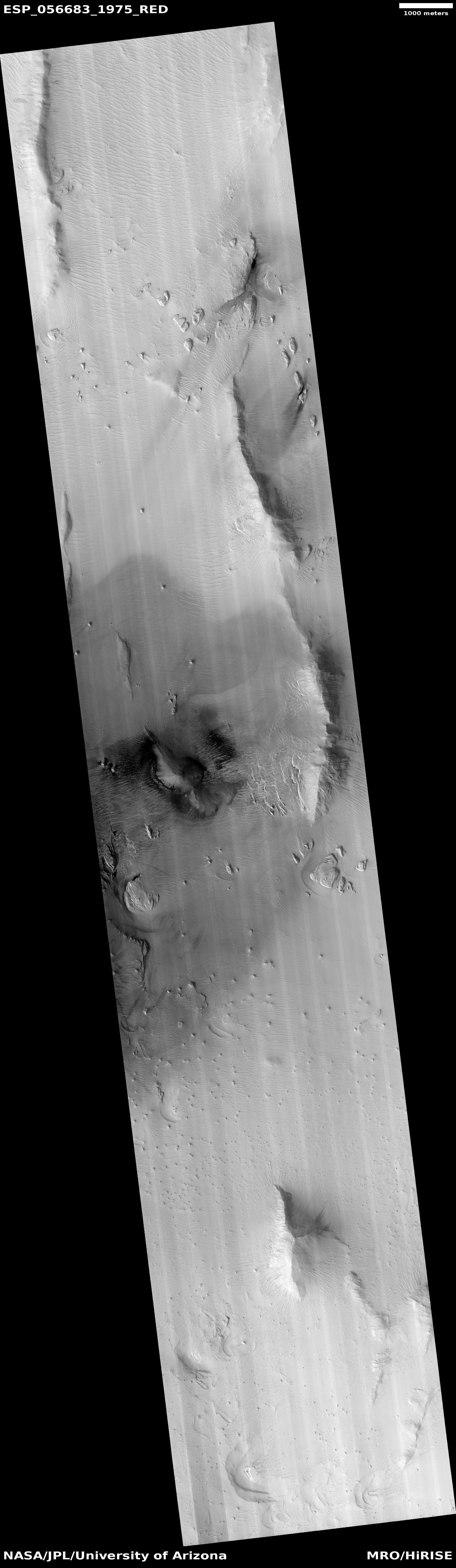
Strange landforms on the flanks of Arsia Mons
Click for original image. Click here for the context camera image.

Cool image time! The center of the photo to the right was taken by the high resolution camera on Mars Reconnaissance Orbiter (MRO) on September 5, 2021. For posting here I have rotated, cropped, and reduced it, as well as added to each side the lower resolution context camera image of this region.

The ground slopes downhill to the north. Make sure you click on the image to see the full resolution version. In only a few miles the terrain changes from a mound with small knobs to a smooth area with few knobs to a chaotic area where the larger ridges and knobs are the dominant feature, with hollows and canyons in between.

You should also take a look at the full context camera image. Just to the southeast of the above picture is a large depression that looks like it has been filled with lava, with its western rim covered by that flow. Scientists have taken a lot of high resolution pictures of this depression with MRO, trying to decipher its geology.
» Read more

4 comments

Today’s blacklisted American: Boston policewoman suspended for leading opposition to COVID shot mandate

Coming to your town in America soon!
Death camps are certainly coming for the unclean unvaccinated.

They’re coming for you next: Shana Cotone, the Boston policewoman who helped form and heads Boston First Responders United, a group for Boston municipal workers that has sued to block the city’s COVID shot mandate on all workers, has been put on administrative leave by her department and is now under “an internal affairs investigation”.

Cottone said BPD officers came to her house and took her badge and gun Saturday morning. “They’re trying to come after me — to silence me,” Cottone told the Herald. “They’re not going to silence me.”

Cottone’s group is not the only one suing. » Read more

5 comments

Data from China’s Chang’e-5 lander detects very tiny amounts of water in lunar soil

The uncertainty of science: In a paper published yesterday, Chinese scientists revealed that data from an instrument on the Chang’e-5 lunar lander has detected evidence of very tiny amounts of water in lunar soil, amounts that confirm past data showing the Moon is very dry.

From China’s state-run press:

The study published on Saturday in the peer-reviewed journal Science Advances revealed that the lunar soil at the landing site contains less than 120 ppm water or 120g water per ton, and a light, vesicular rock carries 180 ppm, which are much drier than that on Earth. … The additional 60 ppm water in the rock may originate from the lunar interior, according to the researchers. [emphasis mine]

It is believed that most of this water is the result of hydrogen in the solar wind.

The paper can be found here.

Before we begin dancing in joy that the Moon is wet, reread the highlighted words. This data instead simply confirms past data that the Moon is very dry. In the paper itself, it is made very clear that this high water content, small as it is, was only detected in a single rock, with all of the surrounding terrain much much drier. From the paper:

The water contents are less than 30 ppm in most measured regolith spots except for [areas] D12 and D17, which may be due to the disturbance of the top layer of the more space-weathered/solar wind–implanted regolith by the lander exhaust and the subsequent sampling process. The unsampled areas of D12 and D17 may have been shielded by [a rock] from the lander exhaust and thus retain the top space-weathered layer that contains higher water content. We predict that higher water content may be found in surface regolith than that from the subsurface of the returned borehole samples if the original stratigraphy is preserved. The estimated water contents of the regolith in the landing area are in agreement with those measured in the Apollo regolith samples and the orbital observations.

In other words, the higher water content, still very dry, appears to only exist on the surface, which is why they suspect it is produced by the solar wind and is also very temporary.

Moreover, there are many uncertainties in this result. The detection might not even be water, but hydroxyl molecules.

What this study suggests is that the patches of suspected water that some orbiters think they have identified in low latitudes on the Moon may simply be these surface molecules left by the solar wind, and that if there is usable water on the Moon, it will only be found in those permanently shadowed craters at the poles, if there.

7 comments

Webb’s primary mirror successfully deployed

Today engineers successfully completed the unfolding of the primary mirror on the James Webb Space Telescope.

The two wings of Webb’s primary mirror had been folded to fit inside the nose cone of an Arianespace Ariane 5 rocket prior to launch. After more than a week of other critical spacecraft deployments, the Webb team began remotely unfolding the hexagonal segments of the primary mirror, the largest ever launched into space. This was a multi-day process, with the first side deployed Jan. 7 and the second Jan. 8.

Mission Operations Center ground control at the Space Telescope Science Institute in Baltimore began deploying the second side panel of the mirror at 8:53 a.m. EST. Once it extended and latched into position at 1:17 p.m. EST, the team declared all major deployments successfully completed.

Next step over the next few months will be aligning the primary mirrors 18 segments with each other as well as the secondary mirror. First science images are expected during the summer, but do not be surprised if NASA releases some test images before then, should all be well and it obtains some eye candy.

9 comments

Debris in Perseverance core sample equipment

Debris in core sample carousel on Perseverance
Click for full image.

In attempting to store its sixth core sample on Mars last week, engineers discovered that Perseverance could not do so because several small pieces of the core sample had fallen into the equipment and prevented the drilling bit with the core from inserting itself completely into the sample storage carousel.

To understand the issue precisely, the engineers commanded Perseverance to first extract the bit from the carousel so they could get pictures of it.

The extraction took place yesterday (1/6) and data was downlinked early this morning. These most recent downlinked images confirm that inside the bit carousel there are a few pieces of pebble-sized debris. The team is confident that these are fragments of the cored rock that fell out of the sample tube at the time of Coring Bit Dropoff, and that they prevented the bit from seating completely in the bit carousel.

The photo to the right shows that material at the image’s bottom.

It appears this issue was anticipated when the rover was designed giving engineers a way to remove the debris. They plan to do so, but will proceed slowly as this will be the first time it will be attempted on Mars.

1 comment

A Martian cliff

A strange Martian cliff
Click for full image.

Many features on Mars immediately make one think of the Grand Canyon and the stark dramatic geology of the American southwest. Today’s cool image on the right, cropped and reduced to post here, is a typical example. Photographed on September 7, 2021 by the high resolution camera on Mars Reconnaissance Orbiter (MRO), it shows a dramatic cliff face that I estimate is about 3,000 feet high.

A closer look, however, almost always shows that this Martian terrain is not like the American southwest at all, but alien in its own way.

At the base of this abrupt cliff the terrain suddenly changes to a series of smooth downward fan-shaped flows. The cliff evokes rough boulders, avalanches, and chaotic erosion. The fans evoke a gentle and organized erosion of small particles like dust or sand. The two processes are completely different, and yet here the former is butted right up against the latter.

The fans also appear to flow out of hollows in the rough cliff, suggesting that somehow as the cliff erodes in chunks those chunks break into sand or dust, find the lowest points, and then flow downward like liquid.

How strange. How Martian. And how truly beautiful.

5 comments

Yutu-2 approaches boulder, has now traveled more than 1,000 meters

Yutu-2's square boulder
Click for original image.

The Chinese state-run press has released some more images from its rover Yutu-2, including a new image of the square-shaped lunar rock that was first identified a month ago. This new image is to the right, cropped and reduced to post here.

In the original image, the rock appeared very square as it was on the horizon and silhouetted by the black sky. As is usual in our emotion- and movie-run society, many began to push wild theories about the rock, proposing it was anything from an alien spacecraft to the monolith from the 1968 movie 2001: A Space Odyssey.

The picture confirms what any thoughtful person would have concluded, that it was simply a rock. The available image does not provide a scale, so I cannot tell you whether this is a large boulder, or a small piece of gravel. However, a wider image taken by Yutu-2 shows that the rock is on the edge of a small crater, which suggests the boulder is probably somewhere between three to ten feet across. The rover has completed only about half of its 260-foot journey to it, and won’t reach it until its next lunar day of operations in February.

The same report also revealed that the rover has now traveled just over 1,000 meters on the far side of the Moon, or about 3,280 feet, since it began operations in early 2019.

2 comments
1 827 828 829 830 831 2,927