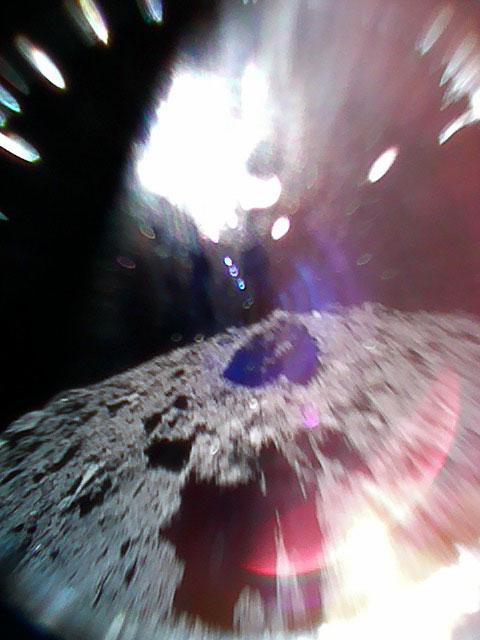
1st stage of Webb sun shield deployment completed

The deployment of the forward and aft pallets required to support the sun shield for the James Webb Space Telescope has apparently been successfully completed.

The link takes you to the website that outlines each step in Webb’s entire 30-day deployment sequence, and is updated to show you the next required step as the process continues. Though I have yet to see any official announcement, this page now shows that both pallets have successfully unfolded and that the next step is removal of the covers that have protected the sun shield membrene during assembly and launch.

2 comments

Firefly forced to postpone next launch because of security issues

Capitalism in space: Firefly has been forced to postpone its next launch of its Alpha rocket, tentative scheduled for late January, because the federal government wants the Ukranian investor — who essentially saved the company when it went bankrupt — to completely divest himself of any ownership.

Noosphere Venture Partners, a fund run by Ukrainian-born investor Max Polyakov, said Dec. 29 that it will retain an investment banking firm to sell its interest in Firefly. That sale comes at the request of the Committee on Foreign Investment in the United States (CFIUS), the company said.

Polyakov invested $200 million to bring the company from the ashes when it was about to be liquidated in bankruptcy proceedings. He left its board of directors last year and reduced his share in the company last year in an effort to ease these same concerns. Apparently that wasn’t good enough, even though his ownership was not a problem when the company obtained a lease for a launch site at Vandenberg Space Force Base.

Though there might be a real security issue, we must not dismiss the possibility that this is a corrupt power play by people in Washington to use Polyakov’s foreign roots to push him out so that they can replace him, now that the company is healthy and moving forward after Polyakov saved it.

I know this is a cynical suspicion, but based on the behavior of our Washington bureaucracy and legislators in the past decade, it is far from an unreasonable one.

7 comments

Iran launches orbital Simorph rocket, does not reach orbit

According to Iran’s state run press, it successfully launched its orbital Simorgh rocket on a test suborbital flight today, carrying three payloads to an altitude of 292 miles.

Ahmad Hosseini, an Iranian defense ministry spokesman, said the satellite-bearing rocket named Simorgh, or “Phoenix,” had launched the three cargoes at an altitude of 292 miles (470 km) and at a speed of 7,350 meters (4,5 miles) per second. “The intended research objectives of this launch were achieved,” Hosseini said, in comments broadcast on state television.

“This was done as a preliminary launch … we will have an operational launch soon,” the spokesman added, without further clarifying whether the devices had successfully entered Earth’s orbit.

In 2020 Iran completed an orbital launch using a mobile launcher, which probably used a different solid rocket instead of Simorgh.

However, since Simorgh is intended as an orbital rocket and it did did not reach orbit this time strongly suggests the rocket failed. Since the Iranian press provided images of the rocket in flight soon after launch, the failure possibly occurred at first stage separation followed by ignition of the second stage, a critical moment in a launch where failures often occur.

No matter. Whether it failed or functioned exactly as planned, this launch will provide Iranian engineers valuable information for that inevitable successful orbital flight.

As an orbital rocket designed to launch satellites, Simorgh actually poses less of a threat than that mobile launcher from 2020. Simorgh isn’t really a missile designed to launch bombs. It takes too long to fuel, and its launch site is vulnerable. The mobile launcher used in 2020, likely using solid rockets, is far more dangerous.

5 comments

December 30, 2021 Zimmerman/Pratt on Texas podcast

Last week I recorded a long interview with Robert Pratt of Pratt on Texas discussing some of the recent blacklist and pushback stories I have posted on Behind the Black. That interview is now available in two parts here.

The most interesting part of the interview for me was when Robert and I discussed the mental strain and stress we both felt writing or discussing these stories every day. Both of us are optimists, and these stories of oppression are depressing, to put it mildly. After awhile you just want to ignore them and deal with something more uplifting.

We don’t however, because we both know that if we ignore this stuff it will only make it more difficult in the coming years to find anything uplifting to write or talk about. Freedom and human creativity is under aggressive attack, and as civilized human beings it is our obligation to report that story, so that all civilized humans will have the knowledge to successful fight back.

Give it a listen and comment below. We face a real civil war in the coming years, and the thoughts of my readers would be appreciated.

And if you are in Texas and can support Robert Pratt’s advertisers, please due so. He was blacklisted himself in January, and this podcast is his way of fighting back.

1 comment

The badlands on the floor of Valles Marineris

The badlands on the floor of Valles Marineris
Click for full image.

Cool image time! The recent discovery that there might be a near surface reservoir of ice on the floor the canyon Valles Marineris, near the Martian equator, immediately brought this location to the forefront as a possible site for establishing colonies. The weather will be less harsh than higher latitudes, the low elevation means a thicker atmosphere, and the terrain will be more appealing than the boring flat northern lowlands.

The picture to the right, cropped and reduced to post here, illustrates however the likely difficulties of landing and living on the floor of Valles Marineris. Taken on July 26, 2021 by the high resolution camera on Mars Reconnaissance Orbiter (MRO), the photo shows just one small area of the floor of Ius Chasm, the western part of Valles Marineris and about 300 miles to the east of that water reserve.

In this one picture we can see trapped sand dunes in hollows, eroded depressions, mottled terrain resembling stucco, and innumerable cliffs and sinks and plateaus. For the first manned spacecraft to land on Mars, this is not a good first choice. Even later, when the first bases have been built, this terrain would still be forbidding for the early colonists to land in and traverse.

The overview map below shows exactly where this picture is relative to the rest of the Valles Marineris.
» Read more

16 comments

Pushback: Citizens create open Christmas soup kitchen when official food drive bans unjabbed

Spokane: Where some charities think some of the poor should starve during Christmas
Spokane: Where some charities think some of the poor should starve
during Christmas, while others step up to provide charity for all.

Pushback against blacklists: When the official annual Christmas soup kitchen in Spokane announced that the homeless and poor would be banned if they didn’t get COVID shots or tested first, a group of local citizens quickly organized an open soup kitchen where no jabs or testing would be required.

The image to the right illustrates the rules for the two competing soup kitchens.

A week before Christmas, in Spokane, WA, the Christmas Bureau food assistance program turned away needy people who could not show proof of Covid-19 vaccination or proof of a negative COVID test no more than 72 hours old.

The Christmas Bureau is an annual holiday assistance program coordinated by Catholic Charities Eastern Washington, Volunteers of America, and the Spokesman-Review. The program is made possible by generous monetary funds and volunteer hours donated by community members and organizations.

In response to the Christmas Bureau’s actions, a group of Christian patriots launched a “No Vaccine Canteen” to feed everyone — regardless of their medical history. [emphasis mine]

I purposely highlight the entities who decided that it was all right to deny charity to some of the poor and homeless during the Christmas season, merely because they hadn’t gotten the government jab. To paraphrase the words of Scrooge, “Maybe these unvaccinated should simply die and decrease the surplus population.”

For those in Spokane with the Christmas season in their hearts, this information should provide guidance next year when these particular organizations come begging for money. It is clear they really don’t have charity in mind, but power and enforcing their will, even onto the most vulnerable.

Instead, Spokane citizens should contact the people who ran the “No-Vaccine Canteen,” who teamed up with an organization called Blessings Under The Bridge, and give them their donations. When they heard about the Christmas Bureau’s decision to turn people away, these people were quickly able to raise $3500 and organize multiple free meal events for the poor.

Below is a video interview with Dan Bell, who helped organize the “No-Vaccine Canteen.” As he says,
» Read more

14 comments

Finalists announced in the ’21 Illusion of the Year contest

The top ten finalists, including the first place winner, in the 2021 best optical illusion of the year contest have now been announced.

The annual illusion contest is run by the Neural Correlate Society, an organization devoted to promoting awareness of the science behind perception and cognition. For 17 years the annual contest has consistently delivered an assortment of compelling illusions, frequently underpinned by fascinating scientific principles.

This year’s winner, from UK scientist and magician Matt Pritchard, is a unique example of an anamorphic illusion. These are illusions that present a viewer with an image that appears distorted until it is looked at from a specific perspective.

I have embedded below a video showing Pritchard’s illusion, dubbed the Phantom Queen. If you go to the contest’s website you can see videos of all ten finalists, all of which are fun and quite remarkable in their ability to fool the eye.
» Read more

2 comments

U.S. military adds Blue Origin to its point-to-point space cargo development program

Capitalism in space: The U.S. military on December 17th signed an agreement with Blue Origin to add it to its point-to-point space cargo development program.

The command last year signed similar agreements with SpaceX and with Exploration Architecture Corp. (XArc). Blue Origin is the third company to ink a CRADA [as these development contracts are called] for the rocket cargo program.

Under CRADAs, companies agree to share information about their products and capabilities but the government does not commit to buying anything. U.S. TRANSCOM’s analysis of industry data will inform the newly created “rocket cargo” program led by the Air Force Research Laboratory and the U.S. Space Force. The Air Force in its budget proposal for fiscal year 2022 is seeking $47.9 million to conduct studies and rocket cargo demonstrations. [emphasis mine]

I highlight the total budget of this program to show that this is a very small government program. The cash it provides these three companies is nice, but it is chicken feed when compared with the total cost of development. It certainly will not result in a faster pace at Blue Origin in developing its New Glenn rocket, which is presently two years behind schedule with further delays almost certain because its BE-4 rocket engine is not yet ready for mass production.

Whether the program itself is a good thing, or merely another example of government crony capitalism, is open to question. The practicality of using either Starship or New Glenn for cargo transport remains very unproven, especially for New Glenn, which was not designed with such a purpose in mind and cannot land its upper stage on Earth as Starship can.

5 comments

Starship prototype #20 completes another static fire launchpad test

Capitalism in space: Despite being blocked by the federal government bureauceacy from launching its Starship/Superheavy rocket on its first orbital flight, SpaceX yesterday successfully completed another static fire launchpad test of the 20th prototype of Starship.

It appears that this was the second static fire test that used all six of prototypes’s Raptor engines.

Meanwhile, Superheavy prototype #4 sits on the orbital launchpad, where similar static fire tests were expected but have not yet occurred. Either SpaceX engineers found they needed to additional revisions of the prototype before attempted such a test, which could fire as many as 29 Raptor engines at once, or the company has decided to hold back its testing because the FAA has not yet approved the environmental reassessment for the Boca Chica launch site. Firing the engines on Superheavy before that approval could be used by SpaceX’s environmental enemies as a public relations weapon to help kill the approval entirely.

Personally I think the answer is the former. It is not Elon Musk’s way to cower in fear of others. In fact, he is more likely to push forward, knowing that the publicity from a successful Superheavy static fire test will almost certainly be mostly positive and enthusiastic, thus helping to force politicians to force the bureaucracy to sign off its approval.

4 comments

Virgin Orbit merger produces only half the investment capital expected

Capitalism in space: It appears that the merger of Virgin Orbit with the special purpose acquisition company (SPAC) NextGen Acquisition II has produced only half the investment capital that had been expected.

The merger had expected to produce $483 million in investment capital for the rocket company. Instead it has produced only $228 million because many shareholders of NextGen cashed out before the merger occurred. Apparently, these shareholders did not have confidence in the Virgin Orbit, and feared their stock value would drop once the merger was completed.

It appears that Virgin Orbit has been stained by the failure of another Richard Branson space company, Virgin Galactic, to deliver on its promises. Virgin Orbit has successfully completed two orbital flights, and is expected to complete a third shortly. Unlike Virgin Galactic, it has done what it said it would, though it took longer than predicted (delays that were not unreasonable considering it was a startup rocket company). Investors have looked at the collapse of Virgin Galactic stocks, and have decided they do not wish to gamble their money on another Branson space company, no matter how successful.

0 comments

China completes two launches to make 2021 the most active year in rocketry ever

China yesterday completed two different launches from two different spaceports using two different rockets.

First it used its Long March 2D rocket to launch an Earth observation satellite from the Jiuquan Satellite Launch Center in northern China.

Then, a few hours later, a Long March 3B rocket launched a classified military satellite from the Xichang Satellite Launch Center in southwest China.

Both launches dropped first stage boosters in the interior of China. No word on whether either used parachutes or grid fins to better control the stages so that they avoid habitable areas.

These two launches bring China’s total number of successful launches in 2021 to 52, a record for that country and the most any single country has achieved since Russia successfully launched 54 times in 1992 as its high launch rate slowly shut down following the fall of the Soviet Union.

The two launches also bring the total number of successful launches in 2021 to 134, the most in any single year in the entire history of space exploration. The last time global launches reached such numbers was in the 1970s and 1980s, numbers that were produced mostly by the launch of a lot of short term low orbit surveillance satellites by the Soviets, using technology that the U.S. had abandoned in the 1960s as inefficient. It took the collapse of the communist state for Russia to finally cease such launches itself.

Now the high number of launches is increasingly being fueled by commercial competition and profits, though China’s record this year is partly due to the same top down communist set-up similar to the Soviet Union. Even so, the number of competing private rocket companies worldwide is on the rise, and in most places (even China in a few cases), it is those companies that are providing the launch services to the government. Profit and private ownership are the watchwords, and so there is aggressive competition that is lowering the launch cost.

I will have more to say about this in my annual report, which I will publish on Monday, January 3rd.

The leaders in the 2021 launch race:

52 China
31 SpaceX
23 Russia
7 Europe (Arianespace)

0 comments
1 833 834 835 836 837 2,929