Lawrence of Arabia: Truth is sometimes stranger than fiction
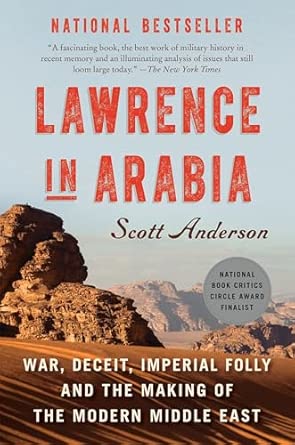
One of the 20th century’s greatest movies is David Lean’s 1962 epic Lawrence of Arabia. The story it tells — of the clash of cultures, of war, and of colonization — combined with the personal story of T.E. Lawrence during World War I, is one of high drama that is unforgettable to anyone who has ever seen it.
Yet, the events it tells seem too dramatic to be believed. Did Lawrence actually rescue a man in the desert, by himself and against the advice of his Arab allies who knew better? Did he actually later execute that man coldly to prevent a tribal war that would have destroyed the Arab revolt against the Ottoman Empire? Did he actually lead those Arab tribes across a deadly desert to take the town of Aqaba from the rear?
And did he actually lead that Arab revolt so successfully that it took Damascus ahead of the British, only to lose it because that medieval tribal culture knew nothing about modern technology?
For years I wondered about these questions and tried to find out. I read T.E. Lawrence’s own memoir of his time there, The Seven Pillars of Wisdom, and found it to be unclear and obscure, answering none of my questions. Other histories about World War I merely touched upon these events, treating them as a minor side show. And histories about the Middle East during that time seemed uninterested in telling this part of the story.
So, the questions remained: Did these events really happen? They seemed too good to be true.
I have now discovered that these stories are not only largely true, the reality of T.E. Lawrence’s life and his time in Arabia was even stranger than I could suppose. I learned this from Scott Anderson’s fine biography of Lawrence, Lawrence in Arabia: War, Deceit, Imperial Folly, and the Making of the Modern Middle East. Anderson not only unveiled Lawrence in all his inexplicable glory in this book, he made clear the complex political background that shaped the Middle East, and made it as we know it today.
First, there is Lawrence himself. From childhood he was a fearless individual quite willing to push his body beyond endurance. Fascinated at a young age with archeology and ancient architecture, at the ages of 18 and 20 he criss-crossed Europe on a solo bicycle tour to see its castles and ancient fortifications for a thesis he was writing at Oxford. He followed this up with a thousand-mile solo walking tour of the Middle East at the age of 21. Prior to the trip he mentioned it to archeologist David Hogarth, who was immediately horrified.
“I’m going,” Lawrence said.
“Well, have you go the money?” Hogarth asked. “You’ll want a guide and servants to carry your tent and baggage.”
“I’m going to walk.”
The scheme was becoming more preposterous all the time. “Europeans don’t walk in Syria,” Hogarth explained. “It isn’t safe or pleasant.”
“Well,” Lawrence said, “I do.”
On this journey Lawrence made friends with archeologist Leonard Woolley, becoming enamoured with his archeological work in Syria. Lawrence soon joined him, and the next five years, until the start of World War I, were probably the happiest in Lawrence’s life, working on archeology digs in Syria. He loved the work. He loved the land. And he loved the people.
When the war started however those digs ended, and the only way Lawrence could get back to the Middle East was through the war department. His personal on the ground knowledge of the Middle East and its people was priceless, though it took the British a ridiculously long time to realize it. And so he was sent to Arabia to help Faisal and the Arab revolt fight the Turks.
Once there, almost everything described in David Lean’s movie occurred, though for dramatic reasons some events and individuals were combined or rearranged. Lawrence did save a man who was lost in the desert, against the advice of the Arabs with him. He did execute a man in cold blood to prevent a tribal war. Unlike the movie, these were separate events spaced in time, and involved two different men. But both happened, in exactly the circumstances describe.
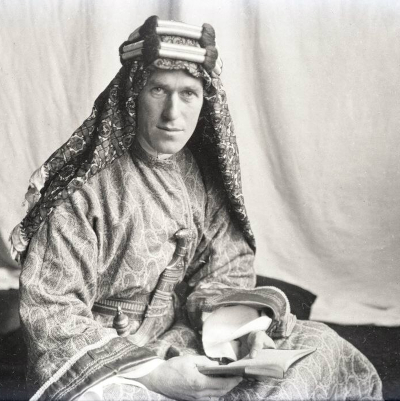
T.E. Lawrence, in Arabia
In fact, practically every event described in Lean’s movie happened more or less as Lean and his screenwriter, Robert Bolt, portrayed it. Lawrence did propose taking Aqaba from the rear by crossing a desert the nomadic Arabs normally avoided, a victory that made Lawrence’s name forever with British officials and allowed him the power to lead that Arab revolt into Damascus. Along the way the savagery of the war changed Lawrence, making him more brutal and robbing him of the innocent love of Arabia he once had.
As I noted, the movie does compress characters and events in order to tell the story practically in a single film, but it remains remarkably true to reality, in almost every way. Such dedication to truth in art is now rare in our world. For their art, filmmakers now think it perfectly okay to rewrite history to fit their own moral and political beliefs, even if it makes no sense. Lean and Bolt refused to do this, and as a result produced a movie of true greatness.
Scott Anderson’s book however is possibly greater, because it provides more depth than any movie can. He not only tells Lawrence’s story clearly in a way that makes the reading easy, he provides the larger context of the story so you understand the reasons why things happened as they did. No one is really the villain, except maybe the Germans who started it all with their desire to conquer France and Europe. That greedy desire forced the French and British to act in their own defense, and in doing so forced them to impose their own will on the Middle East, sometimes in a dishonest and two-faced manner.
The final consequence was the Middle East of today. If you want to understand with some depth why the Arabs are the way they are, I strongly recommend you read Anderson’s book.

On Christmas Eve 1968 three Americans became the first humans to visit another world. What they did to celebrate was unexpected and profound, and will be remembered throughout all human history. Genesis: the Story of Apollo 8, Robert Zimmerman's classic history of humanity's first journey to another world, tells that story, and it is now available as both an ebook and an audiobook, both with a foreword by Valerie Anders and a new introduction by Robert Zimmerman.
The print edition can be purchased at Amazon or from any other book seller. If you want an autographed copy the price is $60 for the hardback and $45 for the paperback, plus $8 shipping for each. Go here for purchasing details. The ebook is available everywhere for $5.99 (before discount) at amazon, or direct from my ebook publisher, ebookit. If you buy it from ebookit you don't support the big tech companies and the author gets a bigger cut much sooner.
The audiobook is also available at all these vendors, and is also free with a 30-day trial membership to Audible.
"Not simply about one mission, [Genesis] is also the history of America's quest for the moon... Zimmerman has done a masterful job of tying disparate events together into a solid account of one of America's greatest human triumphs."--San Antonio Express-News
WW I, not WW II. He died in 1935.
Chester Peake: Of course. That was a stupid typo missed despite multiple rereadings. Fixed. Thank you.
“T.E. Lawrence, the Arab Revolt, and W.W. 1 in the Middle East”
National WW-1 Museum
Dr. John Calvert (2016)
https://youtu.be/pSjhigKBe3Y
(1:11:31)
One of the really odd historical inaccuracies of the movie that I later stumbled upon was that Peter O’Toole (6’2″) was a lot taller than the historical T.E. Lawrence (5’5″). To me, this makes Lawrence an even more remarkable man: his diminutive stature meant one more obstacle to overcome on the road to greatness. It makes his story, his *real* story, even more implausible. History is, indeed, sometimes stranger than fiction.
I also don’t think this diminishes the greatness of the movie.
Richard M: Anderson makes a point to note that Lawrence always appeared much younger than he was. On that first “walk” through Syria at 21, he actually looked like a kid, a young teenager. Makes what he did even more remarkable.
No fan of T.E. a limey Charlie Wilson.
An sleepy Ottoman Empire is preferable to what that fool spawned.
“A sleepy Ottoman Empire is preferable to what that fool spawned.”
This might not be an unreasonable position in the abstract, in the right context. But the moment in which T.E. Lawrence was doing the stuff that made him Lawrence of Arabia was not that context. In its final years, the Ottoman Empire was becoming distinctly *unsleepy* as nationalist Young Turks extended their political power in the Empire, manifested in its most catastrophic way when the Sublime Porte jumped into a great war which was manifestly not in its interest to get into, and then undertaking massive genocides against its various ethnic and religious minorities (most notably the Armenians). Whatever it was in its Sick Man days of the 19th century, it no longer was by 1914-1918. But that was almost certainly an inevitable development.
Richard M: The Jeff Wright quote you cite also illustrates his typical ignorance. Lawrence was against the final settlement as created by France and Great Britain after the war. His own solution might not have been better, but it certainly wasn’t what was forged.
Hello Bob,
You are entirely right about Lawrence’s opposition to the Sykes-Picot agreement, of course; but I couldn’t rule out that Jeff opposed *every* possible post-Ottoman outcome, including an Arab-dominated power vacuum, too!
But I often think that Jeff is often commenting here just to stir the pot.
No…I lament what American interventionism has wrought.
No Charlie Wilson means no 9/11
No Treaty of Versailles means Hitler dies a failed drunken artist in a back alley.
Balfour would likely have happened anyway–but Arabs would be less skilled at terrorism.
For a bunch who purport to follow the Founders, “no entangling alliances” must be Greek to you.
The Founders would be proud of Marshall, and Franklin would have recoiled at NASA cuts.
Jeff Wright: More ignorance from you. The U.S. has almost nothing to do with the Treaty of Versailles or Balfour.
And you clearly know nothing about the Founding Fathers or Franklin.
No American presence in WWI means France can’t lord it over Germany as badly…I am not the only one who understands that. As far as the other Wilson is concerned–I can easily see Bin Laden falling prey to a Hind that wasn’t shot down by Stingers. The USSR likely falls anyway. The Turks did a lot of dirty things, but the US used them as an ally all the same.
How would a very young Israel ever benefit from T.E.L. teaching Arabs how to be insurgents? Had the founders of Israel went to America instead…they would be less put-up on most likely, with Turkey getting ire instead.
A couple of nits about the movie: ISTR reading that the Omar Sharif character was a fiction, perhaps necessary to gel the plot. And no mention of the homosexual Turkish pasha and the caning.
I have said for years that every “troubled” area in the world, the British Empire left it in that state. The Middle East, the Indian Subcontinent, and various African Colonies (South Africa and Rhodesia in particular). They put borders around places of differing ethnic, tribal and/or religious makeup. No wonder there’s so much bloodshed
That movie is one of the best I’ve seen because T. E. Lawrence was a superior individual in any context. I would not blame the state of the Middle East entirely on Europe. The Ottoman decline led to European imperialism. There was internal conflict long before WW1.
Jeff Wright,
Had there been no American involvement in WW1, the French and British would have bled even more to defeat Germany than they did. How you think that would have resulted in a Versaille Treaty that was easier on Germany I cannot fathom.
And the American involvement in WW1 was hardly an “intervention.” It was a response to German scheming to get Mexico to invade the US Southwest. That was something entirely gratuitous that the Kaiser definitely did not need to do but simply demonstrates that the German proclivity toward overreach did not start with Hitler.
Charlie Wilson was not the cause of 9-11. Bin Laden was offended that US military “infidels” had desecrated the sacred territory of Saudi Arabia by their presence there in large numbers to defend The Kingdom from possible Iraqi attack during the build-up to Desert Storm. No good deed goes unpunished it seems.
Stephen Kolcow,
The French, the Belgians and the Dutch all left a lot more chaos in their wakes in Sub-Saharan Africa than did the Brits. Ditto the French and Dutch in Southeast Asia. India’s independence was actually pretty well-handled. It’s hardly the fault of the Brits that Indian Muslims wanted secession afterward. The Middle East would have remained a dog’s breakfast no matter what the Brits did.
I think it’s only fair to look at what was happening in all of these places before the British and French empires showed up.
The book is good but the images from the film endure.
Loved the review till the “Germans started WW1” claim. It was the Serbians, followed by the Russians and the French, who were most responsible, at least from the evidence in “The Sleepwalkers.”
Love this thread. What do y’all think of the history A Peace to End All Peace? It seems well-researched and well-sourced, but I’m no expert. However, I laughed out loud about every third page, the principals were all so clueless. Sometimes (actually practically always) wrong, but never in doubt! That said, the attempt to place blame squarely on any one entity seems of little utility.
Favorite lines from the movie:
“If we’ve told lies, you’ve told half lies. The man who lies merely hides the truth. The man who tell half lies has forgotten where he put it.”
The Ottoman Empire was a reluctant ally of Germany and Austria Hungary. It wanted to stay neutral, but realized Russia and France had ambitions to seize Ottoman territory. The Ottomans offered to enter the war on the side of the Entente (France, Russia, Britain) *if* France and Russia guaranteed the Ottoman boundaries – that the two nations would not carve territory from the Ottoman Empire. France and Russia refused to do so, so the Ottomans threw in with Germany and Austria-Hungary. It was a true case of with allies like France and Russia, who needs enemies. (See “The Fall of the Ottomans” for a full explanation.)
Germany was not solely to blame for the start of WWI. Imperial Russia played a large role in seeing the war begin, something swept under the rug by France, the UK and US during the peace talks.
To all who want to take blame away from Germany: Of all the players in this war, it was the only one who planned an invasion and conquering of France years before the start of hostilities, and wanted those hostilities to occur to allow it to trigger that plan.
Some of the others might have been eager for conflict (though it seems doubtful for France, Britain, and Russia), but Germany sought it, for reasons of ambition and rule over others.
When it sued for peace in 1918, it did so solely to avoid getting conquered itself, and to allow itself time to rebuild and renew that ambition.
I remain puzzled why so many make an effort to absolve Germany of this evil.
Thanks Robert, fascinating stuff.
Islam is a totalitarian death cult political movement of pure satanic evil.
You left that out…
Empires and kingdoms (and empire-building republics) have always split ethnicities as well as enclosing (parts of) them in their frontiers. It started many millennia before the U.K. arrived on the scene.
His postwar career is worthy of mention. He gave up his commission to serve as a ranker in the RAF. Under an assumed name. Everyone knew who he really was but “England.”
He road exquisite high powered motorcycles all over Britain to dine at the tables of the elite.
It was on one of those rides he met his fate.
“I remain puzzled why so many make an effort to absolve Germany of this evil.”
I don’t think I am doing that. I was pointing out that Germany is not solely to blame. Russia was as focused on starting a war a Germany.
Really and truly how dumb do you have to be to refuse to guarantee a potential ally’s boundaries if they enter the war on your side? Considering Russia lost in large part because it could not be supplied from its Black Sea ports, they paid a price for their stupidity. And consider how much more quickly WWI would have ended with the Ottoman Empire on the side of the Entente.
“How would a very young Israel ever benefit from T.E.L. teaching Arabs how to be insurgents?”
Actually, for all his efforts to assist the Arabs,, Lawrence was also sympathetic to the Zionist movement…and viewed the two movements—Arab and Jewish—as compatible.
This was due, in part, because he believed that the entire region, including the Arabs would benefit. King Abdullah of the Kingdom of Transjordan (and then Jordan), brother of Feisal, was persuaded at one point that this might be the case. He paid for this assessment with his life (though there may have been additional reasons why he was murdered).
As far as TEL being favorable to Israel—that doesn’t un-train its enemies. A stronger, unbeaten WWI Germany may have been of more use to rest of Europe as a buffer to the worse threat towards its east. A prolonged Weimar Republic reduces calls for genocide with no wheelbarrows full of paper currency needed just to buy bread.
NATO or something like it would have been stronger and not as reliant on Uncle Sam…meaning the US military would (GASP!) actually protect America by confining itself towards local threats as opposed to endless nation building.
There was a brief time the United States had a few boots in the ground in Russia. A strong post WWI Germany means Lenin’s bunch has a war on two fronts–with Japan easily handling the Russian Navy…as always:)
It may not have been pleasant for China, but no one would know anyone by the name of Mao.
Thanks for mentioning Robert Bolt along with David Lean. Bolt was a genius at adapting complex novels and memoirs for the screen — among his other projects were A Man for All Seasons (adapted from his own play), Dr. Zhivago, Ryan’s Daughter, The Bounty, and The Mission. Hollywood has not made movies like that for decades, and I fear we shall not see Bolt’s like again.
Kathy Harkness: You are welcome. I am a great admirer also of Bolt, though I will have more to day about A Man For All Seasons in a later book review. Bolt characterization in this case did not quite match reality.
There will probably always be a debate over who “started” the war- but by Christmas 1914 the German Army was entrenched upon other peoples’ countries. The only way end the war was if the Germans had said “well, our brilliant Schlieffen plan didn’t work out as we hoped, so let’s pack up and go home..” instead, they insisted on feeding Europe into the meat grinder for another four years.
“…exquisite high powered motorcycles…”
for the sake of accuracy, the fatal ride was upon a brough superior, not the vincent used in the film.
How about NOT reimagining what now IS.
LEARN from the past and live in the present.
cmeat,
By the early 1960s I imagine it was a lot easier to come up with a vintage Vincent than with a vintage Brough Superior. As the early Vincents used the same J.A.P. engines as the Superior, the verisimilitude is certainly far better than, say, the use of American tanks with gray paint and iron crosses on them as faux-Panzers in many WW2 movies.
Sounds like an interesting read. As I recall, it waa Lowell Thomas who made his career on the basis of his lecture tour (with lantern slides) about Laurence, called “With Laurence in Arabia.” I’d heard that Laurence sat in (anonymously) for at least one of Thomas’s presentations and was laughing quietly. But you say the film was pretty accurate….and I’ll take your word from that book.
But then, what was Laurence laughing at? Was Thomas exaggerating about Laurence even beyond his amazing deeds?
Or, and I think I’m remembering now – that Thomas was GREATLY exaggerating how much time he spent “With” Laurence in the Middle East?
Jim A wrote: “It was the Serbians, followed by the Russians and the French, who were most responsible, at least from the evidence in ‘The Sleepwalkers.’”
Robert is more correct. The book “The Guns of August” by Barbara Tuchman goes heavily into the topic of how and why the War to End All Wars [my words, not hers] started. Germany had plans for an invasion of France that was so detailed that they had a count of the number of axles that would pass over each railroad bridge, how long it would take for France to fall, and how and when to move the troops from the western front to the Russian front to kick their butts, too.
Because there had been so many wars in Europe, especially between Germany and France, the German army was convinced that there would be more. They were the ones that made plans for defeating France in two months and then dealing with the Russians once France fell.
Once they had an excuse, kicked off by a little incident by Serbians, they executed that plan perfectly until Russia made an unexpected advance with too few cavalry, resulting in an unnecessary panic from Germany and the movement of a few troops from the west toward the eastern front, and then back again when the Russian advance collapsed. Then some idiot Frenchman disobeyed orders and moved the troops defending Paris, which the Germans had bypassed, into the field to attack the German flank, the German advance stopped in order to defend, and the resulting stagnation disrupted the German plan, became a stationary trench warfare meat grinder that ended only when the Americans came to do their own butt kicking.
“Remember the Alamo!” was the cry. No, wait. It was “Remember the Lusitania!” That was America’s excuse to enter the war and to end the unfolding disaster. Stagnant disaster; there wasn’t enough motion to really call it “unfolding.”
Unfortunately, the Europeans did not listen to one of the few things that Wilson got right, and they humiliated the Germans in a way that led to the second part of this worldwide, European civil war. Hitler gets credit for starting WWII, but the Germans were eager to prove to the world that they were the superior ones, as a people, and that all the others were inferior, starting with the groups that the Germans could get away with kicking around in their own country.