
The Senate cries “Uncle!” on SLS and big goverment with its latest NASA authorization bill
I usually pay relatively little attention to the NASA authorization bills that Congress passes periodically, because these bills are generally nothing more than opportunities for the loudmouths in Congress to use them as a bullhorn to puff themselves up to the public and press. Almost never do such bills really have any real impact on the future, or if they do, that impact is often unintended and negative, as Congress is by and large ignorant about these matters and has priorities counter-productive to getting anything substantive accomplished.
I pay even less attention to authorization bills that have only been approved by a committee, and have not yet been voted on by either house. Such bills are ephemeral and the stuff of fantasy. It is nice to know what’s in them, but until such bills are actually approved by both houses of Congress and signed by the president, their language is even more unworthy of serious attention.

Have the pigs in the Senate learned to stop gorging themselves?
Nonetheless, the NASA authorization bill that was just approved by the Senate Commerce committee is worth reviewing, but not for the reasons that has interested the rest of the mainstream and even the aerospace press.
True, the bill extends ISS until 2032. True, it fully supports the commercial private space stations being built to replace it. True, it endorses NASA administrator Jared Isaacman’s restructuring of the Artemis program. True, it rejects all of Trump’s proposed cuts to NASA’s science programs. And true, it strongly endorses a Moon base as a first step to colonizing Mars.
All of these facts are significant, but to focus on each specifically — as it appears the entire press has done — is to miss the forest for the trees.
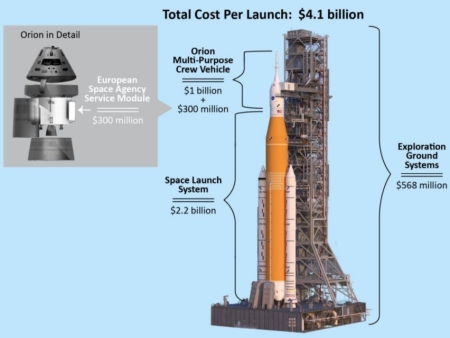
You see, what this authorization bill really tells us is that the Senate has finally cried “Uncle!” on SLS, Orion, and all of the NASA-designed, -owned, and -built projects that the Senate for years has supported blindly, funneling endless gobs of cash to these programs no matter how poorly they were built, how incapable they were of getting anything done, and how much money they wasted. All that mattered was to keep the pork flowing. To our lovely but corrupt Senators, that money had to be spent, regardless of how badly NASA managed and spent it.
The most recent example of this was last fall’s budget bill. In it Senator Ted Cruz (R-Texas) inserted language requiring NASA to fly SLS for two more missions, through Artemis-5. The amendments also funded Lunar Gateway, and ISS for five more years. It didn’t matter that SLS is too expensive, too cumbersome, and too slow to launch, making it useless for developing any viable American space program anywhere. The money had to be spent.
Something clearly has changed in this new authorization bill, which you can read here [pdf]. Its language suggests the Senate, and Cruz, are now taking a different tack. Instead of expanding these and additional government projects, the bill very clearly focuses on encouraging NASA to rely on the private sector. For example, in outlining its demand that a continuous human presence be maintained after ISS, it states right at the beginning that:
Capabilities in low-Earth orbit should include a mix of crewed and uncrewed commercial platforms [and that these] platforms in low-Earth orbit should transition from government-only enterprises to commercially led enterprises.
No more government space stations. NASA can help fund the construction of privately-owned stations, but once built it will simply buy space on them rather than own and operate them.
Even more significant is what this bill says and does not say about SLS. It says nothing about extending the rocket beyond the first five Artemis missions, as presently required by Cruz amendments in the budget bill. Instead, it expressly notes that SLS “has not met the flight rate” as required by the 2022 NASA authorization act, and that the planned more powerful upper stage is “behind schedule and over budget.” It then basically endorses Isaacman’s plan, already begun, to abandon that upper stage and replace it with ULA’s Centaur-5 upper stage, used on its Vulcan rocket.
The bill then requests a briefing in 60 days from Isaacman, reassessing SLS, its budget, and its components, including “a balancing of government and industry workforce components, roles, and responsibilities.” The bill also says this quite unequivocally:
The Administrator may enter into agreements with United States commercial providers or engage in public-private partnerships to procure capabilities and services to support the human exploration of the Moon and cislunar space.
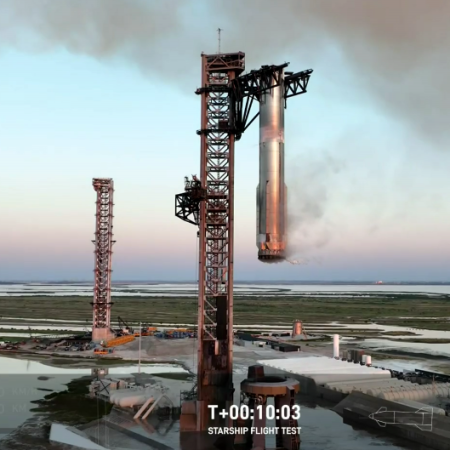
SpaceX’s Superheavy after the October 2024 test flight,
safely captured during the very first attempt
In other words, Isaacman is almost given carte blanche to use commercial resources for NASA’s lunar program. Thus, this language quite literally lays the groundwork for replacing SLS after that fifth Artemis mission, with that replacement process beginning now.
Nor is this all. Throughout the bill the language repeatedly encourages NASA to obtain what it needs from the private sector, in low-Earth orbit, in building a lunar base, a manned spacesuit, in developing missions to Mars, etc. Rather than fund another big NASA project — as the Senate has demanded for decades — it now wants NASA to use its funds to buy such things from outside the agency.
Hallelujah and amen! We might finally have seen a miracle occur: Senators actually writing a bill to support the American people, rather than take their money to build empires and bureaucracies in DC.
I am not so naive to think this new outlook doesn’t carry hidden mines that could blow it up in an instant. The bill for one demands many reports from NASA and Isaacman, and thus reserves the right of Congress to change everything if it so desires.
The bill also very carefully makes sure some pork is distributed to NASA and other agencies. It designates the Johnson Space Center in Texas as responsible for all NASA activities on the commercial space stations, while also making clear that it wants Johnson to have that same responsibility with the future Moon base, without saying so directly. The Glenn Research Center in Ohio is also given the lead in developing communications and GPS capabilities for the lunar base.
Nor is this the only pork in the bill, though refreshingly there is far less compared to previous NASA authorization bills.
Based on this bill, it does really appear that the Senate has finally recognized that SLS — and the government itself — is not the way the United States is going to colonize the solar system. They appear to have finally realized, after almost a half century of resistance, that for the American government to conquer the heavens, the government must rely on the American people to do it.

What a concept! It is almost as if these senators have suddenly realized what country they live in. It ain’t the Soviet Union, ruled from above by government commissars, but the United States, where we have a government for, by, and of the people.
You would think they’d know this, but then they are politicians, and for them, knowledge is generally considered an unnecessary component of their work.
Meanwhile nothing is set in stone. The bill still has to be approved by the Senate, and it must match the bill the House writes up. Though no one knows where those negotiations will lead, the House has tended over the years to favor commercial space and private enterprise, so I don’t think it will change things much for the worse.
Stay tuned. While the future remains decidedly uncertain, there are hopeful glimmers, and it does appear they are growing brighter.

On Christmas Eve 1968 three Americans became the first humans to visit another world. What they did to celebrate was unexpected and profound, and will be remembered throughout all human history. Genesis: the Story of Apollo 8, Robert Zimmerman's classic history of humanity's first journey to another world, tells that story, and it is now available as both an ebook and an audiobook, both with a foreword by Valerie Anders and a new introduction by Robert Zimmerman.
The print edition can be purchased at Amazon or from any other book seller. If you want an autographed copy the price is $60 for the hardback and $45 for the paperback, plus $8 shipping for each. Go here for purchasing details. The ebook is available everywhere for $5.99 (before discount) at amazon, or direct from my ebook publisher, ebookit. If you buy it from ebookit you don't support the big tech companies and the author gets a bigger cut much sooner.
The audiobook is also available at all these vendors, and is also free with a 30-day trial membership to Audible.
"Not simply about one mission, [Genesis] is also the history of America's quest for the moon... Zimmerman has done a masterful job of tying disparate events together into a solid account of one of America's greatest human triumphs."--San Antonio Express-News
“…as Congress is by and large ignorant about these matters and has priorities counter-productive to getting anything substantive accomplished.”
This applies to most of what Congress does.
Thank goodness they have finally started to get rid of Old Space and it’s methods and costs.
I am in awe, actually common sense seems to have won the day.
Well said, Bob.
It took a long time to get here.
I think….there are at least five reasons why Isaacman *seems* to have had some more success in getting Senate buy-in on more commercialization than Jim Bridenstine did in 2019:
1. The Chinese are much more of a looming threat to land men on the Moon than they were in 2019, and unfortunately this is the kind of thing that still motivates a number of congresscritters;
2. In the last seven years, SLS/Orion has managed only one launch, follow on upgrades are far behind schedule, and even Ted Cruz can now see that this is not a recipe for successfully dealing with development (1);
3. The commercial alternatives on offer (Starship, New Glenn especially) are a lot more mature in development than they were 7 years ago, and they *also* now employ a lot more workforce in certain key space states than they did 7 years ago;
4. Jared Isaacman seems to be a good deal more persuasive and politically adept than most of us expected;
5. It’s a different batch of senators than NASA had to deal with in 2010 or 2019. I’m not so sure that Richard Shelby or Bill Nelson would have gone along with all this, even with (1), (2), and (3). But they’re retired now, and their successors are a little more pliable, maybe less hardened sinners.
But we gotta see what the House does now. I suspect most of this will survive there. The Senate was always the locus of resistance to commercial efforts.
Richard M: Your points are all true. However, reread the first few paragraphs of my essay. No matter what happens with the authorization bill, it is largely meaningless in the grand scheme of things. Much more important will be the actual actions of Isaacman and Trump.
Richard M,
I think the first-listed of your five contributing factors dominates the rest. For many years it was fine for Space Launch System (SLS) development to be a cost-plus “forever war” because there was no actual opponent. Now there is. And that makes all the difference.
After 1949 there was a lot of recrimination in Congress about “Who lost China?” No current occupant of that institution now wishes to have to answer questions about “Who lost to China?”
One last comment before bed…
Elon is from South Africa…which is home to the Palabora open pit mine…located in what once was a volcanic plug/Kimberlite pipe.
That thing looks like a scaled-up R-7 pit. A good Arecibo replacement if nothing else?
Where Zack from CSI STARBASE was talking about keeping water out…. maybe it is best to keep it in
I wonder if there are pit mines on islands or blue holes with sturdy rock.
Locks like in Panama might allow huge articles to be floated over the top.