Astronomers detect another galaxy that shouldn’t be there, so soon after the Big Bang
Click for original.
Using the Webb Space Telescopes astronomers have detected another galaxy that shouldn’t be there, so soon after the Big Bang.
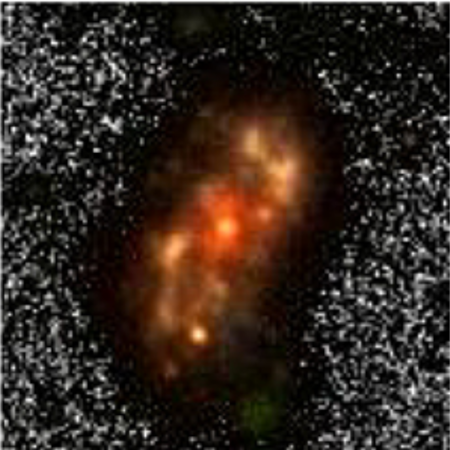
The image to the right comes from figure 1 of the peer-reviewed paper. The galaxy’s two spiral arms form a backward “S” emanating out from the galaxy’s nucleus. From the press release:
Using JWST, researchers Rashi Jain and Yogesh Wadadekar spotted a galaxy remarkably similar to our own Milky Way. Yet this system formed when the cosmos was barely 1.5 billion years old—roughly a tenth of its present age. They named it Alaknanda, after the Himalayan river that is a twin headstream of the Ganga alongside the Mandakini—fittingly, the Hindi name for the Milky Way.
…It already has two sweeping spiral arms wrapped around a bright, rounded central region (the galaxy’s ‘bulge’), spanning about 30,000 light-years across. Even more impressively, it is annually churning out new stars, their combined mass roughly equivalent to 60 times the mass of our Sun. This rate is about 20 times that of the present-day Milky Way! About half of Alaknanda’s stars appear to have formed in only 200 million years—a blink in cosmic time.
This galaxy underlines the difficulty for cosmologists by much of Webb’s data of the early universe. Present theories of galaxy formation say it should take billions of years to form such a spiral galaxy, meaning it shouldn’t exist as yet so soon, only 1.5 billion years after the Big Bang.
Either the theories have to be revised substantially, or they are simply wrong entirely. Or we are missing or lacking in some fundamental information about the early universe that skews all our theories.

On Christmas Eve 1968 three Americans became the first humans to visit another world. What they did to celebrate was unexpected and profound, and will be remembered throughout all human history. Genesis: the Story of Apollo 8, Robert Zimmerman's classic history of humanity's first journey to another world, tells that story, and it is now available as both an ebook and an audiobook, both with a foreword by Valerie Anders and a new introduction by Robert Zimmerman.
The print edition can be purchased at Amazon or from any other book seller. If you want an autographed copy the price is $60 for the hardback and $45 for the paperback, plus $8 shipping for each. Go here for purchasing details. The ebook is available everywhere for $5.99 (before discount) at amazon, or direct from my ebook publisher, ebookit. If you buy it from ebookit you don't support the big tech companies and the author gets a bigger cut much sooner.
The audiobook is also available at all these vendors, and is also free with a 30-day trial membership to Audible.
"Not simply about one mission, [Genesis] is also the history of America's quest for the moon... Zimmerman has done a masterful job of tying disparate events together into a solid account of one of America's greatest human triumphs."--San Antonio Express-News
Click for original.
Using the Webb Space Telescopes astronomers have detected another galaxy that shouldn’t be there, so soon after the Big Bang.
The image to the right comes from figure 1 of the peer-reviewed paper. The galaxy’s two spiral arms form a backward “S” emanating out from the galaxy’s nucleus. From the press release:
Using JWST, researchers Rashi Jain and Yogesh Wadadekar spotted a galaxy remarkably similar to our own Milky Way. Yet this system formed when the cosmos was barely 1.5 billion years old—roughly a tenth of its present age. They named it Alaknanda, after the Himalayan river that is a twin headstream of the Ganga alongside the Mandakini—fittingly, the Hindi name for the Milky Way.
…It already has two sweeping spiral arms wrapped around a bright, rounded central region (the galaxy’s ‘bulge’), spanning about 30,000 light-years across. Even more impressively, it is annually churning out new stars, their combined mass roughly equivalent to 60 times the mass of our Sun. This rate is about 20 times that of the present-day Milky Way! About half of Alaknanda’s stars appear to have formed in only 200 million years—a blink in cosmic time.
This galaxy underlines the difficulty for cosmologists by much of Webb’s data of the early universe. Present theories of galaxy formation say it should take billions of years to form such a spiral galaxy, meaning it shouldn’t exist as yet so soon, only 1.5 billion years after the Big Bang.
Either the theories have to be revised substantially, or they are simply wrong entirely. Or we are missing or lacking in some fundamental information about the early universe that skews all our theories.
On Christmas Eve 1968 three Americans became the first humans to visit another world. What they did to celebrate was unexpected and profound, and will be remembered throughout all human history. Genesis: the Story of Apollo 8, Robert Zimmerman's classic history of humanity's first journey to another world, tells that story, and it is now available as both an ebook and an audiobook, both with a foreword by Valerie Anders and a new introduction by Robert Zimmerman.
The print edition can be purchased at Amazon or from any other book seller. If you want an autographed copy the price is $60 for the hardback and $45 for the paperback, plus $8 shipping for each. Go here for purchasing details. The ebook is available everywhere for $5.99 (before discount) at amazon, or direct from my ebook publisher, ebookit. If you buy it from ebookit you don't support the big tech companies and the author gets a bigger cut much sooner.
The audiobook is also available at all these vendors, and is also free with a 30-day trial membership to Audible.
"Not simply about one mission, [Genesis] is also the history of America's quest for the moon... Zimmerman has done a masterful job of tying disparate events together into a solid account of one of America's greatest human triumphs."--San Antonio Express-News
Nah… that’s just another giant space amoeba
proving: NSTASS no such thing as settled science