Cargo Dragon successfully returns to Earth
A cargo Dragon capsule successfully splashed down in the Pacific late Thursday, February 26, 2026, bringing back several thousand pounds of hardware and experiments.
The ship had been docked at ISS for the past six months, during which it used its engines six different times to raise the station’s orbit. That capability has traditionally been done by Russian Progress freighters, but NASA has been testing other options as they are unsure Russia will remain with the station after 2028. Furthermore, there are risks using Progress to do these reboosts, as the burns take place when Progress is docked to its Zvezda module port, and the hull of the Zvezda module has been developing stress fractures in the past five years that could catastrophically fail.
Not only has Dragon now demonstrated this boost capability, so has Northrop Grumman’s Cygnus capsule.
I strongly expect Russia to stick with ISS for as long as it can, mainly because its own proposed new space station is not likely to launch as presently scheduled later this decade. Since the fall of the Soviet Union, Roscosmos has consistently been unable to complete almost any new proposed projects, and the few it has completed launched literally decades late.
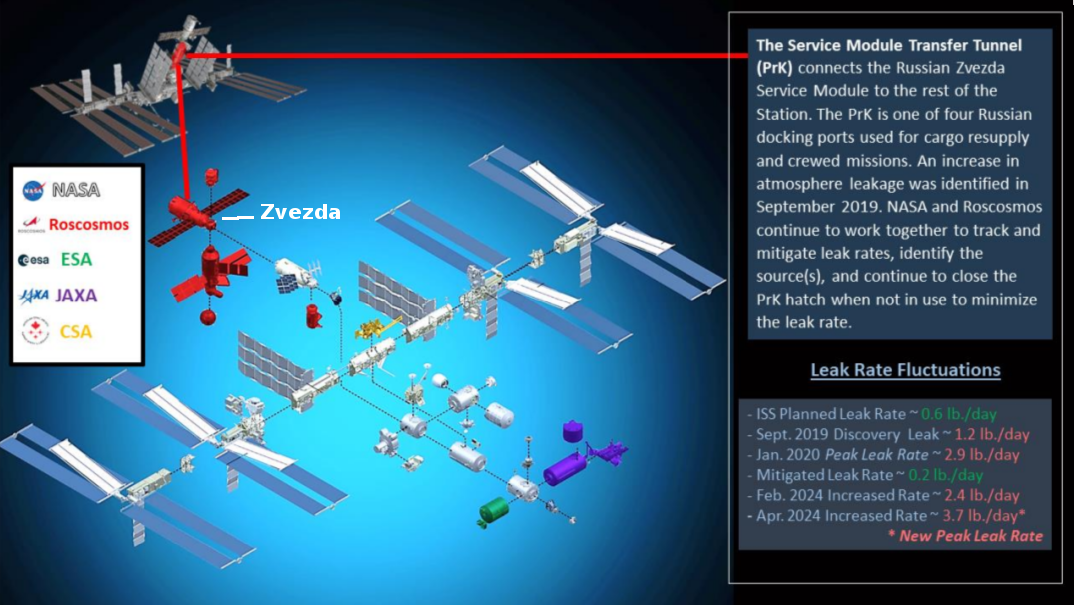
Figure 3 from September 2024 Inspector General report, showing Zvezda’s location on ISS, as well as the station’s leak rate at that time. The leaks in Zvezda now appear to have been sealed, but there is no guarantee more stress fractures will not appear as dockings continue at its port.

On Christmas Eve 1968 three Americans became the first humans to visit another world. What they did to celebrate was unexpected and profound, and will be remembered throughout all human history. Genesis: the Story of Apollo 8, Robert Zimmerman's classic history of humanity's first journey to another world, tells that story, and it is now available as both an ebook and an audiobook, both with a foreword by Valerie Anders and a new introduction by Robert Zimmerman.
The print edition can be purchased at Amazon or from any other book seller. If you want an autographed copy the price is $60 for the hardback and $45 for the paperback, plus $8 shipping for each. Go here for purchasing details. The ebook is available everywhere for $5.99 (before discount) at amazon, or direct from my ebook publisher, ebookit. If you buy it from ebookit you don't support the big tech companies and the author gets a bigger cut much sooner.
The audiobook is also available at all these vendors, and is also free with a 30-day trial membership to Audible.
"Not simply about one mission, [Genesis] is also the history of America's quest for the moon... Zimmerman has done a masterful job of tying disparate events together into a solid account of one of America's greatest human triumphs."--San Antonio Express-News
A cargo Dragon capsule successfully splashed down in the Pacific late Thursday, February 26, 2026, bringing back several thousand pounds of hardware and experiments.
The ship had been docked at ISS for the past six months, during which it used its engines six different times to raise the station’s orbit. That capability has traditionally been done by Russian Progress freighters, but NASA has been testing other options as they are unsure Russia will remain with the station after 2028. Furthermore, there are risks using Progress to do these reboosts, as the burns take place when Progress is docked to its Zvezda module port, and the hull of the Zvezda module has been developing stress fractures in the past five years that could catastrophically fail.
Not only has Dragon now demonstrated this boost capability, so has Northrop Grumman’s Cygnus capsule.
I strongly expect Russia to stick with ISS for as long as it can, mainly because its own proposed new space station is not likely to launch as presently scheduled later this decade. Since the fall of the Soviet Union, Roscosmos has consistently been unable to complete almost any new proposed projects, and the few it has completed launched literally decades late.
Figure 3 from September 2024 Inspector General report, showing Zvezda’s location on ISS, as well as the station’s leak rate at that time. The leaks in Zvezda now appear to have been sealed, but there is no guarantee more stress fractures will not appear as dockings continue at its port.
On Christmas Eve 1968 three Americans became the first humans to visit another world. What they did to celebrate was unexpected and profound, and will be remembered throughout all human history. Genesis: the Story of Apollo 8, Robert Zimmerman's classic history of humanity's first journey to another world, tells that story, and it is now available as both an ebook and an audiobook, both with a foreword by Valerie Anders and a new introduction by Robert Zimmerman.
The print edition can be purchased at Amazon or from any other book seller. If you want an autographed copy the price is $60 for the hardback and $45 for the paperback, plus $8 shipping for each. Go here for purchasing details. The ebook is available everywhere for $5.99 (before discount) at amazon, or direct from my ebook publisher, ebookit. If you buy it from ebookit you don't support the big tech companies and the author gets a bigger cut much sooner.
The audiobook is also available at all these vendors, and is also free with a 30-day trial membership to Audible.
"Not simply about one mission, [Genesis] is also the history of America's quest for the moon... Zimmerman has done a masterful job of tying disparate events together into a solid account of one of America's greatest human triumphs."--San Antonio Express-News
There are so many things on Earth that could develop “stress fractures.”
“Stress fractures” anywhere in space, combined with living, breathing humans, just seems crazy.
Talk about adding to everyday stress!
Exactly what does the Zvesda module provide or do?
pzatchok,
To answer your question: propulsion and getting rid of excess oxygen. To tell you the truth, I don’t know if the thrusters are still operational. They usually use Progress to boost the orbit.
According to the Encyclopedia Astronautica website, it is was completed in February of 1985 as the backup to Mir. 41 years old now.
”Exactly what does the Zvesda module provide or do?”
It provides propulsive attitude control, allowing it to desaturate the CMGs. It is the only module (well, it and the Progress vehicles attached to it) that can perform this function.
It provides orbital reboost capability. Until recently it and the Progress vehicles attached to it were the only ones capable of providing this. Now, Starliner, Cygnus, and Dragon can provide this capability, but only in combination with Zvezda/Progress. One of those two must fire simultaneously with Starliner/Cygnus/Dragon to maintain attitude control during the reboost. In addition, those three vehicles don’t have enough capability to perform all of the reboost ISS requires.
It provides life support for the Russian 3-man crew. The life support for the 4-man USOS crew is provided by the American modules. (OK, technically the life support systems don’t care about the nationalities of the crew, but that’s how the numbers stack up.)
I was curious about the hard numbers of the new Dragon reboost capability. Stephen Clark had a story at Ars Technica last year that clarified this:
“All told, the reboost kit can add about 20 mph, or 9 meters per second, to the space station’s already-dizzying speed, according to Walker.
Spetch said that’s roughly equivalent to the total reboost impulse provided by one-and-a-half Russian Progress cargo vehicles. That’s about one-third to one-fourth of the total orbit maintenance the ISS needs in a year.”
https://arstechnica.com/space/2025/08/spacexs-latest-dragon-mission-will-breathe-more-fire-at-the-space-station/
Impressive. That’s more than I expected.
It’s also worth noting that this Dragon delivered over 1,500 tortillas for the station’s culinary needs. I’ll bet Progress has never delivered any tortillas. (Probably some borscht, though.)
Minor edit at end of second paragraph: “that could catastrophically fail.”
What kind of connections would have to be removed by spacewalks.
Over a short amount of time could it be disconnected and later replaced?
We have all the designs and measurements a very simple replacement could be built quickly. It doesn’t even have to be an exact replacement.
We presently have a launcher that can carry something heavier than it is. I just don’t see a reason to not replace it with something that can be handed over to a private group for use after the station is junked.
After reading the WIKI it doesn’t look like much if any of the original equipment sent up with it is still operational.
Its got 13 windows. Why so many? Replace them with cameras. Lighter and don’t leak.
pzatchok asked: “Its got 13 windows. Why so many?”
People like to see out. Recall ‘The Right Stuff’ (1983) when, on viewing the prototype Mercury capsule, the astronauts complained about the lack of manual control systems, and windows. “Spam-in-a-can”
I don’t think blended-wing transport aircraft are going to be a hit for the same reason. Even in the middle of a 777, you can still see the outside.
That would be fine for Fed-Ex.
I’d like to see private modules take the place of Russian ones. That trusswork could still be useful.
“That trusswork could still be useful.”
It’s a lot of mass you’d have to push around every time you do station-keeping burns. I think it’s instructive how much the commercial stations have each managed to minimize such structure elements on their designs – not just in terms of size, but materials, too.
Bob or anyone
Do we know what the hull temperature of ISS is on the side that faces the sun and the side that is in shadow. I know the side facing the sun changes during an orbit but I’m curious as to the magnitude of temperature change and if this would contribute to stress fractures like that of aircraft pressurization cycles.
Jerry Greenwood: I don’t know the specifics at ISS, but based on what I know was experienced by the Apollo capsules, the range is likely about 400 to 600 degrees Fahrenheit, minus 200-300 Fahrenheit in shadow and plus 200-300 in sunlight.
Others might have more precise information. This is only a rough estimate. Being in Earth orbit rather than traveling to the Moon will impact these numbers.
Bob
Wow!
I had no idea the range was that great.
Thanks
Jerry Greenwood: I suspect the range at ISS is less because of a number of factors.
So if Zvezda/Progress is REQUIRED to provide boost AND attitude control today and the Zvezda has “stress cracks” that every so often surprise NASA and Russia with new “branches” and air leaks; when is a true work-around going to be installed? When will the root cause of these cracks be determined so that a proper assessment can be made and a solution designed and installed. Is the job of boost and attitude adjustment the cause of the cracks? – Who knows? Really, who knows?
This has the trappings of a life-threatening crisis simmering under the surface. The only thing that gives me any reassurance is the capability of SpaceX to possibly react to whatever crisis may arise from this.
When this crisis happens – I suspect it is only a matter of time – who will step up to rescue astronauts? (SpaceX seems to be the only one with capability) Who will be held responsible? What contingencies are in place?
Are we covering our eyes thinking that no one can see us?
Robert Zimmerman
“I suspect the range at ISS is less because of a number of factors.”
One of the factors is thermal blankets, or what is more correctly called multi-layer insulation. Because the American modules were launched within Shuttle bays, they could be launched with the relatively delicate blankets in place. These give a good protection from thermal extremes. The exteriors of the blankets may reach these extremes, or close to them, but the multiple layers slow the transport of the heat into and out of the modules.
As NASA learned with Skylab, when its thermal protection failed during launch, the interior can get rather warm. Thermal management is also necessary for unmanned spacecraft, too.