Changes to the Crab Nebula after a quarter century
For original images go here and here.
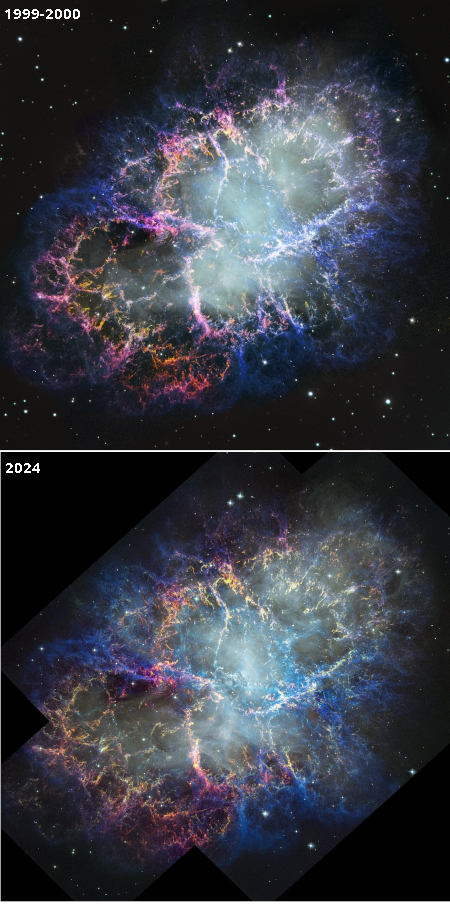
Using the Hubble Space Telescope, astronomers have obtained a new high resolution image of the Crab Nebula, and by comparing it with earlier Hubble images taken in 1999/2000 have been able to track the continuing expansion and evolution of this supernova remnant over a period now covering almost a quarter century.
The supernova itself became visible on Earth in 1054, though it actually erupted about 6,500 years earlier, as the Crab Nebula is 6,500 light years away. In the 25 years Hubble has been tracking the remnant’s expansion astronomers estimate it is expanding at about 3.4 million miles per hour.
[William Blair of Johns Hopkins University] noted that filaments around the periphery of the nebula appear to have moved more compared to those in the center, and that rather than stretching out over time, they appear to have simply moved outward. This is due to the nature of the Crab as a pulsar wind nebula powered by synchrotron radiation, which is created by the interaction between the pulsar’s magnetic field and the nebula’s material. In other well-known supernova remnants, the expansion is instead driven by shockwaves from the initial explosion, eroding surrounding shells of gas that the dying star previously cast off.
The new, higher-resolution Hubble observations are also providing additional insights into the 3D structure of the Crab Nebula, which can be difficult to determine from a 2D image, Blair said. Shadows of some of the filaments can be seen cast onto the haze of synchrotron radiation in the nebula’s interior. Counterintuitively, some of the brighter filaments in the latest Hubble images show no shadows, indicating they must be located on the far side of the nebula.
A movie showing the changes between these two images can be seen here. It is worth your while to take a look. These optical images will be further enhanced as the Webb Space Telescope gathers infrared data.

On Christmas Eve 1968 three Americans became the first humans to visit another world. What they did to celebrate was unexpected and profound, and will be remembered throughout all human history. Genesis: the Story of Apollo 8, Robert Zimmerman's classic history of humanity's first journey to another world, tells that story, and it is now available as both an ebook and an audiobook, both with a foreword by Valerie Anders and a new introduction by Robert Zimmerman.
The print edition can be purchased at Amazon or from any other book seller. If you want an autographed copy the price is $60 for the hardback and $45 for the paperback, plus $8 shipping for each. Go here for purchasing details. The ebook is available everywhere for $5.99 (before discount) at amazon, or direct from my ebook publisher, ebookit. If you buy it from ebookit you don't support the big tech companies and the author gets a bigger cut much sooner.
The audiobook is also available at all these vendors, and is also free with a 30-day trial membership to Audible.
"Not simply about one mission, [Genesis] is also the history of America's quest for the moon... Zimmerman has done a masterful job of tying disparate events together into a solid account of one of America's greatest human triumphs."--San Antonio Express-News
For original images go here and here.
Using the Hubble Space Telescope, astronomers have obtained a new high resolution image of the Crab Nebula, and by comparing it with earlier Hubble images taken in 1999/2000 have been able to track the continuing expansion and evolution of this supernova remnant over a period now covering almost a quarter century.
The supernova itself became visible on Earth in 1054, though it actually erupted about 6,500 years earlier, as the Crab Nebula is 6,500 light years away. In the 25 years Hubble has been tracking the remnant’s expansion astronomers estimate it is expanding at about 3.4 million miles per hour.
[William Blair of Johns Hopkins University] noted that filaments around the periphery of the nebula appear to have moved more compared to those in the center, and that rather than stretching out over time, they appear to have simply moved outward. This is due to the nature of the Crab as a pulsar wind nebula powered by synchrotron radiation, which is created by the interaction between the pulsar’s magnetic field and the nebula’s material. In other well-known supernova remnants, the expansion is instead driven by shockwaves from the initial explosion, eroding surrounding shells of gas that the dying star previously cast off.
The new, higher-resolution Hubble observations are also providing additional insights into the 3D structure of the Crab Nebula, which can be difficult to determine from a 2D image, Blair said. Shadows of some of the filaments can be seen cast onto the haze of synchrotron radiation in the nebula’s interior. Counterintuitively, some of the brighter filaments in the latest Hubble images show no shadows, indicating they must be located on the far side of the nebula.
A movie showing the changes between these two images can be seen here. It is worth your while to take a look. These optical images will be further enhanced as the Webb Space Telescope gathers infrared data.
On Christmas Eve 1968 three Americans became the first humans to visit another world. What they did to celebrate was unexpected and profound, and will be remembered throughout all human history. Genesis: the Story of Apollo 8, Robert Zimmerman's classic history of humanity's first journey to another world, tells that story, and it is now available as both an ebook and an audiobook, both with a foreword by Valerie Anders and a new introduction by Robert Zimmerman.
The print edition can be purchased at Amazon or from any other book seller. If you want an autographed copy the price is $60 for the hardback and $45 for the paperback, plus $8 shipping for each. Go here for purchasing details. The ebook is available everywhere for $5.99 (before discount) at amazon, or direct from my ebook publisher, ebookit. If you buy it from ebookit you don't support the big tech companies and the author gets a bigger cut much sooner.
The audiobook is also available at all these vendors, and is also free with a 30-day trial membership to Audible.
"Not simply about one mission, [Genesis] is also the history of America's quest for the moon... Zimmerman has done a masterful job of tying disparate events together into a solid account of one of America's greatest human triumphs."--San Antonio Express-News
Try this time-lapse view from Chandra in X-ray:
https://chandra.si.edu/photo/2024/timelapse/