Icy Mars
Today’s cool image once again illustrates the fact that most of Mars Mars is not a dry desert like the Sahara, as most news sources and the general public still believes, but a cold icy place similar to Antarctica, with plenty of near surface ice covering almost the whole planet, except for the dry equatorial regions (the one region we have sent almost all our landers and rovers).
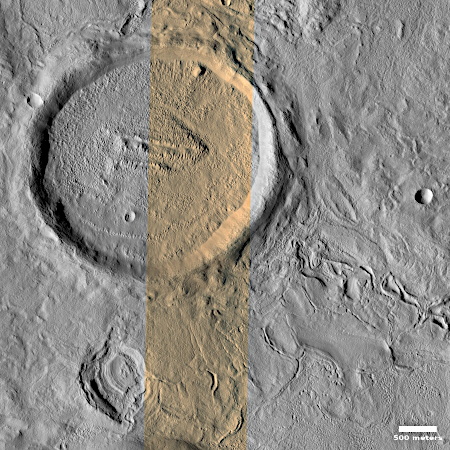
The picture to the right, rotated, cropped, reduced, and sharpened to post here, was taken on November 26, 2025 by the high resolution camera on Mars Reconnaissance Orbiter (MRO). It shows one small section of the floor of an unnamed very old and eroded 82-mile-wide crater located in the northern mid-latitudes of Mars.
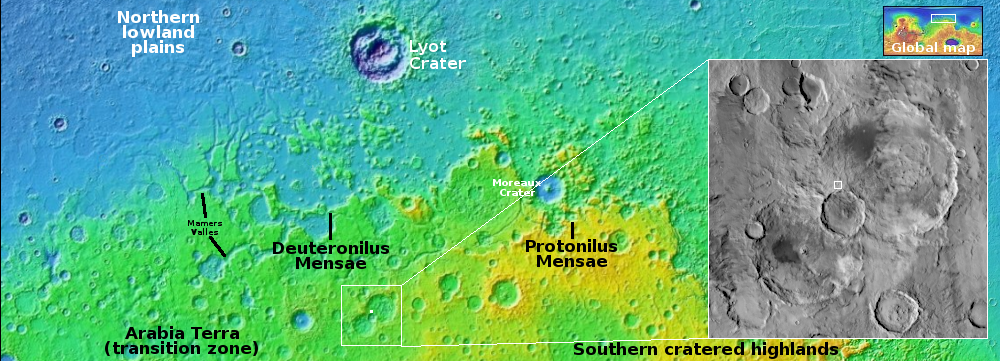
That location is indicated by the white dot on the overview map above. This part of the mid-latitudes is a region I dub “glacier country”, a 2,000-mile long strip where practically every image taken there shows very obvious glacial features.
Today’s image is no different. The 2-mile-wide crater in the upper left appears blobby, as if the impact had landed in mud. Its interior is filled with what the scientists believe is glacial debris. The surrounding landscape has a similar appearance, as if the ground was slushy and easily misshapen by seasonal temperature changes. To the southwest of the crater, within what appears to be a surrounding splash apron, there appears to be an eroded drainage channel, likely created by the flow of glacial ice downward.
So, when you read articles telling you Mars is dry and scientists are still hunting for water there, know that whomever wrote that article had no idea what he or she were talking about. The scientists studying Mars know that Mars has lots of water. Except for the tropics below 30 degrees latitude, there is near surface ice everywhere. Their questions revolve instead on figuring out how deep and extensive it is, and how it has shaped Mars’ overall geology.

On Christmas Eve 1968 three Americans became the first humans to visit another world. What they did to celebrate was unexpected and profound, and will be remembered throughout all human history. Genesis: the Story of Apollo 8, Robert Zimmerman's classic history of humanity's first journey to another world, tells that story, and it is now available as both an ebook and an audiobook, both with a foreword by Valerie Anders and a new introduction by Robert Zimmerman.
The print edition can be purchased at Amazon or from any other book seller. If you want an autographed copy the price is $60 for the hardback and $45 for the paperback, plus $8 shipping for each. Go here for purchasing details. The ebook is available everywhere for $5.99 (before discount) at amazon, or direct from my ebook publisher, ebookit. If you buy it from ebookit you don't support the big tech companies and the author gets a bigger cut much sooner.
The audiobook is also available at all these vendors, and is also free with a 30-day trial membership to Audible.
"Not simply about one mission, [Genesis] is also the history of America's quest for the moon... Zimmerman has done a masterful job of tying disparate events together into a solid account of one of America's greatest human triumphs."--San Antonio Express-News

Today’s cool image once again illustrates the fact that most of Mars Mars is not a dry desert like the Sahara, as most news sources and the general public still believes, but a cold icy place similar to Antarctica, with plenty of near surface ice covering almost the whole planet, except for the dry equatorial regions (the one region we have sent almost all our landers and rovers).
The picture to the right, rotated, cropped, reduced, and sharpened to post here, was taken on November 26, 2025 by the high resolution camera on Mars Reconnaissance Orbiter (MRO). It shows one small section of the floor of an unnamed very old and eroded 82-mile-wide crater located in the northern mid-latitudes of Mars.
That location is indicated by the white dot on the overview map above. This part of the mid-latitudes is a region I dub “glacier country”, a 2,000-mile long strip where practically every image taken there shows very obvious glacial features.
Today’s image is no different. The 2-mile-wide crater in the upper left appears blobby, as if the impact had landed in mud. Its interior is filled with what the scientists believe is glacial debris. The surrounding landscape has a similar appearance, as if the ground was slushy and easily misshapen by seasonal temperature changes. To the southwest of the crater, within what appears to be a surrounding splash apron, there appears to be an eroded drainage channel, likely created by the flow of glacial ice downward.
So, when you read articles telling you Mars is dry and scientists are still hunting for water there, know that whomever wrote that article had no idea what he or she were talking about. The scientists studying Mars know that Mars has lots of water. Except for the tropics below 30 degrees latitude, there is near surface ice everywhere. Their questions revolve instead on figuring out how deep and extensive it is, and how it has shaped Mars’ overall geology.
On Christmas Eve 1968 three Americans became the first humans to visit another world. What they did to celebrate was unexpected and profound, and will be remembered throughout all human history. Genesis: the Story of Apollo 8, Robert Zimmerman's classic history of humanity's first journey to another world, tells that story, and it is now available as both an ebook and an audiobook, both with a foreword by Valerie Anders and a new introduction by Robert Zimmerman.
The print edition can be purchased at Amazon or from any other book seller. If you want an autographed copy the price is $60 for the hardback and $45 for the paperback, plus $8 shipping for each. Go here for purchasing details. The ebook is available everywhere for $5.99 (before discount) at amazon, or direct from my ebook publisher, ebookit. If you buy it from ebookit you don't support the big tech companies and the author gets a bigger cut much sooner.
The audiobook is also available at all these vendors, and is also free with a 30-day trial membership to Audible.
"Not simply about one mission, [Genesis] is also the history of America's quest for the moon... Zimmerman has done a masterful job of tying disparate events together into a solid account of one of America's greatest human triumphs."--San Antonio Express-News
There was a time, not so very long ago, when “official science” — as promoted by the Never A Straight Answer agency — suggested that Mars was indeed a dry as a bone desert world, and the discovery of extant water on or below its surface came as a shocking surprise. Water on Mars? Who knew?
How all of this changed is chronicled in a surprisingly detailed article in Wikipedia, and it seems to comport with much of what has been talked about in this forum, although there may be differences in interpretation.
https://en.wikipedia.org/wiki/Chronology_of_discoveries_of_water_on_Mars
See for example, these global charts (from 2023) of buried ice on Mars: https://en.wikipedia.org/wiki/Chronology_of_discoveries_of_water_on_Mars#/media/File:PIA26046-Mars-BuriedIceMaps-20231026.jpg
For the “rest of the story,” going back to the earliest earth-based attempts to understand Mars, see https://www.amazon.com/Discovering-Mars-History-Observation-Exploration/dp/0816532109 It’s amazing how our picture of the Red Planet has changed so radically over time.
Now, as Robert might say, Mars is better understood as a (mostly) dusty, deep frozen ice planet, and what new discoveries might come out of this insight?