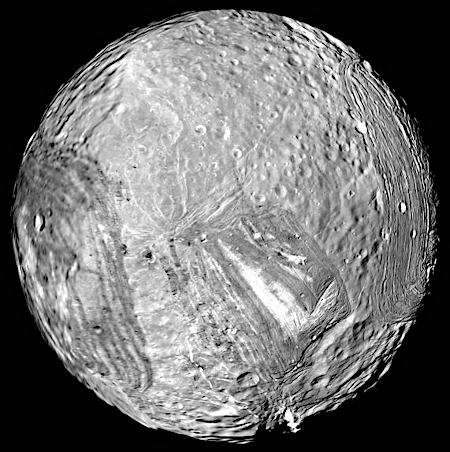
Miranda, the smallest of Uranus’ spherical moons
Click for original image.
Cool image time! The image to the right, reduced and sharpened to post here, was created from photographs taken on January 24, 1986 by Voyager-2 as it made its fly-by of the gas giant Uranus. From a later 1996 release:
Miranda, roughly 300 miles in diameter, exhibits varied geologic provinces, seen in this mosaic of clear-filter, narrow-angle images from Jan. 24, 1986. The images were obtained from distances of 18,730 to 25,030 miles; resolution ranges from 1,840 to 2,430 feet. These are among the highest-resolution pictures that Voyager has obtained of any of the new “worlds” it has encountered during its mission.
On Miranda, ridges and valleys of one province are cut off against the boundary of the next province. Probable compressional (pushed-together) folded ridges are seen in curvilinear patterns, as are many extensional (pulled-apart) faults. Some of these show very large scarps, or cliffs, ranging from 1,600 feet to 3 miles in height — that is, higher that the walls of the Grand Canyon on Earth.
This is really the only close look we have of this distant world. The other hemisphere remains a mystery, as it was in darkness when Voyager-2 zipped past. And though some of the individual shots that make up this mosiac are more detailed, they don’t provide that much more information.
Nonetheless, to my uneducated eye Miranda looks like a ball of thick molasses that some giant stirred a bit as gravity forced it to settle into its spherical shape. In this case the molasses is likely a mix of ice and other materials, not yet fully identified. The result is a tiny misshapen planet with some of the roughest topography known in the solar system, including one 12-mile high cliff face (the white streak at the image bottom) thought to be the highest in the solar system.
We don’t yet have a true understanding of the geological processes that formed this strange landscape, nor will we have until we have a lot more data, including a global map of the entire surface. And that won’t come until a spacecraft is sent there to look more closely. Right now no such mission is in the works. No NASA missions have been funded, though several have been proposed. And a Chinese mission was apparently canceled last year.

On Christmas Eve 1968 three Americans became the first humans to visit another world. What they did to celebrate was unexpected and profound, and will be remembered throughout all human history. Genesis: the Story of Apollo 8, Robert Zimmerman's classic history of humanity's first journey to another world, tells that story, and it is now available as both an ebook and an audiobook, both with a foreword by Valerie Anders and a new introduction by Robert Zimmerman.
The print edition can be purchased at Amazon or from any other book seller. If you want an autographed copy the price is $60 for the hardback and $45 for the paperback, plus $8 shipping for each. Go here for purchasing details. The ebook is available everywhere for $5.99 (before discount) at amazon, or direct from my ebook publisher, ebookit. If you buy it from ebookit you don't support the big tech companies and the author gets a bigger cut much sooner.
The audiobook is also available at all these vendors, and is also free with a 30-day trial membership to Audible.
"Not simply about one mission, [Genesis] is also the history of America's quest for the moon... Zimmerman has done a masterful job of tying disparate events together into a solid account of one of America's greatest human triumphs."--San Antonio Express-News

Click for original image.
Cool image time! The image to the right, reduced and sharpened to post here, was created from photographs taken on January 24, 1986 by Voyager-2 as it made its fly-by of the gas giant Uranus. From a later 1996 release:
Miranda, roughly 300 miles in diameter, exhibits varied geologic provinces, seen in this mosaic of clear-filter, narrow-angle images from Jan. 24, 1986. The images were obtained from distances of 18,730 to 25,030 miles; resolution ranges from 1,840 to 2,430 feet. These are among the highest-resolution pictures that Voyager has obtained of any of the new “worlds” it has encountered during its mission.
On Miranda, ridges and valleys of one province are cut off against the boundary of the next province. Probable compressional (pushed-together) folded ridges are seen in curvilinear patterns, as are many extensional (pulled-apart) faults. Some of these show very large scarps, or cliffs, ranging from 1,600 feet to 3 miles in height — that is, higher that the walls of the Grand Canyon on Earth.
This is really the only close look we have of this distant world. The other hemisphere remains a mystery, as it was in darkness when Voyager-2 zipped past. And though some of the individual shots that make up this mosiac are more detailed, they don’t provide that much more information.
Nonetheless, to my uneducated eye Miranda looks like a ball of thick molasses that some giant stirred a bit as gravity forced it to settle into its spherical shape. In this case the molasses is likely a mix of ice and other materials, not yet fully identified. The result is a tiny misshapen planet with some of the roughest topography known in the solar system, including one 12-mile high cliff face (the white streak at the image bottom) thought to be the highest in the solar system.
We don’t yet have a true understanding of the geological processes that formed this strange landscape, nor will we have until we have a lot more data, including a global map of the entire surface. And that won’t come until a spacecraft is sent there to look more closely. Right now no such mission is in the works. No NASA missions have been funded, though several have been proposed. And a Chinese mission was apparently canceled last year.
On Christmas Eve 1968 three Americans became the first humans to visit another world. What they did to celebrate was unexpected and profound, and will be remembered throughout all human history. Genesis: the Story of Apollo 8, Robert Zimmerman's classic history of humanity's first journey to another world, tells that story, and it is now available as both an ebook and an audiobook, both with a foreword by Valerie Anders and a new introduction by Robert Zimmerman.
The print edition can be purchased at Amazon or from any other book seller. If you want an autographed copy the price is $60 for the hardback and $45 for the paperback, plus $8 shipping for each. Go here for purchasing details. The ebook is available everywhere for $5.99 (before discount) at amazon, or direct from my ebook publisher, ebookit. If you buy it from ebookit you don't support the big tech companies and the author gets a bigger cut much sooner.
The audiobook is also available at all these vendors, and is also free with a 30-day trial membership to Audible.
"Not simply about one mission, [Genesis] is also the history of America's quest for the moon... Zimmerman has done a masterful job of tying disparate events together into a solid account of one of America's greatest human triumphs."--San Antonio Express-News
I have expect Big Muskie on the surface.
I would think an impact would have left cracks spiderwebbing every which way…. anything but what looks like a quarry.
This, Titan and Polyhymnia are the three bodies in our solar system that need probes.
Forget about Mars and Venus for now.
Titan and Miranda make sense, Titan for its strange surface with liquids and apparent atmosphere, Miranda for a surface that looks like it was used as a cat toy for a cat about the size of the moon. Polyhymnia I had to look up. I presume you mean asteroid 33 Polyhymnia (https://en.wikipedia.org/wiki/33_Polyhymnia). The name is clearly Greek and is apparently one of the 9 Muses. The only obvious oddity I see is a VERY high density estimate from a 2012 study by Benoît Carry. It is ~75g/cm^3, which is like 3 times denser than osmium. That is odd, but even Mr. Carry felt there was an error either in the mass or volume, at least one other asteroid (675 Ludmilla) in the study had a 73g/cm^3 density, which was later revised down to a 3.99 g/cm^3, which is somewhere between granite and iron ore densities. As 33 Polyhymnia’s spectra is a boring S type silicate one it wouldn’t seem worth the effort until/unless flight to the outer planets/ asteroid belt gets much cheaper.