NASA’s corrupt Aerospace Safety Advisory Panel: NASA must be bigger and have more control!
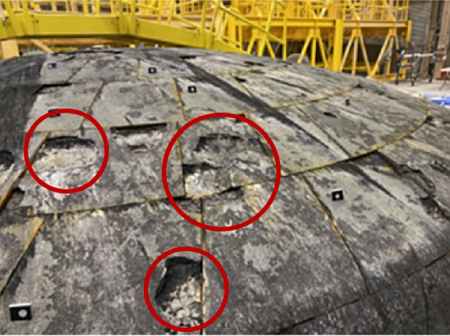
Orion’s damaged heat shield after 2022 flight.
ASAP “Move along! Nothing to see here.”
NASA’s Aerospace Safety Advisory Panel (ASAP) today released its annual report, and once again it demonstrated why I have been calling it corrupt and a waste of money for years.
The report can be read here [pdf], but let me warn you that its findings have nothing to do with ASAP’s original purpose (created after the 1967 Apollo 1 launchpad fire that killed three astronauts), to look at NASA projects to make sure the agency is not ignoring specific safety issues.
Instead, as it has done repeatedly in recent years, the panel focused on management goals and larger strategic issues, and as usual concluded that the best way to do things is to make NASA bigger with more control over the entire space industry.
NASA needs to better govern its contractors with respect to effective risk and safety management through appropriate contract mechanisms and consistent application of insight and oversight.
To come to this conclusion the report focused on the failures of Boeing in developing its Starliner manned capsule. To ASAP, those failures now justify taking control from the private sector. That SpaceX delivered as promised, under the same open contract terms, is barely mentioned. A normal American businessman would compare the two companies and simply continue to use SpaceX while searching for someone else besides Boeing.
ASAP instead wants to blame the entire private sector so that the government can once again rule.
Meanwhile, this corrupt panel sees nothing wrong or dangerous about the upcoming Artemis-2 mission, which will take four astronauts on a ten-day mission around the Moon using an untested life support system and returning with a questionable heat shield.
Throughout 2025, the Agency continued progress towards flight readiness. Safety and technical risks have been identified and, as appropriate, effectively addressed.
When it comes to Artemis-3, the mission to land humans on the Moon, the panel does finally note the many technical and safety risks, and questions whether NASA is ready to fly it as scheduled. It also admits that while SpaceX’s Starship is not yet ready to land humans on the Moon, “at this time it is difficult to imagine another NASA contractor capable of meeting a challenge of this scale and pace as SpaceX.”
Thank you for small blessings!
Overall, ASAP continues to be a paper-pushing waste of money. Not once in the past two decades has its recommendations on safety correctly identified the real dangers and risks. During the development of Dragon and Starliner, it consistently poo-pooed Boeing’s problems, while lambasting SpaceX repeatedly. For years it has ignored the problems with Orion and SLS, making believe — as it does now with Artemis-2 — that NASA has everything under control.
The money NASA wastes on this panel would be far better used elsewhere. Unfortunately, there is no one in Washington willing to face these facts. If anything, all signs suggest that Jared Isaacman agrees with ASAP’s findings, and intends to do exactly what it proposes, increase NASA power and control while squelching the independence and freedom of the newly reborn American private aerospace industry.

On Christmas Eve 1968 three Americans became the first humans to visit another world. What they did to celebrate was unexpected and profound, and will be remembered throughout all human history. Genesis: the Story of Apollo 8, Robert Zimmerman's classic history of humanity's first journey to another world, tells that story, and it is now available as both an ebook and an audiobook, both with a foreword by Valerie Anders and a new introduction by Robert Zimmerman.
The print edition can be purchased at Amazon or from any other book seller. If you want an autographed copy the price is $60 for the hardback and $45 for the paperback, plus $8 shipping for each. Go here for purchasing details. The ebook is available everywhere for $5.99 (before discount) at amazon, or direct from my ebook publisher, ebookit. If you buy it from ebookit you don't support the big tech companies and the author gets a bigger cut much sooner.
The audiobook is also available at all these vendors, and is also free with a 30-day trial membership to Audible.
"Not simply about one mission, [Genesis] is also the history of America's quest for the moon... Zimmerman has done a masterful job of tying disparate events together into a solid account of one of America's greatest human triumphs."--San Antonio Express-News
“…at this time it is difficult to imagine another NASA contractor capable of meeting a challenge of this scale and pace as SpaceX.”
Kind of shocked this line made it into the report.
Robert Zimmerman,
It is characteristic of bureaucratic organizations seeing control slipping away from them to make more than the usual amount of noise in vain efforts to halt the march of history. The NASA Uber Alles days anent space endeavor are gone and aren’t coming back. On the contrary, the private sector will be taking over more and more of what was NASA’s ambit in the last century. Any efforts by ASAP or other organs of NASA to materially resist this trend will fail. One can note the impotent noise without accepting the idea that it actually means anything consequential.
Plenty of useless talking heads in private boardrooms too, guys.
Jeff Wright,
Yep. OldSpace boardrooms are lousy with them.
Jeff Wright:
A key difference is that those companies shut down, merge, or are otherwise outcompeted within reasonable time, while there is no other federal space agency in the US. The learning rate is slower, the bureaucrats are less responsive to citizens’ needs, and progress gets much more expensive because of the lack of accountability. Plus, we don’t see a need to defend bad companies. Let them die, or be reformed if they can; that’s good for everyone.
Robert wrote: “If anything, all signs suggest that Jared Isaacman agrees with ASAP’s findings, and intends to do exactly what it proposes, increase NASA power and control while squelching the independence and freedom of the newly reborn American private aerospace industry.”
This would dash my hopes that NASA would be a good resource for new spacefaring companies to use for help, as was the NACA’s purpose. It is too bad that America has gotten so far away from its roots of free market capitalism. It is even worse that the stalwart Boeing company has screwed up so badly that NASA cannot trust it — or any company — to do a good job without heavy governmental oversight on their projects. Rather than getting a variety of innovations, any contractor to NASA will end up with systems that greatly resemble NASA’s own philosophies, costing more than necessary, and performing largely to NASA’s requirements.
Dr. Alan Binder, in the 1990s, worked on a privately funded lunar orbiter, Lunar Prospector, but ran out of financiers. He then turned over the project to NASA, which eagerly took it. Dr. Binder wrote a book, Lunar Prospector: Against all Odds critical of NASA’s management and wasteful spending. We have seen many of its recent projects have budget overruns and schedule slips, JWST being one example and SLS being an infamous example.
Orion’s heat shield problem came when NASA insisted upon a change away from the original heat shield, which had worked just fine. NASA supervision is not a guarantee of quality products.
“To come to this conclusion the report focused on the failures of Boeing in developing its Starliner manned capsule. To ASAP, those failures now justify taking control from the private sector.”
NASA already will not accept bids from Boeing and has chosen that philosophy for a reason. It is folly for the poor performance from Boeing to influence NASA’s relationship with its other vendors. Boeing has been known for more than half a decade as an untrustworthy vendor. Boeing’s lack of improvement should not become a problem for NASA’s other vendors. If these problems were widespread among vendors, then that would be a reason for concern, but other examples of these problems are really fundamentally caused by NASA’s own management, as evidenced by the budget overruns and schedule slips of so many other NASA projects, such as SLS, James Webb Space Telescope, and the Roman Space Telescope. NASA cannot manage its own projects, so what makes anyone think that they can manage someone else’s projects?
“ When it comes to Artemis-3, the mission to land humans on the Moon, the panel does finally note the many technical and safety risks, and questions whether NASA is ready to fly it as scheduled. It also admits that while SpaceX’s Starship is not yet ready to land humans on the Moon, ‘at this time it is difficult to imagine another NASA contractor capable of meeting a challenge of this scale and pace as SpaceX.’”
Starship is not yet ready? Is it supposed to be ready two years in advance? Grumman’s manned lunar lander was not ready until six months before the lunar landing, four months before its test in lunar orbit, and two months before its test in Earth orbit. Why is a newspace company supposed to have its manned lunar lander ready this far in advance of its use?
What happened to NASA’s contractors, if they are no longer capable of meeting such a challenge? Grumman had less than six years to invent the manned lunar lander.