Old and new optical space telescopes team up to view the Cat’s Eye
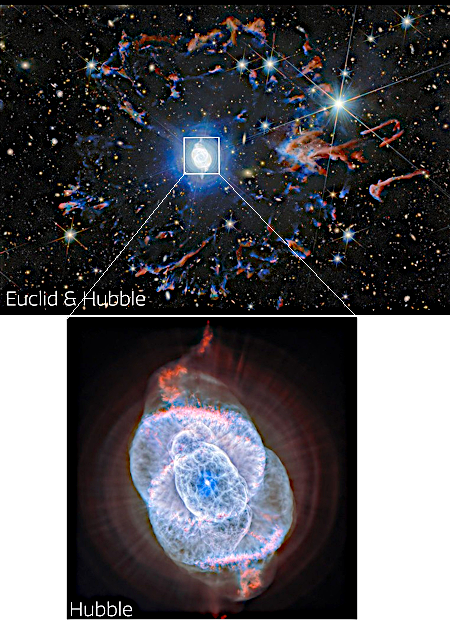
Click for original images.
Astronomers using both NASA’s long established Hubble Space Telescope and Europe’s new Euclid space telescope have produced new optical/infrared images of the Cat’s Eye planetary nebula.
Those images are to the right, cropped, reduced, and sharpened to post here. The Hubble image at bottom shows the complex structure of the nebula itself, located about 4,400 light years away and believed created by the inner orbital motions of a binary star system that act almost like the blades in a blender, mixing the material thrown off by one or both of the stars as they erupt in their latter stages of life.
In Euclid’s wide, near-infrared, and visible light view, the arcs and filaments of the nebula’s bright central region are situated within a halo of colorful fragments of gas zooming away from the star. This ring was ejected from the star at an earlier stage, before the main nebula at the center formed. The whole nebula stands out against a backdrop teeming with distant galaxies, demonstrating how local astrophysical beauty and the farthest reaches of the cosmos can be seen together with Euclid.
Euclid has a primary mirror 1.2 meters in diameter, about half that of Hubble. Though it can’t zoom in with the same resolution, its view is as sharp since it is in space above the atmosphere. It thus provides a wider view, which in this case helps provide a larger context to the detailed close-up view provided by Hubble.
In many ways Euclid is Hubble’s replacement, produced by the European Space Agency, as NASA and the American astronomy community has not been able to get together to build their own new optical orbiting telescope.

On Christmas Eve 1968 three Americans became the first humans to visit another world. What they did to celebrate was unexpected and profound, and will be remembered throughout all human history. Genesis: the Story of Apollo 8, Robert Zimmerman's classic history of humanity's first journey to another world, tells that story, and it is now available as both an ebook and an audiobook, both with a foreword by Valerie Anders and a new introduction by Robert Zimmerman.
The print edition can be purchased at Amazon or from any other book seller. If you want an autographed copy the price is $60 for the hardback and $45 for the paperback, plus $8 shipping for each. Go here for purchasing details. The ebook is available everywhere for $5.99 (before discount) at amazon, or direct from my ebook publisher, ebookit. If you buy it from ebookit you don't support the big tech companies and the author gets a bigger cut much sooner.
The audiobook is also available at all these vendors, and is also free with a 30-day trial membership to Audible.
"Not simply about one mission, [Genesis] is also the history of America's quest for the moon... Zimmerman has done a masterful job of tying disparate events together into a solid account of one of America's greatest human triumphs."--San Antonio Express-News
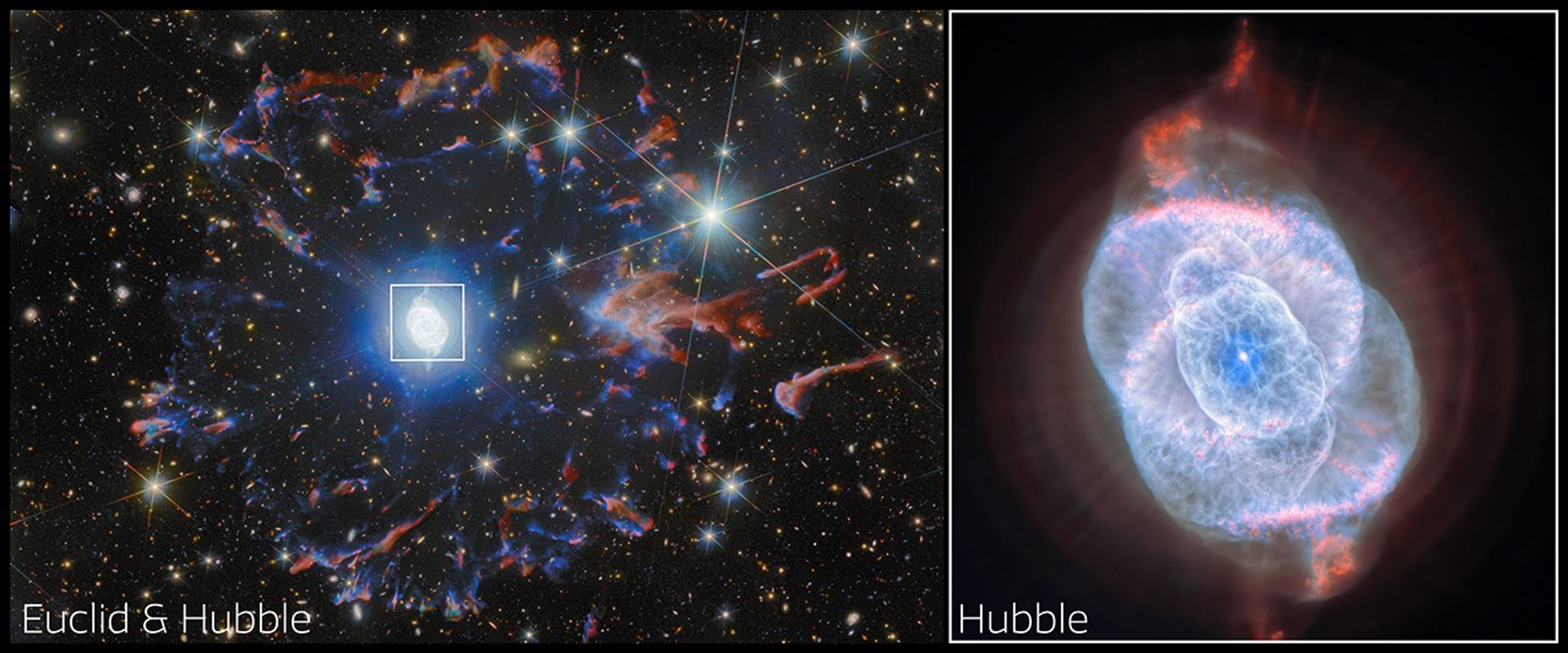
Click for original images.
Astronomers using both NASA’s long established Hubble Space Telescope and Europe’s new Euclid space telescope have produced new optical/infrared images of the Cat’s Eye planetary nebula.
Those images are to the right, cropped, reduced, and sharpened to post here. The Hubble image at bottom shows the complex structure of the nebula itself, located about 4,400 light years away and believed created by the inner orbital motions of a binary star system that act almost like the blades in a blender, mixing the material thrown off by one or both of the stars as they erupt in their latter stages of life.
In Euclid’s wide, near-infrared, and visible light view, the arcs and filaments of the nebula’s bright central region are situated within a halo of colorful fragments of gas zooming away from the star. This ring was ejected from the star at an earlier stage, before the main nebula at the center formed. The whole nebula stands out against a backdrop teeming with distant galaxies, demonstrating how local astrophysical beauty and the farthest reaches of the cosmos can be seen together with Euclid.
Euclid has a primary mirror 1.2 meters in diameter, about half that of Hubble. Though it can’t zoom in with the same resolution, its view is as sharp since it is in space above the atmosphere. It thus provides a wider view, which in this case helps provide a larger context to the detailed close-up view provided by Hubble.
In many ways Euclid is Hubble’s replacement, produced by the European Space Agency, as NASA and the American astronomy community has not been able to get together to build their own new optical orbiting telescope.
On Christmas Eve 1968 three Americans became the first humans to visit another world. What they did to celebrate was unexpected and profound, and will be remembered throughout all human history. Genesis: the Story of Apollo 8, Robert Zimmerman's classic history of humanity's first journey to another world, tells that story, and it is now available as both an ebook and an audiobook, both with a foreword by Valerie Anders and a new introduction by Robert Zimmerman.
The print edition can be purchased at Amazon or from any other book seller. If you want an autographed copy the price is $60 for the hardback and $45 for the paperback, plus $8 shipping for each. Go here for purchasing details. The ebook is available everywhere for $5.99 (before discount) at amazon, or direct from my ebook publisher, ebookit. If you buy it from ebookit you don't support the big tech companies and the author gets a bigger cut much sooner.
The audiobook is also available at all these vendors, and is also free with a 30-day trial membership to Audible.
"Not simply about one mission, [Genesis] is also the history of America's quest for the moon... Zimmerman has done a masterful job of tying disparate events together into a solid account of one of America's greatest human triumphs."--San Antonio Express-News
“In many ways Euclid is Hubble’s replacement, produced by the European Space Agency, as NASA and the American astronomy community has not been able to get together to start their own new optical orbiting telescope.”
It *is* pitiful that it’s taken this long, but we do have Roman* nearly ready to go (it does cover some visible light spectrum), and, more auspiciously, we now have our first major private sector telescope coming in the form of Lazuli**. So, it could be worse!
It is just as well, since Hubble isn’t going to be up there a whole lot longer as things stand now…
___
* Launch September 2026 NET
** Launch 2029 NET, but more likely early 2030s
” . . . , as NASA and the American astronomy community has not been able to get together to start their own new optical orbiting telescope.”
It takes a lot of resources to lobby politicians to restrict Western satcons.