Orion completes short 15-second burn to refine its return-to-Earth
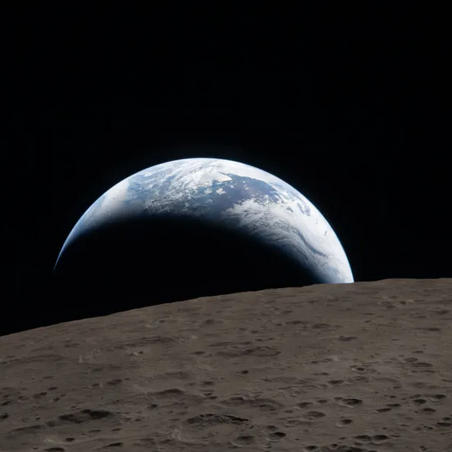
The Earth as seen from Orion just before the capsule swung behind
the Moon yesterday. Click for this and other Artemis-2 lunar images.
The Orion capsule today completed a 15-second engine burn in order to fine-tune its return path for splashdown in the Pacific Ocean on April 10th.
At 8:03 p.m. EDT, the Orion spacecraft, named Integrity, ignited its thrusters for 15 seconds, producing a change in velocity of 1.6 feet-per-second and guiding the Artemis II crew toward Earth. NASA astronaut Christina Koch and CSA (Canadian Space Agency) astronaut Jeremy Hansen reviewed procedures and monitored the spacecraft’s configuration and navigation data.
During today’s mission status briefing, NASA officials shared the first images received from the crew during the lunar flyby and confirmed that the USS John P. Murtha has left port and is headed to the midway point toward the recovery site in the Pacific Ocean.
This was Orion’s first engine burn since it left Earth orbit on April 2, 2026. Unlike the Apollo missions to the Moon in the 1960s-1970s, which involved entering and leaving lunar orbit and doing complex maneuvers while there, the Artemis-2 mission around the Moon has largely been a passive one. The capsule was sent on this course at the start, and has been coasting since. Today’s burn was merely a small adjustment, not a major burn.
The re-entry on April 10, 2026 remains the key moment of the flight, as it has always been. Will that questionable heat shield do as NASA’s engineers predict and work to protect the four astronauts during re-entry? Or will it do things unexpected, because those engineers really don’t understand the engineering issues involved?
I am hopeful and optimistic. I also know that even if everything turns out fine, this flight will simply be a demonstration that NASA has learned nothing from the Challenger and Columbia accidents, and is still willing to risk human lives in order to win some political kudos and get some good PR. And for that reason I am not confident of the agency’s ability to truly do what it says, safely and competently.
One more note: Though the images being sent back are quite beautiful, they are hardly ground-breaking. Lunar Reconnaissance Orbiter has mapped the entire surface of the Moon at much great resolution, far better than anything seen on this mission. NASA might claim the astronauts are doing science, but most of it is minor and not very significant. When you get down to it, this is simply a very expensive tourist trip for four government employees, paid for at an ungodly cost by the American taxpayer.

On Christmas Eve 1968 three Americans became the first humans to visit another world. What they did to celebrate was unexpected and profound, and will be remembered throughout all human history. Genesis: the Story of Apollo 8, Robert Zimmerman's classic history of humanity's first journey to another world, tells that story, and it is now available as both an ebook and an audiobook, both with a foreword by Valerie Anders and a new introduction by Robert Zimmerman.
The print edition can be purchased at Amazon or from any other book seller. If you want an autographed copy the price is $60 for the hardback and $45 for the paperback, plus $8 shipping for each. Go here for purchasing details. The ebook is available everywhere for $5.99 (before discount) at amazon, or direct from my ebook publisher, ebookit. If you buy it from ebookit you don't support the big tech companies and the author gets a bigger cut much sooner.
The audiobook is also available at all these vendors, and is also free with a 30-day trial membership to Audible.
"Not simply about one mission, [Genesis] is also the history of America's quest for the moon... Zimmerman has done a masterful job of tying disparate events together into a solid account of one of America's greatest human triumphs."--San Antonio Express-News
The Earth as seen from Orion just before the capsule swung behind
the Moon yesterday. Click for this and other Artemis-2 lunar images.
The Orion capsule today completed a 15-second engine burn in order to fine-tune its return path for splashdown in the Pacific Ocean on April 10th.
At 8:03 p.m. EDT, the Orion spacecraft, named Integrity, ignited its thrusters for 15 seconds, producing a change in velocity of 1.6 feet-per-second and guiding the Artemis II crew toward Earth. NASA astronaut Christina Koch and CSA (Canadian Space Agency) astronaut Jeremy Hansen reviewed procedures and monitored the spacecraft’s configuration and navigation data.
During today’s mission status briefing, NASA officials shared the first images received from the crew during the lunar flyby and confirmed that the USS John P. Murtha has left port and is headed to the midway point toward the recovery site in the Pacific Ocean.
This was Orion’s first engine burn since it left Earth orbit on April 2, 2026. Unlike the Apollo missions to the Moon in the 1960s-1970s, which involved entering and leaving lunar orbit and doing complex maneuvers while there, the Artemis-2 mission around the Moon has largely been a passive one. The capsule was sent on this course at the start, and has been coasting since. Today’s burn was merely a small adjustment, not a major burn.
The re-entry on April 10, 2026 remains the key moment of the flight, as it has always been. Will that questionable heat shield do as NASA’s engineers predict and work to protect the four astronauts during re-entry? Or will it do things unexpected, because those engineers really don’t understand the engineering issues involved?
I am hopeful and optimistic. I also know that even if everything turns out fine, this flight will simply be a demonstration that NASA has learned nothing from the Challenger and Columbia accidents, and is still willing to risk human lives in order to win some political kudos and get some good PR. And for that reason I am not confident of the agency’s ability to truly do what it says, safely and competently.
One more note: Though the images being sent back are quite beautiful, they are hardly ground-breaking. Lunar Reconnaissance Orbiter has mapped the entire surface of the Moon at much great resolution, far better than anything seen on this mission. NASA might claim the astronauts are doing science, but most of it is minor and not very significant. When you get down to it, this is simply a very expensive tourist trip for four government employees, paid for at an ungodly cost by the American taxpayer.
On Christmas Eve 1968 three Americans became the first humans to visit another world. What they did to celebrate was unexpected and profound, and will be remembered throughout all human history. Genesis: the Story of Apollo 8, Robert Zimmerman's classic history of humanity's first journey to another world, tells that story, and it is now available as both an ebook and an audiobook, both with a foreword by Valerie Anders and a new introduction by Robert Zimmerman.
The print edition can be purchased at Amazon or from any other book seller. If you want an autographed copy the price is $60 for the hardback and $45 for the paperback, plus $8 shipping for each. Go here for purchasing details. The ebook is available everywhere for $5.99 (before discount) at amazon, or direct from my ebook publisher, ebookit. If you buy it from ebookit you don't support the big tech companies and the author gets a bigger cut much sooner.
The audiobook is also available at all these vendors, and is also free with a 30-day trial membership to Audible.
"Not simply about one mission, [Genesis] is also the history of America's quest for the moon... Zimmerman has done a masterful job of tying disparate events together into a solid account of one of America's greatest human triumphs."--San Antonio Express-News