Predicting dust storms in the Starship candidate landing zone on Mars
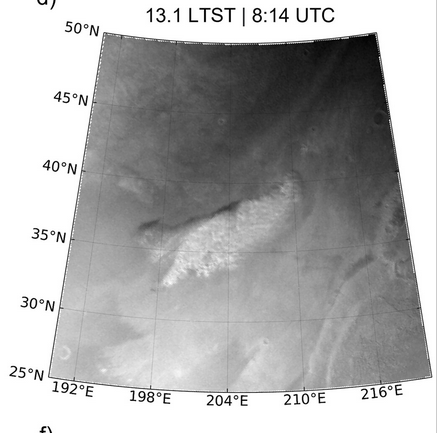
Click for original figure.
Scientists using the UAE’s Al-Amal Mars orbiter were able to track two near-identical dust storms that occurred in the northern lowland plains of Mars and near the candidate landing zone for SpaceX’s Starship spacecraft.
The image to the right comes from figure 2 of the paper, and was taken by Al-Amal approximately 25,000 miles above the red planet’s surface. By comparing the growth and evolution of both storms, the scientists now think they have a method for predicting when such storms occur in this region. From their abstract:
Our observational case study constrains scenarios presented by Ogohara (2025). We show the first scenario, summarized in Section 5 of Ogohara (2025), [explains] dust storms 1 and 2. This scenario is as follows. Dust storms form in the later morning hours through combined effects of the warm sector of a low-pressure system and daytime phenomena. The low-pressure system is associated with wavenumber 3 baroclinic waves.
There is no doubt that dust storms 1 and 2 start to form and develop in the late morning hours, in or near the warm sector of a low-pressure system. Also, combined effects of this low-pressure system and daytime convection are possible. This is supported by evidence for daytime convection, such as the dust devil number in MY 28 and planetary boundary layer height estimates from the Mars Climate Database.
In other words, future SpaceX colonists should be prepared for late morning dust storms when a low-pressure system moves in.

On Christmas Eve 1968 three Americans became the first humans to visit another world. What they did to celebrate was unexpected and profound, and will be remembered throughout all human history. Genesis: the Story of Apollo 8, Robert Zimmerman's classic history of humanity's first journey to another world, tells that story, and it is now available as both an ebook and an audiobook, both with a foreword by Valerie Anders and a new introduction by Robert Zimmerman.
The print edition can be purchased at Amazon or from any other book seller. If you want an autographed copy the price is $60 for the hardback and $45 for the paperback, plus $8 shipping for each. Go here for purchasing details. The ebook is available everywhere for $5.99 (before discount) at amazon, or direct from my ebook publisher, ebookit. If you buy it from ebookit you don't support the big tech companies and the author gets a bigger cut much sooner.
The audiobook is also available at all these vendors, and is also free with a 30-day trial membership to Audible.
"Not simply about one mission, [Genesis] is also the history of America's quest for the moon... Zimmerman has done a masterful job of tying disparate events together into a solid account of one of America's greatest human triumphs."--San Antonio Express-News

Click for original figure.
Scientists using the UAE’s Al-Amal Mars orbiter were able to track two near-identical dust storms that occurred in the northern lowland plains of Mars and near the candidate landing zone for SpaceX’s Starship spacecraft.
The image to the right comes from figure 2 of the paper, and was taken by Al-Amal approximately 25,000 miles above the red planet’s surface. By comparing the growth and evolution of both storms, the scientists now think they have a method for predicting when such storms occur in this region. From their abstract:
Our observational case study constrains scenarios presented by Ogohara (2025). We show the first scenario, summarized in Section 5 of Ogohara (2025), [explains] dust storms 1 and 2. This scenario is as follows. Dust storms form in the later morning hours through combined effects of the warm sector of a low-pressure system and daytime phenomena. The low-pressure system is associated with wavenumber 3 baroclinic waves.
There is no doubt that dust storms 1 and 2 start to form and develop in the late morning hours, in or near the warm sector of a low-pressure system. Also, combined effects of this low-pressure system and daytime convection are possible. This is supported by evidence for daytime convection, such as the dust devil number in MY 28 and planetary boundary layer height estimates from the Mars Climate Database.
In other words, future SpaceX colonists should be prepared for late morning dust storms when a low-pressure system moves in.
On Christmas Eve 1968 three Americans became the first humans to visit another world. What they did to celebrate was unexpected and profound, and will be remembered throughout all human history. Genesis: the Story of Apollo 8, Robert Zimmerman's classic history of humanity's first journey to another world, tells that story, and it is now available as both an ebook and an audiobook, both with a foreword by Valerie Anders and a new introduction by Robert Zimmerman.
The print edition can be purchased at Amazon or from any other book seller. If you want an autographed copy the price is $60 for the hardback and $45 for the paperback, plus $8 shipping for each. Go here for purchasing details. The ebook is available everywhere for $5.99 (before discount) at amazon, or direct from my ebook publisher, ebookit. If you buy it from ebookit you don't support the big tech companies and the author gets a bigger cut much sooner.
The audiobook is also available at all these vendors, and is also free with a 30-day trial membership to Audible.
"Not simply about one mission, [Genesis] is also the history of America's quest for the moon... Zimmerman has done a masterful job of tying disparate events together into a solid account of one of America's greatest human triumphs."--San Antonio Express-News
Can’t wait to plug this location in to accuweather for the seven day outlook!!
Weather obviously matters for a Mars Starship landing. IMO, a level landing area matters just as much and maybe more. So many recent lunar landers fell over when they touched down. IIRC Viking 2 landed about ten degrees off, and at least one Lunar Module also landed a little off. This doesn’t get attention like Mars weather, but I’m sure that SpaceX heavily plans for it.
The winds of Mars have no force, but static electricity will be a threat. HAM radio function squirrelly. I would not trust smartphone tech…at all. 1977 Voyager tech might even have problems.
I remember a wet soccer field where but a single lightning strike felled many players.
Brines a similar threat?
Consider fluidics, Elon.
And all optical computing as back up.
No touch screens.
You have a 1950’s rocket. I want to see 1950’s switches and nixie tubes. NORAD stuff.
Low pressure system? Fascinating, I thought Martian atmosphere was too uniform for such things to occur.
On earth, low pressures are caused by air with lower temperatures, with the most common cause being a storm with a large amount of water mass and humidity. (water when frozen expands becoming lighter or fluffier… when heated, it expands many times it’s normal size becoming buoyant enough to float next to our stratosphere, despite being 4 hydrogen atoms heavier then normal air)
As water vapor expands becoming fluffy taking up more space, heavier nitrogen and oxygen must move out of the way resulting in a drop in air pressure and temperature. This void creates a vacuum resulting in wind which always blows towards the negative air pressure. Wind friction, because it takes energy to force air to move, results in higher air temperatures of a few degrees. Upon reaching the low air pressure, the wind cools and condenses creating more vacuum. Eventually the storm vortex breaks up and spreads out.
This makes me wonder if the near surface water they detected in this area is creating the circumstances for a low pressure event? I’m not going to presume what works on Mars is like earth… especially since CO2 is closer in atomic weight with H402.
I also do not see vortex movement associated with these dust storms, not a cyclone as associated with storms on earth.
But then Mars does not have magnetic field. On earth the storms have a PH (natural acid rain) that induces current, sometimes lightning, which drives the storm to move circular inside of a strong magnetic field.
The closest to a vortex is UV charged dust creating dust devils.
(water when frozen expands becoming lighter or fluffier… when heated, it expands many times it’s normal size becoming buoyant enough to float next to our stratosphere, despite being 4 hydrogen atoms heavier then normal air)
H2O at 18 would seem to be lighter than N2 at 28 and O2 at 32,
On electric fields
https://phys.org/news/2025-11-electric-discharges-mars.html
Lightning?
https://phys.org/news/2025-11-scientists-capture-crackling-lightning-mars.html
John Hare;
H2O is an algebraic Simplification of H4O2.
H2O does not occur in nature except perhaps during a northern lights display. Monoatomic oxygen in the outer atmosphere will combine with anything. Colors change as Solar gases descend into the normal oxygen and ozone layers.
As you pointed out, 18 atomic weight of H2O is lighter than normal air and therefore all water would rise away from the planet surface to the upper atmosphere, just as all light elements and molecules do.
Also when splitting H402 water molecules with electrolysis, we get 2(H2) on one side and 2O on the other.