
Russia’s latest plans for its post-ISS space station
Click for full resolution image.
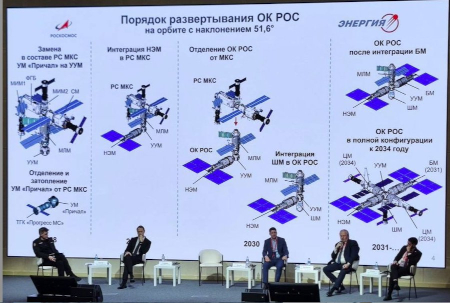
Anatoly Zak yesterday posted the picture to the right, showing a presentation by Russian officials of Roscosmos’ latest plans for its transition from ISS to their own Russian Orbital Station (ROS). Though it is in Russian, I think I can glean from it some significant take-aways about Russia’s future space plans.
First, if these plans proceed as planned (doubtful based on Russia’s track record in the past three decades), at some point in the next four years they will attach a new module to ISS, docking with the Prichal docking hub, launched in 2021. Then in 2030 they will undock this new module as well as Prichal and the Nauka module, which also launched in 2021, and use these three modules as the core of their new station.
That 2030 date is significant, as it is an admission by Russia that it intends to stay with ISS until then. Up till now Roscosmos has only committed to ISS through 2028, even though NASA and its partners at ESA and Japan have set 2030 as ISS’s present retirement date.
Second, they plan to add more modules to this core station, beginning in 2031, and by 2034 to have completed a four-module cross-shaped station with Prichal as the central hub. That completion date is one year later than the timeline Russia announced in 2024, when it claimed ROS would be completed in 2033. That 2024 timeline also said ROS’s first module would be launched in 2027, but the graphic to the right no longer gives any date for that launch. I suspect 2027 is extremely unlikely.
Finally, don’t expect the new modules promised in the 2031-2034 timeframe to launch on schedule either. As I note above, all Russian space projects in this century have routinely been delayed repeatedly, with most never launching at all.
This plan also makes no mention of an agreement with India in December 2025 to coordinate the construction of its station with Russia’s, flying both in the same inclination presently used by ISS. This is not really a surprise, as both projects will operate independently, so that delays in one do not impact the other.
Hat tip BtB’s stringer Jay.

On Christmas Eve 1968 three Americans became the first humans to visit another world. What they did to celebrate was unexpected and profound, and will be remembered throughout all human history. Genesis: the Story of Apollo 8, Robert Zimmerman's classic history of humanity's first journey to another world, tells that story, and it is now available as both an ebook and an audiobook, both with a foreword by Valerie Anders and a new introduction by Robert Zimmerman.
The print edition can be purchased at Amazon or from any other book seller. If you want an autographed copy the price is $60 for the hardback and $45 for the paperback, plus $8 shipping for each. Go here for purchasing details. The ebook is available everywhere for $5.99 (before discount) at amazon, or direct from my ebook publisher, ebookit. If you buy it from ebookit you don't support the big tech companies and the author gets a bigger cut much sooner.
The audiobook is also available at all these vendors, and is also free with a 30-day trial membership to Audible.
"Not simply about one mission, [Genesis] is also the history of America's quest for the moon... Zimmerman has done a masterful job of tying disparate events together into a solid account of one of America's greatest human triumphs."--San Antonio Express-News
Click for full resolution image.
Anatoly Zak yesterday posted the picture to the right, showing a presentation by Russian officials of Roscosmos’ latest plans for its transition from ISS to their own Russian Orbital Station (ROS). Though it is in Russian, I think I can glean from it some significant take-aways about Russia’s future space plans.
First, if these plans proceed as planned (doubtful based on Russia’s track record in the past three decades), at some point in the next four years they will attach a new module to ISS, docking with the Prichal docking hub, launched in 2021. Then in 2030 they will undock this new module as well as Prichal and the Nauka module, which also launched in 2021, and use these three modules as the core of their new station.
That 2030 date is significant, as it is an admission by Russia that it intends to stay with ISS until then. Up till now Roscosmos has only committed to ISS through 2028, even though NASA and its partners at ESA and Japan have set 2030 as ISS’s present retirement date.
Second, they plan to add more modules to this core station, beginning in 2031, and by 2034 to have completed a four-module cross-shaped station with Prichal as the central hub. That completion date is one year later than the timeline Russia announced in 2024, when it claimed ROS would be completed in 2033. That 2024 timeline also said ROS’s first module would be launched in 2027, but the graphic to the right no longer gives any date for that launch. I suspect 2027 is extremely unlikely.
Finally, don’t expect the new modules promised in the 2031-2034 timeframe to launch on schedule either. As I note above, all Russian space projects in this century have routinely been delayed repeatedly, with most never launching at all.
This plan also makes no mention of an agreement with India in December 2025 to coordinate the construction of its station with Russia’s, flying both in the same inclination presently used by ISS. This is not really a surprise, as both projects will operate independently, so that delays in one do not impact the other.
Hat tip BtB’s stringer Jay.
On Christmas Eve 1968 three Americans became the first humans to visit another world. What they did to celebrate was unexpected and profound, and will be remembered throughout all human history. Genesis: the Story of Apollo 8, Robert Zimmerman's classic history of humanity's first journey to another world, tells that story, and it is now available as both an ebook and an audiobook, both with a foreword by Valerie Anders and a new introduction by Robert Zimmerman.
The print edition can be purchased at Amazon or from any other book seller. If you want an autographed copy the price is $60 for the hardback and $45 for the paperback, plus $8 shipping for each. Go here for purchasing details. The ebook is available everywhere for $5.99 (before discount) at amazon, or direct from my ebook publisher, ebookit. If you buy it from ebookit you don't support the big tech companies and the author gets a bigger cut much sooner.
The audiobook is also available at all these vendors, and is also free with a 30-day trial membership to Audible.
"Not simply about one mission, [Genesis] is also the history of America's quest for the moon... Zimmerman has done a masterful job of tying disparate events together into a solid account of one of America's greatest human triumphs."--San Antonio Express-News