Scientists: Shadowcam images suggest there is little water in permanently shadowed lunar craters
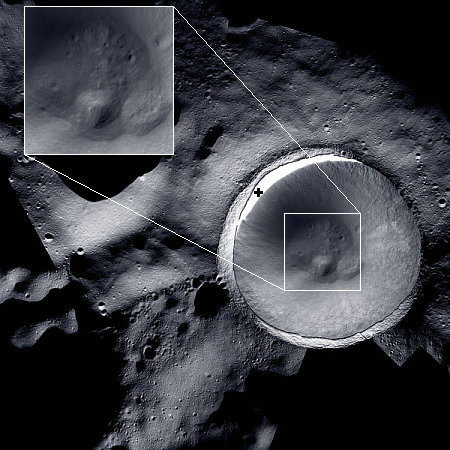
The floor of Shackleton Crater showing no obvious ice deposits,
as seen by Shadowcam, imposed on a Lunar Reconnaissance Orbiter
image. The black cross marks the south pole. Click for original image.
In a new paper published yesterday, the science team for the low-light Shadowcam instrument on South Korea’s lunar orbiter Danuri confirmed their earlier conclusion from 2024, that there appears to be far less water ice than expected in the permanently shadowed lunar craters near the Moon’s south pole. From their abstract:
We used the high-reflectance and forward-scattering optical properties to search for water ice in lunar PSRs [permanently shaded regions]. We found no evidence of widespread water ice in PSRs at abundances above the detection limit of 20 to 30 wt % but could not rule out widespread low-content water ice. A few small locations with both high reflectance and forward-scattering behavior were observed, which could be consistent with >10 wt % ice.
And from their conclusion:
Our manual examination of ShadowCam radiance images that cover all lunar PSRs suggests either that most of the lunar PSRs lack surface ice exposures or that their ice concentration is below the detection limit, approximately 20 to 30 wt % on the basis of the visible reflectance enhancement, which aligns well with previous ShadowCam findings. Only a few candidate high-reflectance anomalies were seen, which, if they are water ice, is consistent with previous sparse detections of lunar surface water ice.
There is still a chance there is water ice in these permanently shadowed craters, but it appears once again that if it exists, it will likely require processing to extract it from the soil, and there won’t be that much available regardless.
These results are not conclusive, but they do suggest that the south pole of the Moon will not be as ideal a location for a lunar base as previously imagined.

On Christmas Eve 1968 three Americans became the first humans to visit another world. What they did to celebrate was unexpected and profound, and will be remembered throughout all human history. Genesis: the Story of Apollo 8, Robert Zimmerman's classic history of humanity's first journey to another world, tells that story, and it is now available as both an ebook and an audiobook, both with a foreword by Valerie Anders and a new introduction by Robert Zimmerman.
The print edition can be purchased at Amazon or from any other book seller. If you want an autographed copy the price is $60 for the hardback and $45 for the paperback, plus $8 shipping for each. Go here for purchasing details. The ebook is available everywhere for $5.99 (before discount) at amazon, or direct from my ebook publisher, ebookit. If you buy it from ebookit you don't support the big tech companies and the author gets a bigger cut much sooner.
The audiobook is also available at all these vendors, and is also free with a 30-day trial membership to Audible.
"Not simply about one mission, [Genesis] is also the history of America's quest for the moon... Zimmerman has done a masterful job of tying disparate events together into a solid account of one of America's greatest human triumphs."--San Antonio Express-News

The floor of Shackleton Crater showing no obvious ice deposits,
as seen by Shadowcam, imposed on a Lunar Reconnaissance Orbiter
image. The black cross marks the south pole. Click for original image.
In a new paper published yesterday, the science team for the low-light Shadowcam instrument on South Korea’s lunar orbiter Danuri confirmed their earlier conclusion from 2024, that there appears to be far less water ice than expected in the permanently shadowed lunar craters near the Moon’s south pole. From their abstract:
We used the high-reflectance and forward-scattering optical properties to search for water ice in lunar PSRs [permanently shaded regions]. We found no evidence of widespread water ice in PSRs at abundances above the detection limit of 20 to 30 wt % but could not rule out widespread low-content water ice. A few small locations with both high reflectance and forward-scattering behavior were observed, which could be consistent with >10 wt % ice.
And from their conclusion:
Our manual examination of ShadowCam radiance images that cover all lunar PSRs suggests either that most of the lunar PSRs lack surface ice exposures or that their ice concentration is below the detection limit, approximately 20 to 30 wt % on the basis of the visible reflectance enhancement, which aligns well with previous ShadowCam findings. Only a few candidate high-reflectance anomalies were seen, which, if they are water ice, is consistent with previous sparse detections of lunar surface water ice.
There is still a chance there is water ice in these permanently shadowed craters, but it appears once again that if it exists, it will likely require processing to extract it from the soil, and there won’t be that much available regardless.
These results are not conclusive, but they do suggest that the south pole of the Moon will not be as ideal a location for a lunar base as previously imagined.
On Christmas Eve 1968 three Americans became the first humans to visit another world. What they did to celebrate was unexpected and profound, and will be remembered throughout all human history. Genesis: the Story of Apollo 8, Robert Zimmerman's classic history of humanity's first journey to another world, tells that story, and it is now available as both an ebook and an audiobook, both with a foreword by Valerie Anders and a new introduction by Robert Zimmerman.
The print edition can be purchased at Amazon or from any other book seller. If you want an autographed copy the price is $60 for the hardback and $45 for the paperback, plus $8 shipping for each. Go here for purchasing details. The ebook is available everywhere for $5.99 (before discount) at amazon, or direct from my ebook publisher, ebookit. If you buy it from ebookit you don't support the big tech companies and the author gets a bigger cut much sooner.
The audiobook is also available at all these vendors, and is also free with a 30-day trial membership to Audible.
"Not simply about one mission, [Genesis] is also the history of America's quest for the moon... Zimmerman has done a masterful job of tying disparate events together into a solid account of one of America's greatest human triumphs."--San Antonio Express-News
Not a particularly surprising conclusion – at least to me. But then I’ve been a lunar water skeptic pretty much since the get-go.
This means that the lunar poles are no longer prime real estate for any lunar base concept that was predicated on large supplies of native water. The poles are still the only places where “always-on” solar electric power can be a thing so the poles still seem the best locations at which to bootstrap the sort of large-scale industrialization Elon Musk is now bent on accomplishing. With both the PRC and NASA now hinting at sites far from the poles as targets for their respective initial/next human lunar landings, the poles might well get left to Elon by default.
I’m with you…I never did buy into lunar water.
It is still a good idea to have a base at either pole…in that both bases can receive constant power and are so far from each other to allow for triangulation for defense needs.
With no atmosphere, no rats, no oceans one might lay cable longitudinally from pole to pole.
Might that allow for a Dyson Harrop style generation of electricity without having vast acres of solar panels?
Power would run down the cable to a series of rovers from each pole….maybe a golden spike where the two meet :
This could be repeated, this time a spiral route.
Disappointing if true. But we will still need some ground truth from landers, drones, and rivers with the necessary instrumentation to really be sure….and those are, fortunately, in preparation.
“Our manual examination of ShadowCam radiance images . . . ”
‘Look Ma! No AI!’ It seems that Human vetting, or, participation, in a process is now noteworthy. ‘AI’ appears on the way to becoming slang for ‘lazy’. “Oh, yeah. Jimmy just AI’d it.” Agents definitely have a place in the Human knowledge acquisition and expression spaces: we’re still trying to figure out where the current expression fits.
Jeff Wright,
Pole-to-pole lunar electricity transmission infrastructure is something I’ve also been thinking about. I figure the pole-to-pole lunar electricity cables should be run through tunnels that can maintain a temperature low enough to allow superconductivity. I’ve been working on an idea for multiple such cables called “Project Basketball” as the cable routes would somewhat resemble the pseudo-seams on that class of sportsball, radiating out from each pole. Surface PV solar fields could be constructed at intervals along each cable to feed in additional energy. Surface rectenna fields could also figure in the mix and be fed by phased-array antennae on orbiting solar power satellites. The power would flow to the poles where the main industrial sites would be located.
The nice thing is that such a system could be built out incrementally from quite a modest beginning at each pole. Multiple cable routes radiating from the poles would always allow at least half of the associated surface solar arrays to be in sunlight except during lunar eclipses. Given the steerable nature of phased-array antennae beams, more than 50% of rectenna fields could likely be absorbing power from the orbiting powersats at any given time as well and the powersats could be placed in orbits high enough to avoid being shaded by lunar eclipses.
There is also no necessity for any Golden Spike moment before the whole thing is useful. At whatever point Golden Spike moments occur along any of the cable routes, it would simply become possible to wheel power in either direction to improve resiliency. But, unlike a transcontinental railroad, the whole thing doesn’t have to be completed before accomplishing its primary task.
It’s important to start building on the Moon, and to start processing materials there and see what we can do. On thing to remember, though – certain elements are very scarce. These include N, H, and Cu. So long copper wire might be a problem, leading to likely placement of materials processing right next to power generating equipment, whether solar or atomic. there are ways to store heat energy thru the lunar night, for example directing solar power to a pit, heating it up until contents are molten. Above a certain size, it will stay hot thru the 14 day lunar night. And don’t forget it’s a steady -20 six feet down in the dirt.
The focus on the poles really was on production of H2 and O2 for rocket motors that use those propellants. But my guess is that if H2 is found in abundance in those eternally cold craters, it will be far, far too valuable as an element in materials processing to permit it to be burned as a rocket propellant.