Space Force shifts another ULA Vulcan launch to SpaceX
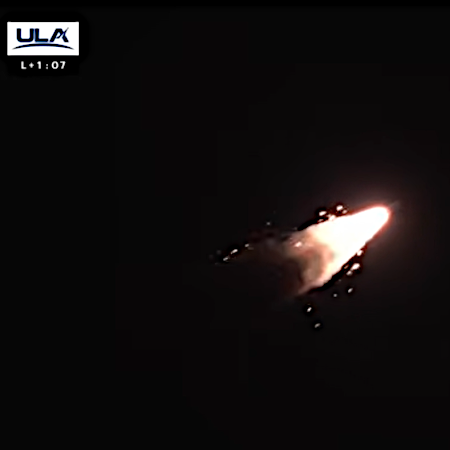
Nozzle failure during February 12, 2026 Vulcan launch
As expected, the Space Force has taken its next GPS satellite launch from ULA’s Vulcan rocket and given it to SpaceX’s Falcon 9.
The reason for the change is the repeated problems with the solid-fueled side boosters used on Vulcan and built by Northrop Grumman. The nozzles on two different launches failed. Though the rocket’s core stage in both cases was able compensate and get the payload into the proper orbit, the Space Force decided in late February to suspend further launches on Vulcan until ULA gets the problem fixed and proves it by launching other commercial payloads.
The Space Force however is not yet reducing the number of launches it has purchased from ULA, merely delaying them.
If all goes to plan, the satellite — the 10th and final one in the GPS III line — will lift off no earlier than late April from Space Launch Complex 40 at Cape Canaveral Space Force Station in Florida [on a Falcon 9].
Vulcan Centaur, in return, will launch USSF-70, a national security mission that had been manifested on a SpaceX Falcon Heavy. USSF-70 will fly no earlier than summer 2028, according to Space Force officials.
Nonetheless, the situation is not good for ULA. This is the third such ULA launch the Space Force has shifted to SpaceX. At some point, if ULA doesn’t get the problem fixed the military it will be forced to reduce its reliance on Vulcan.

On Christmas Eve 1968 three Americans became the first humans to visit another world. What they did to celebrate was unexpected and profound, and will be remembered throughout all human history. Genesis: the Story of Apollo 8, Robert Zimmerman's classic history of humanity's first journey to another world, tells that story, and it is now available as both an ebook and an audiobook, both with a foreword by Valerie Anders and a new introduction by Robert Zimmerman.
The print edition can be purchased at Amazon or from any other book seller. If you want an autographed copy the price is $60 for the hardback and $45 for the paperback, plus $8 shipping for each. Go here for purchasing details. The ebook is available everywhere for $5.99 (before discount) at amazon, or direct from my ebook publisher, ebookit. If you buy it from ebookit you don't support the big tech companies and the author gets a bigger cut much sooner.
The audiobook is also available at all these vendors, and is also free with a 30-day trial membership to Audible.
"Not simply about one mission, [Genesis] is also the history of America's quest for the moon... Zimmerman has done a masterful job of tying disparate events together into a solid account of one of America's greatest human triumphs."--San Antonio Express-News
Nozzle failure during February 12, 2026 Vulcan launch
As expected, the Space Force has taken its next GPS satellite launch from ULA’s Vulcan rocket and given it to SpaceX’s Falcon 9.
The reason for the change is the repeated problems with the solid-fueled side boosters used on Vulcan and built by Northrop Grumman. The nozzles on two different launches failed. Though the rocket’s core stage in both cases was able compensate and get the payload into the proper orbit, the Space Force decided in late February to suspend further launches on Vulcan until ULA gets the problem fixed and proves it by launching other commercial payloads.
The Space Force however is not yet reducing the number of launches it has purchased from ULA, merely delaying them.
If all goes to plan, the satellite — the 10th and final one in the GPS III line — will lift off no earlier than late April from Space Launch Complex 40 at Cape Canaveral Space Force Station in Florida [on a Falcon 9].
Vulcan Centaur, in return, will launch USSF-70, a national security mission that had been manifested on a SpaceX Falcon Heavy. USSF-70 will fly no earlier than summer 2028, according to Space Force officials.
Nonetheless, the situation is not good for ULA. This is the third such ULA launch the Space Force has shifted to SpaceX. At some point, if ULA doesn’t get the problem fixed the military it will be forced to reduce its reliance on Vulcan.
On Christmas Eve 1968 three Americans became the first humans to visit another world. What they did to celebrate was unexpected and profound, and will be remembered throughout all human history. Genesis: the Story of Apollo 8, Robert Zimmerman's classic history of humanity's first journey to another world, tells that story, and it is now available as both an ebook and an audiobook, both with a foreword by Valerie Anders and a new introduction by Robert Zimmerman.
The print edition can be purchased at Amazon or from any other book seller. If you want an autographed copy the price is $60 for the hardback and $45 for the paperback, plus $8 shipping for each. Go here for purchasing details. The ebook is available everywhere for $5.99 (before discount) at amazon, or direct from my ebook publisher, ebookit. If you buy it from ebookit you don't support the big tech companies and the author gets a bigger cut much sooner.
The audiobook is also available at all these vendors, and is also free with a 30-day trial membership to Audible.
"Not simply about one mission, [Genesis] is also the history of America's quest for the moon... Zimmerman has done a masterful job of tying disparate events together into a solid account of one of America's greatest human triumphs."--San Antonio Express-News
I can’t blame them.
Vulcan is a sorry rocket… designed by folks in Colorado as per James Knauf (Byeman, Jim, etc)
Northrop’s quality control (or is it quality assessment?) problems are really costing ULA.
Even if ULA can book the revenue for a swapped NSSL payload later this year, as planned (and that is not a sure thing), they are clearly going to launch significantly fewer payloads in 2026. That’s lost revenue on this fiscal year.
As I mentioned in a previous comment, John Elbon made a statement a few days ago that Vulcan would be launching again this summer (presumably a commercial payload, but he did not specify), suggesting that they and NG had sorted out the nozzle problem. For their sake, I hope so; but I think we need the Space Force to confirm it, and so far they have not.
You can bet ULA is pressing Northrop hard over the GEM 63s; they have an otherwise fine product hampered by third-party failures. While not even SpaceX does everything in-house, having their propulsion run internally is a huge benefit for them. Too bad that wasn’t an option for ULA.
Maybe instead of going with the NG GEM-60 in 2015, ULA should have stuck with the Rocketdyne AJ-60A that had been used on Atlas V since the start.
Looks like Tory Bruno made a bad call 11 years ago that is just now showing up.
Publius,
The first thing to be said about the GEM is that it delivers 2,026 kN, which is almost 20% more thrust than the AJ60A did.
But what ULA said at that time for their rationale in taking the ATK bid over AJR was that it was significantly cheaper. Maybe you’d say you get what you pay for, but given ATK’s experience with solids, I don’t think it was unreasonable to think they’d be reliable.
Anyway, as Nate says, outsourcing all of their propulsion has always been a risk that ULA has been forced to live with.
Richard M:
You are conflating the GEM60XL with the GEM60. The GEM60 is a “drop in” replacement for the AJ60A. Basically the same propellant load. The GEM60XL is a stretched version in length thus allowing the 20% greater propellant load.
The public statements by ULA in 2015 was that the unit cost for AJ was 50% greater. At the same time the GEM nozzels were having uneven burn issues, stated in public sources. It would give cause for pause if the GEM nozzel.geometry was being test.to the four corners of the box?
No inside knowledge here but maybe Tory did’t push back enough on his engineers to buy enough risk down expecially given the delays the whole Vulcan program was encountering. Since there was a 50% cost difference between the “drop in” replacements that would have raised red flags on a “commodity item” like SRBs. Corners were cut that is the only explanation for such a cost delta on nearly identical things.
Take some of the margin and ask for the GEM to do some extensive testing to failure of the nozzels so the corners of the box are well known.
35 years of Systems Engineering tells me when a supplier is [deleted]. Seriously telling me their commodity product is 50% cheaper?
“Anyway, as Nate says, outsourcing all of their propulsion has always been a risk that ULA has been forced to live with”
Another Fallacy. No one is FORCED to live with a Risk. They CHOOSE to live with the risk.
If I had been in Tory’s shoes the conservative route would have given 10% of the saving back in exchange for extensive instrumented testing that my engineers could watch closely OR go back to Rocketdyne and tell them if they want the deal to eat 60% of the cost delta between the two since they were the incumbant suppllier at the time.
I would have had enough risk with the new core stage that I would not have wanted to change strap on solids provider and add MORE risk. Get the vehicle launching and THEN tender an extended length srb RFP.
IMHO
Nate P said:
“You can bet ULA is pressing Northrop hard over the GEM 63s; they have an otherwise fine product hampered by third-party failures.”
Pressing hard having meetings. If the NGIS engineers had any technical fortitude then we would see them firing off GEMs under varying conditions until some.blew up like the SRB they blew the nozzel off in 2009. FIND THE CORNERS OF THE BOX. And be public about it. Make a failure blooper reel on Youtube. Show people you are testing all normal and edge conditions.
If I were ULA I would be sending love notes, boxes of chocolate, wine and brewskies to Rocketdyne about a second supplier.
They are clearly not making Space Force comfortable with their recovery plan.
“While not even SpaceX does everything in-house, having their propulsion run internally is a huge benefit for them.”
I believe that Elon has nightmares about naked COPVs filled with Helium immersed in supercooled liquids… :)
SpaceX ran into some very interesting boundary conditions physics with the AMOS testing explosion. No one saw that one coming and even NASA got caught surprised. It is the Unknown Risk that keeps people up at night.
SpaceX is still battling with COPVs for Starship and Superheavy. We have seen losses of both, but those failures add to the body of knowledge.
“Too bad that wasn’t an option for ULA.”
There were but Tory chose not to take them. There are always options for mitigating risk. His name was at the top of the chain where the buck stop and he is an engineer. Dont cry to me about the ULA stockholders. And I am not.letting current ULA management off the hook, they should have done more after the first failure and asked for extensive physical testing. Simulation only gets you so far.
I believe that simulation said that Starship couldn’t belly flop, but physics slapped the computer program up the side of the code and said hold my beer.
Atlas’s solids have a bit of a different nose…might that make a difference.
I have been reading about moisture weakening composites. Neutron and especially OceanGate come to mind..
Perhaps an additive can help…
Publius: I have deleted your use of a minor obscene phrase. Though hardly the worst obscenity, I’d rather err on the side of keeping things at BtB clean than not.
Please remember my rules in commenting. It makes for a more civilized conversation.
Publius: Bruno is at the mercy of Lockheed and Boeing. Certainly he could have picked different SRBs, but what I’m getting at is that he didn’t have the flexibility to bring engine production in-house. There is no universe where ULA’s parent companies would agree to fund that.
Jeff Wright: SpaceX uses carbon composites in their fairings, which get dunked in the water. Neutron’s issues aren’t from the structural material. CF has been in widespread use for many years, and Rocket Lab has extensive flight experience with it. The GEM issues aren’t from the nose cone, but the nozzle.
“Another Fallacy. No one is FORCED to live with a Risk. They CHOOSE to live with the risk.”
Well, Nate is in the right of it: it *was* a choice, and that choice was made by Lockheed and Boeing, who are ULA’s sole stakeholders, who had zero interest in the up front costs of establishing an in house propulsion development team. Moving propulsion in house simply wasn’t within Tory Bruno’s remit. (Whether he would have tried if he had had the power, I don’t know but he never had the power.)
So Tory had to make the best of a bad situation. He did choose the better engine bid on offer (BE-4 over the AR-1), reduced head count and physical plant footprint where he could. In the end, though, his efforts look likely to be just a stay of execution for ULA: an extra decade of life. For ULA’s stakeholders, that was probably enough.
Nate P wrote
“Publius: Bruno is at the mercy of Lockheed and Boeing. Certainly he could have picked different SRBs, but what I’m getting at is that he didn’t have the flexibility to bring engine production in-house. There is no universe where ULA’s parent companies would agree to fund that.”
You are not reading what I wrote. I never sid bring it in house to ULA. They never have had facilities nor expertise to build SRMs.
I said, and you never replied to the fact that they had a choicr between Rocketdyne Aerojet who was the incumbant supplier of SRMs for Atlas V or go with NGIS. There are easy negotiating points to get the cost down while maintain risk and schedule. Please see my comments above for details.
Robert Zimmerman said:
“Publius: I have deleted your use of a minor obscene phrase. Though hardly the worst obscenity, I’d rather err on the side of keeping things at BtB clean than not.”
Sorry Bob, I had thought your objection might have been double entendre about strap-on SRBs but instead it was smoke and posteriors. My apologies, I though common engineering use and my self sanitizing would have been enough. No problem.
I dont want to distract from the point of proper risk management since I thought it was fitting considering the.current issue of the Orion heat shield and the associated risk management.
There are always multiple options when dealing with risk mitigation. Sometimes it takes bravery to invoke some choices.
To Nate,
I know the issues are with the nozzle—my question is how airflow from the pointed solids might buffet the iffy nozzles so as to break them—with rounded forward sections allowing airflow to not buffet/vibrate things to pieces.
It might just be that the Atlas solids just have better luck, are not as violent, etc.
Publius: I did read what you wrote, actually, it just wasn’t relevant to what I was getting at with my comment. That’s fine, not everything has to be, we’re just in different chapters of what appears to be the same book.