Space station Starlab gets major new investor
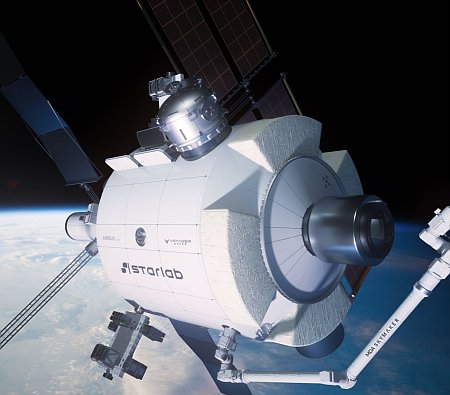
The Starlab design in 2025. Click
for original image.
The consortium led by Voyager Technologies that is building the Starlab space station announced last week that it has obtained a major new investor with more than a billion dollars in assets.
The investor, Seven Grand Managers, is based in New York. The announcement did not specify how much the firm had committed to the Starlab project, but it was clear from this statement that involved significant funds.
“Starlab is being built to be commercially viable from Day One,” said Chris Fahy, founder and chief investment officer, Seven Grand. “Our investment recognizes that commercial infrastructure in the post-ISS era is not speculative, but tangible, bankable and poised for growth. Starlab’s world-class management team and strategic partners are unlocking the beginning of this enormous opportunity.” [emphasis ine]
The highlighted quote suggest Seven Grand was impressed with the Starlab concept, a single very large ready-to-go station launched on Starship. Most of the other stations will involve assembly of multiple modules on multiple launches before they are “ready-to-go.” The only other station launching as a single module, Max Space’s Thunderbird, has only recently entered the race, and is thus far behind.
Starlab had previously raised $383 million in a public stock offering, in addition to the $217.5 million provided by NASA. This new private investment capital further strengthens its future, and suggests the station could get built and launched, even if it fails to win a major station construction contract from NASA.
Below are my rankings of the five American space station projects:
- Haven-1, being built by Vast, with no NASA funds. The company is moving fast, with Haven-1 to launch in 2026 for a three-year period during which it will be occupied by four 2-week-long manned missions. The company is already testing an unmanned small demo module in orbit. By flying actual hardware and manned missions it hopes this will put it in the lead to win NASA’s phase 2 contract to build its much larger multi-module Haven-2 station. It has also made preliminary deals with Colombia, Uzbekistan, Japan, and the Maldives possible astronaut flights to Haven-1.
- Axiom, being built by Axiom, has launched four tourist flights to ISS, with the fourth carrying government passengers from India, Hungary, and Poland. The rumors of cash flow issues seem to have been alleviated with an infusion of $100 million from Hungary’s telecommunications company 4iG. The development of its first two modules has also been proceeding more or less as planned, with the first’s hull completed and presently undergoing testing. It has also signed Redwire to build that module’s solar panels.
- Starlab, being built by a consortium led by Voyager Space, Airbus, and Northrop Grumman, with extensive partnership agreements with the European Space Agency and others. Though no construction has yet begun on its NASA-approved design, it has raised $383 million in a public stock offering, the $217.5 million provided by NASA, and an unstated amount from private capital. It has also begun signing up a number of companies to build the station’s hardware.
- Thunderbird, proposed by the startup Max Space. It is building a smaller demo test station to launch in ’27 on a Falcon 9 rocket, and has begun work on its manufacturing facility at Kennedy in Florida. Its management includes one former NASA astronaut and one former member of the Bigelow space station team that built the first private orbiting inflatable modules, Genesis-1, Genesis-2, and BEAM (still operating on ISS).
- Orbital Reef, being built by a consortium led by Blue Origin and Sierra Space. This station looks increasingly dead in the water. Blue Origin has built almost nothing, as seems normal for this company. And while Sierra Space has successfully tested its inflatable modules, including a full scale version, its reputation is soured by its failure in getting its Dream Chaser cargo mini-shuttle launched.

On Christmas Eve 1968 three Americans became the first humans to visit another world. What they did to celebrate was unexpected and profound, and will be remembered throughout all human history. Genesis: the Story of Apollo 8, Robert Zimmerman's classic history of humanity's first journey to another world, tells that story, and it is now available as both an ebook and an audiobook, both with a foreword by Valerie Anders and a new introduction by Robert Zimmerman.
The print edition can be purchased at Amazon or from any other book seller. If you want an autographed copy the price is $60 for the hardback and $45 for the paperback, plus $8 shipping for each. Go here for purchasing details. The ebook is available everywhere for $5.99 (before discount) at amazon, or direct from my ebook publisher, ebookit. If you buy it from ebookit you don't support the big tech companies and the author gets a bigger cut much sooner.
The audiobook is also available at all these vendors, and is also free with a 30-day trial membership to Audible.
"Not simply about one mission, [Genesis] is also the history of America's quest for the moon... Zimmerman has done a masterful job of tying disparate events together into a solid account of one of America's greatest human triumphs."--San Antonio Express-News

The Starlab design in 2025. Click
for original image.
The consortium led by Voyager Technologies that is building the Starlab space station announced last week that it has obtained a major new investor with more than a billion dollars in assets.
The investor, Seven Grand Managers, is based in New York. The announcement did not specify how much the firm had committed to the Starlab project, but it was clear from this statement that involved significant funds.
“Starlab is being built to be commercially viable from Day One,” said Chris Fahy, founder and chief investment officer, Seven Grand. “Our investment recognizes that commercial infrastructure in the post-ISS era is not speculative, but tangible, bankable and poised for growth. Starlab’s world-class management team and strategic partners are unlocking the beginning of this enormous opportunity.” [emphasis ine]
The highlighted quote suggest Seven Grand was impressed with the Starlab concept, a single very large ready-to-go station launched on Starship. Most of the other stations will involve assembly of multiple modules on multiple launches before they are “ready-to-go.” The only other station launching as a single module, Max Space’s Thunderbird, has only recently entered the race, and is thus far behind.
Starlab had previously raised $383 million in a public stock offering, in addition to the $217.5 million provided by NASA. This new private investment capital further strengthens its future, and suggests the station could get built and launched, even if it fails to win a major station construction contract from NASA.
Below are my rankings of the five American space station projects:
- Haven-1, being built by Vast, with no NASA funds. The company is moving fast, with Haven-1 to launch in 2026 for a three-year period during which it will be occupied by four 2-week-long manned missions. The company is already testing an unmanned small demo module in orbit. By flying actual hardware and manned missions it hopes this will put it in the lead to win NASA’s phase 2 contract to build its much larger multi-module Haven-2 station. It has also made preliminary deals with Colombia, Uzbekistan, Japan, and the Maldives possible astronaut flights to Haven-1.
- Axiom, being built by Axiom, has launched four tourist flights to ISS, with the fourth carrying government passengers from India, Hungary, and Poland. The rumors of cash flow issues seem to have been alleviated with an infusion of $100 million from Hungary’s telecommunications company 4iG. The development of its first two modules has also been proceeding more or less as planned, with the first’s hull completed and presently undergoing testing. It has also signed Redwire to build that module’s solar panels.
- Starlab, being built by a consortium led by Voyager Space, Airbus, and Northrop Grumman, with extensive partnership agreements with the European Space Agency and others. Though no construction has yet begun on its NASA-approved design, it has raised $383 million in a public stock offering, the $217.5 million provided by NASA, and an unstated amount from private capital. It has also begun signing up a number of companies to build the station’s hardware.
- Thunderbird, proposed by the startup Max Space. It is building a smaller demo test station to launch in ’27 on a Falcon 9 rocket, and has begun work on its manufacturing facility at Kennedy in Florida. Its management includes one former NASA astronaut and one former member of the Bigelow space station team that built the first private orbiting inflatable modules, Genesis-1, Genesis-2, and BEAM (still operating on ISS).
- Orbital Reef, being built by a consortium led by Blue Origin and Sierra Space. This station looks increasingly dead in the water. Blue Origin has built almost nothing, as seems normal for this company. And while Sierra Space has successfully tested its inflatable modules, including a full scale version, its reputation is soured by its failure in getting its Dream Chaser cargo mini-shuttle launched.
On Christmas Eve 1968 three Americans became the first humans to visit another world. What they did to celebrate was unexpected and profound, and will be remembered throughout all human history. Genesis: the Story of Apollo 8, Robert Zimmerman's classic history of humanity's first journey to another world, tells that story, and it is now available as both an ebook and an audiobook, both with a foreword by Valerie Anders and a new introduction by Robert Zimmerman.
The print edition can be purchased at Amazon or from any other book seller. If you want an autographed copy the price is $60 for the hardback and $45 for the paperback, plus $8 shipping for each. Go here for purchasing details. The ebook is available everywhere for $5.99 (before discount) at amazon, or direct from my ebook publisher, ebookit. If you buy it from ebookit you don't support the big tech companies and the author gets a bigger cut much sooner.
The audiobook is also available at all these vendors, and is also free with a 30-day trial membership to Audible.
"Not simply about one mission, [Genesis] is also the history of America's quest for the moon... Zimmerman has done a masterful job of tying disparate events together into a solid account of one of America's greatest human triumphs."--San Antonio Express-News
Setting up prefab individual modules that link together to form a larger habitat is our current technology. Every module having it’s service hardware tested and installed before launching for cramped human habitation.
I’ve been thinking about larger habitats, even spinning stations from Si-Fi illustrations… constructing in space is extremely difficult in that the spacesuit gloves don’t bend properly or allow full body movement. We are not ready for robots to take on this project though ultimately that is their destiny… (If we can just keep them from malfunctioning and falling into deep space!)
I picture future space suits not to have gloves but articulation control pads for controlling artificial hands, power tools that fit over the arms, magnetic manipulators… using your hands effectively would only be necessary in space, for someone’s pet monkey. A technological race would eliminate the need for manual labor or control. (if a doctor can perform surgery from a different country, the construction in space can be handled from the control room on station)
I picture preformed/bent sections of insulated flexible metal (like 4 x 8 sheets that we are familiar with, only larger to fill the space in the nose cone) that inter locks with a semi fluid rubber seal, that can assemble to form a circular hull. An entire stack can be launched on one ship to form an empty cylinder (or wheel) much larger than any thought previously possible which can be done with current technology. The interlocking pieces (similar to metal roofing) will be held together by air pressure with safety locks of course. (The groove is no more complicated then to place your hands “one facing up” with your fingers curled and the other “facing down” with your fingers curled and locking the fingers together) this method in a pressurized unit cannot come apart and is flexible with no stress cracks from hot to cold or torquing. Modular, in that it can be expanded or taken apart to remove something large inside. (Welding should be done in a vacuum to prevent metal and chemical contamination of the air system)
Air scrubbers and heating units will become modular as well and easy to replace like snap in accessories. Interchangeable mass produced units that can be installed by idiots. (A good reliable design with familiar parts would be welcome on every ship and lunar base/mars base… because spare parts will be hard to order, better to have a back up)
So the interior of these cylinders will be built to design specifications, that can be outfitted for what purpose is intended. (extra rooms and air scrubbers for a hotel, or a large empty bay for constructing super large telescopes?)
In 30 to 40 years, fabrication factories on the moon will knock these units out quickly and slingshot them into orbit for the construction crew.