
SpaceX issues 1st statement regarding Superheavy test explosion
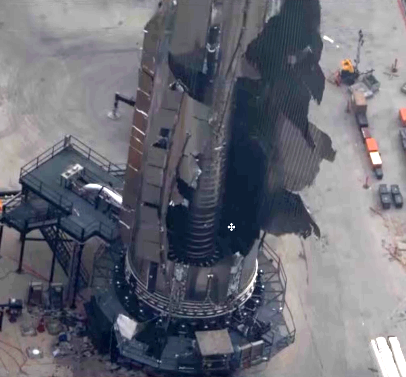
Click for original image.
SpaceX yesterday issued its first update regarding the explosion in the lower half of the Superheavy booster that it had planned to fly on the next orbital test flight.
Booster 18 suffered an anomaly during gas system pressure testing that we were conducting in advance of structural proof testing. No propellant was on the vehicle, and engines were not yet installed. The teams need time to investigate before we are confident of the cause. No one was injured as we maintain a safe distance for personnel during this type of testing. The site remains clear and we are working plans to safely reenter the site.
That no propellant was involved explains why the booster and test pad experienced relatively little damage. They were likely pumping nitrogen through the system to test it, and while something exploded, the gases were not volatile.
The picture to the right is a screen capture from aerial drone flights performed by RGV Aerial Photography and posted on nasaspaceflight.com. I have enhanced it to bring out the details. Note the lack of damage on all sides of the booster at its base. The explosion was clearly confined to the booster, and appears to have occurred from within.

On Christmas Eve 1968 three Americans became the first humans to visit another world. What they did to celebrate was unexpected and profound, and will be remembered throughout all human history. Genesis: the Story of Apollo 8, Robert Zimmerman's classic history of humanity's first journey to another world, tells that story, and it is now available as both an ebook and an audiobook, both with a foreword by Valerie Anders and a new introduction by Robert Zimmerman.
The print edition can be purchased at Amazon or from any other book seller. If you want an autographed copy the price is $60 for the hardback and $45 for the paperback, plus $8 shipping for each. Go here for purchasing details. The ebook is available everywhere for $5.99 (before discount) at amazon, or direct from my ebook publisher, ebookit. If you buy it from ebookit you don't support the big tech companies and the author gets a bigger cut much sooner.
The audiobook is also available at all these vendors, and is also free with a 30-day trial membership to Audible.
"Not simply about one mission, [Genesis] is also the history of America's quest for the moon... Zimmerman has done a masterful job of tying disparate events together into a solid account of one of America's greatest human triumphs."--San Antonio Express-News
Click for original image.
SpaceX yesterday issued its first update regarding the explosion in the lower half of the Superheavy booster that it had planned to fly on the next orbital test flight.
Booster 18 suffered an anomaly during gas system pressure testing that we were conducting in advance of structural proof testing. No propellant was on the vehicle, and engines were not yet installed. The teams need time to investigate before we are confident of the cause. No one was injured as we maintain a safe distance for personnel during this type of testing. The site remains clear and we are working plans to safely reenter the site.
That no propellant was involved explains why the booster and test pad experienced relatively little damage. They were likely pumping nitrogen through the system to test it, and while something exploded, the gases were not volatile.
The picture to the right is a screen capture from aerial drone flights performed by RGV Aerial Photography and posted on nasaspaceflight.com. I have enhanced it to bring out the details. Note the lack of damage on all sides of the booster at its base. The explosion was clearly confined to the booster, and appears to have occurred from within.
On Christmas Eve 1968 three Americans became the first humans to visit another world. What they did to celebrate was unexpected and profound, and will be remembered throughout all human history. Genesis: the Story of Apollo 8, Robert Zimmerman's classic history of humanity's first journey to another world, tells that story, and it is now available as both an ebook and an audiobook, both with a foreword by Valerie Anders and a new introduction by Robert Zimmerman.
The print edition can be purchased at Amazon or from any other book seller. If you want an autographed copy the price is $60 for the hardback and $45 for the paperback, plus $8 shipping for each. Go here for purchasing details. The ebook is available everywhere for $5.99 (before discount) at amazon, or direct from my ebook publisher, ebookit. If you buy it from ebookit you don't support the big tech companies and the author gets a bigger cut much sooner.
The audiobook is also available at all these vendors, and is also free with a 30-day trial membership to Audible.
"Not simply about one mission, [Genesis] is also the history of America's quest for the moon... Zimmerman has done a masterful job of tying disparate events together into a solid account of one of America's greatest human triumphs."--San Antonio Express-News
An ugly photo.
Lots of people in the usual places are panicking — or simply indulging whatever pre-existing dislike of Elon Musk or Starship or SpaceX generally — over this incident.
No doubt it is a setback; it obviously was not a “test to destruction test,” and it was something SpaceX’s Starship team would rather not have happened. But I think it should be clear that it’s not as big a setback as the S36 explosion this summer. The booster is a write-off, and that hurts because B19 has not even begun stacking yet. But it’s also clear that very little damage was done to Massey’s. No Raptors were lost. It could have been much worse.
One would wish that this sort of hiccup was something they;d be past now, but it was after all the very first flight booster of the V3 Starship. So there is bound to be a learning curve. Whereas S36 was well into the V2 series program, a version that the Starship team had more experience with.
I’m hoping this was a process, not a design, failure. But if it was the latter, better to learn about that *now* than at a later part of the Flight 19 schedule.
By the way, as for what the timeline looks like going forward, SpaceX just posted a tweet on X about ten minutes ago:
“The Starbase team plans to have the next Super Heavy booster stacked in December, which puts it on pace with the test schedule planned for the first Starship V3 vehicle and associated ground systems. Starship’s twelfth flight test remains targeted for the first quarter of 2026.”
https://x.com/spacex/status/1992287913036648577
We’ll see if they can make that schedule stick. It would make my 6-8 week delay prediction not too far off the mark….
Richard M: As usual, the naysayers are likely missing the whole point of this. SpaceX is still in the development phase for both Starship and Superheavy. Problems like this are expected to occur.
In this case, it is so much better that it happened during a test on the ground, not involving propellants, than during a launch. It will make it much easier pinpointing the issue and fixing it so it never happens again.
I emphasize that last phrase because this has been SpaceX’s engineering approach from the get-go, an approach it has proven it achieves with unmatched success.
Hi Bob,
Indeed. And it’s worth reflecting on the relentless 24/7 video coverage from streamers all around Boca Chica (including even overflight photography!!) which makes it difficult to hide things like this, no matter how little SpaceX “officially” says. We have nothing like that level of scrutiny on any other launch provider or space systems developer.
SpaceX is not perfect. They make mistakes, too. But when something does go wrong, whether through avoidable error or not, they learn from it, adapt, and overcome, with astonishing speed.
“The chrome chest-burster was unavailable for comment”
—Elon/Yutani spokesman ;)
Robert wrote: “””pinpointing the issue and fixing it so it never happens again. This has been SpaceX’s engineering approach from the get-go, an approach it has proven it achieves with unmatched success.”””
And, while they correct the problem, they continue movie forward, upgrading, testing constantly. They do not just fix one issue and test only for that. Imagine the guts to LEAVE OFF some heat tiles to see how the stainless steel takes it during reentry.
Once again, Robert Heinlein is smiling.
Re: my typo above
they continue movie forward,
they continue MOVING forward,
Although most of the SpaceX “movies”
(launch, recovery, return, or ocean platform landing videos) are very cool also.
It looks like a lot of the welds let loose. As you can see by all the separated panels which should be fully welded together.
Maybe they changed the welding technique for some reason and they did not weld as strong as they should have.
Very clear now from the photos that the LOx tank experienced pressure beyond it’s capability. Hopefully, SpaceX had tank pressure data that went that high, as a burst test is an excellent data point to have! But, the root cause is now sounding like a COPV failure, or possibly a tank pressurization regulating valve.
And Bob, with regard to your comment about ”pinpointing the issue and fixing it so it never happens again”, I sure wish I could feel the same. But if the cause ultimately turns out to be one of the COPVs, this would mark the third one (F9-AMOS-6, Ship 36, and now B18). I believe these COPVs are NOT part of SpaceX’s vertical integration, meaning they buy them, not build them.
Do I think SpaceX will fix this? Well, I’m sure it’s going to get a HUGE amount of scrutiny after this event. Time will tell.
But, as they are SO hardware-rich, it’s kind of fun to see them rise to the occasion. No one else in this business could recover as quickly as they can.
As with every previous SpaceX anomaly, a misfortune, not a disaster.
RGV Aerial Photography did another flyover, with an interesting video posted just now on Youtube. Meanwhile, SpaceX crews have already started cutting Booster 18 apart. It looks like they’ll be trying to salvage the hot stage truss, at least.
If there is an upside to this unfortunate incident, it is that it has exposed a lot of the interior of the V3 booster design to all of the ring watchers out here. RGV is already digging into what looks to be in-depth examination of the tank’s complex plumbing and slosh baffles.
P.S. And watching the RGV shots, it’s clear that I underestimated just how many changes were made in the V3 booster design over V2. It’s not just that beefier downcomer; the plumbing in the aft section just looks much more complex, too. It also appears that the downcomer is for transferring CH4, not LOX. This really is a significantly different vehicle than the V2 booster.
Casey Handmer takes up the Booster 18 episode, and shreds Senator Mark Kelly, NASA safety culture, and Orion’s heat shield in a tweet that is truly a joy to read. “I’ll give you $100 if you do the right thing here.
https://x.com/CJHandmer/status/1992627005809131722
Richard M wrote: “SpaceX is not perfect. They make mistakes, too.”
SpaceX’s Starship development is still in the range of trying new things to see whether they work. Version 3 is supposed to have fewer of these than in the past, so that they can get close to an operational launch vehicle and spaceship, but the philosophy is only beginning to leave the range of ‘failure is not an option, it is a necessity.’ When the best part is no part, the other philosophy comes into play: ‘if you don’t have to put parts back on, then you didn’t take off enough parts.’ This is the difference between version 2 and version 3. They got version 2 to work, but they are still trying new things on version 3, applying previous lessons, and finding out where they went wrong. It is not so much a mistake as it is not applying the lesson quite right, which sounds like a mistake, now that I proofread it.
This happened with the early flights of version 2, too. There were two spectacular failures, except during flight rather than during ground testing. This time, airline flights were not affected and no one ended up with rocket parts falling in their back yards. As Robert wrote in a reply to a comment, above: “… because this has been SpaceX’s engineering approach from the get-go, an approach it has proven it achieves with unmatched success.”
Success is right. They have learned many things from attempting the impossible. They learned that a flat pad is not the best pad for the world’s largest blowtorch (I haven’t heard Musk call it that since it destroyed some of his “stage zero”), that a rocket really can be caught like a fly in chopsticks, that weird things happen when you chill your propellants to near solids then slosh them around during maneuvers to return to launch site after a hot-staging separation of the upper stage, that it really is tricky but possible to flip 100 tons quickly right before landing after belly flopping through the lower atmosphere, and possibly more surprising than the chopstick catch: at the top of a 12-mile climb, flipping a 100-ton Starship ninety degrees in five or six seconds without it spinning out of control (I have seen it on multiple occasions, but I still don’t believe it — how the hell did they do that?!?). At least at the bottom of the belly flop they had thrust from an engine or three to provide vector control during the rapid flip, but at the top of that climb they shut down the engine seemingly before it could control the final attitude of the flip.
Oh, and they showed us that flight hardware can be stored outdoors and still remain clean enough to be used on a rocket that does not blow up during flight. Frankly, those guys at SpaceX aren’t just crazy, they are insane! ‘If you don’t have to put parts back on, then you didn’t take off enough parts?’ Have you ever heard anyone else say such a crazy thing? I haven’t.
And what about that Raptor 3? Everyone was right that it couldn’t have been a completed engine. It couldn’t. No engine looks that simple except for Estes model-rocket solid-fuel motors. And now SpaceX is claiming that they don’t need those heavy heat shields for their Raptor 3 engines.
Or as Ronaldus Magnusreminded us, leaving off thermal protection tiles just to see the reaction of the steel during reentry, yet still expecting a successful reentry? Who else have you ever seen do such a deranged thing?
Geez, if other companies tried such demented design and development methods, we would likely start seeing reentry/reusable rockets that hold onto their fairings, which open up then close again like something out of a 1960s James Bond movie. Or maybe some company putting their rocket engines around the perimeter of a heat shield. If we start seeing bizarre things like those, then maybe we could conclude that insanity is contagious and is spreading like a plague around the rocket-science industry.
On the other hand, maybe this is not the insanity that it seems but is just the rocket scientists having finally found a way to try things that government contractors would never dare to suggest, because their government customers would assume that they have gone mad and wouldn’t ever hire them again.* Maybe the audacity to try the impossible is resulting in newer and better hardware and methods that are bringing space closer to the rest of us.
______________
pzatchok wrote: “It looks like a lot of the welds let loose. As you can see by all the separated panels which should be fully welded together. Maybe they changed the welding technique for some reason and they did not weld as strong as they should have.”
Not necessarily. When engineering something, it is good to control the failure modes. In this case, a rocket’s propellant tanks generally are better to burst outward, radially, rather than burst the dome in the direction of the payload, especially when the payload is a human crew. The welds on these rings should not be as strong as the welds at the domes, so we should expect them to fail before the domes fail.
______________
One thing that astonishes me about the condition of the booster is that the large-sized fuel down-tube became a major structural member, holding up the upper part of the booster.
______________
* No, I don’t think this is what happened to Boeing to wind up on NASA’s do-not-accept-bids list. Boeing did some real management screw-ups that makes us wonder why the owners/investors allowed them to keep top management for so long, and to make us hope that their new top-dog can successfully turn around the company.
Looks like Elon is talking up space solar power:
https://x.com/niccruzpatane/status/1992353438332526846
That should keep the media morons occupied while they sweep up the hidden meth lab remains that actually caused the burst….in other news, the missing COPV was seen across the border as a still. :)
Until 2020, their stock price just kept going up, up, up. As long as it kept doing that, shareholders were not going to look under the hood.
Jeff Wright,
Elon is not “talking up space solar power” if by that you mean the idea of beaming it down from orbit for terrestrial consumption. He’s talking about the generating capacity it would be possible to launch for use in-situ to power space-based AI data centers.
Elon made a tremendous number of enemies over the course of the past 18-24 months. His alliance with Trump – it goes beyond mere support – earned him eternal emnity in many quarters.
It is interesting that since late 2024 Starship/booster’s formerly stratospheric pace of development has slowed markedly, with numerous uncharacteristic and public failures of advanced (meaning, fully assembled, not components) test articles. This has been out of step with most prior SpaceX development efforts over the preceding 10-15 years.
Given attacks made against other of Musk’s interests, I don’t think sabotage can be ruled out. I wonder if SpaceX is reviewing their employee’s history and social media posts in depth? I hope so, because they are at risk of losing momentum and dominant leadership in the space launch industry for the first time in over a decade.
Larry R wrote: “It is interesting that since late 2024 Starship/booster’s formerly stratospheric pace of development has slowed markedly, with numerous uncharacteristic and public failures of advanced (meaning, fully assembled, not components) test articles. This has been out of step with most prior SpaceX development efforts over the preceding 10-15 years.”
Actually, it is completely in step with most prior SpaceX development efforts.
There is a video of a long series os spectacular explosions of Falcon 9 boosters as SpaceX learned and applied lessons to landing orbital class boosters. A dragon spectacularly exploded on a test stand. Starships kept exploding as they learned and applied lessons to landing immediately after a flip at the bottom of a bellyflop descent.
Starship’s developmental integrated flight test (IFT) program has been full of explosions from the very first integrated test launch. Test articles have exploded on test stands Dragon style. It is from these failures that lessons are learned and applied. Starship went from version 1 to version 3 during this time that you think the development has slowed markedly.
Many people have tuned in to the launch webcasts just to see how the rocket will explode this time. It is the successful Starship and booster landings that are out of step with the usual efforts. Few people expected the first chopstick landing to be successful. During SpaceX’s development tests, failure is not an option; it is a necessity. It is why SpaceX’s test plans include extreme stressing of various parts of their test units. It is during development that you want the problems to manifest themselves, that way you can design a safe and reliable operational version.
I keep getting upset that no one understands the difference between development and operational flights, but maybe that is because so few companies have been this open about development. The book The Right Stuff begins with failed aircraft development tests as well as accidents from more routine flights. Apparently, it is difficult to really conceive of the realities of development. Maybe that is because so many rocket companies don’t have the same development regimens. They fly their test units and design their rockets so much like previous designs and methods that this kind of flight development testing is unnecessary.
It isn’t just development testing that can have such difficulties. While I worked as a test engineer to verify that the assembled and integrated flight hardware worked as intended, we had some of the darnedest problems and failures occur. They were rarely design faults and sometimes they were problems with well established and long-used ground test equipment. It does not surprise me at all that SpaceX development hardware is failing, especially since the object of the exercise is to find the limits of the design concept.
Sometimes I am surprised by the success despite the phase that SpaceX is in with Starship. Test flight 11 had at least one obvious hole burned through in an area where heat protection tiles had been intentionally left off just to see what would happen, yet the test ship survived all the way to splashdown. I keep harping on about the success of the first chopstick catch, but how many people really thought that would work the first time? Now that was out of step with most of the prior SpaceX development efforts.
Edward wrote, “I keep getting upset that no one understands the difference between development and operational flights.”
I agree. You and I and numerable other commenters here at BtB have said this over and over, that these explosions are exactly what SpaceX wants to happen so it can prevent them from happening later. Unfortunately, few seem to understand this. Instead, all that matters is that “something went wrong!” This fact is then used either to bash SpaceX stupidly, or to panic like Chicken Little.
This is a test program. These explosions aren’t failures, they are important and incredibly useful data points that the engineers at SpaceX are using to build this spaceship. I just wish we could get more Americans to recognize that.
Maybe this tendency comes from the fact that most Americans are no longer mechanical tinkerers, as had been the case in the past. When the airline and car industries were developing in the first half of the 20th century such incidents occurred routinely as engineers refined the designs of both. No one complained. It was simply understood that these nascent technologies required failure to get it right.
Should be interesting to see if a COPV was involved in the festivities. If so, the problem may be bigger than popping a line of exterior welds, as the COPV is supposed to be intact for a couple years pressurized on the way to Mars. Cheers –
Might this diamond coating strengthen plumbing?
https://phys.org/news/2025-11-lab-grown-diamond-coatings-shown.html