
Starlab assembles a full scale mock up of its proposed space station
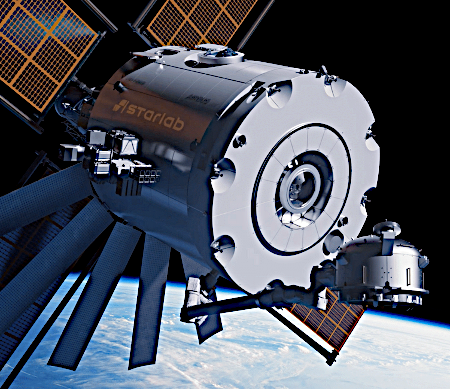
Starlab design as of November 2025. Click for original
The consortium that is building the Starlab space station designed to be launched as a single large module on a SpaceX Starship rocket has now assembled a full scale mock up of that module at the Johnson Space Center in order to test the interior design and perform training exercises.
The Starlab space station mockup has three “floors” – or HAB1, HAB2 and HAB3. The first floor of the Starlab station, HAB1, will house life support systems, exercise equipment, a hygiene area for astronauts and two toilets. [Courtenay McMillan, mission segment lead for Starlab Space,] said the extra toilet is especially important for the roughly 1,600-square-foot station that’s about the size of a two-bedroom house. “Two toilets is a big deal,” McMillan said. “Anyone who has ever gone on a house hunt knows how important this is.”
The second floor of the station, HAB2, is where most of the research will occur. The mockup currently has graphics that show where plants could grow and experiments could be stored. McMillan said the mockup could eventually have a functional workbench, glovebox and other research hardware to train crew members on conducting research in space.
The top floor, HAB3, is where the crew will live. It will have eight beds split among two quadrants, with four bunks each. The Starlab station is expected to house four crew members for six months, and its occupancy would increase to eight people during crew handovers or when shorter two-week missions join the long-duration crew.
In many ways this mock-up is a variation of a game a lot of big space contractors play to make it seem they are doing something in order to increase the chance they will win a contract from NASA. In some cases, these big contractors (such as Boeing with Starliner) do practically nothing but showpieces with no real substance until the contract is awarded, and then have to play catch up (which in the case of Starliner turned out to be a disaster).
In this case I am less cynical. The Starlab consortium, led by Voyager Space (but includes a lot of major companies and international partners), seems here to be doing the right due diligence. This mock-up is not a show-piece, but an engineering model that engineers intend to use extensively to test and revise the station’s interior design. It appears to be part of an overall plan that now includes one American subcontractor to build the station’s hull, another to design the interior, and a third to integrate everything for launch.
Though I have not yet changed my rankings below of the four American space stations under development, my impression of Starlab continues to go up, so that it now ranks below Axiom by only a very tiny amount.
- Haven-1, being built by Vast, with no NASA funds. The company is moving fast, with Haven-1 to launch in 2026 for a three-year period during which it will be occupied by four 2-week-long manned missions. The company is already testing an unmanned small demo module in orbit. By flying actual hardware and manned missions it hopes this will put it in the lead to win NASA’s phase 2 contract to build its much larger multi-module Haven-2 station.
- Axiom, being built by Axiom, has launched four tourist flights to ISS, with the fourth carrying government passengers from India, Hungary, and Poland. Though there have been rumors it has cash flow issues, development of its first two modules has been proceeding more or less as planned, with the first’s hull completed and presently undergoing testing. It has also signed Redwire to build that module’s solar panels.
- Starlab, being built by a consortium led by Voyager Space, Airbus, and Northrop Grumman, with extensive partnership agreements with the European Space Agency and others. Though no construction has yet begun on its NASA-approved design, it has raised $383 million in a public stock offering in addition to the $217.5 million provided by NASA. It has also begun signing up a number of companies to build the station’s hardware.
- Orbital Reef, being built by a consortium led by Blue Origin and Sierra Space. This station looks increasingly dead in the water. Blue Origin has built almost nothing, as seems normal for this company. And while Sierra Space has successfully tested its inflatable modules, including a full scale version, its reputation is soured by its failure in getting its Dream Chaser cargo mini-shuttle launched.

On Christmas Eve 1968 three Americans became the first humans to visit another world. What they did to celebrate was unexpected and profound, and will be remembered throughout all human history. Genesis: the Story of Apollo 8, Robert Zimmerman's classic history of humanity's first journey to another world, tells that story, and it is now available as both an ebook and an audiobook, both with a foreword by Valerie Anders and a new introduction by Robert Zimmerman.
The print edition can be purchased at Amazon or from any other book seller. If you want an autographed copy the price is $60 for the hardback and $45 for the paperback, plus $8 shipping for each. Go here for purchasing details. The ebook is available everywhere for $5.99 (before discount) at amazon, or direct from my ebook publisher, ebookit. If you buy it from ebookit you don't support the big tech companies and the author gets a bigger cut much sooner.
The audiobook is also available at all these vendors, and is also free with a 30-day trial membership to Audible.
"Not simply about one mission, [Genesis] is also the history of America's quest for the moon... Zimmerman has done a masterful job of tying disparate events together into a solid account of one of America's greatest human triumphs."--San Antonio Express-News
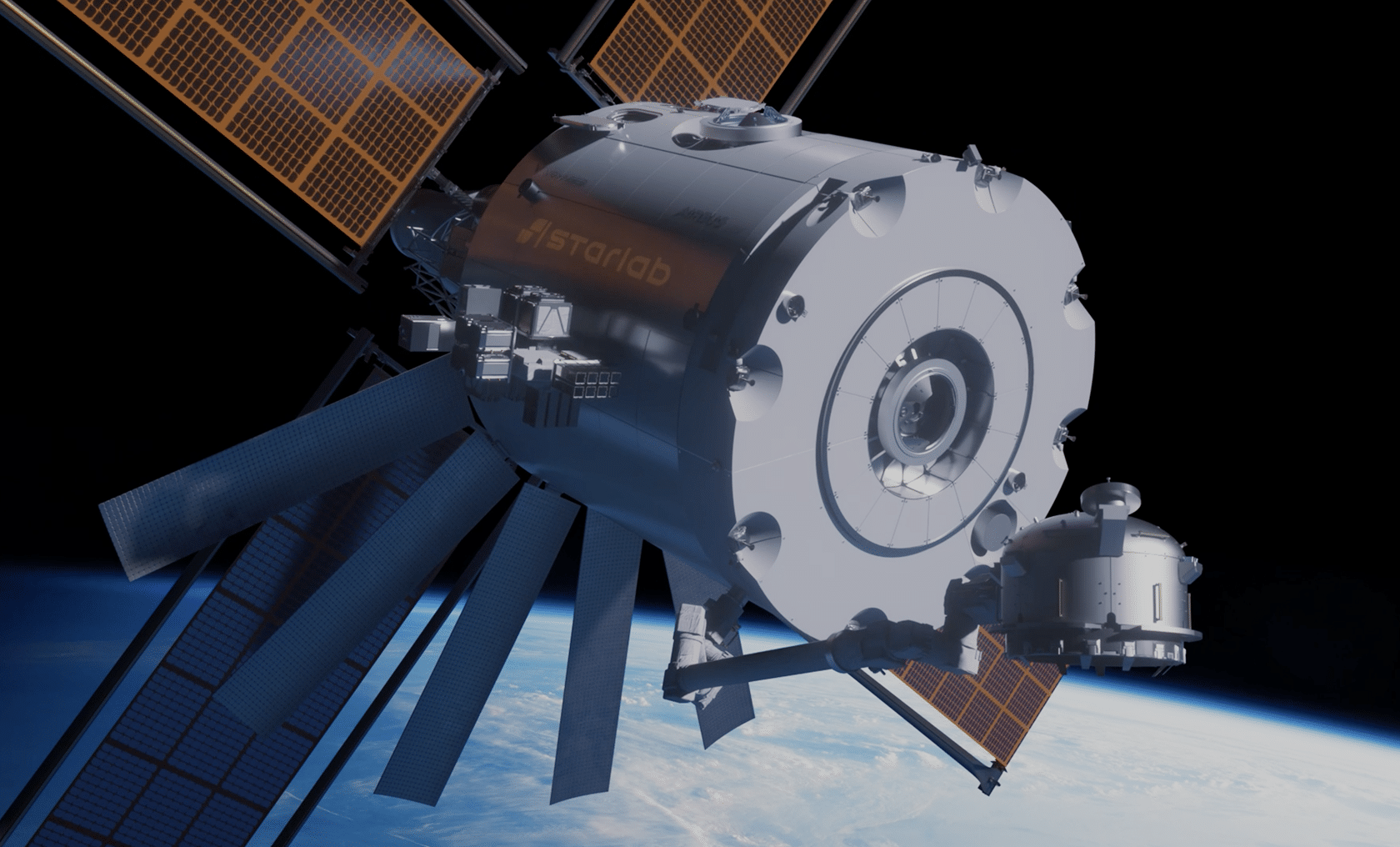
Starlab design as of November 2025. Click for original
The consortium that is building the Starlab space station designed to be launched as a single large module on a SpaceX Starship rocket has now assembled a full scale mock up of that module at the Johnson Space Center in order to test the interior design and perform training exercises.
The Starlab space station mockup has three “floors” – or HAB1, HAB2 and HAB3. The first floor of the Starlab station, HAB1, will house life support systems, exercise equipment, a hygiene area for astronauts and two toilets. [Courtenay McMillan, mission segment lead for Starlab Space,] said the extra toilet is especially important for the roughly 1,600-square-foot station that’s about the size of a two-bedroom house. “Two toilets is a big deal,” McMillan said. “Anyone who has ever gone on a house hunt knows how important this is.”
The second floor of the station, HAB2, is where most of the research will occur. The mockup currently has graphics that show where plants could grow and experiments could be stored. McMillan said the mockup could eventually have a functional workbench, glovebox and other research hardware to train crew members on conducting research in space.
The top floor, HAB3, is where the crew will live. It will have eight beds split among two quadrants, with four bunks each. The Starlab station is expected to house four crew members for six months, and its occupancy would increase to eight people during crew handovers or when shorter two-week missions join the long-duration crew.
In many ways this mock-up is a variation of a game a lot of big space contractors play to make it seem they are doing something in order to increase the chance they will win a contract from NASA. In some cases, these big contractors (such as Boeing with Starliner) do practically nothing but showpieces with no real substance until the contract is awarded, and then have to play catch up (which in the case of Starliner turned out to be a disaster).
In this case I am less cynical. The Starlab consortium, led by Voyager Space (but includes a lot of major companies and international partners), seems here to be doing the right due diligence. This mock-up is not a show-piece, but an engineering model that engineers intend to use extensively to test and revise the station’s interior design. It appears to be part of an overall plan that now includes one American subcontractor to build the station’s hull, another to design the interior, and a third to integrate everything for launch.
Though I have not yet changed my rankings below of the four American space stations under development, my impression of Starlab continues to go up, so that it now ranks below Axiom by only a very tiny amount.
- Haven-1, being built by Vast, with no NASA funds. The company is moving fast, with Haven-1 to launch in 2026 for a three-year period during which it will be occupied by four 2-week-long manned missions. The company is already testing an unmanned small demo module in orbit. By flying actual hardware and manned missions it hopes this will put it in the lead to win NASA’s phase 2 contract to build its much larger multi-module Haven-2 station.
- Axiom, being built by Axiom, has launched four tourist flights to ISS, with the fourth carrying government passengers from India, Hungary, and Poland. Though there have been rumors it has cash flow issues, development of its first two modules has been proceeding more or less as planned, with the first’s hull completed and presently undergoing testing. It has also signed Redwire to build that module’s solar panels.
- Starlab, being built by a consortium led by Voyager Space, Airbus, and Northrop Grumman, with extensive partnership agreements with the European Space Agency and others. Though no construction has yet begun on its NASA-approved design, it has raised $383 million in a public stock offering in addition to the $217.5 million provided by NASA. It has also begun signing up a number of companies to build the station’s hardware.
- Orbital Reef, being built by a consortium led by Blue Origin and Sierra Space. This station looks increasingly dead in the water. Blue Origin has built almost nothing, as seems normal for this company. And while Sierra Space has successfully tested its inflatable modules, including a full scale version, its reputation is soured by its failure in getting its Dream Chaser cargo mini-shuttle launched.
On Christmas Eve 1968 three Americans became the first humans to visit another world. What they did to celebrate was unexpected and profound, and will be remembered throughout all human history. Genesis: the Story of Apollo 8, Robert Zimmerman's classic history of humanity's first journey to another world, tells that story, and it is now available as both an ebook and an audiobook, both with a foreword by Valerie Anders and a new introduction by Robert Zimmerman.
The print edition can be purchased at Amazon or from any other book seller. If you want an autographed copy the price is $60 for the hardback and $45 for the paperback, plus $8 shipping for each. Go here for purchasing details. The ebook is available everywhere for $5.99 (before discount) at amazon, or direct from my ebook publisher, ebookit. If you buy it from ebookit you don't support the big tech companies and the author gets a bigger cut much sooner.
The audiobook is also available at all these vendors, and is also free with a 30-day trial membership to Audible.
"Not simply about one mission, [Genesis] is also the history of America's quest for the moon... Zimmerman has done a masterful job of tying disparate events together into a solid account of one of America's greatest human triumphs."--San Antonio Express-News