Uranus’s moon Oberon, of which we know little
 The historically known moons of Uranus. Click for original NASA press release.
Click for original image.
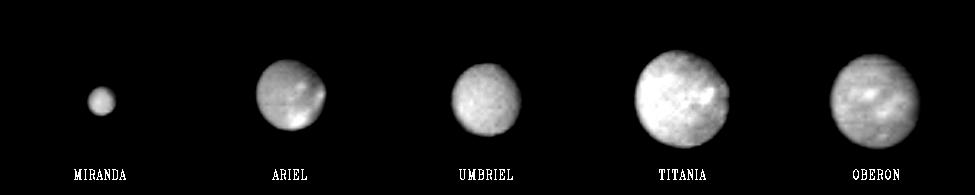
Today we finish our week-long tour of the five largest moons of Uranus, all discovered by astronomers before the start of the space age, and imaged successfully if not very completely by Voyager-2 when it did its fly-by of the planet on January 24, 1986. The gallery of these moons above was taken by the spacecraft when it was on approach, still about three million miles from Uranus, and shows them in order from the innermost on the left to the outermost on the right. They are also scaled to show their relative sizes. To see Voyager-2’s close-up images of the four inner moons, posted earlier this week, go here, here, here, and here.
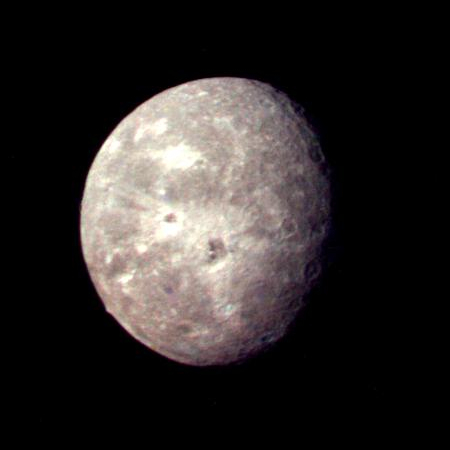
The picture to the right, cropped slightly to post here, is Voyager-2’s only high resolution image of Oberon, the outermost moon of this group. From NASA’s press release:
This Voyager 2 picture of Oberon is the best the spacecraft acquired of Uranus’ outermost moon. The picture was taken shortly after 3:30 a.m. PST on Jan. 24, 1986, from a distance of 410,000 miles. The color was reconstructed from images taken through the narrow-angle camera’s violet, clear and green filters.
The picture shows features as small as 7 miles on the moon’s surface. Clearly visible are several large impact craters in Oberon’s icy surface surrounded by bright rays similar to those seen on Jupiter’s moon Callisto. Quite prominent near the center of Oberon’s disk is a large crater with a bright central peak and a floor partially covered with very dark material. This may be icy, carbon-rich material erupted onto the crater floor sometime after the crater formed. Another striking topographic feature is a large mountain, about 6 km (4 mi) high, peeking out on the lower left limb.
Oberon is about 946 miles in diameter, making it the tenth-largest moon in the solar system. Because of the quickness of Voyager-2’s fly-by, it could get no closer images, and none of the planet’s nightside. Thus, only 40% of the surface has been photographed, and at not very high resolution.
Later spectroscopy from Hubble and other telescopes suggests there is water ice on the surface. Other data suggests Oberon may have a liquid underground ocean, but that conclusion is highly uncertain. Other than these vague facts and the image to the right, we essentially know almost nothing about this moon. Like Titiania, Uranus’s largest moon, Voyager-2’s data merely gave us a tantalizing glimpse, and that glimpse is now forty years old. No other mission has been there since, and none is planned in the near future.
Tomorrow, to summarize this tour, I will outline further what little we know of Uranus and its moons

On Christmas Eve 1968 three Americans became the first humans to visit another world. What they did to celebrate was unexpected and profound, and will be remembered throughout all human history. Genesis: the Story of Apollo 8, Robert Zimmerman's classic history of humanity's first journey to another world, tells that story, and it is now available as both an ebook and an audiobook, both with a foreword by Valerie Anders and a new introduction by Robert Zimmerman.
The print edition can be purchased at Amazon or from any other book seller. If you want an autographed copy the price is $60 for the hardback and $45 for the paperback, plus $8 shipping for each. Go here for purchasing details. The ebook is available everywhere for $5.99 (before discount) at amazon, or direct from my ebook publisher, ebookit. If you buy it from ebookit you don't support the big tech companies and the author gets a bigger cut much sooner.
The audiobook is also available at all these vendors, and is also free with a 30-day trial membership to Audible.
"Not simply about one mission, [Genesis] is also the history of America's quest for the moon... Zimmerman has done a masterful job of tying disparate events together into a solid account of one of America's greatest human triumphs."--San Antonio Express-News
The historically known moons of Uranus. Click for original NASA press release.

Click for original image.
Today we finish our week-long tour of the five largest moons of Uranus, all discovered by astronomers before the start of the space age, and imaged successfully if not very completely by Voyager-2 when it did its fly-by of the planet on January 24, 1986. The gallery of these moons above was taken by the spacecraft when it was on approach, still about three million miles from Uranus, and shows them in order from the innermost on the left to the outermost on the right. They are also scaled to show their relative sizes. To see Voyager-2’s close-up images of the four inner moons, posted earlier this week, go here, here, here, and here.
The picture to the right, cropped slightly to post here, is Voyager-2’s only high resolution image of Oberon, the outermost moon of this group. From NASA’s press release:
This Voyager 2 picture of Oberon is the best the spacecraft acquired of Uranus’ outermost moon. The picture was taken shortly after 3:30 a.m. PST on Jan. 24, 1986, from a distance of 410,000 miles. The color was reconstructed from images taken through the narrow-angle camera’s violet, clear and green filters.
The picture shows features as small as 7 miles on the moon’s surface. Clearly visible are several large impact craters in Oberon’s icy surface surrounded by bright rays similar to those seen on Jupiter’s moon Callisto. Quite prominent near the center of Oberon’s disk is a large crater with a bright central peak and a floor partially covered with very dark material. This may be icy, carbon-rich material erupted onto the crater floor sometime after the crater formed. Another striking topographic feature is a large mountain, about 6 km (4 mi) high, peeking out on the lower left limb.
Oberon is about 946 miles in diameter, making it the tenth-largest moon in the solar system. Because of the quickness of Voyager-2’s fly-by, it could get no closer images, and none of the planet’s nightside. Thus, only 40% of the surface has been photographed, and at not very high resolution.
Later spectroscopy from Hubble and other telescopes suggests there is water ice on the surface. Other data suggests Oberon may have a liquid underground ocean, but that conclusion is highly uncertain. Other than these vague facts and the image to the right, we essentially know almost nothing about this moon. Like Titiania, Uranus’s largest moon, Voyager-2’s data merely gave us a tantalizing glimpse, and that glimpse is now forty years old. No other mission has been there since, and none is planned in the near future.
Tomorrow, to summarize this tour, I will outline further what little we know of Uranus and its moons
On Christmas Eve 1968 three Americans became the first humans to visit another world. What they did to celebrate was unexpected and profound, and will be remembered throughout all human history. Genesis: the Story of Apollo 8, Robert Zimmerman's classic history of humanity's first journey to another world, tells that story, and it is now available as both an ebook and an audiobook, both with a foreword by Valerie Anders and a new introduction by Robert Zimmerman.
The print edition can be purchased at Amazon or from any other book seller. If you want an autographed copy the price is $60 for the hardback and $45 for the paperback, plus $8 shipping for each. Go here for purchasing details. The ebook is available everywhere for $5.99 (before discount) at amazon, or direct from my ebook publisher, ebookit. If you buy it from ebookit you don't support the big tech companies and the author gets a bigger cut much sooner.
The audiobook is also available at all these vendors, and is also free with a 30-day trial membership to Audible.
"Not simply about one mission, [Genesis] is also the history of America's quest for the moon... Zimmerman has done a masterful job of tying disparate events together into a solid account of one of America's greatest human triumphs."--San Antonio Express-News