
Chet Atkins & Mark Knopfler – I’ll see you in my dreams/Walk of Life
An evening pause: Performed live c2019. I have started the embed after introductions. If you want to see it all, click to begin at the beginning.
Hat tip Doug Johnson.
An evening pause: Performed live c2019. I have started the embed after introductions. If you want to see it all, click to begin at the beginning.
Hat tip Doug Johnson.
Courtesy of BtB’s stringer Jay. This post is also an open thread. I welcome my readers to post any comments or additional links relating to any space issues, even if unrelated to the links below.

On Christmas Eve 1968 three Americans became the first humans to visit another world. What they did to celebrate was unexpected and profound, and will be remembered throughout all human history. Genesis: the Story of Apollo 8, Robert Zimmerman's classic history of humanity's first journey to another world, tells that story, and it is now available as both an ebook and an audiobook, both with a foreword by Valerie Anders and a new introduction by Robert Zimmerman.
The print edition can be purchased at Amazon or any other book seller. If you want an autographed copy the price is $60 for the hardback and $45 for the paperback, plus $8 shipping for each. Go here for purchasing details. The ebook is available everywhere for $5.99 (before discount) at amazon, or direct from my ebook publisher, ebookit. If you buy it from ebookit you don't support the big tech companies and the author gets a bigger cut much sooner.
"Not simply about one mission, [Genesis] is also the history of America's quest for the moon... Zimmerman has done a masterful job of tying disparate events together into a solid account of one of America's greatest human triumphs."--San Antonio Express-News
The uncertainty of science: Using the Webb Space Telescope, astronomers now claim they have detected a super-massive black hole at a new record-setting distance that puts it far closer to the Big Bang that cosmologists have predicted.
A global team of astronomers, led by The University of Texas at Austin’s Cosmic Frontier Center, has confirmed the discovery of the most distant black hole ever observed. This black hole resides within a galaxy known as CAPERS-LRD-z9, which existed only 500 million years after the Big Bang.
In other words, the light we see from it has traveled 13.3 billion years, revealing the universe at just 3% of its current age.
The black hole, estimated to have the mass of 300 million suns, sits in the center of one of the mysterious “little red dots” that Webb has discovered in the early universe that remain a mystery. This black hole suggests each is an early galaxy with its own super-massive black holes.
I must note that there is great uncertainty in the claim of a black hole discovery. It is based on the spectroscopic emissions detected by Webb, which had features generally seen only in super-massive black holes in the recent universe. Thus, the scientists are making some large assumptions in concluding those emissions also indicate a super-massive black hole in this little red dot.
We must also note that if this black hole really exists, it confounds the theories of cosmologists as to the formation of the universe. It is too soon after the Big Bang for such a black hole to have formed, according to those theories.
The first rocket launch from Quebec and the first attempt by a student-built rocket to reach suborbital space unfortunately failed soon after lift-off on August 15, 2025 when the second stage separated prematurely.
The launch was part of a program by the rocketry division of a Canadian educational organization, Space Concordia.
While the launch appeared to start smoothly, it was approximately 23 seconds into the launch that the team reported that “vehicle split apart into 2 pieces.” Space Concordia said “the nosecone (came) tumbling to the ground” and that the airframe coasted “briefly before following suit.”
After the launch, and during the webcast, a representative said the “second stage separated early” and mentioned MaxQ, which is when the rocket will be under maximum aerodynamic pressure. Space Concordia said in a press release, “The team is continuing to review data to find the root cause of the anomaly.”
This student rocketry division has had some success over the years with smaller rockets, winning first prize in 2018 in the Intercollegiate Rocket Engineering Competition. This failure simply means it must try again. Either way, it appears it is training a new cadre of Canadian rocket engineers.
Note too that a similar student educational organization in Great Britain, Surrey Space, eventually upgraded its student-built cubesats into a profitable and very successful commercial cubesat manufacturing operation. It is very possible Space Concordia could do the same in Canada with rockets.

Now available in hardback and paperback as well as ebook!
From the press release: In this ground-breaking new history of early America, historian Robert Zimmerman not only exposes the lie behind The New York Times 1619 Project that falsely claims slavery is central to the history of the United States, he also provides profound lessons about the nature of human societies, lessons important for Americans today as well as for all future settlers on Mars and elsewhere in space.
“Zimmerman’s ground-breaking history provides every future generation the basic framework for establishing new societies on other worlds. We would be wise to heed what he says.” —Robert Zubrin, founder of the Mars Society.
All editions are available at Amazon, Barnes & Noble, and all book vendors, with the ebook priced at $5.99 before discount. All editions can also be purchased direct from the ebook publisher, ebookit, in which case you don't support the big tech companies and the author gets a bigger cut much sooner.
Autographed printed copies are also available at discount directly from the author (hardback $29.95; paperback $14.95; Shipping cost for either: $6.00). Just send an email to zimmerman @ nasw dot org.

Click for original image.
In a successful test of its cameras and pointing capabilities, the science team operating the probe Psyche — on its way to the asteroid Psyche — were able to snap a picture of Earth-Moon system from about 180 million miles away.
On July 20 and July 23, the spacecraft’s twin cameras captured multiple long-exposure (up to 10-second) pictures of the two bodies, which appear as dots sparkling with reflected sunlight amid a starfield in the constellation Aries.
One of those pictures is shown to the right. The scientists had previously taken similar calibration images of Jupiter and Mars.
To determine whether the imager’s performance is changing, scientists also compare data from the different tests. That way, when the spacecraft slips into orbit around Psyche, scientists can be sure that the instrument behaves as expected. “After this, we may look at Saturn or Vesta to help us continue to test the imagers,” said Jim Bell, the Psyche imager instrument lead at Arizona State University in Tempe. “We’re sort of collecting solar system ‘trading cards’ from these different bodies and running them through our calibration pipeline to make sure we’re getting the right answers.”
The spacecraft is scheduled to arrive at the metal asteroid Psyche in 2029, and will then spend at least two years flying in formation with it.
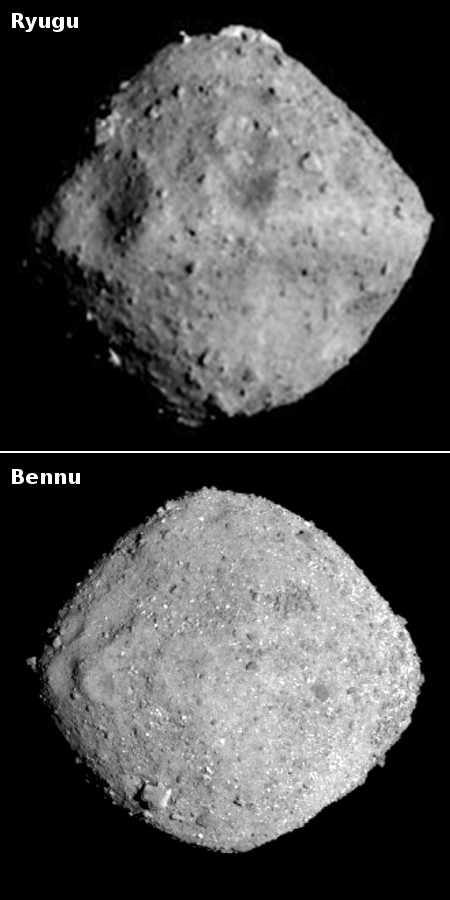
Scientists comparing the spectroscopy of samples returned from the near Earth asteroids Bennu and Ryugu have found they closely resemble the much larger main belt asteroid Polana, suggesting all three formed at the same time and place.
You can read the paper here [pdf] From the press release:
The study compared spectroscopy data from Polana with spacecraft and laboratory data from Bennu and Ryugu samples, discovering similarities in their near-infrared spectrum sufficient to support the theory that they originate from the same parent asteroid. “Very early in the formation of the solar system, we believe large asteroids collided and broke into pieces to form an ‘asteroid family’ with Polana as the largest remaining body,” said SwRI’s Dr. Anicia Arredondo, lead author of the study. “Theories suggest that remnants of that collision not only created Polana, but also Bennu and Ryugu as well.”
While the similarities are great, the paper notes there are differences, possibly from “space weathering, particle size, surface texture, or different compositions.” The scientists believe the differences were caused by the asteroids’ different environments, with the 33-mile-wide and much older Polana in the asteroid belt beyond Mars, and Ryugu and Bennu, both less than a mile wide, orbiting the Sun inside Mars.
It is also possible the asteroids have little to do with each other, and the similar spectroscopy only informs us of some of the more common components of the early solar system.
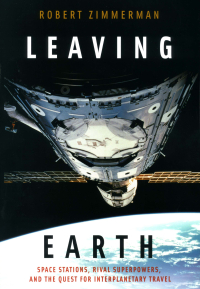
Leaving Earth: Space Stations, Rival Superpowers, and the Quest for Interplanetary Travel, can be purchased as an ebook everywhere for only $3.99 (before discount) at amazon, Barnes & Noble, all ebook vendors, or direct from my ebook publisher, ebookit.
If you buy it from ebookit you don't support the big oppressive tech companies and I get a bigger cut much sooner.
"Leaving Earth is one of the best and certainly the most comprehensive summary of our drive into space that I have ever read. It will be invaluable to future scholars because it will tell them how the next chapter of human history opened." -- Arthur C. Clarke

Proposed Australian spaceports.
Click for original image.
After being forced to change locations because of red tape and the refusal of the local aborigine authorities to sign an agreement, the Australian commercial spaceport startup Space Centre Australia has now obtained a land lease for its new location, dubbed Atakani, on the eastern shore of Cape York.
Space Centre Australia Pty Ltd (SCA) has secured a spaceport land lease, signing a multi-decade agreement with the local Traditional Landowners for approximately 300 km² at Billy’s Lagoon, Cape York. The agreement paves the way for the development of the Atakani Space Centre (ASC).
The Binding Term Sheet, signed with the support of Mokwiri RNTBC, marks the first time an Australian-based spaceport has secured a lease and opportunity of this scale. It ensures Traditional Owner access to country for cultural and ceremonial purposes, governance participation through the soon-to-be-established Luthiggi Corporation, and direct involvement in environmental management, cultural heritage monitoring, and operational activities. A royalty framework will deliver long-term economic benefits in addition to the spaceport’s operational revenue.
At the moment it appears the spaceport’s focus will be attracting suborbital launch companies, with the eventual goal to bring orbital rockets to the site.
China today successfully placed seven satellites into orbit, its Kinetica-1 (or Lijian-1) rocket lifting off from its Jiuquan spaceport in northwest China.
No word on where the rocket’s lower stages crashed inside China. Its state-run press provided almost no information about the launch, except for trumpeting the fact that it lifted off from the launchpad at Jiuquan that China has built for its pseudo-commercial companies. The rocket itself however is built by pseudo-company CAS Space, which is simply a division created by the government-run Chinese Academy of Sciences.
The leaders in the 2025 launch race:
101 SpaceX
47 China
11 Rocket Lab
9 Russia
SpaceX still leads the rest of the world in successful launches, 101 to 80.
An evening pause: Performed on French television in 1966. I suspect they are lip-synching to the record album, but the editing makes this hard to confirm.
Hat tip Diane Zimmerman.
Courtesy of BtB’s stringer Jay. This post is also an open thread. I welcome my readers to post any comments or additional links relating to any space issues, even if unrelated to the links below.

Increasingly irrelevant in the right places
My headline reflects the sense of utter irrelevance of the FAA in announcing its approval of the launch licence for the tenth test launch of Starship/Superheavy (now scheduled for August 24, 2025) as well as its “closing” of its “investigation” into the failure during test flight nine.
As per the FAA in its statement, “There are no reports of public injury or damage to public property. The FAA oversaw and accepted the findings of the SpaceX-led investigation. The final mishap report cites the probable root cause for the loss of the Starship vehicle as a failure of a fuel component. SpaceX identified corrective actions to prevent a reoccurrence of the event.”
The FAA did not “oversee” SpaceX’s investigation. No one at the FAA has the slightest qualifications for doing so. All its bureaucrats did is sit in and watch, and when SpaceX’s engineers completed their work and “identified corrective actions,” the FAA paper-pushers pushed some paper to rubber stamp those conclusions.
Moreover, unlike during the Biden administration, the FAA did not waste any time or money retyping the SpaceX investigation. They simply approved it as is, and issued the launch license. And they apparently instantly agreed to the schedule proposed by SpaceX. In fact, it appears almost as if SpaceX announced the date before the FAA announced the license approval.
Elections matter. And they would matter less if we had had the sense in the past century to not cede so much power to an unelected federal bureaucracy that is really unfit to do the work we gave them. The goal now should be to take that power away from them, and to do it as quickly as it is humanely possible.
It appears at least when it comes to FAA launch licenses, Trump has made some significant progress towards this goal.
SpaceX today successfully placed another 24 Starlink satellites into orbit, its Falcon 9 rocket lifting off from Vanenberg in California.
The first stage completed its ninth flight, landing on a drone ship in the Pacific.
The leaders in the 2025 launch race:
101 SpaceX
46 China
11 Rocket Lab
9 Russia
SpaceX now leads the rest of the world in successful launches, 101 to 79.
Click for original image.
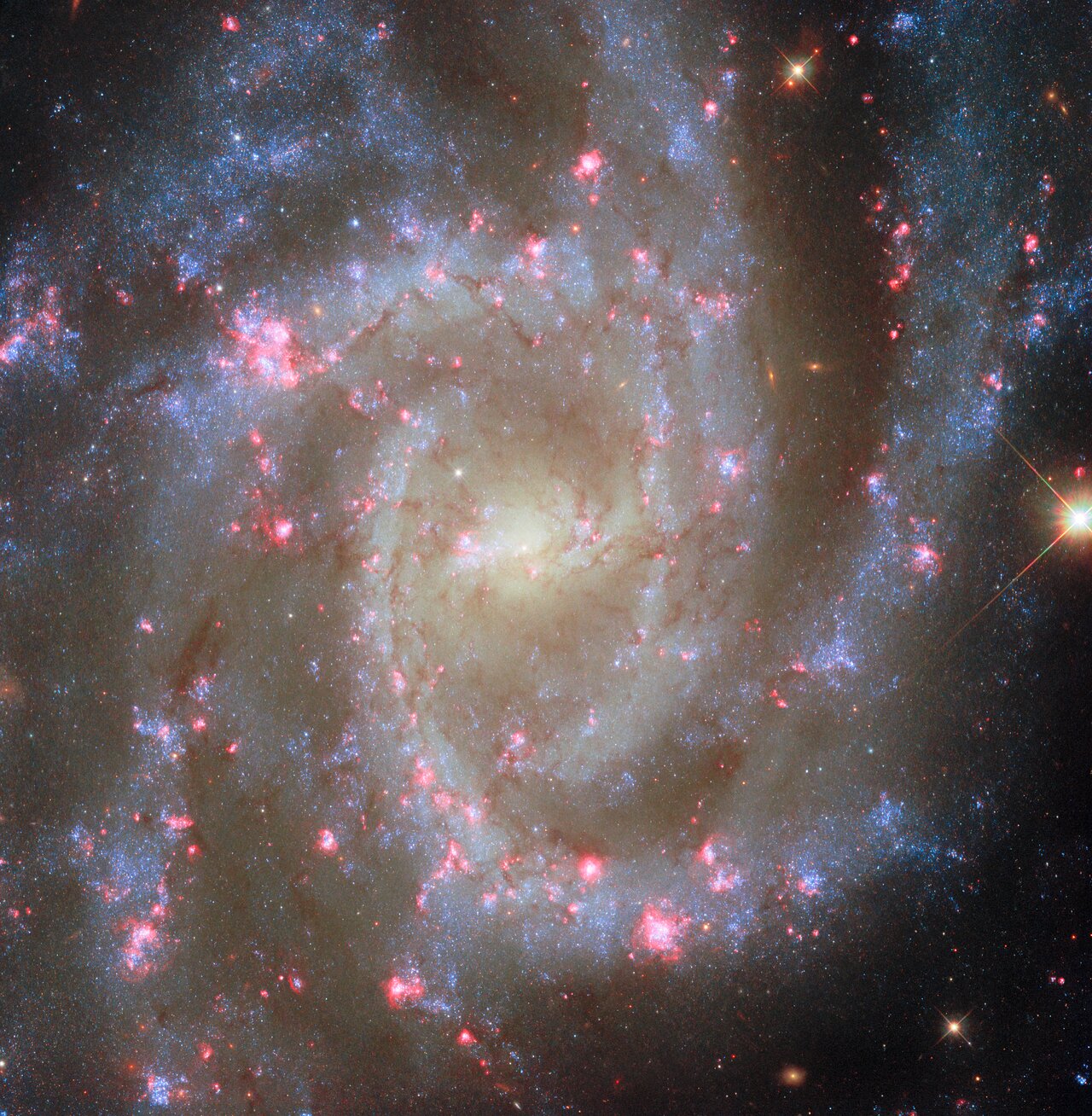
Cool image time! The picture to the right, reduced and sharpened to post here, was taken by the Hubble Space Telescope as part of a survey of nineteen nearby galaxies. The galaxy, NGC 2835 and 35 million light years away, has been imaged many times in the past, but the new image contacts new wavelength data designed to identify nebulae. From the caption:
This image differs from previously released images because it incorporates new data from Hubble that captures a specific wavelength of red light called H-alpha. The regions that are bright in H-alpha emission can be seen along NGC 2835’s spiral arms, where dozens of bright pink nebulae appear like flowers in bloom. Astronomers are interested in H-alpha light because it signals the presence of several different types of nebulae that arise during different stages of a star’s life. Newborn massive stars create nebulae called H II regions that are particularly brilliant sources of H-alpha light, while dying stars can leave behind supernova remnants or planetary nebulae that can also be identified by their H-alpha emission.
Compare this image with the 2020 photo. The spiral arms are now alive with red and blue features not seen previously.
This survey hopes to find 50,000 nebula in the galaxies being observed.
The Kazakhstan government is now hoping to convert portions of its Baikonur spaceport not leased by Russia so that international rocket startups, or maybe its own commercial rocket startup, could launch from there.
While much of the site is still under Russian lease, Kazakhstan acquired the 100 km² Zenit launch site and assembly centre in 2018, and earlier this year took over the former “Gagarin” launch pad, which is now a tourist attraction. This opens the door for Astana [Kazakhstan’s capital] to negotiate directly with foreign operators.
… To give itself an edge and capitalise on the site’s potential, Kazakhstan plans to set up a special economic zone for “national space projects and foreign start-ups.” Kazakhstan’s Prime Minister Olzhas Bektenov has already confirmed talks with India’s Skyroot, China’s Deep Blue Aerospace, and several European firms. “We briefly discussed options for launch pads or joint grant applications,” confirmed Christian Schiemer, CEO of Germany’s HyImpulse. Other interested parties include Germany’s OHB and Rocket Factory Augsburg, as well as Airbus Defence & Space and Luxembourg’s SES.
China has also held talks about using Baikonur.
All of this however is very speculative, with sources expressing skepticism.
Kazakhstan however increasingly needs to do something to save Baikonur. At the moment the Russians have only one active launchpad, for its Soyuz-2 rocket. Two other launchpads for its Proton rocket are listed as active, but that rocket is largely retired. A fourth launchpad for Russia’s proposed new Soyuz-5 rocket remains unfinished, its future uncertain. With Russia increasingly shifting launches to its new Vostochny spaceport in the far east, it is very possible that it will eventually abandon Baikonur.
Kazakhstan has other reasons to make deals with foreign startups. Such deals will make it more independent from its untrustworthy neighbor to the north.
The Japanese rocket startup Interstellar, which is being backed largely by Toyota, has announced that it has gotten five customer payloads for the first orbital launch of its Zero rocket.
This milestone mission will include cubesats from four organizations, Ocullospace, Wolfpack, Osaka Metropolitan University and Tokyo City University, and a fifth participant, DALRO Aerospace, that will supply the separation system for the universities’ cubesats. These 5 customers have already signed each a Launch Service Agreement with Interstellar. This launch highlights Interstellar’s growing global partnerships and commitment to expanding access to orbit.
These payloads are typical for a first launch. Three of these payloads are for educational institutions, while the remaining two are smallsat startups that have not launched yet, with one supported by the South Korean government. None have much money, so are willing to take the risk of a first launch.
As for when that first launch will take place, this is unclear. The company had previously targeted a launch in 2025, but based on the present status, this seems highly unlikely. The company itself was largely inactive from 2018 (when it did some suborbital test launches) until this year (when both Toyota and the Japanese government stepped in to provide financing). Expect it therefore to take time to get back into operation.
China today completed two launches using two different rockets from two different spaceports.
First, its Long March 4C rocket lifted off from its Xichang spaceport in southwest China, placing what its state-run press described as a satellite designed to do “space environment exploration and related technology tests,” No other information was released.
Next, its Long March 6A rocket lifted off from its Taiyuan spaceport in north China, placing the ninth set of Guowang satellites into orbit for a planned 13,000 constellation designed to compete with Starlink and Kuiper. This launch placed five satellites into orbit, bringing the total launched so far to 72.
In both cases, no word was released on where the rockets’ lower stages crashed inside China. This is especially significant for the Long March 4C rocket, which uses very toxic hypergolic fuels and lifted off from a spaceport much more inland than the Long March 6A.
The leaders in the 2025 launch race:
100 SpaceX
46 China
11 Rocket Lab
9 Russia
SpaceX now leads the rest of the world in successful launches, 100 to 79.
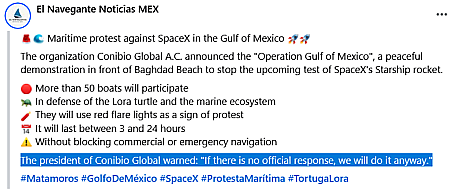
Protest announcement. Click for original.
A Mexico activist group now plans to launch a fleet of boats that plan to violate the range and prevent the next Starship/Superheavy test launch.
A translated version of the protest announcement can be seen to the right. From the first link above:
A Mexican environmental group, Comité Global A.C., said it plans to protest the launch by sending boats into the Gulf of Mexico near Starbase. If they enter designated safety areas during the planned launch period, they could delay the mission.
The group’s leader said the Matamoros Port Authority gave permission for the protest dubbed “Operación Golfo de México.” It will also include protesters on Playa Bagdad, a Mexican beach just south of the Rio Grande where people often gather for Starship launches.
I have not yet gotten confirmation that the local port authority has approved this protest as the organization claims, but it also appears that this activist group intends to show up in boats regardless. If so, this protest could easily cause the next test launch, now scheduled for August 24, 2025, to be delayed endlessly.
It seems this is a matter for Trump and the Coast Guard. Someone must move in and remove these boats, arresting and fining the occupants for violating launch range restrictions that apply to all international waters.
Hat tip to reader Richard M.
Embedded below the fold in two parts.
To listen to all of John Batchelor’s podcasts, go here.
» Read more
An evening pause: Hat tip Willi Kusche.
Courtesy of BtB’s stringer Jay. This post is also an open thread. I welcome my readers to post any comments or additional links relating to any space issues, even if unrelated to the links below.