French startup The Exploration Company opens U.S. subsidiary
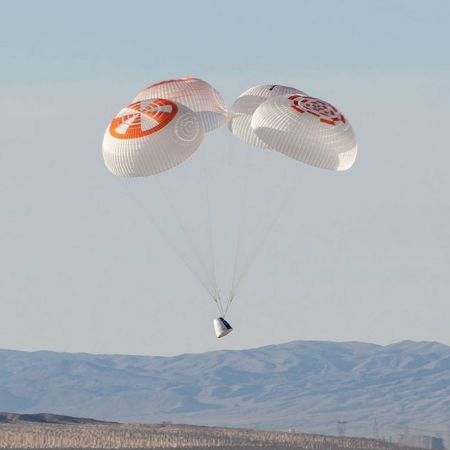
June 2026 successful drop test of Nyx prototype
The French startup The Exploration Company (TEC), which is building the Nyx reusable cargo capsule for supplying future space stations, has now established a U.S. office in Houston, with the clear intention of competing for NASA and Space Force contracts.
Located in Houston near NASA Johnson Space Center, the TEC Rapid Innovation Lab brings together engineers, designers, and operators in a space built for efficient, rapid innovation. At its center is a full-scale mockup of the future Nyx crew capsule, enabling teams to prototype, test, and refine crew interfaces in close collaboration with partners, astronauts, and NASA personnel.
…The company also established TEC Federal, a dedicated U.S. entity designed to serve government customers. Operating as a U.S.-controlled organization, TEC Federal enables participation in U.S. government programs and contracts, while ensuring compliance with applicable regulatory requirements.
Since its inception in 2021 the company has styled itself as a European company providing cargo and manned-space-related services for the European Space Agency (ESA). The problem is that ESA is not building any space stations. It is thus a very limited market. This new action tells us the company has recognized that the customers for Nyx — the five American space stations presently under development — are really in America, and so it is now beginning to shift operations here.