China completes launch abort test of Mengzhou capsule; also vertically lands Long March 10A 1st stage in ocean
Click for source.
China today completed a major test for its future manned lunar program. In launch for the first time the first stage of its new Long March 10A, it not only succeeded in completing a launch abort of its next generation Mengzhou manned capsule — intended not only for its space station but for its manned lunar program — the first stage successfully completed a vertical soft splashdown in the ocean.
The uncrewed vessel took off from the Wenchang Satellite Launch Centre on the southern island of Hainan aboard a Long March-10 prototype test rocket at 11am on Wednesday.
The Mengzhou vessel separated from the rocket shortly after launch, before splashing down in the ocean at its designated landing spot, according to the China Aerospace Science and Technology Corporation (CASC).
The first stage of the Long March-10 rocket also safely splashed down in its designated ocean landing spot, CASC said. The state-owned aerospace contractor developed both the rocket and the crewed spacecraft.
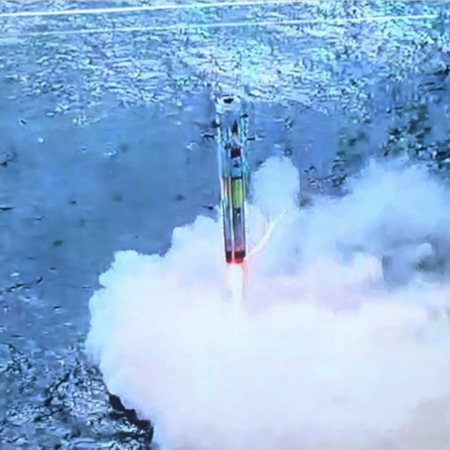
Courtesy of BtB’s stringer Jay, video of the launch can be seen here. Jay also found two additional images, one showing the stage just before splashdown standing vertical (as shown in the picture to the right) and the other of the stage floating in the water just before it was picked up by a recovery vessel. According to comments at these tweets, it is speculated that the interstage unit that connected the capsule to the stage was either ejected at landing or was torn off when the stage hit the water.
This is a major achievement for China. It gets it closer to being able to use Mengzhou for longer missions to places like the Moon.
The modular Mengzhou spacecraft has two variants: a seven-astronaut near-Earth model designed to support the country’s Tiangong space station and a model with a smaller crew capacity for missions to the moon. The latter is expected to work in tandem with the Lanyue lunar surface lander, designed to carry two astronauts to the moon’s surface.
The soft splashdown of the Long March 10A first stage also gets China closer to its first reuse of a rocket.
I must note that this success is part of a larger story about China’s space industry that is not so hopeful.
» Read more
Click for source.
China today completed a major test for its future manned lunar program. In launch for the first time the first stage of its new Long March 10A, it not only succeeded in completing a launch abort of its next generation Mengzhou manned capsule — intended not only for its space station but for its manned lunar program — the first stage successfully completed a vertical soft splashdown in the ocean.
The uncrewed vessel took off from the Wenchang Satellite Launch Centre on the southern island of Hainan aboard a Long March-10 prototype test rocket at 11am on Wednesday.
The Mengzhou vessel separated from the rocket shortly after launch, before splashing down in the ocean at its designated landing spot, according to the China Aerospace Science and Technology Corporation (CASC).
The first stage of the Long March-10 rocket also safely splashed down in its designated ocean landing spot, CASC said. The state-owned aerospace contractor developed both the rocket and the crewed spacecraft.
Courtesy of BtB’s stringer Jay, video of the launch can be seen here. Jay also found two additional images, one showing the stage just before splashdown standing vertical (as shown in the picture to the right) and the other of the stage floating in the water just before it was picked up by a recovery vessel. According to comments at these tweets, it is speculated that the interstage unit that connected the capsule to the stage was either ejected at landing or was torn off when the stage hit the water.
This is a major achievement for China. It gets it closer to being able to use Mengzhou for longer missions to places like the Moon.
The modular Mengzhou spacecraft has two variants: a seven-astronaut near-Earth model designed to support the country’s Tiangong space station and a model with a smaller crew capacity for missions to the moon. The latter is expected to work in tandem with the Lanyue lunar surface lander, designed to carry two astronauts to the moon’s surface.
The soft splashdown of the Long March 10A first stage also gets China closer to its first reuse of a rocket.
I must note that this success is part of a larger story about China’s space industry that is not so hopeful.
» Read more