
Snack Attack
An evening pause: Hat tip Jim Mallamace.
An evening pause: Hat tip Jim Mallamace.
A new analysis of Dawn data suggests that the poles of Ceres have wandered by as much as 36 degrees, and the data also adds further support for the existence of a liquid water layer between the dwarf planet’s crust and mantle.
“The most surprising aspect of this paper is to me the observation that the pole of Ceres must have followed an indirect path to its current pole. A multi-step reorientation could mean that the equatorial density anomaly was still evolving during the reorientation, and this could be because the crust and mantle were weakly rotationally coupled, allowing the crust to start reorienting while the mantle would lag behind,” Tricarico said. “If crust and mantle are allowed to shift with respect to one another, that could point to a layer of reduced friction between crust and mantle, and one of the possible mechanisms to reduce friction could be an ancient water ocean beneath the crust.”
In other words, the crust and mantle are not locked together. Imagine a baseball where the ballcover is not tightly held to the inner core, and slides around it. (Boy there are a lot of pitchers who wish they could get a hand on that baseball.) The cause of that looseness on Ceres is possibly because of a liquid layer in-between the crust and the mantle.
Need I note that there are uncertainties here?

On Christmas Eve 1968 three Americans became the first humans to visit another world. What they did to celebrate was unexpected and profound, and will be remembered throughout all human history. Genesis: the Story of Apollo 8, Robert Zimmerman's classic history of humanity's first journey to another world, tells that story, and it is now available as both an ebook and an audiobook, both with a foreword by Valerie Anders and a new introduction by Robert Zimmerman.
The print edition can be purchased at Amazon or any other book seller. If you want an autographed copy the price is $60 for the hardback and $45 for the paperback, plus $8 shipping for each. Go here for purchasing details. The ebook is available everywhere for $5.99 (before discount) at amazon, or direct from my ebook publisher, ebookit. If you buy it from ebookit you don't support the big tech companies and the author gets a bigger cut much sooner.
"Not simply about one mission, [Genesis] is also the history of America's quest for the moon... Zimmerman has done a masterful job of tying disparate events together into a solid account of one of America's greatest human triumphs."--San Antonio Express-News
NOAA yesterday released its monthly update of the solar cycle, covering sunspot activity for September 2018. As I have done every month since this website began in July 2011, I am posting it below, annotated to give it some context.
Sunspot activity on the Sun in September dropped slightly from August. More significantly, the activity continues to match closely the weak activity seen in 2008, when the Sun last went through its last solar minimum. We are unquestionably now in the new minimum, and its arrival in the past few months makes the now-ending solar cycle about one to two years shorter than predicted.
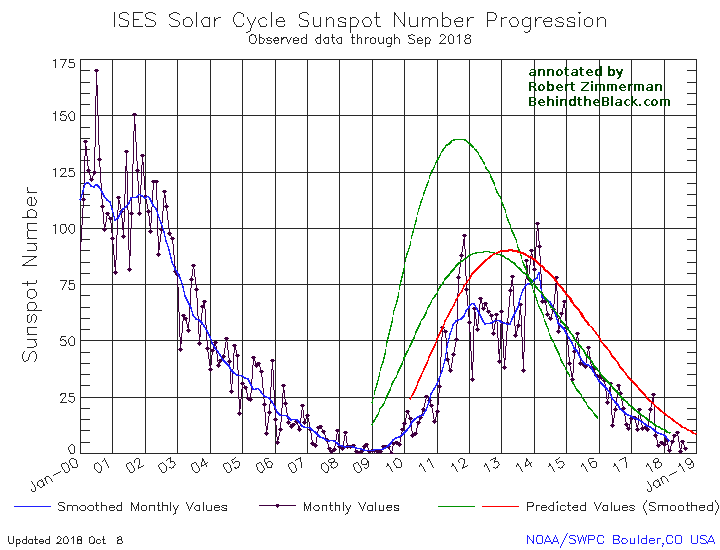
The graph above has been modified to show the predictions of the solar science community. The green curves show the community’s two original predictions from April 2007, with half the scientists predicting a very strong maximum and half predicting a weak one. The red curve is their revised May 2009 prediction.
As I noted last month, the NOAA graph is now getting very close to its right edge, which ends in December 2019. They will very soon have to update this graph so that it can take us into the next solar cycle.
What that new cycle will bring will be the next mystery. I have been following this cycle now since its unusual beginning, with a solar minimum much much longer and more inactive than any solar scientist had ever expected. We can only guess at the surprises the Sun will give us in the coming decade, especially since the science of solar sunspot activity remains superficial and in its infancy. We do not really understand why the Sun’s activity fluctuates. Nor do we understand why it periodically stops producing sunspots for long periods, resulting in what solar scientists call a grand minimum.
There are some scientists who think another grand minimum is coming. We shall have to wait and see. I certainly am going to follow their upcoming observations, as this work remains one of the great scientific studies humans are presently pursuing.
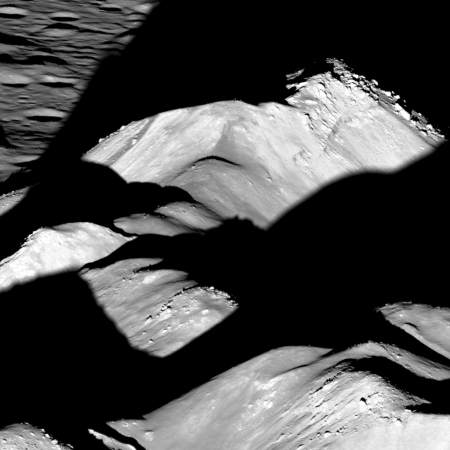
Cool image time! Lunar Reconnaissance Orbiter science team has released a new image of the central peaks of Copernicus Crater, shown on the right cropped and reduced in resolution.
Copernicus (9.62°N, 339.92°E), which is easily seen with a moderately powerful backyard telescope, is one of the best-known craters on the Moon. Despite its age (around 860 million years), it is well preserved with over 4000 meters of relief from floor to rim, and the tallest of its central peaks rises approximately 1300 meters above the crater floor. This image, centered on the central peaks, was captured just after dawn (86° incidence angle) as the Lunar Reconnaissance Orbiter slewed west to a 67°angle.
The image is similar to one taken back in 2012, but has a higher resolution because it was shot from 50 miles elevation instead of 75.
This crater was also the subject of one of the first breath-taking images ever taken of the Moon from lunar orbit, by Lunar Orbiter in November 1966.
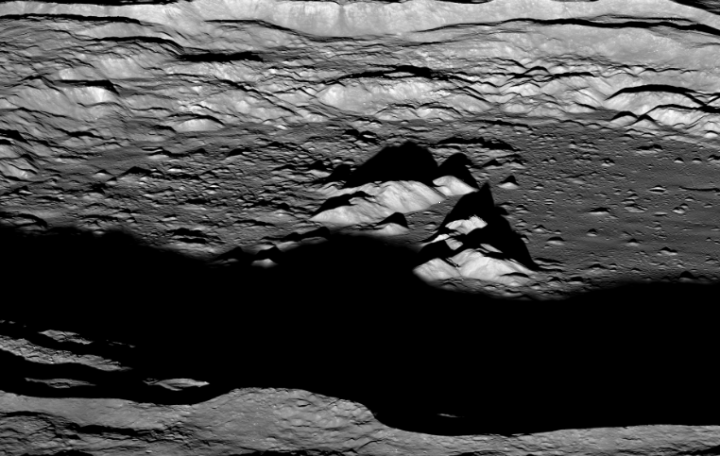
The wider view taken by LRO gives some context for the image above. The peaks shown in closeup here are part of the lower right grouping. If you go to the first link above you can zoom in and explore all parts of the full image, and see some quite amazing details, including the large boulders scatter throughout the hollows between the peaks.

Now available in hardback and paperback as well as ebook!
From the press release: In this ground-breaking new history of early America, historian Robert Zimmerman not only exposes the lie behind The New York Times 1619 Project that falsely claims slavery is central to the history of the United States, he also provides profound lessons about the nature of human societies, lessons important for Americans today as well as for all future settlers on Mars and elsewhere in space.
“Zimmerman’s ground-breaking history provides every future generation the basic framework for establishing new societies on other worlds. We would be wise to heed what he says.” —Robert Zubrin, founder of the Mars Society.
All editions are available at Amazon, Barnes & Noble, and all book vendors, with the ebook priced at $5.99 before discount. All editions can also be purchased direct from the ebook publisher, ebookit, in which case you don't support the big tech companies and the author gets a bigger cut much sooner.
Autographed printed copies are also available at discount directly from the author (hardback $29.95; paperback $14.95; Shipping cost for either: $6.00). Just send an email to zimmerman @ nasw dot org.
In a new paper scientists note that getting the congressionally mandated Europa Clipper safely to the surface of Jupiter’s moon might be threatened by the existence there of forests of giant five-story high ice pinnacles.
Probes have shown that Europa’s ice-bound surface is riven with fractures and ridges, and new work published today in Nature Geosciences suggests any robotic lander could face a nasty surprise, in the form of vast fields of ice spikes, each standing as tall as a semitruck is long.
Such spikes are created on Earth in the frigid tropical peaks of the Andes Mountains, where they are called “pentinentes,” for their resemblance to devout white-clad monks. First described by Charles Darwin, pentinentes are sculpted by the sun in frozen regions that experience no melt; instead, the fixed patterns of light cause the ice to directly vaporize, amplifying minute surface variations that result in small hills and shadowed hollows. These dark hollows absorb more sunlight than the bright peaks around them, vaporizing down further in a feedback loop.
This work is based on computer models, so it has a lot of uncertainty. It also appears to assume that these pentinentes will be widespread across Europa’s equatorial regions, something so unlikely I find it embarrassing that they even imply it. I guarantee Europa’s surface will be more varied than that. If they are designing Europa Clipper properly, it will go into orbit first to scout out the best landing site, and will be able to avoid such hazards.
Turf war! Even as Trump is pushing for a new Space Force, the military bureaucracy is proposing competing proposals for rearranging its space bureaucracy.
Some of the details are a bit in the weeds but the following lays out some of the basics
Griffin and Wilson take very different approaches.
In her memo, Wilson suggests the Space Development Agency should be organized under the existing Space Rapid Capabilities Office and that it should be geographically and organizationally connected to U.S. Space Command. She recommends using “existing structures designed and chartered to acquire capabilities rapidly, rather than establishing new structures.”
Griffin is proposing a new D.C.-based agency with a staff of 112 government personnel that would report to him initially, but eventually would shift to the control of a new assistant secretary of defense for space, an office that would first have to be approved by Congress.
In Wilson’s plan, the Space Development Agency and other acquisition organizations would transition to the new Department of the Space Force. She pointedly pushes back on the idea of having an assistant secretary of defense for space or a Space Development Agency that reports to that office. She argues that such a setup would create additional bureaucracy that would be removed from the operators who use and maintain the equipment.
Griffin, a former NASA administrator, seems more focused in his proposal in transitioning the military towards using private commercial assets rather than building its own, but his apparent love for building his own empire might work against that stated goal.

Leaving Earth: Space Stations, Rival Superpowers, and the Quest for Interplanetary Travel, can be purchased as an ebook everywhere for only $3.99 (before discount) at amazon, Barnes & Noble, all ebook vendors, or direct from my ebook publisher, ebookit.
If you buy it from ebookit you don't support the big oppressive tech companies and I get a bigger cut much sooner.
"Leaving Earth is one of the best and certainly the most comprehensive summary of our drive into space that I have ever read. It will be invaluable to future scholars because it will tell them how the next chapter of human history opened." -- Arthur C. Clarke
The end might be near: The Hubble Space Telescope went into safe mode this weekend when one of its three working gyroscopes failed.
Hubble has six gyroscopes, all of which were replaced by spacewalking astronauts during a servicing mission in May 2009. The telescope needs three working gyroscopes to “ensure optimal efficiency,” mission team members have written, and the failure brings that number down to two (if the “problematic” one that had been off can’t be brought back online).
But that doesn’t mean it’s time to panic. Hubble can do good science with two gyroscopes, or even one, astrophysicist Grant Tremblay, of the Harvard-Smithsonian Center for Astrophysics, said via Twitter Sunday.
While it is true that Hubble can do science on one or two gyroscopes, in that mode it will no longer be able to take the sharp spectacular pictures that represent its great glory.
Hubble was launched in 1990, fixed in 1993, and has been the most successful science robot ever launched. Scientists had hoped, when they made the James Webb Space Telescope their priority in the very early 2000s that both would be in space and operating to provide top notch science data, with Hubble working in visible wavelengths and Webb in the infrared. Webb’s endless delays and cost overruns has now probably made that impossible.
Worse, there are no plans to build a replacement for Hubble. For the first time since 1993, the human race will no longer be able to see, with our own eyes, the universe sharply.
Capitalism in space: SpaceX today successfully launched an Argentinian radar satellite, while also achieving the first on-land first stage recovery at Vandenberg.
The first stage was a Block 5 that was used and landed on a barge in July, meaning they turned it around in about two months, the fastest turn-around on the West Coast. With this successful landing on land at Vandenberg, they will able to speed up that turn-around time considerably in the future.
The leaders in the 2018 launch race:
26 China
17 SpaceX
8 Russia
7 ULA
6 Europe (Arianespace)
China remains the leader in the national rankings, 26 to 25, over the United States.
Embedded below the fold in two parts.
» Read more
Because of increased funding to SLS from Congress, NASA is now pushing Boeing to do upgrades to the interim SLS upper stage as well as its final full power upper stage, dubbed the Exploration Upper Stage (EUS) and originally planned for most SLS missions.
Those changes were prompted by the decision NASA made earlier this year to delay the introduction of the EUS. That stage was originally planned to enter use with the second SLS mission, Exploration Mission (EM) 2. Instead, the first flight of what’s known as the Block 1B configuration of SLS has been delayed to the fourth SLS launch, likely no earlier than 2024.
“That has put a slow down on the Exploration Upper Stage work,” said (John Shannon, vice president and program manager for the Space Launch System at Boeing). “We were rapidly approaching the critical design review.”
NASA has asked Boeing to spend some time to try and “optimize” the EUS with the goal of increasing the amount of additional payload it can carry. Such co-manifested payloads, such as modules for NASA’s proposed lunar Gateway, would be carried on the SLS underneath the Orion spacecraft. (emphasis mine)
Shannon also made what might be the biggest understatement I have ever heard when asked about SLS’s endless delays, noting that “We underestimated that somewhat,” referring to the time it has taken to build the rocket.
NASA got Congress to give them extra money to allow more flights of the interim stage, since putting humans on EUS on its first flight was absurdly risky. This way they could also avoid further delays on that first SLS/Orion manned mission, now set for 2023, almost twenty years since it was first proposed. By pushing for more upgrades, they can also justify again stretching the program out longer, thus stretching out the pork without actually flying anything.
The contrast with SpaceX’s development of Falcon Heavy with NASA’s development of SLS continues to be striking. The former was conceived, built, and launched in less than ten years, for a cost of half a billion. The latter remains unflown and unready to fly after fourteen years of development, and likely will not fly for another six years plus. And its development cost will likely top $50 billion by that time.
If I was a customer looking to buy a product, I would laugh NASA out of the room if it tried to sell me its SLS rocket. Unfortunately, the critters in Congress aren’t that smart, and continue to pour money into this dead end project, money that could be much more effectively spent buying rockets from the private sector.
The sixth biggest Michigan meteorite ever discovered had been used as a doorstop for decades and was only identified when its present owner got curious and had it inspected by scientists.
Central Michigan University says Thursday that the 22.5-pound space rock was recently identified by Department of Earth and Atmospheric Sciences professor Dr. Monaliza Sirbescu after the owner “brought it to her out of curiosity.” The Grand Rapids man was apparently inspired to investigate after seeing news of meteorite hunters finding shards and selling them for thousands of dollars after a meteor sighting in January in the Detroit area.
The chunk of iron and nickel was later valued at $100,000 after the Smithsonian Institution verified the find, CMU said in a release. The rock, which was initially used as a doorstop in the Edmore area for several decades after a farmer recovered it sometime in the 1930s, turned out to be Michigan’s sixth-largest meteorite, a university spokesperson said.
Hat tip Wayne DeVette.
New data since August from Voyager 2 now suggests it is finally leaving the heliosphere of the solar system and entering interstellar space.
Since late August, the Cosmic Ray Subsystem instrument on Voyager 2 has measured about a 5 percent increase in the rate of cosmic rays hitting the spacecraft compared to early August. The probe’s Low-Energy Charged Particle instrument has detected a similar increase in higher-energy cosmic rays.
Cosmic rays are fast-moving particles that originate outside the solar system. Some of these cosmic rays are blocked by the heliosphere, so mission planners expect that Voyager 2 will measure an increase in the rate of cosmic rays as it approaches and crosses the boundary of the heliosphere.
In May 2012, Voyager 1 experienced an increase in the rate of cosmic rays similar to what Voyager 2 is now detecting. That was about three months before Voyager 1 crossed the heliopause and entered interstellar space.
The scientists warn that there is great uncertainty here, and that the actual transition into interstellar space might take longer than with Voyager 1 since Voyager 2 is traveling in a different direction and is leaving during a different time in the solar cycle.
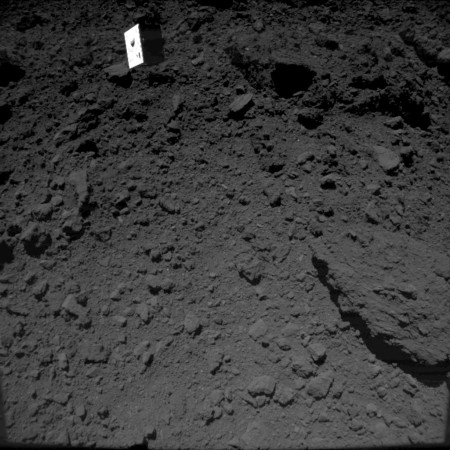
The Hayabusa-2 science team today released images taken of MASCOT as it descended to the surface of Ryugu, including images showing where it landed.
In the image on the right, reduced slightly to post here, you can see MASCOT as it slowly moves downward towards the asteroid shortly after its release from Hayabusa-2. At the link there is another image showing the mini-lander as a white dot when it was still about 115 feet above the surface. Other images show its location on the surface where it operated for seventeen hours and completed three hops.
The next big event from Hayabusa-2 will be the spacecraft’s own landing, sometime later this month.
New Horizons this week successfully made its final major course correction in preparation for its January 1st fly-by of the Kuiper Belt object the science team has dubbed Ultima Thule.
NASA’s New Horizons spacecraft carried out a short engine burn on Oct. 3 to home in on the location and timing of its New Year’s flyby of the Kuiper Belt object nicknamed Ultima Thule.
Word from the spacecraft that it had successfully performed the 3½-minute maneuver reached mission operations at the Johns Hopkins Applied Physics Laboratory in Laurel, Maryland, at around 10:20 p.m. EDT. The maneuver slightly tweaked the spacecraft’s trajectory and bumped its speed by 2.1 meters per second – just about 4.6 miles per hour – keeping it on track to fly past Ultima (officially named 2014 MU69) at 12:33 am EST on Jan. 1, 2019.
As the spacecraft gets closer they will do more refinements, but right now they are a very precise course. The January 1st fly-by will end a spectacular fall season of planetary mission rendezvous, landings, fly-bys and sample gatherings.
Posted from Chicago.
An evening pause: Performed live at the 2012 Telluride Bluegrass Festival, demonstrating that there really is a link between baroque music and American bluegrass. The fiddlers who came to early America had been trained to play this kind of music.
Hat tip Danae.
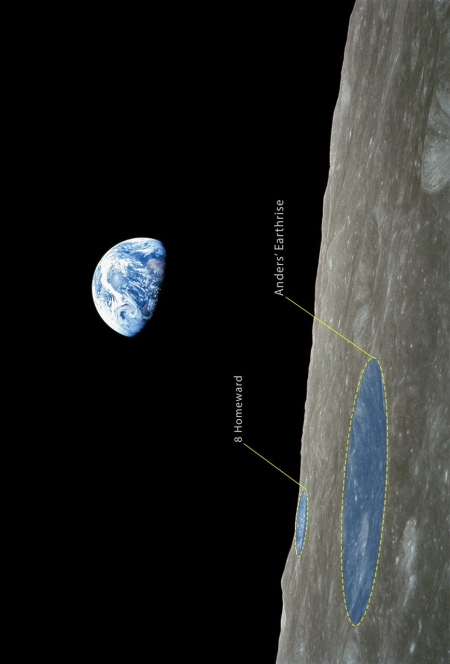
The International Astronautical Union has named two craters “8 Homeward” and “Anders’ Earthrise,” both visible in astronaut Bill Anders iconic Earthrise image, in honor of the upcoming fiftieth anniversary of the Apollo 8 mission to the Moon.
The Working Group for Planetary System Nomenclature of the International Astronomical Union has today officially approved the naming of two craters on the Moon to commemorate the 50th anniversary of the Apollo 8 mission. The names are Anders’ Earthrise and 8 Homeward.
The newly named craters are visible in the foreground of the iconic Earthrise colour photograph taken by astronaut William Anders. It depicts the moment that our shiny blue Earth came back into view as the spacecraft emerged out of the dark from behind the grey and barren Moon. This is arguably the most famous picture taken by Apollo 8. It became iconic and has been credited with starting the environmental movement.
The image is to the right, with the two craters indicated. I have rotated the image so that the horizon is on the right, since is how Anders took it. As I noted in Genesis: the Story of Apollo 8 (now available as both an ebook and audiobook),
Bill Anders’ photograph of earthrise, taken on December 24, 1968, possibly one of the most reprinted photographs ever taken. The way it is usually reproduced, however, with the Moon’s horizon at the bottom, is not how Bill Anders took it.
Instead, the way it is shown on the cover of Genesis: the Story of Apollo 8 is the way he framed it, with the Moon’s horizon on the right. This is also how it is framed at Bill Anders’s home, which also was the first time I had ever seen it oriented that way. When I asked Anders why it was framed that way, he answered, “That’s how I took it.”
To Anders, floating in zero gravity, the earth wasn’t rising from behind an horizon line (which is how a human living on a planet’s surface would perceive it). Instead, floating in a space capsule seventy miles above the moon, Anders saw himself circling the moon’s equator. The lunar horizon therefore appeared vertical to him, and the earth moved right to left as it came out from behind the moon.
In 1968 the IAU had refused to accept some of the astronauts’ naming choices. This honor now somewhat corrects that injustice.
UPDATE: One more historical note: On Saturday there will be a 50th Reunion Dinner for the Apollo 8 astronauts at the Museum of Science and Industry in Chicago. I will be attending, so today is a travel day.
Hayabusa-2’s mini-lander MASCOT has ended its mission on Ryugu after seventeen hours, slightly longer than the planned sixteen hours.
The lander made one hop, and successfully transmitted all its data back to Hayabusa-2, which still has one more mini-lander on board that will be sent to Ryugu’s surface, probably after Hayabusa-2 makes its own landing.
Meanwhile, the two Minerva-2 bouncers continue to operate on Ryugu.
NASA today released an updated schedule for the Dragon and Starliner test flights, indicating the first Dragon flight has been pushed to January 2019.
It appears from the article that SpaceX was prepared to fly its first flight in December, meaning only a one month delay, but scheduling conflicts at ISS forced them to push it to January.
With the Boeing flights, the scheduling has less to do with delays and more do to do with setting more precise launch dates.
An evening pause: Hat tip Jim Mallamace.
They’re coming for you next: The Democratic congressional aide who has been arrested for releasing private information of at least three Republican elected officials also threatened to release the health information and social security numbers of their children if anyone turned him in.
Jackson Cosko, who recently worked for Rep. Sheila Jackson Lee, D-Texas, was arrested for allegedly posting the personal information (or “doxxing”) of a number of senators including Lindsey Graham, R-S.C., Mike Lee, R-Utah, and Orrin Hatch, R-Utah on Wikipedia — with information such as their home addresses and phone numbers. Graham, Lee and Hatch’s information was published on Thursday.
According to a sworn statement by Capitol Police Captain Jason Bell, a witness Tuesday saw Cosko at a computer in a senator’s office, where he used to work, a day after two other unnamed senators’ information had been put on Wikipedia. Cosko worked for other Democratic senators including Sen. Dianne Feinstein, D-Calif., Sen. Maggie Hassan, D-N.H., and former Sen. Barbara Boxer, D-Calif. While earlier reports identified Cosko as an intern for Jackson Lee, his lawyer said that he was working as a fellow in her office, paid by an outside institution.
Sources familiar with the case tell Fox News Cosko was in Sen. Hassan’s office, where he was caught using a login he was not authorized to use. Cosko earlier was let go by Senator Hassan’s office. A spokesman for Hassan says she “strongly denounces the alleged actions.”
According to Bell’s statement, Cosko is alleged to have been confronted by the staffer and then walked out. Hours later the witness received an email from “livefreeorpwn@gmail.com” saying: “If you tell anyone I will leak it all. Emails signal conversations gmails. Senators children’s health information and socials.”
While his actions have been disavowed by the Democratic lawmakers for whom he worked, his actions reveal once again the fascist and hateful culture that presently permeates the entire left. They are willing to do you real harm, and if that doesn’t make you shut up and stop opposing them, they will go after your children.
Don’t believe me? You still think this is only a rare exception? Then read this letter from the wife of Senator Rand Paul (R-Kentucky):
Paul wrote Wednesday that she and her family had “experienced violence and threats of violence at a horrifying level” over the past 18 months. “I now keep a loaded gun by my bed,” she said. “Our security systems have had to be expanded. I have never felt this way in my life.”
For decades the Democrats have allowed this kind of behavior to go unpunished. It is now getting out of their control. Bad things are coming. If you don’t tow the leftist line, get ready. Be prepared. You will need to defend not only yourself, but all your loved ones.