NASA funds hopper to jump into shadowed lunar craters and find ice

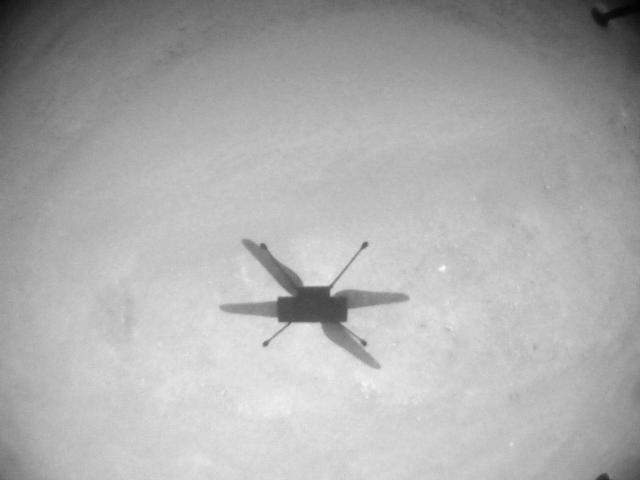
Capitalism in space: NASA has awarded a $41.6 million contract to Arizona State University and the private company Intuitive Machines to build a tiny hopper that will be used to explore the permanently shadowed craters near the Moon’s south pole, looking for water ice.

Micro-Nova can carry a 1-kilogram payload more than 2.5 kilometers to access lunar craters and enable high-resolution surveying of the lunar surface under the flight path. Intuitive Machines’ Micro-Nova, a lunar hopper that will explore permanently shaded regions of the moon.

…“Intuitive Machines’ Micro-Nova is our first-ever chance to explore from within a lunar permanently shaded region (PSR),” said the mission science lead Mark Robinson, of ASU’s School of Earth and Space Exploration. “We will be able to take very high resolution color images near the hopper and black and white images of about half the PSR. What will we see, that is the question!”

This tiny hopper, only 30 inches square, will be built by ASU and launched on Intuitive Machines’ first Moon lander, Nova-C, presently scheduled for launch in December 2022.

0 comments

Russia launches Nauka, its first new ISS module in 11 years

Russia today used its Proton rocket to successfully place in orbit its new ISS module, Nauka, the first new Russian module in eleven years, and fourteen years after it was originally supposed to launch.

After launch and orbit insertion, the module, MLM-U Nauka, is now performing an eight day phase to the Station for an automated docking on July 29 to the nadir docking port of the Zvezda service module, a port currently occupied by the Pirs module.

Upon arrival, Nauka will become the third largest module of the Russian segment of the ISS and will add 70 cubic meters of space to the Station’s internal volume, a third Russian-side sleeping location, an additional toilet, as well as new water regeneration and oxygen production systems — augmenting some of the original systems in Zvezda that are showing their 22 year age.

The main task for the Nauka module will be to conduct scientific experiments. The pressurized compartment of the module contains 21 universal working places (URM), including four locations with sliding shelves, a glove box, a frame with an automatic rotating vibration-proof platform, and a porthole with a diameter of 426 mm for visual and instrumental observations.

The article above provides a very interesting review of Nauka’s complex and difficult history.

The leaders in the 2021 launch race:

23 China
20 SpaceX
12 Russia
3 Northrop Grumman

The U.S. still leads China 29 to 23 in the national rankings.

3 comments

Israel: Airborne High Power Laser Weapon test

An evening pause: I’m not sure if this fits as an evening pause, but the engineering is startling, and has ramifications both good and bad, for the future. The first half of the video shows the test, the second half explains it.

Israelis are surrounded by neighbors dominated by a culture that wishes to kill them all. They need this kind of defense, especially because the world will no longer defend them against this threat of genocide. In fact, many of our ruling “intellectual” class celebrate that possibility.

That they are forced to develop this technology sadly means that some bad actors will get it soon as well. The dark age is so fast approaching that it takes the breath away. That this is where we are, on the anniversary of the Apollo 11 landing on the Moon, is tragic beyond words.

Hat tip Jim Malamace.

12 comments

Ice-filled craters in Mars’ glacier country?

Craters in Protonilus Mensae
Click for full image.

Today’s cool image returns us to the chaos region dubbed Protonilus Mensae, the middle of three adjacent mensae regions in the northern hemisphere that I like to dub Mars’ glacier country because there is so much evidence of buried ice there.

The photo to the right, cropped to post here, was taken on May 31, 2021 by the high resolution camera of Mars Reconnaissance Orbiter (MRO). Titled “Layered Feature in Crater in Protonilus Mensae,” the section I have posted focuses on several craters, with the one with the central mesa likely the picture’s target. Based on many similar features found in craters in this region, it is somewhat safe to assume that this mesa is made of buried ice.

The overview map below as always provides the context.
» Read more

0 comments

Rocket Lab identifies cause of May launch failure; ready to launch again

Capitalism in space: Rocket Lab announced yesterday that it has identified and corrected the cause of a May 15 launch failure and is now ready to resume launches, as early as before the end of July.

Rocket Lab said an investigation by the company traced the root cause to the rocket’s second stage engine igniter system. A problem with the igniter corrupted signals in the computer on the stage, which in turn caused the thrust vector control system to “deviate outside nominal parameters.” The engine computer then shut down the Rutherford engine.

The igniter problem, the company said, resulted from “a previously undetectable failure mode within the ignition system that occurs under a unique set of environmental pressures and conditions” not noticed in previous testing of the engine or on previous Electron launches. Engineers have replicated the problem in the lab and created what Rocket Lab called “redundancies” in the ignition system, including changes to the design of the igniter and how it is manufactured, to prevent the problem from happening again.

Rocket Lab has had two launch failures in the past year, so getting back flying as quickly as possible is critical for them, especially because a lot of new smallsat launch companies are coming up from behind. Virgin Orbit initiated commercial launches this year, having already completed two, and Astra and Firefly both seem ready, based on recent announcements, to make their first orbital launches before the end of this year.

1 comment

SpaceX completes first static fire test of Superheavy prototype #3

Superheavy booster #3 fires
Superheavy booster #3 fires.

Capitalism in space: SpaceX yesterday successfully completed the first static fire test of the third Superheavy prototype, firing up three Raptor engines for about two seconds.

I have embedded the live stream from NASASpaceflight.com below the fold, cued to just before the engines fire. Because there was a delay of a few minutes from when the static fire was expected and when it actually happened, the announcers had began talking and were caught off guard by the burn.

Next up:

Booster 3 provides a first-time operation for fueling the huge booster with Liquid Oxygen (LOX) and Liquid Methane (CH4) during the test. How much propellant will be loaded, and the schedule for the sequence was unknown. However, NSF’s Adrian Beil wrote a feature on the expectations based on previous experiences with Starship being applied to Super Heavy.

Based on those evaluations, it was expected that Super Heavy would also undergo a Starship-like countdown of 45-60 minutes, with fueling beginning in the 30-40 minute range. Engine chill would then follow at T-12 minutes, ahead of the firing. As with previous Static Fires, the T-10 minute siren sounded, as per the alert notice to local residents. However, as with Starship, mini-holds can be expected, pushing the ignition time to the right. This proved to be the case on Monday.

The booster fired up all three engines for the expected duration, confirmed by Musk before he noted that “depending on progress with Booster 4, we might try a 9 engine firing on Booster 3.”

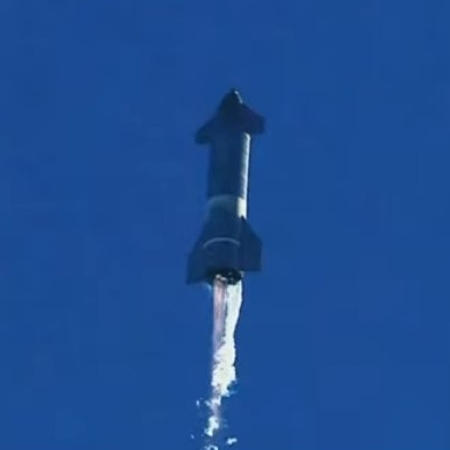
Booster #4 will be put on the orbital launchpad rather than the test pad, and is likely the booster to be used for the first orbital test flight of Starship, likely to be launched before the end of summer.
» Read more

8 comments

Blue Origin completes first commercial suborbital flight

New Shepard just prior to landing
New Shepard just prior to landing.

Capitalism in space: Blue Origin this morning successfully flew its first commercial suborbital flight using its New Shepard spacecraft, taking Jeff Bezos and four other passengers, one paying, to an altitude of 66.5 miles.

The flight lasted just over ten minutes.

I have embedded the video of the flight, cued to just before launch, below the fold. Try to ignore the blather of Blue Origin’s announcer, which fortunately mostly stops once the spacecraft passes 62 miles and enters space. At that point microphones from inside the capsule take over, and you get to hear the reaction of the passengers themselves.

A grand success for Blue Origin and Jeff Bezos. And another grand success for freedom and private enterprise.

Next up, the beginning of regular commercial orbital manned tourist flights, starting in September. Here is the present flight manifest:

  • September 2021: SpaceX’s Dragon capsule flies four private citizens on a three day orbital flight
  • October 2021: The Russians will fly two passengers to ISS to shoot a movie
  • December 2021: The Russians will fly billionaire Yusaku Maezawa and his assistant to ISS for 12 days
  • cDecember 2021: Space Adventures, using a Dragon capsule, will fly four in orbit for five days
  • January 2022: Axiom, using a Dragon capsule, will fly four tourists to ISS
  • 2022-2024: Three more Axiom tourist flights on Dragon to ISS
  • 2024: Axiom begins launching its own modules to ISS, starting construction of its own private space station
  • c2024: SpaceX’s Starship takes Yusaku Maezawa and several others on a journey around the Moon.

» Read more

25 comments

Watching New Shepard’s first manned commercial flight tomorrow

Blue Origin will be live streaming the suborbital flight tomorrow of its New Shepard spacecraft, carrying Jeff and Mark Bezos, Wally Funk, and passenger 18-year-old Oliver Daemen, his ticket paid for by his father at an undisclosed price.

The broadcast begins at 7 am (Eastern), with launch scheduled for 9 am (Eastern).

The flight itself will be about about ten to twelve minutes total, expecting to reach an altitude exceeding 67 miles, Though it will fly higher than Virgin Galactic’s suborbital flight last week, which reached about 53.5 miles, it will be far shorter. Because Virgin Galactic’s spacecraft takes off attached to the bottom of an airplane, the flight includes more than an hour of flight time getting up to the right altitude to release the spacecraft.

New Shepard launches from the ground, goes straight up, and reaches its maximum height within minutes.

Which is a better deal? That’s up to you. Since orbital tourist flights are now available and will be launching monthly beginning in September, both of these very short suborbital hops seem much less interesting then they would have only two years ago.

4 comments

Cracks, chaos, and maybe caves in one place on Mars

Mosaic of Avernus Cavi fissures
Click for higher resolution. Original images found here and here.

Today’s cool image to the right is a mosaic I have made from two images taken by the context camera on Mars Reconnaissance Orbiter (MRO), showing a most intriguing region on Mars dubbed Avernus Cavi, located in the large volcanic plain called Elysium Planitia between the giant volcanoes Elysium Mons and Olympus Mons, a region I like to call Mars’ volcano country.

The mosaic shows in one picture much of the typical terrain in Avernus Cavi. We see many linear depressions or cracks, created when the ground stretched and cracked at weak points. We also see many depressions that suggest sinkholes, places where the surface sagged down because of a void below ground.

The area of knobs and mesas in the picture’s southeast quadrant is very typical Martian chaos terrain, the later result of long term erosion of these cracks and depressions.

The white box shows the area covered by the image below.
» Read more

2 comments

The future of SLS?

In this long NASASpaceflight.com article describing the building the second core stage for NASA’s SLS rocket (the stage scheduled to take astronauts around the Moon in September 2023) was also additional information about the status of later core stages, still not entirely funded.

The key tidbit of information is this:

Core Stage-3 is the first build under the new “Stages Production and Evolution Contract” that was initiated in 2019; the contract is not yet completely finalized, with the latest estimate for definitization being early in Fiscal Year 2022 (which begins on October 1st, 2021).

Both NASA and Boeing are proceeding under the assumption that this Congress will approve full funding for later SLS rockets after flights one and two. While the signs strongly suggest that funding for at least two more rockets will arrive, that funding still depends largely on the success of the first unmanned SLS test flight, tentatively scheduled for November-December 2021.

It also depends on the political winds, and when Starship starts reaching orbit somewhat regularly (and cheaply). When that happens, all bets are off on the future of SLS. At some point it will become obvious that it can’t compete against that SpaceX rocket, and Congress will shift its funding appropriately.

Sadly, knowing Congress and the corrupt DC culture, this change will likely only happen after a lot of taxpayer money is wasted on a rocket that is simply too expensive and too cumbersome, and thus not practical for making space exploration possible.

12 comments

China launches four satellites

Using its Long March 2C rocket, China today successfully launched four satellites, three military reconnaissance satellites and one data communications satellite.

While the first stage crashed inside China (no word on whether it landed near habitable areas), China also claimed it attempted a recovery of the fairings for reuse. At this time no information has been released on what was achieved.

The leaders in the 2021 launch race:

23 China
20 SpaceX
11 Russia
3 Northrop Grumman

The U.S. still leads China 29 to 23 in the national rankings.

8 comments

The lacy rocks of Mars

Lacy rocks on Mars
Click for full image.

Cool image time! The image to the right, cropped and reduced to post here, was taken on July 16, 2021 by the Mars rover Curiosity, using its high resolution mast camera.

There isn’t much to say. These are alien rocks, created in a place with a gravity only about a third that of Earth’s in a climate that is very different. Their delicate nature suggests we are looking at something that was once more substantial and has since been undergoing erosion.

Nor has it been that unusual to find rocks so dainty on Mars. In fact, the more Curiosity has climbed, the more such things have been visible. And similar things were seen by the rovers Spirit and Opportunity.

How such rocks formed initially in the far past, under what climate conditions, remains the number one mystery on Mars. What is now causing it to flake away into such a finespun gossamer of complexity is as much a mystery, tied more to the climate and geology of Mars today.

This rock sits on the bottom flank of Mt Sharp in Gale Crater, at the highest elevation Curiosity has yet climbed. At this point the rover has just entered a new geological unit, what scientists have dubbed the sulfate unit. The evidence gathered from a distance (that so far appears confirmed by recent observations) suggest that this unit was formed under a fluctuating environment that laid down many layers of sediment as conditions ebbed and flowed.

4 comments

China test flies reusable suborbital spacecraft

The new colonial movement: China’s state-run press today announced that it had recently flown and landed a new reusable suborbital spacecraft. Here’s their full release:

A reusable suborbital carrier landed stably at an airport in Alxa League in north China’s Inner Mongolia Autonomous Region during a flight demonstration and verification project on Friday.

Earlier on Friday, the carrier was launched from the Jiuquan Satellite Launch Center in northwest China’s Gobi Desert. Its first flight mission was a complete success.

Developed by the China Aerospace Science and Technology Corporation, the reusable suborbital carrier can be used in the space transport system.

The success of the flight has laid a solid foundation for the development of China’s reusable space transportation. Enditem

The release provided no further information. It also provided no images.

This could very much be a real thing, but it also could be entirely fake. The timing of such a factual-devoid press release, coming as it does between two different American commercial suborbital flights, suggests the Chinese government does not want to appear left out, and is claiming, without producing any evidence, that it too has a reusable suborbital spacecraft.

If this release is fake, it also does not mean that China does not have such a spacecraft in development. In fact, it almost certainly does. Like the Soviet Union, China’s state-controlled press has a tendency to exaggerate their achievements for propaganda reasons. But like the Soviet Union, China is careful to base the exaggerations on actual achievements or plans, no matter how tentative.

Based on this, I suspect that what this release tells us is that China’s government is building such a thing, but might not have actually flown it yet. If they have as the press release claims, then expect some images in the next week or so.

24 comments

Hubble returned to science operations

Engineers today completed their testing of their computer hardware fix on the Hubble Space Telescope and took it out of safe mode, allowing science observations to resume after more than a month.

The first observation is scheduled for Saturday afternoon after some instrument calibrations are completed. Most observations missed while science operations were suspended will be rescheduled for a later date.

Now let us all pray that there are no more major failures for the next few years until the U.S. capabilities in space grow and a relatively fast mission to repair the telescope is possible.

12 comments

First attempts to map the layered geology of Mars

layers in Jiji Crater on Mars
Click for full image.

Today’s cool image illustrates well the central task of much of today’s geological research on Mars, using the orbital images to try to map out the visible geological layers seen, and figure out if those layers mark over wide regions specific geological epochs, as they do on Earth.

The photo to the right, cropped and reduced to post here, was taken on May 4, 2021 by the high resolution camera on Mars Reconnaissance Orbiter (MRO), and featured on July 12th as a captioned image entitled “Layers Blanket a Crater Floor.” From the caption:

This image shows a layered rock formation within Jiji Crater that has eroded into buttes and stair-like layers.

This formation extends west and east. Similar layered rocks are within several craters in Arabia Terra and Meridiani Planum, including [nearby] Sera and Banes craters. The similarities suggest that the same process was forming deposits over a large geographic area long ago. Our image also indicates that much of the formation has eroded away relative to what has remained.

As you can see in the photo, the layers form a neat staircase of terraces descending from the south crater rim to the crater floor. They suggest that once the crater was filled with this material, which over time eroded away.

An image of similar layered buttes and mesas in Sera crater, only about 20 miles away, was featured here on Behind the Black in December 2020 The overview map below shows the relationship between Jiji, Sera, and Banes craters.
» Read more

0 comments

Juno team creates dramatic animation of Ganymede/Jupiter fly-by

Using images from Juno’s fly-by of both Ganymede and Jupiter on June 7th and 8th, the science team has produced a dramatic animation, with background music, showing that fly-by from the point of view of the spacecraft.

I have embedded it below the fold.

The 3:30-minute-long animation begins with Juno approaching Ganymede, passing within 645 miles (1,038 kilometers) of the surface at a relative velocity of 41,600 mph (67,000 kph). The imagery shows several of the moon’s dark and light regions (darker regions are believed to result from ice sublimating into the surrounding vacuum, leaving behind darkened residue) as well as the crater Tros, which is among the largest and brightest crater scars on Ganymede.

It takes just 14 hours, 50 minutes for Juno to travel the 735,000 miles (1.18 million kilometers) between Ganymede and Jupiter, and the viewer is transported to within just 2,100 miles (3,400 kilometers) above Jupiter’s spectacular cloud tops. By that point, Jupiter’s powerful gravity has accelerated the spacecraft to almost 130,000 mph (210,000 kph) relative to the planet.

Among the Jovian atmospheric features that can be seen are the circumpolar cyclones at the north pole and five of the gas giant’s “string of pearls” – eight massive storms rotating counterclockwise in the southern hemisphere that appear as white ovals. Using information that Juno has learned from studying Jupiter’s atmosphere, the animation team simulated lightning one might see as we pass over Jupiter’s giant thunderstorms.

The lightning shown on Jupiter, while entertaining, is a complete fantasy. The flashes are much too bright and large. At the scale created, some would cover the Earth. In reality, that lightning wouldn’t be visible until you are very very close, and even then probably difficult to spot in the vastness of Jupiter.

» Read more

6 comments

Maezawa reveals status of competition to join him on a private Starship mission to Moon

Capitalism in space: In a video released yesterday Japanese billionaire Yusaku Maezawa provided an update on his Dear Moon competition for choosing the eight individuals who will join him on his private Starship mission around the Moon.

The mission has changed a lot since it was first announced in 2018. Maezawa had planned to invite artists onboard the Starship and venture with them on a circuit around Earth’s only natural satellite. But earlier this year, he changed the process and opened up spots to practically everyone, calling on budding lunar explorers to register for a ticket aboard the Starship and then produce videos on why they want to go to space.

I have embedded the video below. In it Maezawa reveals that he received more than a million applications from every single country on Earth, with many sending short videos describing why they should be chosen. The video provides a sampling of clips from those videos.

What struck me most while watching the video is how completely confident all the applicants were that this private mission on Starship will fly. Even though this is a manned mission around the Moon, something that has only been done nine times, and not for a half century, all seemed entirely sure Maezawa’s mission would happen, and wanted to be on it. I was also struck by the variety of applicants from many places.

Capitalism and freedom is opening the heavens for all humans. And it is about time.

» Read more

5 comments

NASA pushing for an SLS launch before the end of the year

According to a statement by NASA administrator Bill Nelson earlier this week, the agency is working hard in its stacking of the SLS rocket in Florida, with the goal of launching before the end of the year.

That statement was revealed in the last sentence of this article describing the work on getting SLS ready, work that appears to be moving along briskly with few surprises.

The present official targeted launch date is set for November. The agency had said it would take between six to ten months to get the rocket ready after the core stage arrived at Kennedy in May. This pointed to a launch sometime between November and March. Right now it appears that NASA is trying very hard to meet that earlier date.

This aggressive effort to launch on schedule is behavior quite out of character for the NASA of the past three decades. In the past, the agency would have moved leisurely along, so that those four months of margin would have almost certainly been used and the launch would have been delayed until March.

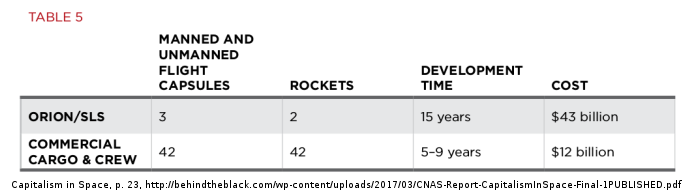
I suspect this push now to launch on time is partly generated by a fear that SpaceX’s Starship will reach orbit before SLS. If that happens it will be a major embarrassment to NASA, considering that the agency has spent about three times longer and ten times more money on its rocket than SpaceX.

Isn’t competition wonderful? It even makes government work more efficiently.

Stay tuned. There is still a lot of time between now and November. This race between comparable rockets being built by the government and a private company appears to be neck and neck as we head down the stretch.

8 comments

Thales Alenia to build first two modules of Axiom’s commercial space station

Capitalism in space: The Italian company Thales Alenia today announced it has finalized the contract to build the first two modules of Axiom’s private commercial space station, set to be docked to ISS initially but eventually to fly independent once ISS is decommissioned.

Total price for the contract is 110 million euros. According to the press release, they are targeting 2024 and 2025 for launching these modules, which will be able to house as many as eight residents.

Based on its past successful experience in building modules for the International Space Station, Thales Alenia Space is responsible for the design, development, assembly and test of the primary structure and the Micrometeoroid & Debris Protection System for the two Axiom modules.

The welding activities of the primary structure of the first module will start in September 2021, with the assembly process concluding in 2022. The first module will arrive at Axiom facilities in Houston in July 2023, where Axiom will integrate and outfit the core systems and certify it for flight prior to shipping to the launch facility.

With the launch of this station, human spaceflight in the United States will become completely independent of the federal government. Private companies will own the rockets, spacecraft, and stations, and the government will no longer have a major say on what goes on in space. The NASA bureaucracy that makes getting an experiment onto ISS cumbersome, difficult, and discouraging will be out of a job. (An example: In the 2000s American scientists studying plant growth in weightlessness ended up launching their experiments with the Russians because getting NASA approval turned out to be too difficult.)

This doesn’t mean that it will be easy to get a payload or experiment onto Axiom’s station. The demand will be quite high. It just means that the decision will no longer reside with the government, but with the private companies and citizens of the United States.

As it always should have been.

Furthermore, that the demand is going to exceed the supply will mean that additional stations will be built, and quickly, because the lure of profit will be there. For example, many of the commercial medical experiments that were on the verge of paying off but were shut down after the Challenger accident in 1986 could very well be brought back to life.

3 comments
1 322 323 324 325 326 814