OSIRIS-REx flies past Earth
The OSIRIS-REx asteroid probe flew past Earth today as part of its flight plan to slingshot to the asteroid Bennu.
I expect images of the fly-by to be released shortly.
The OSIRIS-REx asteroid probe flew past Earth today as part of its flight plan to slingshot to the asteroid Bennu.
I expect images of the fly-by to be released shortly.
China has de-orbited its its first test unmanned freighter, Tianzhou-1, after completing three docking tests and three refueling tests with its Tiangong-2 space station module.
Tiangong-2 remains in orbit, with no clear indication for how long.
The United Arab Emirates space center in charge of its Mars mission has announced its second student competition for designing future missions to Mars.
Explore Mars Competition targets university undergraduate students in science or engineering disciplines. The students will need to propose an innovative mission design to Mars and highlight a novel approach in either engineering design or in the science mission. The competition is geared towards identifying and solving a scientific or engineering challenge in planetary exploration.
The competition is divided into two categories, the first is focused on introducing a scientific project, and the second focuses on developing an idea to design a mission to Mars. Students who are interested in the first category about Mars Science can suggest a topic related to the Martian atmosphere or Mars geology. Furthermore, in Mars mission category, topics can address unique concepts and designs for space missions to Mars, new designs for scientific instruments for Mars science, or innovative spacecraft.
This is the second year in the row they have run such a contest. The winners for the first contest are supposed to be revealed at a science conference in late September.
A Russian Soyuz-2 rocket today successfully placed one of that country’s GPS satellites in orbit.
Russia now has the lead over SpaceX in the 2017 launch race, having completed 14 launches, one more than SpaceX. It however trails the U.S.’s total (19) by 5. That U.S. total did not rise yesterday because a scheduled Atlas 5 launch by ULA was delayed because of a battery problem. Its new launch date is tomorrow.
Link here.
United announced Monday that its final Boeing 747 flight will take place Nov. 7 with a celebratory recreation of its first United flight from San Francisco to Honolulu.
Twenty-eight minutes later, at 3:47 p.m. Monday, Delta announced that it recently operated its final Boeing 747 Tokyo Narita-Honolulu flight (on Sept. 5), and that it had operated what were thought to be the final domestic 747 flights from Honolulu to Los Angeles to Detroit. Delta subsequently used two 747s on Orlando evacuation flights as Hurricane Irma approached, bringing a widely-applauded end to its domestic 747 flying.
United plans to recreate the 1970 San Francisco-Honolulu flight, its first commercial Boeing 747 flight, on the Nov. 7 flight. “From a 1970s-inspired menu to retro uniforms for flight attendants to inflight entertainment befitting of that first flight, passengers will help send the Queen of the Skies off in true style,” United said in a press release.
Though the plane has been bypassed by newer technology, I suspect that we will see 747s flying for many years to come, but only in specialized situations. It was a grand achievement, and proved that giant planes could be built.
Capitalism in space: In its new effort to upgrade its satellite business to compete in the new satellite business, Lockheed Martin today unveiled a new line-up of standardized satellite buses which customers could then build their specific satellites around.
The core elements of each bus will retain commonality with other buses for a wide range of components, including propulsion, reaction wheels, gimbals, power regulation, solar arrays, battery technology, thermal control and software and avionics. Such component commonality, Sears said, will enable the company to leverage its supply chain more effectively. Lockheed software systems will also make each bus rapidly reconfigurable, depending on the particular mission need or type of satellite.
The smallest member of the new lineup is the LM 50 series of flexible nanosat buses. Weighing 10 to 100 kilograms, the spacecraft are being develop with Terran Orbital, which, Sears said, offers advanced nanosat technology and operational experience that Lockheed lacks. Lockheed Martin Ventures announced in June an unspecified “strategic investment” in Terran Orbital, a nanosatellite manufacturer.
It is very clear that the company is anticipating a boom in smallsats, and is trying to market itself as the go-to place for having those satellites built.
Capitalism in space: Stratolaunch announced today that it has successfully tested the six engines that will fly on the giant plane that it will use as a first stage.
This isn’t that big a deal, since the engines were built for the 747s that were scavenged by Stratolaunch to assemble their giant plane. If those engines didn’t work I would have been very surprised.
The most interesting part of this story is this:
Despite the plane’s giant size, Stratolaunch plans to initially use the aircraft as a platform for Orbital ATK’s Pegasus XL rocket, which is currently launched from a much smaller L-1011 airplane. The Stratolaunch plane will ultimately have the ability to carry three Pegasus rockets that could be launched one at a time on a single flight. An initial launch, the company said in May, could take place as early as 2019.
A recent deal could combine two of Stratolaunch’s partners. Scaled Composites, who developed the aircraft for Stratolaunch, is owned by Northrop Grumman, which announced Sept. 18 a deal to acquire Orbital ATK for $9.2 billion.
This might make Pegasus more affordable for smallsat launches, and provide those smallsat companies much greater launch flexibility. Moreover, the purchase of Orbital ATK by Northrop Grumman appears to work to the advantage of Stratolaunch.
Capitalism in space: Mitsubishi has been awarded a commercial launch contract from Inmarsat.
Recent Inmarsat satellites have launched on Proton, Falcon 9, and Ariane 5 rockets operated by International Launch Services, SpaceX and Arianespace. MHI [Mitsubishi Heavy Industries] has positioned the H-2A as a secondary player in the global launch market, and the Inmarsat 6 F1 contract gives the Japanese company its second commercial telecom launch deal after the Canadian-owned Telstar 12 Vantage satellite lifted off from Tanegashima in November 2015.
Japan has made noises about shifting control of its launch industry from its space agency JAXA to the private sector. This new contract between Mitsubishi and Inmarsat suggests that they are following through with that shift. However, though no specific price was mentioned in the article, the quote below indicates that Mitsubishi will have a big hill to climb to become competitive.
“The reason why we got the launch order from Inmarsat, I think, was not, of course, the cost-competitiveness of the H-2A launch vehicle, but I think our launch record is very good — 35 consecutive successes, high reliability — and another is on-time launch,” [Ko Ogasawara, Mitsubishi vice president] said in remarks last week at Euroconsult’s World Satellite Business Week conference in Paris. “We keep our schedule, and I think they put a high value on that.”
Mitsubishi’s next generation rocket, the H3, is being targeted for a launch price of $50 million, half of what the H-2A charges and more competitive in today’s market.
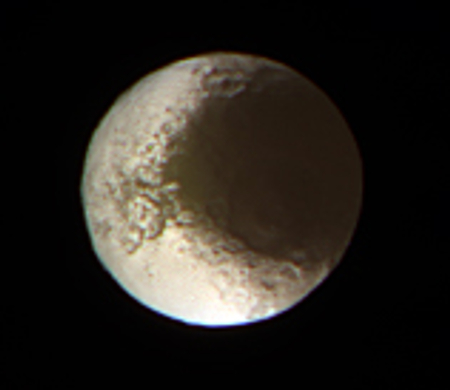
The image on the right is a cropped and scaled up version of one of Cassini’s last images of Saturn’s moon, Iapetus.
The moon is unique in that its east and west hemispheres have completely opposite albedos, with one being very dark and the other very bright. It also has a very distinctive large crater, seen in this image. Scientists do not quite understand what causes the dichotomy, though they have models that partly explain it, partly from material being deposited on the moon’s leading hemisphere combined with the temperature differences at different latitudes.
The cause of the extreme brightness dichotomy on Iapetus is likely to be thermal segregation of water ice on a global scale. Thermal effects are usually expected to act latitudinally. That is, polar areas are colder than equatorial terrain in most cases due to the more oblique angle of the solar irradiation. Therefore, an additional process is required to explain the longitudinal difference as well. In one model, dark, reddish dust coming in from space and preferentially deposited on the leading side forms a small, but crucial difference between the leading and trailing hemispheres, which is sufficient to allow the thermal effect to evaporate the water ice on the leading side completely, but only marginally on the trailing side.
It was this moon’s strange dichotomy that had Arthur Clarke use it in 2001: A Space Odyssey. While Cassini’s images clearly prove that the brightness difference was not created by an alien civilization, as imagined by Clarke, those images have not really provided us a full explanation for its cause. The uncertainty of science marches on!
Link here. It appears that this transition not only includes replacing Ariane 5 with Ariane 6, but also the phase out of Russian Soyuz rockets by 2022. This loss of business is going to hurt Russia, as the government there desperately needs cash with the drop in oil prices.
The article also noted that ArianeGroup will charge two prices for Ariane 6, depending on configuration and payload, $85 million and $130 million per launch. These prices seem high, but because they likely cover the launch of two satellites, customers will be charged half these amounts, $40 million and $65 million, which is competitive in today’s market.
Will these prices be competitive in 2020s? I have my doubts. I estimate, based on news reports, that SpaceX is charging about $40 million today for a launch with a reused first stage, and $62 million for a launch with an entirely new rocket. Give them another five years of development and I expect those prices to drop significantly, especially as they shift to entirely reused first stages for almost every launch and begin to demonstrate a routine launch cadence of more than one launch per month.
This quote below explains how ArianeGroup really intends to stay alive in the launch market:
The price targets assume that European governments — the European Space Agency, the European Commission, Eumetsat and individual EU nations — agree to guarantee the equivalent of five Ariane 62 missions per year, plus at least two missions for the light-lift Vega rocket.
In other words, ArianeGroup really doesn’t wish to compete for business. It wants to use government coercion to force European space agencies and businesses to buy its product. They might get that, but the long term result will be a weak European presence in space, as everyone else finds cheaper and more efficient ways to do things.
Capitalism in space: Aerospace giant Northrop Grumman has made a deal to acquire Orbital ATK for $9.2 billion.
This deal essentially allows Northrop Grumman to return as a player in the space industry. In recent years the company has not been visible in any major way in space. Orbital ATK gives it that.
At the same time, the flexibility and risk-taking seen at Orbital ATK that allowed them to build Antares and Cygnus for crew cargo will likely be more difficult as part of a giant corporation.
China’s test cargo freighter Tianzhou-1 has completed its third refueling test on test space station module Tiangong-2, and has undocked for the last time.
Both will spend a bit more time in orbit, after which they will be deorbited to burn up in the atmosphere.
Capitalism in space: SpaceX’s last new Dragon capsule today returned successfully from ISS, splashing down in the Pacific.
I had originally described this Dragon capsule as the first reused capsule. It is not. That capsule returned to Earth in July. Thank you to SCooper, one of my readers, for noting my mistake. It is now corrected.
Despite an August 31 launch failure, India is still planning to resume launches before December.
On Friday, Mr Kiran Kumar [head of ISRO] was optimistic that the workhorse rocket would resume flights within a couple of months. “We have identified what the problem is, and we are going through simulations to make sure what we are concluding, is what has exactly happened (during the unsuccessful flight on August 31). The committee, which has been set up to go through the report is having detailed discussions and the report will come out very soon. After the committee gives its final report, we will resume the launches by November-December,” he said, on the sidelines of silver jubilee celebrations of Antrix Corporation Ltd, the corporate arm of ISRO.
They might not meet this goal, but that they are trying to resume launches in less than four months indicates that they are emulating the private sector and not most typical government agencies like NASA in this matter. Both NASA and ISRO have in the past sometimes taken years to recover from a launch failure. After SpaceX’s launchpad explosion in September 2016 they vowed to launch in less than four months, and managed to do it in five months. That ISRO is now trying to do the same indicates that the competition has forced them to up their game.
Another citizen scientist who goes by the moniker of mesno has uploaded a spectacular 3D anaglyph of one of Juno’s images of Jupiter.
I could post it here, but I’d have to reduce its resolution, and I don’t think this will work well. If you have red-blue anaglyph 3D glasses the image does a great job of showing the differing vertical heights of Jupiter’s many horizontal bands, especially since it exaggerates the vertical scale significantly to bring out these differences.
Mesno has done three other anaglyphs. Check them out. The image of the Great Red Spot really shows how this is a vast whirlpool boring deep into Jupiter’s atmosphere.
Capitalism in space: Orbital ATK has begun the assembly of Mission Extension Vehicle 1, (MEV-1), designed to attach itself to commercial satellites and extend their life.
Controlled by the company’s satellite operations team, the MEV 1 uses a reliable, low-risk docking system that attaches to existing features on a customer’s satellite. The MEV-1 provides life-extending services by taking over the orbit maintenance and attitude control functions of the client’s spacecraft. The vehicle has a 15 year design life with the ability to perform numerous dockings and repositionings during its life span.
They hope to launch before the end of 2018. Meanwhile, the legal battle between Orbital ATK’s effort to build this satellite repair mission and DARPA’s effort to subsidize SSL’s own satellite repair mission continues in Congress with the introduction of two amendments favoring Orbital ATK.

After a seven year journey and thirteen years in orbit around Saturn, Cassini’s mission ended early this morning with a dive into Saturn’s atmosphere.
The image above, cropped to show here, is actually one from a short movie, showing Enceladus setting behind the horizon of Saturn. The images were taking two days ago, but provide a fitting image for the mission’s end.
Some of the best images from the dive, including Cassini’s last image, can be found here.
While most of the press will rightly wax eloquent about the magnificence of this mission, my focus remains on what will come next. We no longer have any way to observe what is happening on Saturn. We are blind. We should not be.
The European Space Agency (ESA) has purchased the first two Ariane 6 launches to place four of its Galileo GPS satellites in orbit in the 2020-21 timeframe.
This is not a big surprise, since ESA is mandated to use Arianespace’s rockets, and the space agency is the obvious candidate for making the first commitment to this new rocket’s use.
The press release does not mention the price that Arianespace is charging for these launches, but I suspect it isn’t anywhere near as cheap as they will have to charge to truly private and commercial customers. Essentially, I am willing to bet that this contract award is a bit of crony capitalism, designed to pass some extra cash from ESA to Arianespace.
The SpaceX blooper reel! It shows some crash footage that had not been released earlier. Also, the captions almost certainly were written by Musk himself, and if not, reek of his sense of humor, and also reveal the humbleness that he and his company bring to this effort. If you can’t laugh at yourself, you will make it hard to spot the moment when you are making a major error.
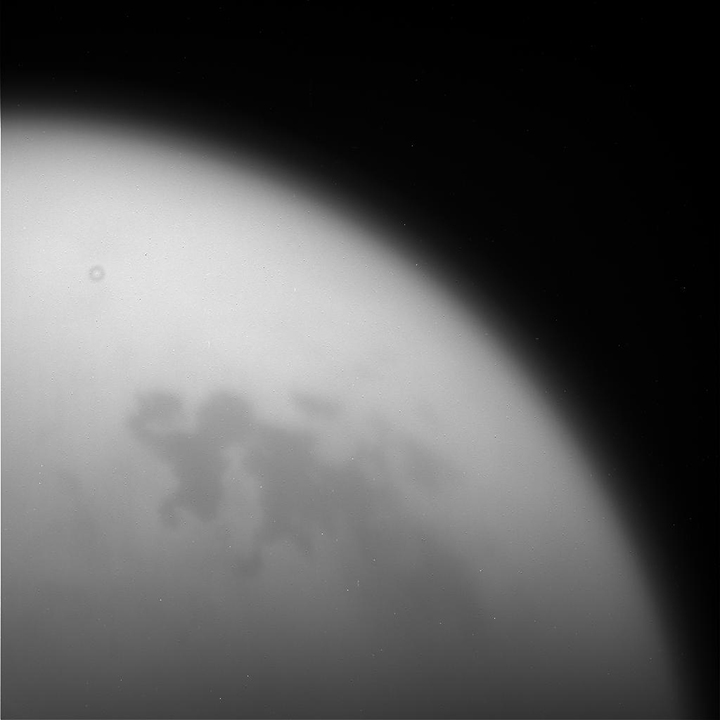
The Cassini science team has released the spacecraft’s last shot of Titan, taken during its last fly-by of that moon of Saturn on September 11, 2017, and posted below.