
Judy Garland & Deanna Durbin – Americana
An evening pause: From the short 1936 film, Every Sunday, made essentially as a screen test for the two young future stars.
Hat tip Edward Thelen.
An evening pause: From the short 1936 film, Every Sunday, made essentially as a screen test for the two young future stars.
Hat tip Edward Thelen.
The first movie ever made of a solar eclipse, taken in 1900, has been rediscovered and restored.
The film was taken by British magician turned pioneering filmmaker Nevil Maskelyne on an expedition by the British Astronomical Association to North Carolina on 28 May, 1900. This was Maskelyne’s second attempt to capture a solar eclipse. In 1898 he travelled to India to photograph an eclipse where succeeded but the film can was stolen on his return journey home. It was not an easy feat to film. Maskelyne had to make a special telescopic adapter for his camera to capture the event. This is the only film by Maskelyne that we know to have survived.
I have embedded the movie below the fold.
» Read more
NASA has confirmed that the signals detected in 2016 do come from an experimental satellite, LES-1, that failed in 1967.
LES stands for Lincoln Experimental Satellite, and was the first in a series of test satellites built by MIT’s Lincoln Laboratory for the Air Force. It was launched on February 11, 1965. Though it was reported to be operating properly, it was placed in an incorrect orbit that made its experiments useless. It ceased transmissions in 1967 and was thought lost, until amateur astronomer Phil Williams picked up a signal in 2016.
Williams told Southgate Amateur Radio News that the signal he detected from his base in Cornwall seemed to cycle every four seconds, diminishing and returning to create an eerie repetitive sound.
It would later be determined that the fluctuation was the result of the long-lost satellite barreling end over end through the void of space, causing variations in the light reaching the solar panels that Gunter’s Space Page says likely now power the depleted batteries of this 65 lb (30 kg) relic of the space age.
Scientists are unclear as to how the satellite continues to operate — Williams himself expressed some uncertainty as to how the craft might continue to function given the particularly harsh environment of space and its tendency to destroy electronic equipment.
This story is nothing more than a curiosity, but a fine one nonetheless.
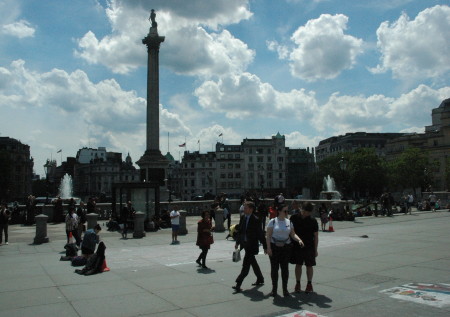
Yesterday we took the train to London and settled into a really super modern hi-tech hotel dubbed “The Hub by Premier Inns.” It is also the crummiest hotel I have ever stayed at. I picked it because it was well recommended and was located less than a block from Trafalgar Square, shown on the right. And yes, it is new and fancy, with motion-controlled LED lights and fancy touch buttons and aps to control everything. It is also tiny, cramped, the controls are too limited and too difficult to decipher, even for a science journalist like myself. I suppose I shouldn’t complain, as it was reasonable in price considering the location. I still dislike the hi-tech nature of the room that only ended up limiting our convenience and comfort.
And the hotel didn’t even have an ice machine!
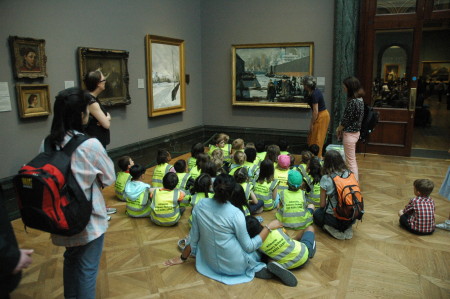
Today we wandered about the square, watching the street performers (buskers in British lingo) and admiring the statues and sights. Then we went into the National Gallery to enjoy some of humanity’s greatest art, as were a class of elementary school children as shown in the picture on the right.
The museum was packed with people from everywhere. I saw Japanese, Chinese, and Israeli tour groups. I saw people of all types clearly from London, including several school groups like the one to the right.
Interestingly, these crowds were all found in the permanent exhibits. One temporary exhibit we wandered through, art by an modern abstract artist by the name of Sean Scully, was practically empty.
» Read more
An evening pause: This piece comes from a 1930 Soviet propaganda ballet, with music by Dmitri Shostakovich. It tells the story of a Soviet-era soccer team traveling through Europe in the 1920s, which provides the setting for the propaganda. I like the musical give-and-take. It is almost like two people arguing.
Hat tip Diane Wilson.
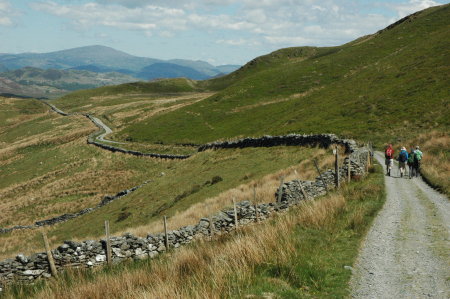
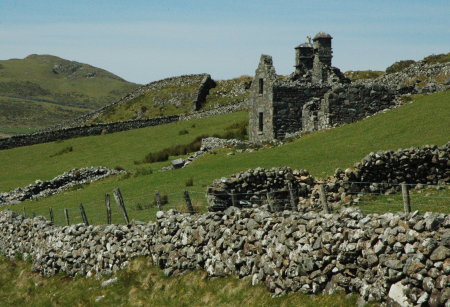
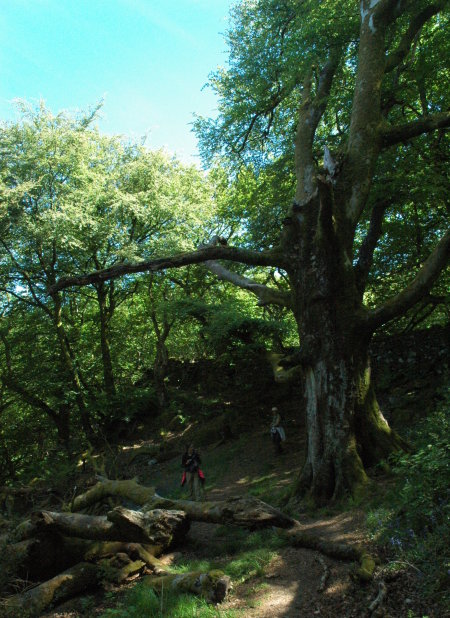
In our final day of our Wales journey, we spent the day strolling across the beautiful countryside of Cregennan, one of several parks along the flanks of the Cadair Idris range, which runs north-south to the coast. This park is closest to the ocean, so at our highest point we were overlooking the Irish Sea and the town of Barmouth.
The three pictures on the right are only a small selection of the beauty of this region. There were several magnificent lakes nestled amid the mountains and fields. There were pastures with numerous sheep, some eating, some resting like white blobs on the green grass, and some “baa’ing” at each other. It was especially entertaining when a lamb started calling out for its mother, the mother responding, and then the two searching and finding each other.
And of course there were the standing stones and ancient ruins scattered about on several hilltops.
The abandoned house in the second picture is of special interest because it had been the home of an obscure 18th century Welsh composer by the name of John Williams. Williams was actually quite successful in his time, but only recently have some locals rediscovered unpublished manuscripts of his work. They plan a performance this fall.
Apparently his father was a hat-maker of some note, able to accumulate enough wealth to build this large country house in such a setting. Though I don’t know this, I suspect his success came from providing high quality hats to the upper classes, and this in turn gave his son the contacts necessary to become even more successful as a composer.
The last photo was taken as we walked downhill toward the ocean in a forested area beside a flowing stream, passing numerous waterfalls. This area is where our tour leader, Hywel “Taff” Roberts, was born and grew up, so he could give us some extra historical details about everything we saw. For example, the giant tree in that last picture was something that he remembered since childhood, home for birds and animals galore. It is old now, which is why several large branches have broken off.
Tomorrow the tour ends, and Diane and I will be taking the train to London, where we will spend two days before flying back to the states.
 c
c
 c
c
After yesterday’s long hike on Mount Snowdon, today was planned as an easier day. First we changed locations, driving south to the village of Dolgellau.
In the morning we heard two short presentations, first about the first discovery of Wales by tourists in the 1700s, and second a more scholarly look at the place names of Wales that appear connected to Arthur. In this case the speaker, Scott Lloyd of the Royal Commission on Ancient and Historical Monuments of Wales, was focused more on what is really known, and was thus less sure about Arthur’s links to Wales than our previous expert, Gareth Roberts. Lloyd has documented the many place names (see his book, The Arthurian Place Names of Wales), but he has also documented the important detail that most started appearing after the first writings about Arthur started to appear, with most appearing several centuries after Arthur supposedly lived. This suggests that the names were chosen because of the legend, not because the man had been there.
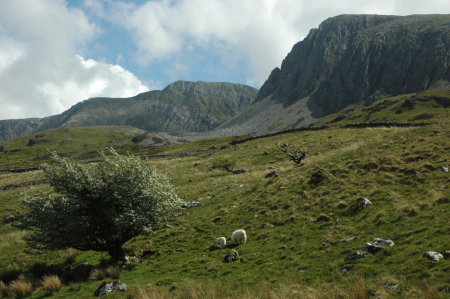
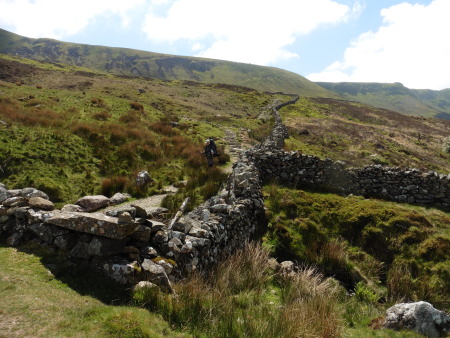
In the afternoon some of us did a short hike halfway up the nearby mountain Cader Idris. The first picture shows the mountain at the top right, with sheep in the center, and a hawthorn tree in bloom to the left. The second picture shows the trail going uphill parallel to one of the many typical stone walls found everywhere in Wales. The land is very rocky, and to make it better for grazing farmers would clear the stones from the fields, putting them in piles to the side. Then, when the enclosure laws were passed in the early 1800s they used those stones to build the walls to define their property lines.
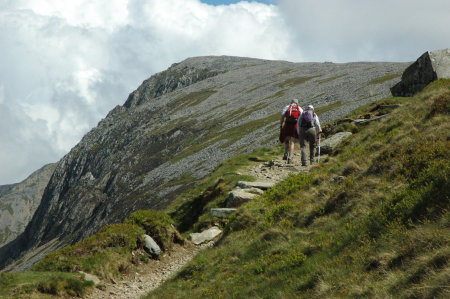
The third picture shows Taff and Barbara ahead of me, with Cader Idris in the distance. Shortly thereafter we stopped to lie on the soft heather to chat and admire the countryside and the grey rocky slope going up to the peak ahead of us. We then headed back down for dinner and an evening in town.
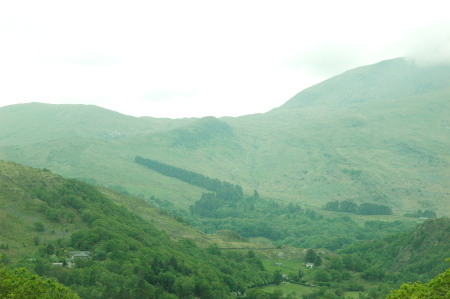
Today’s adventure in Wales was a pleasant seven mile hike up onto a small hill, Dinas Emrys, nestled in the pass in Snowdonia National Park that crosses from north to south Wales past Mount Snowdon. Our hotel, Sygun Fawr, can be seen in the lower left corner in the first picture on the right, which I took from the top of this hill. If you look close, you can see the window of our second floor room, looking out at the mountains.
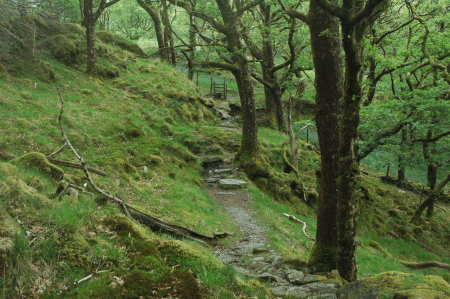
The hike was through some of the lushest green woods I’ve ever seen, as illustrated by the second picture on the right. The trail itself was clearly very old, with stone steps and even a simple bridge made of flat stones and laid across a stream with a single larger rock in the center for support.
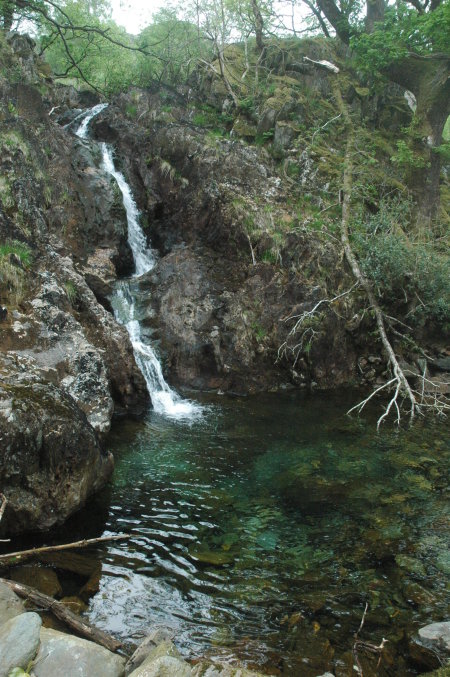
The hill itself is associated with Merlin in a number of ways. For example, the pool at the base of the waterfall in the third picture has been called Merlin’s Pool for centuries. Furthermore, Merlin supposedly hid a treasure in a cave somewhere on the hill, which will only be discovered by someone with golden hair and blue eyes and who will be guided to the cave by a bell ringing.
Fleeing Anglo-Saxon invaders Vortigen came to Wales and chose the hillfort as his retreat. However all efforts at building on the site failed, with workers returning daily to find collapsed masonry. Vortigern was counselled to seek the help of a young boy born of a virgin mother; a suitable boy was found named Myrddin Emrys (Merlin Ambrosius). Vortigern’s plan to kill Myrddin to appease the supernatural powers preventing him from building his fortress was scorned by Myrddin who instead explained that the fort could not stand due to a hidden pool containing two dragons. The White Dragon – he explained – of the Saxons would in time be defeated by the British Red Dragon.
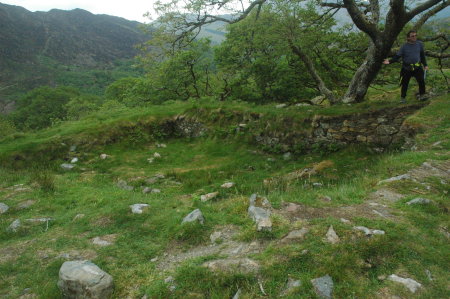
The fourth pictures shows Gareth Roberts, our guide who as mentioned yesterday has been researching Welsh Arthurian place names, standing on the foundation of the ruin at Dinas Emrys’ top. To his left and slightly lower down on the hill in a gully was a second foundation and a pool from a natural spring. This spring was another reason this hilltop was a favored site for a stronghold, as it not only gave clear views both up and down the valley, was very defensible, but also had a ready supply of water. A fortress here would withstand attack for a considerable time.
Tomorrow we climb Mount Snowdon itself, The hike’s length will likely be about nine miles, and will gain 2,900 feet in elevation, somewhat comparable to many hikes in southern Arizona. The weather looks excellent, with spring temperatures at the mountain’s base.
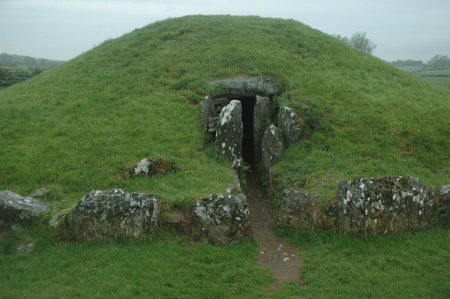
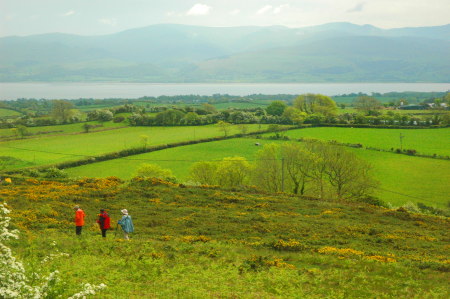
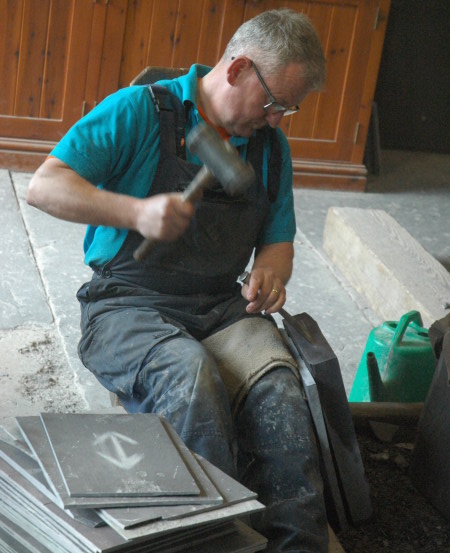
Our travels today in Wales took us to three sites, all completely different.
First we visited Bryn Celli Ddu, a neolithic burial chamber, built about 5,000 years ago and shown in the top right photo. After following a well-defined path along the edge of two fields, we all entered this mound and stood in the chamber inside. The entrance shown in the image was aligned with the summer solstice so that the sun at sunrise would beam directly into the inner chamber.
Next, we drove to the northeast corner of the island of Anglesey to climb a flat-topped hill called Arthur’s Table. Our guide, Gareth Roberts, has been doing extensive research on the place names in Wales that appear to link directly to the legend of King Arthur. It is his contention (supported by those place names as well as research by others) that Arthur was actually a Welsh military leader, born of Roman parents (who had integrated into Welsh society) and who united the tribes to fight the Saxon invaders in the sixth century, after the Romans had abandoned the British Isles. He has found more than a hundred place names in this part of Wales named in honor of Arthur. He has also found in the written record much evidence linking Arthur to Wales and the war to resist the Saxons.
This particular hilltop has been identified by archeology as the location of a significant Welsh village from the time the Romans were conquering Great Britain. The middle right photo, taken from the top, looks east across the Menai Strait that separates Anglesey from the mainland, with the mountains of Snowdonia beyond. This strait is where the Romans crossed in their first attempt to conquer Anglesey and Wales.
Roberts’ thinks that the Round Table from the King Arthur legends was a misinterpretation by later French and British storytellers of this important Welsh hilltop village. Instead of being a table where Arthur ruled with his knights, the table was this hilltop, where that Roman invasion was first spotted during their initial invasion. Five hundred years later, when the Saxons invaded and Arthur led the resistance to them, Roberts’ believes the name was given because in some way Arthur was connected to it.
The third image shows slate cutter John Jo as he demonstrates how to split slate into the thin slate tiles that are used to cover rooftops. We watched this demonstration as part of a full tour of the National Slate Museum, nestled within the mountains on the way to Snowdonia, where for more than hundred years one of the world’s biggest slate mines mined, processed, and sold slate. Closed since 1969, the mine facility now serves as a museum. The most spectacular feature of this mine facility was the still functioning giant water wheel, more than fifty feet in diameter, that was turned by a stream of gravity-fed water at its base and was used to run all the belts that powered all the belt-driven machinery in the facility. The video of the wheel, embedded below the fold, shows the wheel as we saw it today. Unfortunately it does not include any people in it for scale, though one of the last shots shows a ladder for accessing the wheel’s top. Trust me, a person seems dwarfed by this wheel.
We then drove up over the mountain pass in Snowdonia National Park to our hotel, nestled at the base of Mount Snowdon. We shall be spending the rest of our trip hiking these mountains. The hike tomorrow will once again be led by Gareth Roberts and will show us further links between Arthur and Wales. On Sunday we will attempt to hike to the top of Mount Snowdon.
» Read more
The tyrannical Earth moves to oppress future spacefarers: Scientists have now proposed a new fascist plan designed to exclude any human development in 85% of the entire solar system.
Great swathes of the solar system should be preserved as official “space wilderness” to protect planets, moons and other heavenly bodies from rampant mining and other forms of industrial exploitation, scientists say.
The proposal calls for more than 85% of the solar system to be placed off-limits to human development, leaving little more than an eighth for space firms to mine for precious metals, minerals and other valuable materials.
While the limit would protect pristine worlds from the worst excesses of human activity, its primary goal is to ensure that humanity avoids a catastrophic future in which all of the resources within its reach are permanently used up. [emphasis mine]
These fascists really only want power. They really have no interest in preserving anything. If their proposal was ever made law it would put control over that 85% in the hands of bureaucrats on Earth, not the people who will be living and working in space and who would also know best how to handle the situation. Also, their justification for the proposal, to prevent humans from using up all the available resources, is beyond ludicrous. We haven’t yet come close to using up Earth’s resources, even though doomsayers have been predicting that to happen repeatedly for the past century.
This story more than anything provides a window into the future political conflicts that will occur once humans finally establish space colonies. Much as the American colonies had to revolt from Great Britain’s overbearing power, colonists in space will have to do the same to get away from the same overbearing power coming from Earth.
Posted on a ferry taking us from Dublin, Ireland, to Holyhead, Wales.
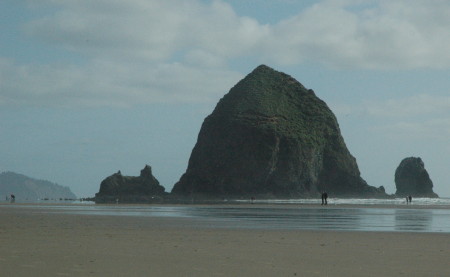
Posting has been somewhat mixed this week because Diane and I are out in Oregon at a beach-side hotel in Cannon Beach. We and my oldest friend Lloyd and his family are here to visit and see some sites.
On the right is a picture of the beach and Haystack Rock, which rises more than 230 feet above the sea. We did two hikes to its base, one when the tide was out and you could get very close and see the aquatic life in the tidal pools. Quite beautiful.
This location is where Lewis & Clark first saw the Pacific during their expedition. The local museum, the Cannon Beach History Center & Museum, was fascinating. For one thing I had not known that the town was named after an actual ship cannon from the shipwreck of the American Navy ship the Shark, which foundered here in 1846. The crew was all saved, but the ship and its military equipment were lost.
In October 1846, Lieutenant Howison received information through the Tillamook people that part of the ship’s hull “with guns upon it,” had come ashore south of Tillamook Head. The lieutenant sent Midshipman Simes to visit the location. Simes reported finding the wreckage and succeeded in “getting one cannon above the high-water mark,” while two others were left buried.
Then in December 1863, mail carrier John Hobson reported seeing a cannon at present-day Arch Cape Creek. Soon after, this cannon became lost when tides buried it in sand. In June 1898, however, it was spotted once again-this time by mail carrier George Luce. With the help of his Nehalem neighbors John and Mary Gerritse and their team of horses, Luce succeeded in pulling the cannon out of the sand, after which time it stood in front of the Austin House Post Office in Arch Cape for several years.
Hobson by the way spent the last thirty years of his life, from 1864 to 1894, searching in vain for the cannon. It was only found four years after his death.
The cannon is now in the museum. In addition, the other two cannons were finally found in 2008.
An evening pause: A quick review, with images, of the Computer History Museum in Mountain View, California. Like them, I was tickled by the gigantic scale of technological improvement that took place in this field in such a relatively short time.
Hat tip Ben K.
The Rosetta science team has now made available to the public all 70,000 images taken by the spacecraft’s high resolution camera.
Between 2014 and 2016, the scientific camera system OSIRIS onboard ESA’s Rosetta spacecraft captured almost 70000 images of comet 67P/Churyumov-Gerasimenko. They not only document the most extensive and demanding comet mission to date, but also show the duck-shaped body in all its facets. In a joint project with the Department of Information and Communication at Flensburg University of Applied Sciences, the Max Planck Institute for Solar System Research (MPS), head of the OSIRIS team, has now published all of these images. The OSIRIS Image Viewer is suited to the needs of both laymen and expert and offers quick and easy access to one of the greatest scientific treasures of recent years.
The Rosetta archive can be found here.
R.I.P. Skylab astronaut Owen Garriott has passed away at 88.
From a different time and place.
Link here. The introduction:
A short list of the most transformative products of the past century and a half would include the lightbulb, Ford’s Model T—and the IBM System/360. This mainframe series forever changed the computer industry and revolutionized how businesses and governments worked, enhancing productivity and making countless new tasks possible.
In the years leading up to its 7 April 1964 launch, however, the 360 was one of the scariest dramas in American business. It took a nearly fanatical commitment at all levels of IBM to bring forth this remarkable collection of machines and software. While the technological innovations that went into the S/360 were important, how they were created and deployed bordered on disaster. The company experienced what science policy expert Keith Pavitt called “tribal warfare”: people clashing and collaborating in a rapidly growing company with unstable, and in some instances unknown, technologies, as uncertainty and ambiguity dogged all the protagonists.
Ultimately, IBM was big and diverse enough in talent, staffing, financing, and materiel to succeed. In an almost entrepreneurial fashion, it took advantage of emerging technologies, no matter where they were located within the enterprise. In hindsight, it seemed a sloppy and ill-advised endeavor, chaotic in execution and yet brilliantly successful. We live in an age that celebrates innovation, so examining cases of how innovation is done can only illuminate our understanding of the process.
Read it all. The story is fascinating, especially in how intellectual honesty made it a success. In one case two computer managers were competing directly against each other for the lead in how the product would be developed. The man that was picked immediately asked the loser to help him build his proposal, a level of honesty that certainly made this company work in the 1960s.
The story also has one bit of real irony. The 360 was a big success because it was compatible with IBM’s previous computer line, and was designed to be compatible across the board.
In the 1980s, IBM lost its entire dominance in the personal computer field when it introduced its second generation PC, the PS/2, which was NOT compatible with their first PC line. Customers fled to independent companies making computers compatible to IBMs first PC, and this loss of business ended up killing IBM entirely.
You would have thought they would have known better.
Hat tip Thomas Biggar.
An evening pause: I like the commentary about this song at the youtube webpage. “Although it has been described as a protest song, it poses a series of rhetorical questions about peace, war and freedom. The refrain “The answer, my friend, is blowin’ in the wind” [is] … impenetrably ambiguous: either the answer is so obvious it is right in your face, or the answer is as intangible as the wind.
In this sense, Bob Dylan’s song really does transcend the 1960s, as does much of his work.
Hat tip John Vernoski.
In local elections yesterday the party of Turkey’s long-time president Recep Tayyip Erdogan was pounded by several startling defeats.
The party of Turkey’s President Recep Tayyip Erdogan has lost control of the capital, Ankara, in local elections, in a blow to his 16-year rule.
The main opposition is also slightly ahead in the contest for mayor of Istanbul, figures published by the state-run Anadolu news agency suggest.
But the president’s AKP party is challenging the result in both cities.
Municipal elections were held across the nation on Sunday and an AKP-led alliance won more than 51% of the vote. [emphasis mine]
The article at the link hints at a depressed economy as the cause of these defeats, but I wonder if Erdogan’s recent moves trending in support of radical Islam also contributed. I also suspect that Erodgan’s support was actually a lot less than indicated by these numbers. Turkey is not really a democracy as an American would perceive it.
With most media either pro-government or controlled by Mr Erdogan’s supporters, critics believe opposition parties campaigned at a disadvantage. Mr Erdogan’s rallies dominated TV coverage.
The opposition pro-Kurdish Peoples’ Democratic Party (HDP) said the elections were unfair and refused to put forward candidates in several cities. Some of its leaders have been jailed on terrorism charges, accusations they reject.
I will not be surprised if the results flip in the coming week’s so that Erdogan’s party retains control in both cities. If this happens, however, I would also expect more turmoil there, as we are also seeing in many other places worldwide. Elections results recently have repeatedly slammed the status quo in places ruled by globalists, leftists, or Islamists. The establishment that has been in control then maneuvers things to nullify those elections.
The result: protests, violence, revolution, and bloodshed. Expect this in Turkey if the vote changes.
An evening pause: From the Wikipedia page:
Havah Nagilah…was composed in 1915 in Ottoman Palestine, when Hebrew was being revived as a spoken language after falling into disuse in this form for approximately 1,700 years, following the destruction of the Second Temple in 70 CE and the Bar Kokhba revolt in 132–136 CE. For the first time, Jews were being encouraged to speak Hebrew as a common language, instead of Yiddish, Arabic, Ladino, or other regional Jewish languages.
The lyrics reflect these events:
Let’s rejoice
Let’s rejoice
Let’s rejoice and be happy
Let’s sing
Let’s sing
Let’s sing and be happy
Awake, awake, my brothers!
Awake my brothers with a happy heart
Awake, my brothers, awake, my brothers!
With a happy heart
May we all sing with as much joy.
Hat tip Edward Thelen.
Buzz Aldrin and his family have decided to end their legal fight over the assets of the former Apollo astronaut.
Seeking to restore family harmony months before 50th anniversary celebrations of the first human moon landing, Apollo 11 astronaut Buzz Aldrin has dropped a lawsuit that accused two of his children and the family foundation of abusing his finances and trust.
His children, Andy and Jan, also have dismissed an effort to win legal guardianship of their father, an 89-year-old Satellite Beach resident whom they claimed suffers from dementia.
A evening pause: From the vimeo webpage: “Mozart illustrated the score for the Rondo from his Horn Concerto No.1 with a series of naughty notes and jokes aimed at his horn player friend, Joseph Leutgeb.”
Performed by the OAE orchestra, with Roger Montgomery on the horn.
Hat tip Dan Coovert.
Mozart's Naughty Notes from OAE on Vimeo.