
Is the pole of the Milky Way’s central black hole pointing directly at us?

The uncertainty of science: New data obtained using a constellation of Earth-based telescopes, working as a unit, strongly suggests that the pole of the Milky Way7s supermassive central black hole, dubbed Sagittarius A* (pronounced A-star), is pointing directly at us.

The high quality of the unscattered image has allowed the team to constrain theoretical models for the gas around Sgr A*. The bulk of the radio emission is coming from a mere 300 milllionth of a degree, and the source has a symmetrical morphology. “This may indicate that the radio emission is produced in a disk of infalling gas rather than by a radio jet,” explains Sara Issaoun, graduate student at the Radboud University Nijmegen in the Netherlands, who leads the work and has tested several computer models against the data. “However, that would make Sgr A* an exception compared to other radio emitting black holes. The alternative could be that the radio jet is pointing almost at us”.

The German astronomer Heino Falcke, Professor of Radio Astronomy at Radboud University and PhD supervisor of Issaoun, calls this statement very unusual, but he also no longer rules it out. Last year, Falcke would have considered this a contrived model, but recently the GRAVITY team came to a similar conclusion using ESO’s Very Large Telescope Interferometer of optical telescopes and an independent technique. “Maybe this is true after all”, concludes Falcke, “and we are looking at this beast from a very special vantage point.”

If this is true, it might explain why Sgr A* is generally observed to be one of the quietest central supermassive black holes known. Compared to many others, its flux of emissions is far less.
1 comment

Looking at the south pole of the Milky Way

Link here. The link provides instructions for finding the spot in the sky that corresponds to the south pole of the galaxy, pointing in a perpendicular direction away from its center.

No star marks the position. It sits in the faint southern constellation of Sculptor, the sculptor’s studio, hence its identification is intellectual rather than sensorial.

This is the case of the dog that did not bark. The reason there is little to see there is that you will be looking down out of the plane of the galaxy, in a direction with the fewest stars to see. The view is therefore looking out of our galaxy, at intergalactic space, vast and empty.

0 comments

Early Milky Way collision uncovered by Gaia

Data from the space telescope Gaia has revealed a Milky Way merger event that occurred about 10 billion years ago.

Using the first 22 months of observations, a team of astronomers led by Amina Helmi, University of Groningen, The Netherlands, looked at seven million stars – those for which the full 3D positions and velocities are available – and found that some 30,000 of them were part of an ‘odd collection’ moving through the Milky Way. The observed stars in particular are currently passing by our solar neighbourhood.

We are so deeply embedded in this collection that its stars surround us almost completely, and so can be seen across most of the sky.

Even though they are interspersed with other stars, the stars in the collection stood out in the Gaia data because they all move along elongated trajectories in the opposite direction to the majority of the Galaxy’s other hundred billion stars, including the Sun. They also stood out in the so-called Hertzprung-Russell diagram – which is used to compare the colour and brightness of stars – indicating that they belong to a clearly distinct stellar population.

The sheer number of odd-moving stars involved intrigued Amina and her colleagues, who suspected they might have something to do with the Milky Way’s formation history and set to work to understand their origins. In the past, Amina and her research group had used computer simulations to study what happens to stars when two large galaxies merge. When she compared those to the Gaia data, the simulated results matched the observations. “The collection of stars we found with Gaia has all the properties of what you would expect from the debris of a galactic merger,” says Amina, lead author of the paper published today in Nature.

At the time, the two galaxies were both probably about the same size, approximately equivalent to the Magellanic Clouds.

Must I mention that there is some uncertainty here? The data is good, and the conclusions seem quite reasonable. At the same time, the data is still somewhat thin. We need a lot more Gaia-type telescopes mapping out the motions and positions of all the stars of the Milky Way in far more detail before the uncertainties here will shrink.

1 comment

More intergalactic stars discovered

Worlds without end: Using the data from Gaia’s second data release astronomers have identified twenty stars that are moving too fast to be permanent members of the Milky Way galaxy.

More significantly, most appeared to be approaching the galaxy, not flying away from it, suggesting they are visitors from other galaxies.

It is possible that these intergalactic interlopers come from the Large Magellanic Cloud, a relatively small galaxy orbiting the Milky Way, or they may originate from a galaxy even further afield. If that is the case, they carry the imprint of their site of origin, and studying them at much closer distances than their parent galaxy could provide unprecedented information on the nature of stars in another galaxy – similar in a way to studying Martian material brought to our planet by meteorites.

…An alternative explanation is that the newly identified sprinting stars could be native to our Galaxy’s halo, accelerated and pushed inwards through interactions with one of the dwarf galaxies that fell towards the Milky Way during its build-up history. Additional information about the age and composition of the stars could help the astronomers clarify their origin.

At least two more data releases shall come from Gaia, launched by Europe to precisely track the location and motions of a billion stars. So far, they have complete 3D velocity information for about seven million stars. After these additional data releases they expect to have complete 3D velocity information for 150 million stars, and should identify a lot more intergalactic stars at that time.

2 comments

Galaxies collide!

Using data from then space telescope Gaia, astronomers have identified evidence that 8 to 10 billion years ago the Milky Way collided with a dwarf galaxy.

The astronomers propose that around 8 billion to 10 billion years ago, an unknown dwarf galaxy smashed into our own Milky Way. The dwarf did not survive the impact: It quickly fell apart, and the wreckage is now all around us.

“The collision ripped the dwarf to shreds, leaving its stars moving in very radial orbits” that are long and narrow like needles, said Vasily Belokurov of the University of Cambridge and the Center for Computational Astrophysics at the Flatiron Institute in New York City. The stars’ paths take them “very close to the center of our galaxy. This is a telltale sign that the dwarf galaxy came in on a really eccentric orbit and its fate was sealed.”

It is thought that this dwarf galaxy was quite large for a dwarf galaxy.

10 comments

Astronomers find evidence for thousands of black holes near galaxy center

The uncertainty of science: Using data from the Chandra X-Ray Observatory, astronomers have found evidence suggesting that thousands of stellar-mass black holes might exist circling Sagittarius A* (pronounced A-star), the super-massive black hole at the center of the Milky Way.

Essentially, they found a dozen likely black hole candidates in what they think are X-ray binaries system. From this they extrapolate the number of potential stellar-massed black holes at the center of the galaxy. However,

While the authors strongly favor the black hole explanation, they cannot rule out the possibility that up to about half of the observed dozen sources are from a population of millisecond pulsars, i.e., very rapidly rotating neutron stars with strong magnetic fields.

In other words, this conclusion is very uncertain. Nonetheless, even if half of their candidates are not stellar-mass black holes, the results do suggest that there are a very large number of black holes circling Sagittarius A*. Using this information astronomers will be able to better refine their theories on the formation process for such super-massive black holes.

0 comments

Fastest stars in Milky Way escaped from Large Magellanic Cloud?

Astronomers have proposed that the fastest stars in Milky Way actually escaped from the Large Magellanic Cloud (LMC), the largest nearby satellite dwarf galaxy.

The LMC is the largest and fastest of the dozens of dwarf galaxies in orbit around the Milky Way. It only has 10% of the mass of the Milky Way, and so the fastest runaways born in this dwarf galaxy can easily escape its gravity. The LMC flies around the Milky Way at 400 kilometres per second and, like a bullet fired from a moving train, the speed of these runaway stars is the velocity they were ejected at plus the velocity of the LMC. This is fast enough for them to be the hypervelocity stars. “These stars have just jumped from an express train – no wonder they’re fast,” said co-author Rob Izzard, a Rutherford fellow at the Institute of Astronomy. “This also explains their position in the sky, because the fastest runaways are ejected along the orbit of the LMC towards the constellations of Leo and Sextans.”

Their calculations predict how many hypervelocity stars should be detectable and where in the sky they should be. If right, the data from Gaia, soon to be released, should prove them right or wrong.

2 comments

Stars in the Milky Way so old they predate it

Astronomers have discovered stars inside the Milky Way that are thought to be so old that they were formed prior to the existence of the galaxy, and that the Milky Way formed around them.

The stars, found near the centre of the Milky Way, are surprisingly pure but contain material from an even earlier star, which died in an enormous explosion called a hypernova. “These pristine stars are among the oldest surviving stars in the Universe, and certainly the oldest stars we have ever seen,” said Louise Howes, lead author of the study published in the latest issue of Nature. “These stars formed before the Milky Way, and the galaxy formed around them,” said Ms Howes, a PhD student at the ANU Research School of Astronomy and Astrophysics.

Not surprisingly, the discovery challenges theories that describe the early universe.

0 comments

The largest astronomical image ever

Astronomers have assembled the largest single image of the entire Milky Way ever taken.

It is 46 billion pixels across.

The amazing view of the Milky Way was built out of 268 individual views of the galaxy that includes the sun and the Earth, captured night after night over the course of five years with telescopes in Chile’s Atacama Desert. Astronomers at Ruhr-Universität Bochum used the data to examine stars whose brightness changes over time — and the image portrays more than 50,000 new objects with variable brightness that have never been recorded before.

0 comments

Milky Way’s central black hole is getting active

The uncertainty of science: Sagittarius A* (pronounced A-Star), the Milky Way’s supermassive central black hole, has shown signs of increased activity in recent months.

The new study reveals that Sagittarius A* (Sgr A* for short) has been producing one bright X-ray flare about every ten days. However, within the past year, there has been a ten-fold increase in the rate of bright flares from Sgr A*, at about one every day. This increase happened soon after the close approach to Sgr A* by a mysterious object called G2.

“For several years, we’ve been tracking the X-ray emission from Sgr A*. This includes also the close passage of this dusty object” said Gabriele Ponti of the Max Planck Institute for Extraterrestrial Physics in Germany. “A year or so ago, we thought it had absolutely no effect on Sgr A*, but our new data raise the possibility that that might not be the case.”

G2 was first thought to be a cloud that would be ripped apart as it passed close to Sgr A*, causing an outburst of activity. When it wasn’t ripped apart and there was no immediate increase in activity astronomers concluded that G2 was a star surrounded by dust which was generally unaffected by its close fly-by of the black hole.

The timing of this new activity now is puzzling. It comes much later than it should have if it was caused by G2, but astronomers don’t have any other explanation for it. It might be because of G2’s fly-by, or maybe the activity is just the natural variability of this poorly understand object. Either way it illustrates how little we really know about the behavior of giant black holes.

0 comments

Mysterious X-rays at the center of the galaxy

The uncertainty of science: The x-ray space telescope NuSTAR has detected high energy x-rays at the center of the Milky Way coming from no obvious source.

In and of themselves, X-rays from the galactic center aren’t unusual. But the X-rays NuSTAR detects don’t seem to be associated with structures already known to exist. For example, a supernova remnant named Sgr A East emits low-energy X-rays but not high-energy X-rays. The high-energy blotch doesn’t correlate with structures seen in radio images either, such as the dust and gas clouds of Sgr A West that are falling toward the supermassive black hole.

Instead, Perez and her colleagues propose that thousands of stellar corpses could be responsible for the high-energy X-rays: massive (and still-growing) white dwarfs, spun-up pulsars, or black holes or neutrons stars feeding on low-mass companion stars.

All of their proposed solutions, however, have serious problems explaining all of the data.

0 comments

The Milky Way is like ripples in a pond

Milky Way ripples

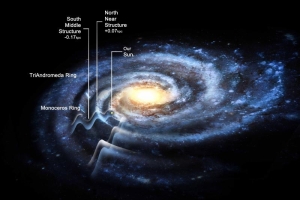
The uncertainty of science: New survey data of the stars in the Milky Way suggest that the galaxy is not only corrugated with concentric ripples — like you’d see if you dropped a stone in a pond — it is also about 50% larger than previous estimates.

I have watched the size of the Milky Way fluctuate up and down depending on the research for the past forty years. Sometimes it is larger than expected. Sometimes smaller. Without doubt we are getting a better idea of its actual size, but don’t be surprised if the numbers continue to bounce about for decades, even centuries, to come.

The confirmation that the spiral arms are the equivalent of ripples in a pond is also not surprising, as it confirms the intuitive conclusion of anyone who looks at a whirlpool-shaped spiral galaxy: It is a whirlpool spiraling into the gravity well at its center.

1 comment

New Hubble images to celebrate its upcoming 25th anniversary

The Space Telescope Science Institute (STScI) that operates the Hubble Space Telescope yesterday released two spectacular new images at the January meeting of the American Astronomical Society.

They also announced new data from Hubble that suggests a major eruption had occurred at the center of the Milky Way about two million years ago.

0 comments

G2 survives Milky Way center fly by

The uncertainty of science: The gas cloud, dubbed G2, that was going to be eaten by the supermassive black hole at the center of the Milky Way as it did a close fly-by this summer has instead turned out to be a massive star formed when the star’s of its binary system merged.

G2 survived the fly-by, produced no big fireworks which were what was predicted if it has been a gas cloud. The data now suggests that the object is instead a very big star formed when two stars merged.

Massive stars in our galaxy, [astronomer Andrea Ghez] noted, primarily come in pairs. When the two stars merge into one, the star expands for more than one million years “before it settles back down,” Ghez said. “This may be happening more than we thought; the stars at the center of the galaxy are massive and mostly binaries. It’s possible that many of the stars we’ve been watching and not understanding may be the end product of a merger that are calm now.”

Be warned that this new hypothesis about G2 has its own uncertainties. Better data might eventually find it to be something else again.

0 comments

G2 survives fly-by of Milky Way’s supermassive black hole

The uncertainty of science: The mysterious object G2, thought by astronomers to be either a cloud or a star, has survived its close fly-by of Sagittarius A* (pronounced A-star), the supermassive black hole at the center of the Milky Way, without telling scientists whether it is a cloud or a star.

Not only do astronomers still not know clearly what G2 is, the Milky Way’s supermassive black hole continues to behave in ways that baffle them.

0 comments

New measurements cut dark matter in Milky Way by half

The uncertainty of science: New more robust measurements by Australian astronomers has shown that the amount of dark matter in the Milky Way galaxy is about half of what previous measurements had estimated.

Without doubt something is causing the outer stars in galaxies to orbit their galaxies at much greater speeds than they should. The answer that astronomers have posited since the late 1950s is that there is additional unidentified mass, dubbed dark matter, lurking as a halo around each galaxy, pulling on those outer stars and making them move faster.

The problem remains that no one has as yet detected this unidentified dark matter. Moreover, there are enormous uncertainties in the measurements of the motions of stars. This result helps narrow those uncertainties.

8 comments

Universal Big Bang lithium deficit confirmed

The uncertainty of science: New data from a globular cluster in nearby dwarf galaxy has confirmed that the deficit of lithium that astronomers have found in the Milky Way also exists in other galaxies.

According to the Big Bang theory, the amount of lithium in the universe should be two or three times more than it is. This result shows that the deficit exists outside the Milky Way, which suggests strongly that something significant is wrong with the Big Bang theory.

14 comments

The Milky Way’s most distant stars

Astronomers have discovered the two most distant stars of the Milky Way.

Both stars are red giants, aging suns that shine so brightly observers can see them from afar. One star is about 890,000 light-years from Earth in the constellation Pisces—33 times farther from the Milky Way’s center than we are and well beyond the edge of the galactic disk. The only other Milky Way member at a comparable distance is a small galaxy named Leo I, which orbits ours at a distance of 850,000 light-years. If the star in Pisces revolves on a circular path as fast as we do, it takes some eight billion years to complete a single orbit around the galaxy. That’s more than half the age of the universe.

The other newfound star is about 780,000 light-years distant in the constellation Gemini and more than a million light-years from the other star. For comparison, the previous record-breaking individual star was only about half a million light-years from Earth.

Both stars are so far outside the galaxy’s disk that it is quite possible that they are not part of the Milky Way at all.

0 comments
1 2 3 4