
NASA switches lunar landing site for Astrobotic’s Peregrine lander
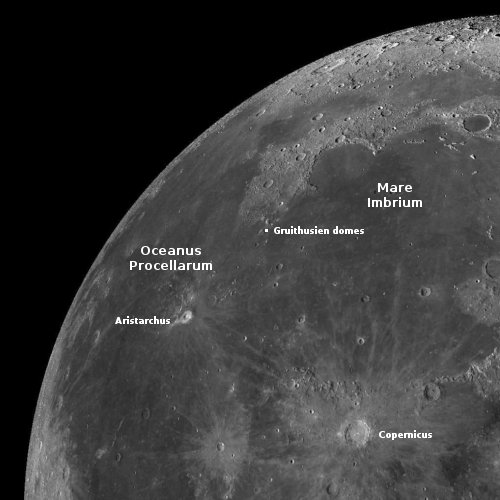
Peregrine landing site

NASA today announced that it has changed the planned landing site on the Moon for Astrobotic’s Peregrine lunar lander, presently scheduled for launch at the end of March on the first flight of ULA’s new Vulcan rocket.

The original landing site for Astrobotic’s flight within Lacus Mortis, which is in the northeast quadrant of the lunar nearside of the Moon, was chosen by Astrobotic to suit its lander performance and safety, as well as Astrobotic’s preferences. However, as NASA’s Artemis activities mature, it became evident the agency could increase the scientific value of the NASA payloads if they were delivered to a different location. The science and technology payloads planned for this delivery to the Moon presented NASA scientists with a valuable opportunity, prompting the relocation of the landing site to a mare – an ancient hardened lava flow – outside of the Gruithuisen Domes, a geologic enigma along the mare/highlands boundary on the northeast border of Oceanus Procellarum, or Ocean of Storms, the largest dark spot on the Moon.

The white dot on the map to the right shows this location. The original location was to the west of Atlas Crater in the northeast quadrant of the Moon’s near side, where Ispace’s Hakuto-R lunar lander plans to touch down in April.

This decision by NASA was apparently prompted by the decision to send Intuitive Machines Nova-C lander to Vallis Schröteri in Oceanus Procellarum, which is the rill that flows west out of the crater Aristarchus. Gruithuisen Domes had been a potential landing site for Nova-C, and NASA probably did not want to lose an opportunity to go there.

3 comments

NASA and Russian engineers meeting to discuss status of leaks on ISS’s Zvezda module

According to Russia’s state-run press, NASA and Russian engineers have been reviewing the status of the repairs on the cracks in the Zvezda module on ISS.

Repairs to the various cracks in Zvezda’s hull, done by Russian astronauts in ’20 and ’21, have reduced the leakage from 1,140 grams per day to 300 grams per day. Normally ISS is expected to lose 325 grams per day, across the entire station, so the Zvezda leak doubled this loss, even after the repair. Thus, the hatch to Zvezda is kept closed in order to maintain the atmosphere of ISS at its normal levels, and opened only when there is need to enter it. In addition, its port is no longer used for dockings.

The engineering review is also looking into the cause of the cracks, which are believed to be stress fractures caused by the age of Zvezda (ISS’s second oldest module) combined with the many dockings that had occurred at its port. The review is also discussing ways to reduce the problem, until ISS’s retirement in 2030.

3 comments

Lunar Flashlight cubesat in trouble

The mission of NASA’s test cubesat Lunar Flashlight is now threatened because of a problem with its experimental thrusters that use what the agency labels a new “green” propellant.

The spacecraft, called Lunar Flashlight, launched last month on a mission to seek out water ice on the moon. The probe was also expected to test a new “green” propellant during its four-month voyage to the moon, but its thrusters have a problem, NASA said on Thursday (Jan. 12). “While the smallsat is largely healthy and communicating with NASA’s Deep Space Network, the mission operations team has discovered that three of its four thrusters are underperforming,” NASA wrote in an update. “Based on ground testing, the team thinks that the underperformance might be caused by obstructions in the fuel lines that may be limiting the propellant flow to the thrusters.”

Engineers are now devising a plan to fire the thrusters longer and more frequently to make up for the lower thrust. If successful, the cubesat will enter its planned lunar orbit in about four months, where it will use infrared lasers to search for ice in the permanently shadowed craters at the lunar poles while testing a variety of other new technologies.

9 comments

Russian investigators conclude leak on Soyuz caused by external impact

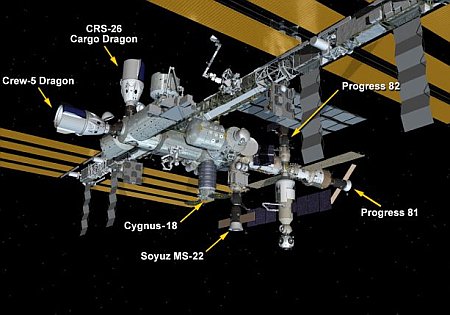
ISS as of November 28, 2022
ISS after November 28, 2022 docking of unmanned Dragon freighter.
MS-22 is the Soyuz capsule that is leaking.

The Russian investigators yesterday concluded that the coolant leak on the Soyuz capsule docked to ISS was caused by an external impact, either by a meteroid or a small piece of space junk.

A decision on whether this capsule is still usable for manned flight will be made sometime in January. If not, Russia will move up the launch of the next Soyuz to ISS one month from March to February, but launch it empty. If so, managers will leave the schedule as is.

If the engineers determine the capsule is not flightworthy, it will mean however that until February, ISS is short one lifeboat. At present there are two Dragon capsules docked to ISS, one manned and one cargo. Both return to Earth with a habitable interior, but the cargo capsule is not intended for manned flight. In an emergency however it might be possible to use it.

This situation suggests that NASA should pay to get SpaceX to upgrade the cargo Dragons so that they could always be used as an emergency lifeboat.

9 comments

Today’s blacklisted American: Black scientist blacklisted for doing good research

Oluseyi Hakeem, blacklisted
Hakeem Oluseyi, Space Science Education Lead
for NASA’s Science Mission Directorate

They’re coming for you next: Today’s blacklist column describes an effort to not only cancel from history the man who led NASA for almost the entire 1960s space race, but to also blackball a scientist for doing good research that proved the campaign was not based on any facts.

Shortly before the launch of the James Webb Space Telescope last year, a petition was instigated to get it renamed because of accusations that Webb had persecuted homosexuals during his term as NASA administrator in the 1960s. As is now typical of our modern bankrupt intellectual class, as soon as this petition was issued more than 1,700 people signed it, all accepting at face value its accusations against Webb without any further research.

One scientist, who happened to be black, took a more detailed look at those accusations however and found them to be spurious. As Hakeem Oluseyi wrote:
» Read more

9 comments

Newly passed Senate bill requires consultation between industry and government on space junk

Though the bill still needs to be passed by the House, a just passed Senate bill requires consultation between industry and government on space junk, short circuiting recent attempts at the FCC as well as in the House to impose arbitrary government regulations.

You can read the Senate bill here [pdf].

The final result will still be government regulation on the lifespan and final deposition of any object placed in orbit, from nanosats to large manned space stations, but unlike the earlier FCC proposal and House bill, NASA and other government agencies will have to obtain feedback from the commercial space industry before such regulations are imposed.

Sounds great, eh? In truth, this bill in the end still gives full power to the federal government to control the launching of future spacecraft of all sizes. It also leaves the details entirely up to the bureaucracy. If passed Congress would cede its regulatory power to unelected bureaucrats in the executive branch.

The requirement that industry consultation occur simply means that the initial regulations will likely make some sense. Beyond that however the power it bequeaths to the federal bureaucracy in NASA, FAA, FCC, and other agencies will in the long run be still abused.

The need for the establishment of an independent space-faring society, free from odious Earthbound regulation, continues to grow.

4 comments

Soyuz hole not caused by a Geminid meteor

According to an analysis by both NASA and Russian engineers, the 0.8 mm hole in the coolant system on the Soyuz docked to ISS was not caused by an object from the Geminid meteor shower that had occurred about the time the leak appeared.

The Soyuz vehicle, known as MS-22, sprayed its coolant into space on Dec. 14, the same day that the annual Geminid meteor shower peaked. But there’s no causal connection, NASA and Russian space officials said. “We did look at the meteor showers that were occurring,” Joel Montalbano, NASA’s International Space Station program manager, said during a press briefing on Thursday (Dec. 22). “Both the trajectory team in Houston and the trajectory team in Moscow confirmed it was not from the meteor showers; it was in the wrong direction.”

The engineers claim the hole could still have been caused by an impact, just not from these meteors.

0 comments

NASA requesting proposals for raising Hubble’s orbit

NASA has published a request for proposals from the private commercial space industry for a possible future mission to raise Hubble’s orbit.

NASA published a request for information (RFI) Dec. 22 asking industry how they would demonstrate commercial satellite servicing capabilities by raising the orbit of Hubble. The agency said it is looking for technical information about how a company would carry out the mission, the risks involved and the likelihood of success.

NASA emphasized in the RFI that it had no plans to procure a mission to reboost Hubble. “Partner(s) would be expected to participate and undertake this mission on a no-exchange-of-funds basis,” the document stated, with companies responsible for the cost for the mission.

Apparently, this RFI was issued as a direct result of the agreement between NASA and SpaceX to study a Dragon mission to do exactly this, which in turn was prompted by Jared Isaacman, as part of his private Polaris program of manned Dragon/Starship space flights. I suspect that NASA officials realized that not only were their engineering advantages to getting more proposals, there were probably legal and political reasons for opening the discussion up to the entire commercial space community.

Ideally, a Hubble reboost mission should occur by 2025, though the telescope’s orbit will remain stable into the mid-2030s.

12 comments

Webb in safe mode intermittently during the past two weeks

According to a short update today from the science team, the Webb Space Telescope went into safe mode on December 7, 2022 and was in that state “intermittently” through December 20, 2022 because of a software issue.

The James Webb Space Telescope resumed science operations Dec. 20, after Webb’s instruments intermittently went into safe mode beginning Dec. 7 due to a software fault triggered in the attitude control system, which controls the pointing of the observatory. During a safe mode, the observatory’s nonessential systems are automatically turned off, placing it in a protected state until the problem can be fixed. This event resulted in several pauses to science operations totaling a few days over that time period. Science proceeded otherwise during that time. The Webb team adjusted the commanding system, and science has now fully resumed.

It would be nice to have a more detailed description of that “software fault”, and how it affected the attitude control system. Such things can be very trivial, or they can be disastrous. NASA has a responsibility to tell the public which.

0 comments

Rocket Lab reschedules first Wallops launch to January

Having had to scrub the launch on December 18th and December 19th due of weather, Rocket Lab has now officially rescheduled its first Wallops launch to January.

The move of the planned launch window from December 2022 to early 2023 was driven by weather and the additional time that the National Aeronautics and Space Administration (NASA) at Wallops and the Federal Aviation Administration (FAA) required to complete essential regulatory documentation for launch. The delay in documentation left only two days in the originally scheduled 14-day launch window and both of those final remaining days were unsuitable for launch due to bad weather. The Mid-Atlantic Regional Spaceport within NASA’s Wallops Flight Facility is now closed for launch activity for the remainder of the December due to holiday airspace restrictions, preventing further launch attempts in 2022.

Rocket Lab originally wanted to launch from Wallops two years ago, but has been repeatedly stymied by government red tape. At that time the company wanted to use the software of its own flight termination system, a system that it has successfully used in New Zealand more than two dozen times, including several times where launch failures actually required the system to destroy the rocket. NASA said no, and instead insisted on spending two years apparently creating its own software which also requires the added presence of NASA officials during launch.

5 comments

More results from DART impact of Dimorphos

Didymos and Dimorphos as seen from Earth
Click for movie.

At a science conference this week scientists provided an update on the changes that occurred to the asteroid Dimorphos after it was impacted by the DART spacecraft in September, shortening its orbit around the larger asteroid Didymos by 33 minutes.

The image to the right is a screen capture from a short movie made from 30 images taken by the Magdalena Ridge Observatory in New Mexico, and part of a new image release of the asteroid pair.

It shows the motion of the Didymos system across the sky over the course of roughly 80 minutes, and features a long, linear tail stretching to the right from the asteroid system to the edge of the frame. The animation is roughly 32,000 kilometers across the field of view at the distance of Didymos.

According to the scientists, the impact displaced more than two million pounds of material from Dimorphos.

Observations before and after impact, reveal that Dimorphos and its larger parent asteroid, Didymos, have similar makeup and are composed of the same material – material that has been linked to ordinary chondrites, similar to the most common type of meteorite to impact the Earth. These measurements also took advantage of the ejecta from Dimorphos, which dominated the reflected light from the system in the days after impact. Even now, telescope images of the Didymos system show how solar radiation pressure has stretched the ejecta stream into a comet-like tail tens of thousands of miles in length.

Putting those pieces together, and assuming that Didymos and Dimorphos have the same densities, the team calculates that the momentum transferred when DART hit Dimorphos was roughly 3.6 times greater than if the asteroid had simply absorbed the spacecraft and produced no ejecta at all – indicating the ejecta contributed to moving the asteroid more than the spacecraft did.

This information is teaching us a great deal about these two particular asteroids, which could be used if for some reason their totally safe orbit got changed and they were going to impact Earth. However, NASA’s repeated effort to make believe this info would be useful for deflecting other asteroids is somewhat absurd. It is helpful, but each asteroid is unique. The data from DART is mostly helping astronomers get a better understanding of the geology of these specific asteroids, which will widen their understanding of asteroids in general. Planetary defense is really a very minor aspect of this work.

5 comments

SpaceX launches oceanography satellite

SpaceX early this morning used its Falcon 9 rocket to successfully launch an oceanography satellite, dubbed SWOT, for both NASA and France’s space agency CNES.

The satellite it designed to measure the height of water on 90% of the Earth’s surface.

The first stage was making its sixth flight, and successfully returned to Earth, touching down on its landing pad at Vandenberg Space Force Base.

The leaders in the 2022 launch race:

59 China
57 SpaceX
21 Russia
9 Rocket Lab
8 ULA

The U.S. now leads China 81 to 59 in the national rankings, but trails the entire world combined 91 to 81.

These numbers however should change again later today, as SpaceX has another launch scheduled.

0 comments

NASA approves $1.2 billion asteroid-hunting space telescope

NASA has given the go-ahead to build NEO-Surveyor for $1.2 billion, more than twice the cost of its original proposal, to launch by 2028 and then look for potentially dangerous asteroids.

Notably, NEO Surveyor was earlier estimated to cost between $500 million and $600 million, or around half of the new commitment. The NASA statement said that the cost and schedule commitments outlined align the mission with “program management best practices that account for potential technical risks and budgetary uncertainty beyond the development project’s control.” Earlier this year, the project’s launch was delayed two years, from 2026, due to agency budget concerns.

The mission is designed to discover 90% of potentially Earth-threatening asteroids and comets 460 feet (140 meters) or larger that come within 30 million miles (48 million kilometers) of Earth’s orbit. The spacecraft will carry out the survey while from Earth-sun Lagrange Point 1, a gravitationally stable spot in space about 930,000 miles (1.5 million kilometers) inside the Earth’s orbit around the sun.

A prediction: It will cost more, and not launch on time. NASA’s decision to double the budget and delay the launch two years suggests it did not trust the JPL cost and time estimates. Based on most NASA-centered projects, however, it is likely the new numbers will still be insufficient.

5 comments

Orion successfully splashes down in the Pacific

NASA’s Orion capsule today successfully returned from a three week trip around the Moon, splashing down in the Pacific where it was successfully recovered.

The next Artemis flight will be a manned one, using SLS and Orion to fly around the Moon. It will also be the first time Orion will use its full environmental system, with humans on board. Though presently scheduled for May 2024, it is almost certainly not going to fly before 2025.

The actual Artemis manned lunar landing will follow, no sooner than two years after that. As presently designed, that mission requires the establishment of the Lunar Gateway station — astronauts can be transferred from Orion to Starship and back again, and that station is likely not going to be ready in this time frame.

As I said yesterday, I predict the two already purchased private Starship missions around the Moon, paid for by Yusaku Maezawa and Jared Isaacman, will happen first. Both will certainly beat NASA’s planned landing on the Moon. I also expect both to beat that Orion manned fly-around in ’24-’25. And each will cost pennies compared to the entire SLS/Orion program, while actually making a profit that will be used to further development and more manned private flights.

2 comments

NASA extends Boeing’s contract to produce more SLS rockets

NASA yesterday announced that it will pay Boeing $3.2 billion for two more SLS rockets.

NASA has finalized its contract with Boeing of Huntsville, Alabama, for approximately $3.2 billion to continue manufacturing core and upper stages for future Space Launch System (SLS) rockets for Artemis missions to the Moon and beyond.

Under the SLS Stages Production and Evolution Contract action, Boeing will produce SLS core stages for Artemis III and IV, procure critical and long-lead material for the core stages for Artemis V and VI, provide the exploration upper stages (EUS) for Artemis V and VI, as well as tooling and related support and engineering services.

All this really means is that NASA is going depend on SLS and Orion to fly its astronauts to and from the Moon, and because of that its pace of flight will be — at best — slow and long-drawn out. For example, this new order extends the contract out to 2028. It will thus leave plenty of time for SpaceX and other nations to get there first.

I predict that the private Starship missions paid for by Yusaku Maezawa and Jared Isaacman will both fly before these two new Artemis missions. You heard it here first.

20 comments

SOFIA to retire to Arizona museum

NASA yesterday announced that its airborne 747 SOFIA telescope will be retired to the Pima Air & Space Museum in Tucson, Arizona, making its final flight there December 13, 2022.

Pima, one of the world’s largest aerospace museums, is developing plans for when and how the SOFIA aircraft will eventually be on display to the public. Along with six hangars, 80 acres of outdoor display grounds, and more than 425 aircraft from around the world, Pima also has its own restoration facility where incoming aircraft like SOFIA are prepared for museum immortalization after their arrival.

While the idea of SOFIA, putting a astronomical telescope on an airplane to get it above most of the atmosphere, has some merit, this particular NASA project was always too costly and simply produced too little science to justify its expense.

In many ways, this museum display will provide one of the best ways to see a 747 itself, now also retired.

3 comments

NASA awards Collins contract to build spacesuits for space station spacewalks

Capitalism in space: NASA yesterday awarded Collins Aerospace a $97.2 million contract to build spacesuits for the agency’s future space station spacewalks.

In June NASA had picked Collins and Axiom as the vendors who would build spacesuits for the agency. In September it purchased its its first Artemis Moon spacesuits from Axiom. This new contract has NASA buying its first new space station suits from Collins.

In both cases, the companies own their designs, and can thus sell them to the other private space stations presently under construction.

This contract award follows NASA abandonment of its own failed spacesuit effort, which spent fourteen years and a billion dollars and produced nothing.

1 comment

Astrobotic’s Peregrine lunar lander passes launch tests

Astrobotic’s first demonstration lunar lander, dubbed Peregrine, has passed its vibration and acoustic tests, demonstrating it can survive launch on ULA’s Vulcan rocket, presently scheduled for the first quarter of ’23.

The lander is now undergoing electromagnetic interference testing, which will be followed by thermal vacuum tests. Once those tests are complete, the company said, it will ship the lander to Cape Canaveral, Florida, to be integrated with the Vulcan Centaur for a launch currently scheduled in the first quarter of 2023. That launch will be the inaugural flight of the Vulcan Centaur.

A great deal will be riding on that first Vulcan launch, both for Astrobotic and ULA.

1 comment

Blue Origin-led team bids for NASA manned lunar lander contract

Capitalism in space: Though few details have been released, Blue Origin has teamed up with Boeing and Lockheed Martin to bid for a NASA contract to build a second manned lunar lander, after SpaceX’s Starship.

Blue Origin revealed its team’s submission to that second NASA program in a brief statement posted on its website on Tuesday, saying “in partnership with NASA, this team will achieve sustained presence on the Moon.”

The deadline for proposals was Tuesday. NASA is expected to make an award decision in June 2023.

Blue Origin’s team also includes spacecraft software firm Draper, Pittsburgh, Pennsylvania-based Astrobotic and Honeybee Robotics, a manufacturer of military and civil robotic systems that was acquired by Blue Origin in January.

It will be interesting to see if this proposed lander is significantly different than the previous proposal, which NASA considered overpriced and not as capable as Starship.

10 comments

Delays threaten Europa Clipper mission

A variety of issues delaying completion of the science instruments on the Europa Clipper mission are now threatening to prevent the spacecraft from meeting its 2024 launch date.

[W]ith less than two years to go before launch, only three of those instruments have been installed on the main spacecraft body, and five haven’t yet arrived at JPL.

Some context: Europa Clipper has been under development since 1997, though actual design work did not begin until 2013, nine years ago. It presently has a budget of $4.25 billion (more than double its first proposed budget of $2 billion). Yet now, less than years from launch, seven of ten instruments are behind schedule?

What is really disgusting about this story is that it is par for the course for NASA, which almost never finishes anything on time or on budget.

3 comments
1 29 30 31 32 33 117