Pluto’s cratered glacial terrain

Panorama of Pluto's eastern limb
Click for full resolution. For original images go here, here, here, and here.

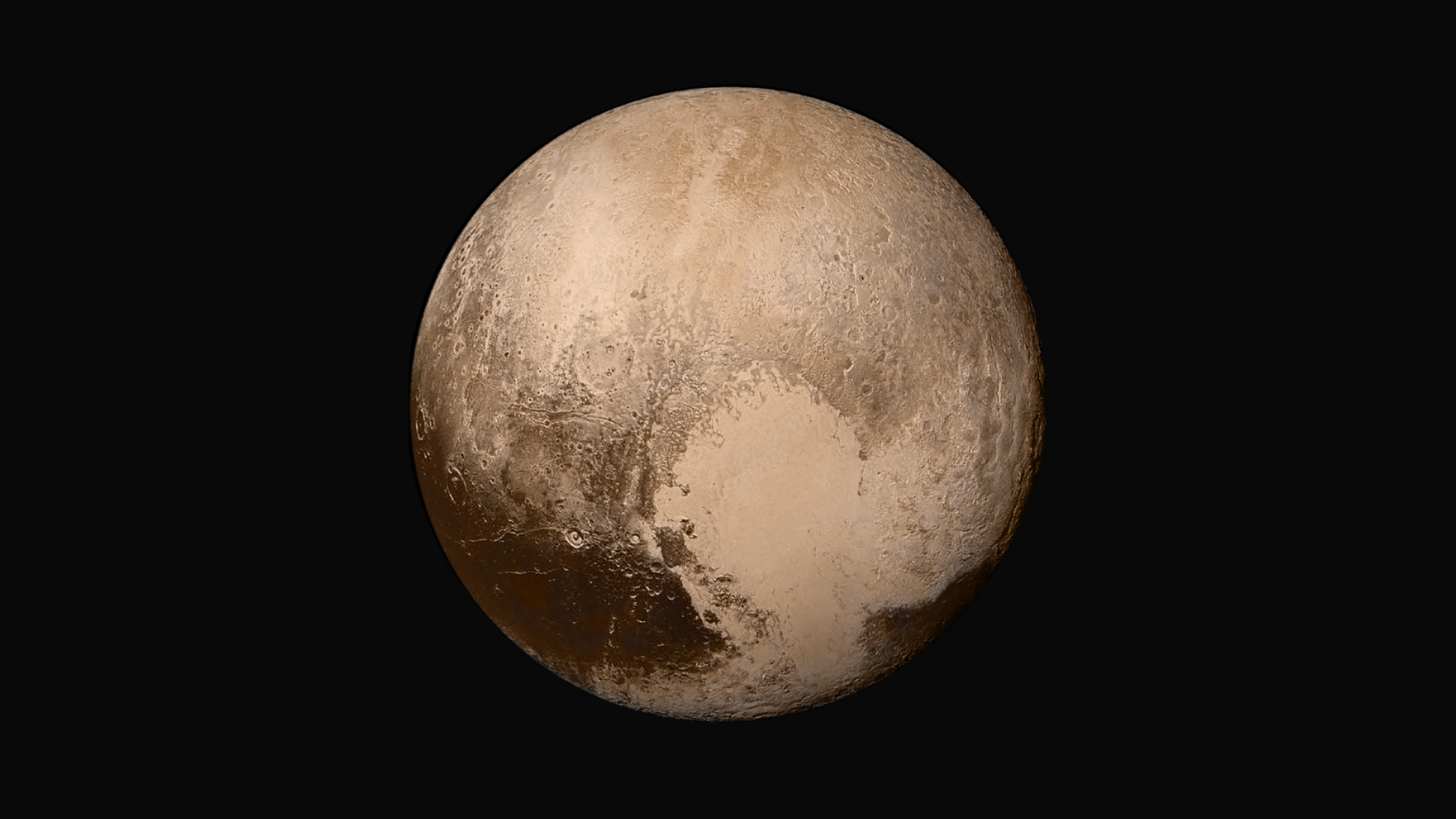
Pluto in true color
Click for original image.

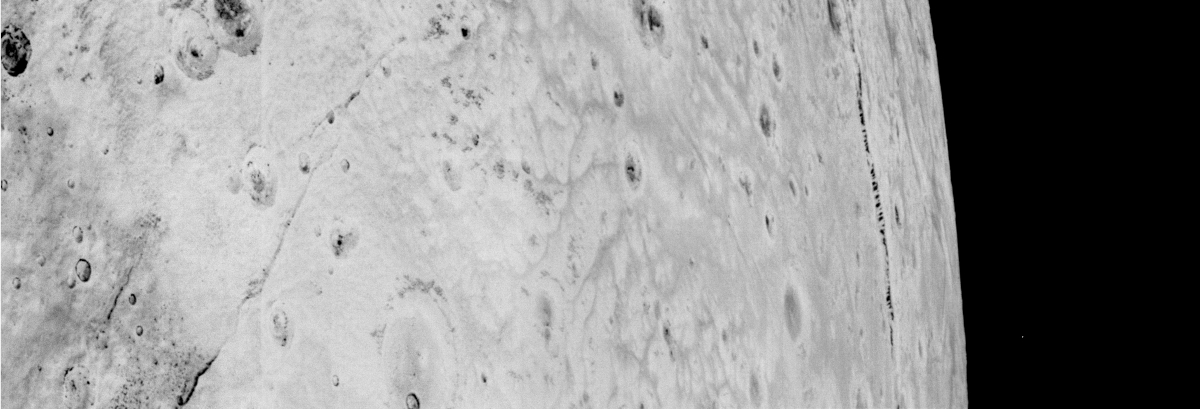
Cool image time! The panorama above, created from four New Horizons’ images that were cropped and enhanced to post here, was taken by New Horizons on July 14, 2015 (here, here, here, and here), about 30 minutes before its closest approach of 7,800 miles above Pluto.

I have searched the New Horizons’ press release archive, and as far as I can tell, this sequence of images and the terrain it shows was never highlighted publicly by the science team. For that reason, I am not sure exactly where to place it on the global true-color image of Pluto to the right, released by the science team shortly after that fly-by. I suspect the panorama covers a strip on the eastern limb of the globe, in the darker crater region to the east of Pluto’s giant frozen nitrogen sea. It is also possible this is actually covering the north pole regions, with the raw images as released oriented with north to the right.

Other than these guesses I cannot tell. If anyone has better information please provide it in the comments.

What the panorama does show us is cracked and pitted terrain, thought to be mostly made up of frozen ice mixed with dust and debris with some nitrogen and other materials thrown in. Though in many ways it resembles the Moon, that similarity is only very superficial. For example, the polygon shapes near the picture’s center suggest ice floes or glaciers, though there is no underground liquid ocean on which they could float.

This is a very alien world. And it is likely even more alien than the few pictures obtained during that New Horizons’ fly-by have suggested. After all, we only saw in high resolution one hemisphere. Who knows what’s really on the planet’s other side?
Charon’s surface, completely unlike Pluto

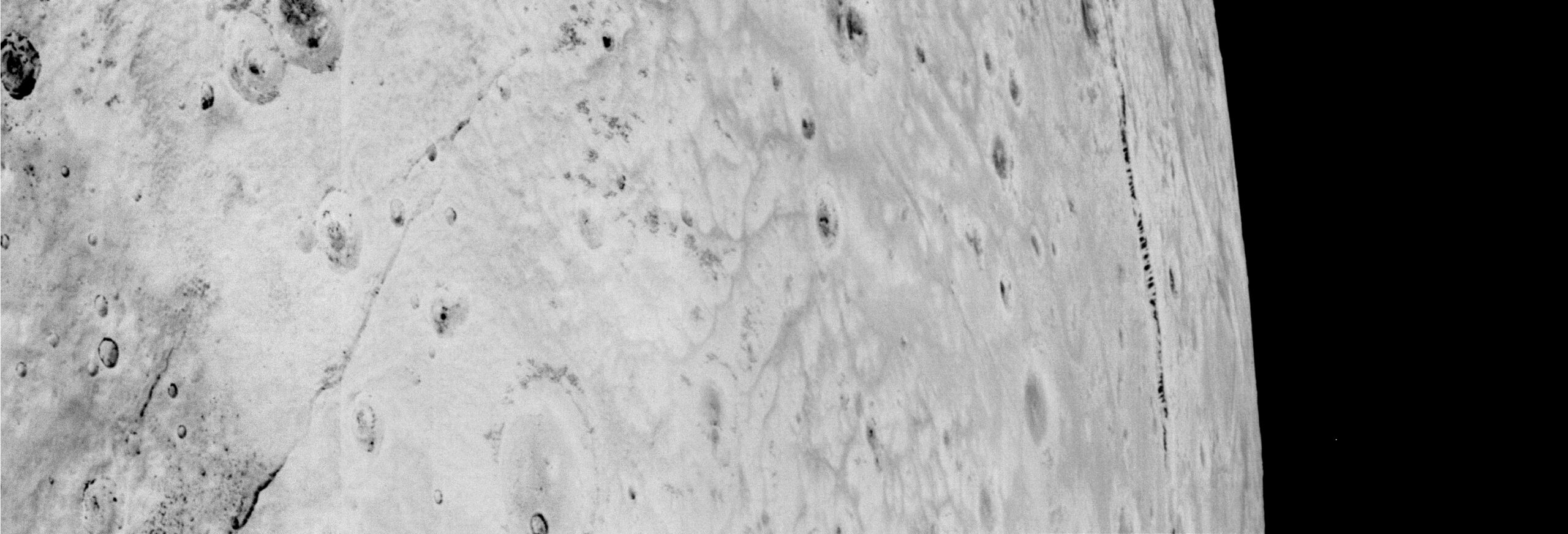
Panorama of part of Charon's surface
Click for full resolution. For original images go here, here, and here.

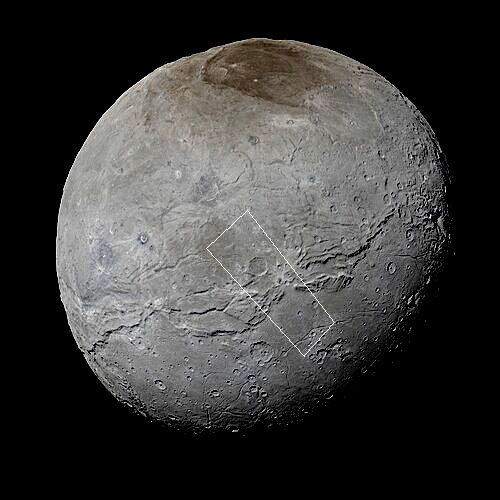
Charon

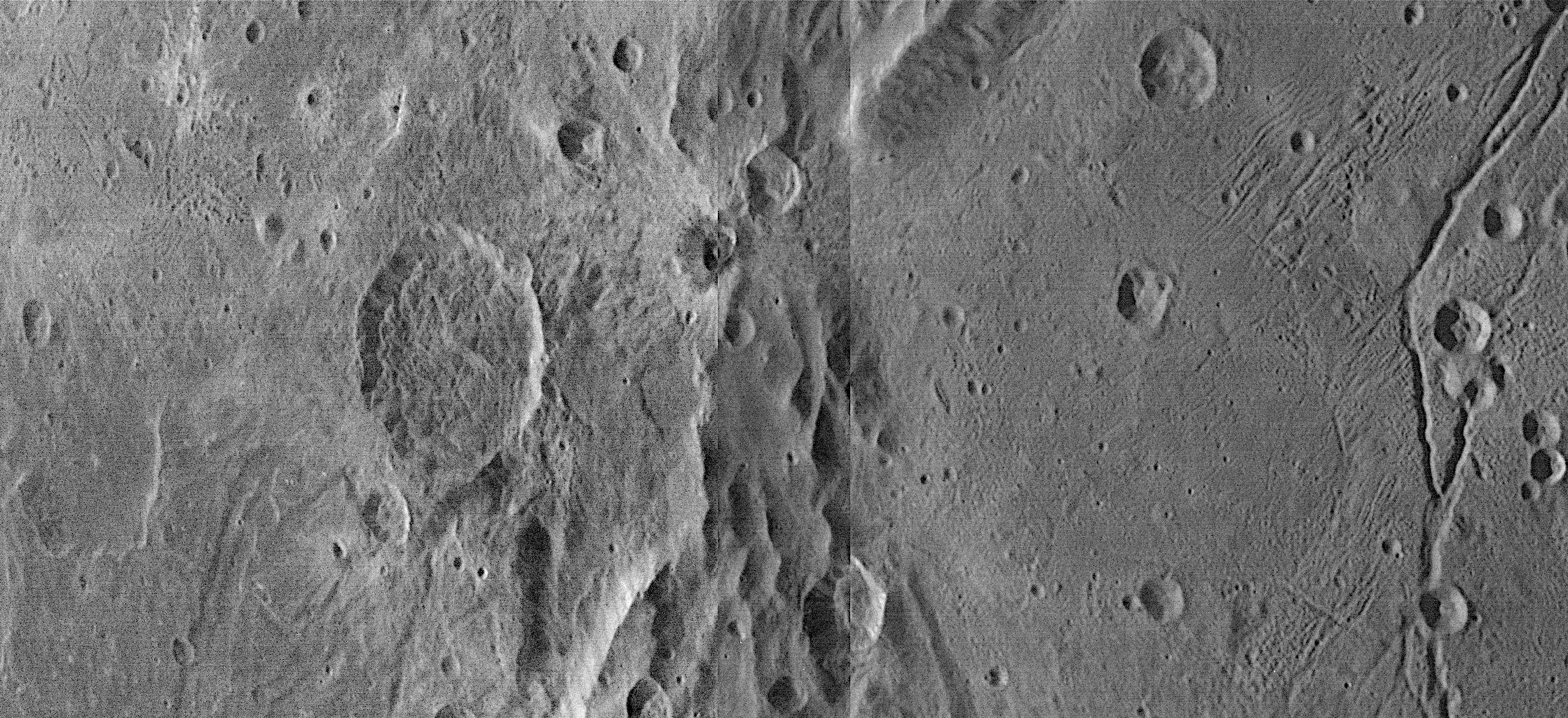
Cool image time! The panorama above, created from three images taken by New Horizons as it began its July 14, 2015 fly-by of the Pluto-Charon double planet system (found here, here, and here), show in close-up one specific swath of Charon cutting across its equatorial regions.

The true color global image of Charon to the right shows the approximate area covered by the panorama above. For scale, Charon has a diameter of about 750 miles, about half that of Pluto. For clarity I have rotated the panorama so that it more closely aligns with the rectangle of global image.

One of the most remarkable discoveries made during New Horizons’ fly-by was how completely different Pluto and Charon appeared, despite their likely formation together at the same time and in the same location of the early solar system. While Pluto had frozen nitrogen seas and water ice mountains floating at the shores, Charon more resembled Mercury, cratered with many large ridges and canyons criss-crossing its service. Both planets appear to be icy, but somehow Charon appears to lack the large differentiated variety of materials seen on Pluto.

The shoreline of Pluto’s frozen nitrogen sea

The shoreline of Pluto's frozen nitrogen sea
Click for full resolution. For original
images go here and here.

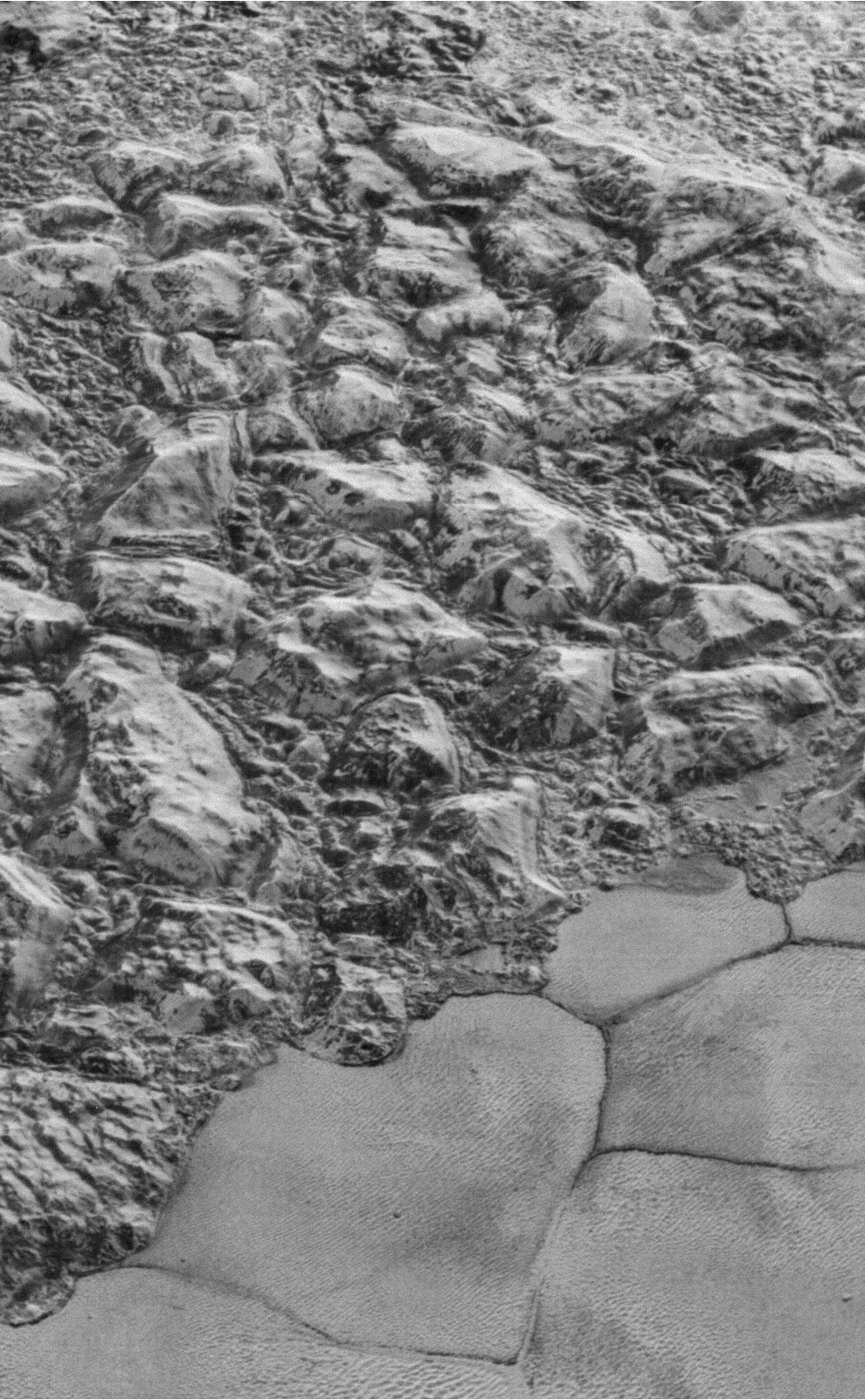
Cool image time! In my continuing exploration of the New Horizons’ image archive, I keep finding things that I do not remember ever seeing before. The two New Horizon pictures used to create the panorama to the right (here and here) were taken by the spacecraft only thirteen minutes before its closest approach to Pluto at 7,800 miles on July 14, 2015. It shows the Al-Idrisi mountains — thought to be made up of frozen ice as hard as granite — and the frozen nitrogen sea that pushes against those mountains and squeezes them into their jumbled shape. For scale, the image is estimated to be fifty miles wide.

In December 2015 the science team released a small section of one of two images, focused specifically at that nitrogen sea shoreline, noting:

Great blocks of Pluto’s water-ice crust appear jammed together in the informally named al-Idrisi mountains. Some mountain sides appear coated in dark material, while other sides are bright.

The team however did not release this wider panorama produced by both images, which I think gives a better perspective of what we are looking at.

I posted an even wider shot of this shoreline on January 29, 2026. If you look closely at that picture, you can spot the features to the right, but much smaller seen from a greater distance.

For the larger context, below is a wide shot of Pluto indicating the part of the planet where this image is located.
» Read more

Pluto’s splotched surface

Pluto's splotched surface
For original images go here and here.

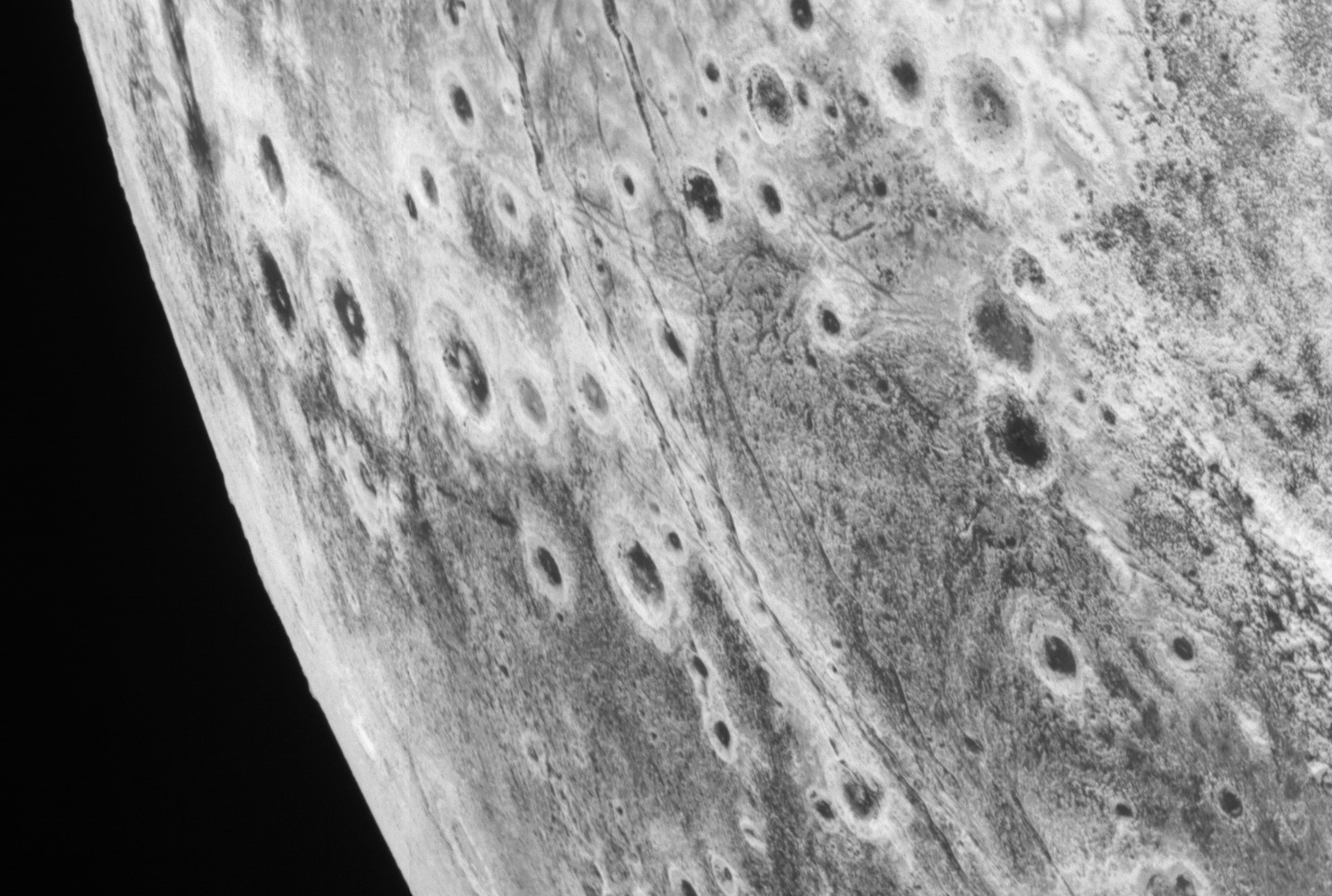
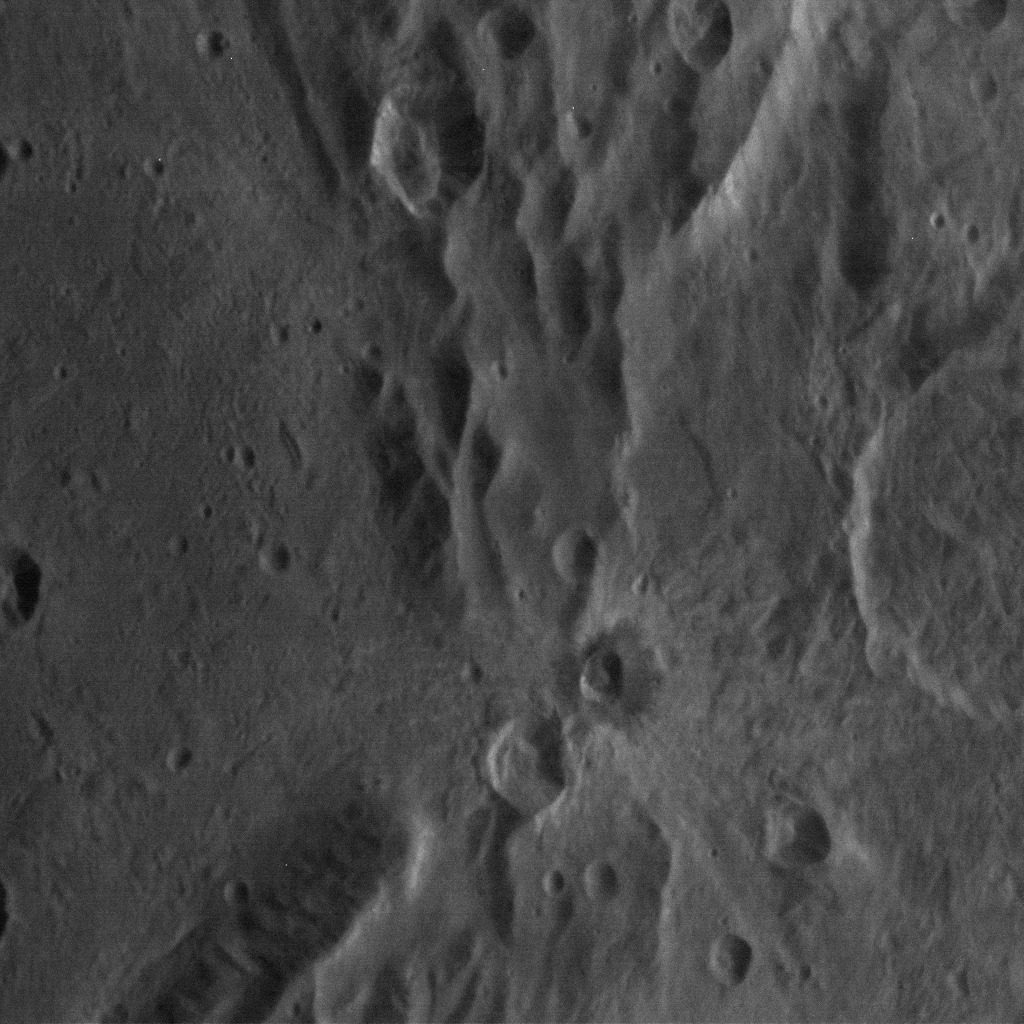
Cool image time! The panorama above was created using two photographs (found here and here) taken by New Horizons during its close fly-by of Pluto on July 14, 2015. It looks at Pluto’s western limb, well lit by the Sun, from a distance of approximately 60,000 miles.

I pulled these images from the New Horizons’ archive specifically because I don’t remember ever seeing them publicly released by the science team. More important, they show a surface far more alien than other more well-known New Horizon pictures. Are those round splotches impact craters or some alien type of volcanic caldera? Note also the vertical cracks that appear to divide this terrain near the center.

It would be a serious mistake to make any conclusions. In the emptiness of the outer solar system, the impact rates are going to be far less than in the inner solar system, so assuming impacts is dangerous. Pluto meanwhile has an alien surface of frozen nitrogen seas often filled with floating mountains of frozen water ice. For it to also produce weird volcanic eruptions of nitrogen, sublimating away like bubbling tomato sauce when it is simmering, is quite possible.

Pluto’s floating mountains of frozen ice

Pluto's floating mountains
Click for original image.

Cool image time! The picture to the right, rotated, cropped, and sharpened to post here, was taken by New Horizons on July 14, 2015 when it made its close fly-by of Pluto.

The picture looks at the part of Pluto that was close to sunset. Hence the mountain’s long dramatic shadow. The raw image webpage provides little information, including a scale of 0.0 meters, which means nothing. My guess is that these mountains could be several hundred to several thousand feet high based on data from other New Horizon mountain images, but that is a pure guess.

What we think we know is that these mountains are likely made of ice, which at Pluto’s eternally cold environment is as hard as granite. We also think we know that they float on a layer of frozen nitrogen, but because that nitrogen can sublimate into gas when Pluto’s climate warms as its orbit brings it closer to the Sun, the foundation of these mountains is quite unstable. They can roll and drift about, even if they are the size of the Appalachian mountains in the eastern U.S.

I continue to delve into the New Horizons’ archive, and have discovered a trove of quite amazing pictures that hadn’t been featured by the science team during the fly-by. Pluto really is an alien place. Stay tuned, there is more to come!

Pluto’s implausible atmosphere, as seen in 2015 by New Horizons

Pluto's implausible atmosphere
Click for original image.

Cool image time! The picture to the right, cropped to post here, was taken on July 14, 2015 by the camera on the New Horizons probe as it flew past Pluto, the only time a human craft has gotten close to this distant planet. From the link:

These high phase angle images show many artifacts associated with scattered sunlight; the Sun was less then 15 degrees from the center of the LORRI frame for these observations. But the outline of Pluto and its hazy atmosphere are also visible.

To see the atmosphere the light from the planet itself has been blocked out.

What is implausible about Pluto’s atmosphere is the location of the planet, about 3.7 billion miles from the Sun, out in the nether reaches of the solar system. At that distance sunlight is very weak, and produces very little energy. And yet, there is enough energy here to produce an atmosphere of mostly nitrogen gas, with trace amounts of metane and carbon monoxide. Scientists think this atmosphere only exists when Pluto is closer to the Sun in its somewhat oblong orbit, and freezes out the rest of the time. As Pluto was just retreating in 2015 from that closest approach in the last two decades of the 20th century, New Horizons could detect its presence.

But then, we really can’t be sure if this atmosphere truly vanishes when the planet is farthest from the Sun, as we have only so far observed 96 years in Pluto’s 248-year orbit.

Pluto and Charon come out of the dark

Pluto and Charon come out of the dark
Click for original image.

Cool image time! I have decided to start delving into the archives of some of the older planetary missions, because there is value there that is often forgotten now years later, that should not be forgotten.

In looking through the archive of images from the main camera on New Horizons as it sped past Pluto in July 2015, I found the picture to the right, taken on July 10, 2015 when New Horizons was still about three million miles away.

This is the raw image from that camera, cropped, reduced, and sharpened to post here. It is also the first time in human history we had a sharp look at these two planets that sit at the outer fringes of the solar system. The science team that day released a version that they enhanced to bring out the details, which I immediately posted. They then noted the following:

A high-contrast array of bright and dark features covers Pluto’s surface, while on Charon, only a dark polar region interrupts a generally more uniform light gray terrain. The reddish materials that color Pluto are absent on Charon. Pluto has a significant atmosphere; Charon does not. On Pluto, exotic ices like frozen nitrogen, methane, and carbon monoxide have been found, while Charon’s surface is made of frozen water and ammonia compounds. The interior of Pluto is mostly rock, while Charon contains equal measures of rock and water ice. “These two objects have been together for billions of years, in the same orbit, but they are totally different,” said Principal Investigator Alan Stern of the Southwest Research Institute (SwRI), Boulder, Colorado.

This difference is quite clear in the raw image, with Charon markedly dimmer than Pluto even though they are getting the same amount of light from the Sun.

More than any other objects in the solar system, the double planet system of Pluto-Charon demonstrates how uniquely different every object in the solar system is from every other object. Even when formed together, as these two planets were, they formed in a manner that made them drastically different.

Pluto’s mountains of ice surrounded by a sea of frozen nitrogen

Ice mountains floating in nitrogen sea on Pluto
Click for original image.

Cool image time! Though we only have a limited archive of high resolution pictures of Pluto that were taken when New Horizons did its close fly-by of the planet in July 2015, it is worthwhile sometimes to take a second look at some of those images. The picture to the right, cropped and annotated to post here, was taken during that July 14, 2015 fly-by, and shows a mountainous region dubbed Al-Idrisi Montes on the shore of a white frozen ocean. The red dotted line indicates a large trench that separates the Al-Idrisi mountains from the mountainous region to the west.

Sounds similar to an arctic shoreline here on Earth, doesn’t it? Not in the least. Those mountains, ranging from 600 to 9,000 feet high, are made of frozen ice, which on Pluto are as hard as granite due to the endless cold. And the white frozen ocean is frozen nitrogen, broken into polygon shaped blocks. Even stranger: those ice mountains might even be floating in that nitrogen sea! A paper from 2019 [pdf] looked at the New Horizons data and concluded as follows:

Evidence suggests that the Al-Idrisi mountains may have been uplifted by the formation of
the western trench feature. Solid state convection appears to be our best supposition as to how the Al-Idrisi Montes reached their heights.

In other words, as that large trench/depression formed, convection (the bubbles you see when you simmer tomato sauce) pushed these mountains of ice upward to float above the “sea level” of that nitrogen sea.

At least, that’s one hypothesis. The scientists who wrote this paper admit their “our hypothesis still remains in need of study and this trench-mountain system warrants serious further research.” In other words, we simply don’t know enough to have a definitive understanding of the geology of this extremely alien planet.

House committee support for threatened NASA missions is actually quite questionable

According to a House appropriations committee spending bill that it approved this week, it appears on the surface that it is canceling the proposed 24% cut by Trump to NASA’s budget as well as endorsing continued funding for some threatened missions. A close look however suggests this congressional support for NASA is somewhat superficial, and might actually be ephemeral.

The key is the language of the bill. From the link above:

The bill was largely unchanged from what the CJS [commerce, justice and science] subcommittee approved July 14. It includes $24.838 billion for NASA, nearly the same as the $24.875 billion the agency received in fiscal 2024 and 2025, and far above the $18.8 billion the administration proposed for fiscal 2026 in May.

Members adopted a manager’s amendment, a package of noncontroversial changes and corrections, on a voice vote. That amendment also made additions to the report accompanying the bill. The report includes language expressing support for several NASA missions targeted for cancellation, including the Chandra X-ray Observatory, the Juno mission at Jupiter and the New Horizons mission in the Kuiper Belt.

The report does not specify funding levels for those missions, but the “continues support” language signals to NASA that it should fund continue operations within the agency’s science budget. [emphasis mine]

It is the vagueness of this language that suggests the support is ephemeral. The courts recently have consistently ruled that if Congress doesn’t specifically mandate spending on a project, the White House is free to move money around as it sees fit. By not expressly outlining funding for Chandra, Juno, and New Horizons, these congressmen are playing a shell game, whereby to their constituents they can point to this vote and claim they wholeheartedly supported NASA and these missions. At the same time, they also appear to be allowing Trump the freedom to go ahead and shut the missions down, as his budget has already proposed.

None of this is yet real. The bill still must be passed by the full House, as well as the Senate. It then has to be signed by Trump. A lot of changes would happen in that process.

Either way, it appears that within the House at least, there is some movement to at least make some budget cuts possible. The sad thing is that the House is not actually cutting the budget, even as it is allowing Trump a way to cut these relatively inexpensive on-going missions. Considering the debt, it would have been much better had the committee actually trimmed NASA’s budget, even a little, while at the same time allocating specific funds to keep these very cost-effective missions alive.

New Horizons placed in hibernation, possibly forever

The science team running the New Horizons probe, now more then 5.7 billion miles from Earth, has placed the spacecraft into what will be its longest hibernation period so far, with the possibility that it could even last forever.

New Horizons, which had been in active data-collection mode since April, will now remain in hibernation. Pending a final Fiscal Year 2026 budget, the spacecraft may be awoken in late June 2026. This will be the longest hibernation period of the mission so far, surpassing the previous mark of 273 days from June 2022 to March 2023.

But the spacecraft won’t be completely at rest; New Horizons will continue to take round-the-clock measurements of the charged-particle environment in the Sun’s outer heliosphere and the dust environment of the Kuiper Belt using three different onboard scientific instruments. These data will be transmitted back to Earth when New Horizons wakes up. [emphasis mine]

Though the NASA press release puts up an optimistic front, it is very likely that this hibernation period will last significantly longer than planned, due to those budget negotiations. Trump’s budget proposes eliminating all funding for New Horizons, which will mean this hibernation period will be permanent. There will be no money to hire anyone to reactivate it.

Even if the budget is cut, it is probable that NASA management in the future will provide some cash. At the moment there is little for it to observe on a daily basis. All that needs to be done is to turn it on for short periods to download the heliosphere data. Management could simply decide to turn it on once every five years or so.

Active volcanoes on Pluto?

Elevation map of Wright Mons on Pluto

The uncertainty of science: According to new research published yesterday, scientists now posit that there might be recent volcanic activity on Pluto, based on data and images sent back by New Horizons during its fly-by of the planet in 2015.

You can read the paper here. From its abstract:

The New Horizons spacecraft returned images and compositional data showing that terrains on Pluto span a variety of ages, ranging from relatively ancient, heavily cratered areas to very young surfaces with few-to-no impact craters. One of the regions with very few impact craters is dominated by enormous rises with hummocky flanks. Similar features do not exist anywhere else in the imaged solar system. Here we analyze the geomorphology and composition of the features and conclude this region was resurfaced by cryovolcanic processes, of a type and scale so far unique to Pluto. Creation of this terrain requires multiple eruption sites and a large volume of material (>104 km3) to form what we propose are multiple, several-km-high domes, some of which merge to form more complex planforms. The existence of these massive features suggests Pluto’s interior structure and evolution allows for either enhanced retention of heat or more heat overall than was anticipated before New Horizons, which permitted mobilization of water-ice-rich materials late in Pluto’s history. [emphasis mine]

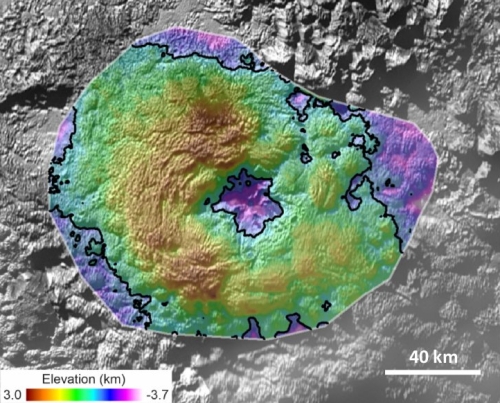
The image to above is Figure 10 in the paper’s supplementary material [pdf]. It shows the volcano-like appearance of Wright Mons on Pluto, a mound approximately 3,000 feet high with a central depression equally deep, with a volume “similar in magnitude to that of the Hawaiian volcano Mauna Loa.”

These conclusions are quite tantalizing, but the amount of data is sparse, and thus it is wise not to take them too seriously. For example, the scientists have no idea how Pluto could presently have any form of liquid or active volcanism. Another mission to Pluto — studying it over a long time from orbit — will be required to determine how active the planet really is, or if it is active at all.

New Horizons discovers two binary asteroids in Kuiper Belt

Overview map
Click for full map.

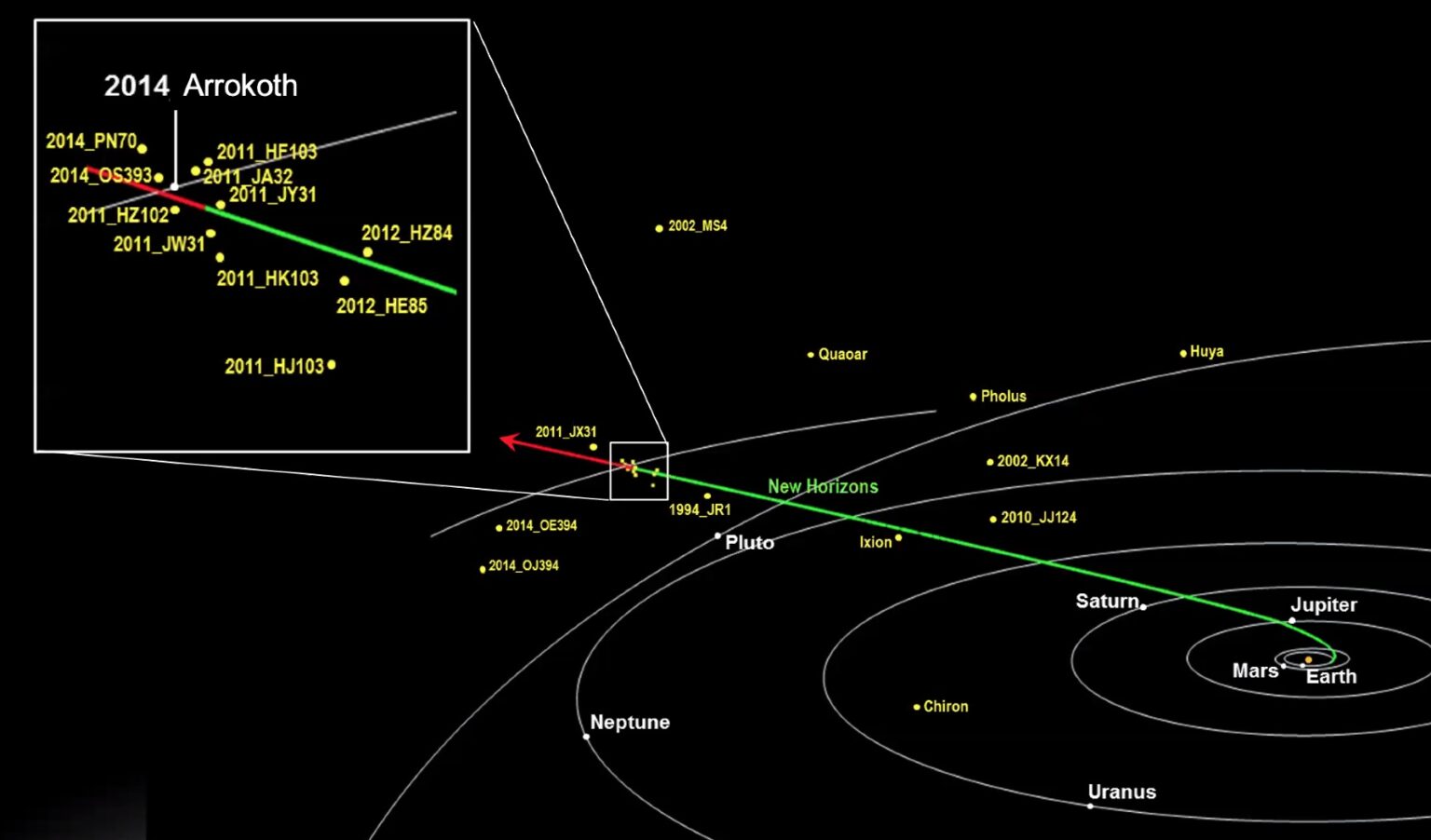
As New Horizons traveled from Pluto to the asteroid Arrokoth in 2018, scientists used it to take images of the relatively nearby asteroids that it was passing, and found that two of those asteroids appeared elongated.

[T]he team fit the shapes with a two-body model: two asteroids in a tight orbit. Even though the individual rocks weren’t resolved, the modeling showed that two bodies were better able to explain the elongation, as well as the brightness seen. The model for 2011 JY31 had two 50-km-wide objects nearly 200 km apart, while for 2014 OS393, the model had slightly smaller bodies (30 km across) that orbited each other 150 km apart.

The map, cropped and further annotated by me, shows New Horizons’ path during this time period, with the two binary asteroids indicated in blue.

This data, combined with the double lobe shape of Arrokoth (formerly named Ultima Thule), strongly suggests that it was not unusual for these primitives asteroids in the early solar system to coalesce from comparably sized partners.

Pluto’s mountains are white-capped but with methane not ice

Pluto's white-capped mountains
Pluto’s mountains, capped with methane snow.
Click for full figure.

Scientists now theorize that the white-capped mountains first photographed by New Horizons during its 2015 fly-by of Pluto are capped not with ice but with methane snow, as part of that planet’s methane gas-ice cycle.

The image to the right, from their paper, shows these white-capped mountains on Pluto.

The exact composition of this frost on Pluto was unclear. While researchers identified methane, it was unknown whether it is pure frozen methane, frozen methane diluted with frozen nitrogen or a mix of both. The uncertainty about the frost’s composition made it unclear how it might have formed.

To help solve these mysteries, scientists in this new study examined high-resolution data from New Horizons, focusing on the composition of the frost at high altitudes. This new analysis revealed that the snowcap frost “is almost pure methane ice, with traces of nitrogen ice,” Bertrand said.

The researchers also developed high-resolution computer simulations of Pluto’s climate. They focused on how methane circulates around the dwarf planet. [emphasis mine]

Though their simulations of the methane cycle that produces the caps are reasonable, I purposely highlight the fact that this is what they are, and as such must be treated with great skepticism. We might now know the composition of these snowcaps, but our overall knowledge of Pluto remains to limited to trust blindly any computer model.

New Horizons sees stellar parallax

New Horizons is now far enough away from Earth that its perspective of the universe shifts at least two nearby stars into slightly different positions than seen on Earth.

On April 22-23, the spacecraft turned its long-range telescopic camera to a pair of the closest stars, Proxima Centauri and Wolf 359, showing just how they appear in different places than we see from Earth. Scientists have long used this “parallax effect” – how a star appears to shift against its background when seen from different locations — to measure distances to stars.

An easy way to see parallax is to place one finger at arm’s length and watch it jump back and forth when you view it successively with each eye. Similarly, as Earth makes it way around the Sun, the stars shift their positions. But because even the nearest stars are hundreds of thousands of times farther away than the diameter of Earth’s orbit, the parallax shifts are tiny, and can only be measured with precise instrumentation. “No human eye can detect these shifts,” Stern said.

But when New Horizons images are paired with pictures of the same stars taken on the same dates by telescopes on Earth, the parallax shift is instantly visible. The combination yields a 3D view of the stars “floating” in front of their background star fields.

The resulting 3D image, available at the link, is very cool. Both stars clearly appear closer than the surrounding background stars, which of course is true as they are among the closest stars to the Sun.

New simulations of Pluto’s atmosphere

New simulations of Pluto’s atmosphere, created using data obtained during the 2015 fly-by by New Horizons of Pluto, suggest that the planet’s thin atmosphere, mostly made up of nitrogen, generally blows in a retrograde direction when compared with the planet’s rotation.

Bertrand and his colleagues set out to determine how circulating air – which is 100,000 times thinner than that of Earth’s – might shape features on the surface. The team pulled data from New Horizons’ 2015 flyby to depict Pluto’s topography and its blankets of nitrogen ice. They then simulated the nitrogen cycle with a weather forecast model and assessed how winds blew across the surface.

The group discovered Pluto’s winds above 4 kilometers (2.5 miles) blow to the west — the opposite direction from the dwarf planet’s eastern spin — in a retro-rotation during most of its year. As nitrogen within Tombaugh Regio vaporizes in the north and becomes ice in the south, its movement triggers westward winds, according to the new study.

The press release is very badly written. It tries to make it sound as this work discovered the atmosphere of Pluto, and that this process is more unique in the solar system than it is. It also neglects to mention that we only have good information about one hemisphere of Pluto. The fly-by did not see the planet’s other half, and so any computer model based on New Horizons’ data is by definition guaranteed to be half incomplete, with gigantic uncertainties.

Still, it gives us another example of the unexpected complexity of the geological processes on Pluto, something no one expected for a place so far from the Sun where there is so little energy to drive such processes.

New Horizons confirms solar wind slows at greater solar distances

The New Horizons science team today released data that confirms that, as theorized, the speed of the solar wind decreases as it travels farther from the Sun.

As the solar wind moves farther from the Sun, it encounters an increasing amount of material from interstellar space. When interstellar material is ionized, the solar wind picks up the material and, researchers theorized, slows and heats in response. SWAP [an instrument on New Horizons] has now detected and confirmed this predicted effect.

The SWAP team compared the New Horizons solar wind speed measurements from 21 to 42 astronomical units to the speeds at 1 AU from both the Advanced Composition Explorer (ACE) and Solar TErrestrial RElations Observatory (STEREO) spacecraft. (One AU is equal to the distance between the Sun and Earth.) By 21 AU, it appeared that SWAP could be detecting the slowing of the solar wind in response to picking up interstellar material. However, when New Horizons traveled beyond Pluto, between 33 and 42 AU, the solar wind measured 6-7% slower than at the 1 AU distance, confirming the effect.

The data also suggests that New Horizons could exit the heliosphere and enter interstellar space as early as sometime in the 2020s.

New Horizons team renames “Ultima Thule” to “Arrokoth”

The New Horizons team has renamed the Kuiper Belt object that the spacecraft flew past on January 1, 2019 from its informal nickname of “Ultima Thule” to “Arrokoth,” which means “sky” in Powhatan/Algonquian language.

This official, and very politically correct, name has apparently gotten the stamp of approval from the IAU.

In accordance with IAU naming conventions, the discovery team earned the privilege of selecting a permanent name for the celestial body. The team used this convention to associate the culture of the native peoples who lived in the region where the object was discovered; in this case, both the Hubble Space Telescope (at the Space Telescope Science Institute) and the New Horizons mission (at the Johns Hopkins Applied Physics Laboratory) are operated out of Maryland — a tie to the significance of the Chesapeake Bay region to the Powhatan people.

“We graciously accept this gift from the Powhatan people,” said Lori Glaze, director of NASA’s Planetary Science Division. “Bestowing the name Arrokoth signifies the strength and endurance of the indigenous Algonquian people of the Chesapeake region. Their heritage continues to be a guiding light for all who search for meaning and understanding of the origins of the universe and the celestial connection of humanity.” [emphasis mine]

It is a good name, especially because its pronunciation is straight-forward, unlike the nickname.

The blather from Glaze above, however, is quite disingenuous. The Algonquian people have had literally nothing to do with the modern scientific quest for “meaning and understanding of the origins of the unverse.” They were a stone-age culture, with no written language. It was western civilization that has made their present lives far better. And it was the heritage of western civilization, not “the indigenous Algonquian people” that made the New Horizons’ journey possible. Without the demand for knowledge and truth, as demanded by western civilization, we would still not know that Arrokoth even existed.

New Horizons data suggests the Kuiper Belt is emptier that previously believed

The uncertainty of science: An analysis of data from New Horizons now suggests a paucity of small objects in the Kuiper Belt.

Using New Horizons data from the Pluto-Charon flyby in 2015, a Southwest Research Institute-led team of scientists have indirectly discovered a distinct and surprising lack of very small objects in the Kuiper Belt. The evidence for the paucity of small Kuiper Belt objects (KBOs) comes from New Horizons imaging that revealed a dearth of small craters on Pluto’s largest satellite, Charon, indicating that impactors from 300 feet to 1 mile (91 meters to 1.6 km) in diameter must also be rare.

I therefore wonder how the objects we do find there formed. The volume of space in the Kuiper Belt is gigantic, and if the larger bodies found so far are the bulk of the objects there, what did they coalesce from? Moreover, it seems unlikely that the few large objects we have found there would have been able to clear the region out of small objects.

Overall, this is a fundamental mystery tied directly to how the solar system formed, and illustrates how little we know about that process.

New high resolution images of Ultima Thule

Highest resolution image of Ultima Thule
Click for full resolution image.

The New Horizons team has released new high resolution images of Ultima Thule, taken during its fly-by on January 1, 2019.

These new images of Ultima Thule – obtained by the telephoto Long-Range Reconnaissance Imager (LORRI) just 6½ minutes before New Horizons’ closest approach to the object (officially named 2014 MU69) at 12:33 a.m. EST on Jan. 1 – offer a resolution of about 110 feet (33 meters) per pixel.

…The higher resolution brings out a many surface features that weren’t readily apparent in earlier images. Among them are several bright, enigmatic, roughly circular patches of terrain. In addition, many small, dark pits near the terminator (the boundary between the sunlit and dark sides of the body) are better resolved. “Whether these features are craters produced by impactors, sublimation pits, collapse pits, or something entirely different, is being debated in our science team,” said John Spencer, deputy project scientist from SwRI.

Available at the link above is a three-second long movie they created from these images, showing Ultima Thule as it zips across the camera’s view.

IAU approves China’s proposed names for Chang’e-4 landing site

That was fast! The International Astronomical Union (IAU) has approved all of the proposed names that China submitted for the features at or near Chang’e-4 landing site.

The IAU Working Group for Planetary System Nomenclature has approved the name Statio Tianhe for the landing site where the Chinese spacecraft Chang’e-4 touched down on 3 January this year, in the first-ever landing on the far side of the Moon. The name Tianhe originates from the ancient Chinese name for the Milky Way, which was the sky river that separated Niulang and Zhinyu in the folk tale “The Cowherd and the Weaver Girl”.

Four other names for features near the landing site have also been approved. In keeping with the theme of the above-mentioned folk tale, three small craters that form a triangle around the landing site have been named Zhinyu, Hegu, and Tianjin, which correspond to characters in the tale. They are also names of ancient Chinese constellations from the time of the Han dynasty. The fifth approved name is Mons Tai, assigned to the central peak of the crater Von Kármán, in which the landing occurred. Mons Tai is named for Mount Tai, a mountain in Shandong, China, and is about 46 km to the northwest of the Chang’e-4 landing site.

Compare this fast action with the IAU’s approval process for the names the New Horizons team picked for both Pluto and Ultima Thule. It took the IAU more than two years to approve the Pluto names, and almost three years to approve the Charon names. It is now almost two months after New Horizons’ fly-by of Ultima Thule, and the IAU has not yet approved the team’s picks for that body.

Yet it is able to get China’s picks approved in less than a month? Though it is obviously possible that there is a simple and innocent explanation for the differences here, I think this illustrates well the biases of the IAU. Its membership does not like the United States, and works to stymie our achievements if it can. This factor played a part in the Pluto/planet fiasco. It played a part in its decision to rename Hubble’s Law. And according to my sources, it was part of the background negotiations in the naming of some lunar craters last year to honor the Apollo 8 astronauts.

The bottom line remains: The IAU has continually tried to expand its naming authority, when all it was originally asked to do was to coordinate the naming of distant astronomical objects. Now it claims it has the right to approve the naming of every boulder and rock anywhere in the universe. At some point the actual explorers are going to have to tell this organization to go jump in a lake.

New Horizons’ farewell image of Ultima Thule

Ultima Thule's shape

The New Horizons science team has released the last sequence of images taken by the spacecraft as flew away after its flyby.

The link has a nice video of that sequence. However, it is the information gleaned from this sequence that is most interesting.

The newly released images also contain important scientific information about the shape of Ultima Thule, which is turning out to be one of the major discoveries from the flyby.

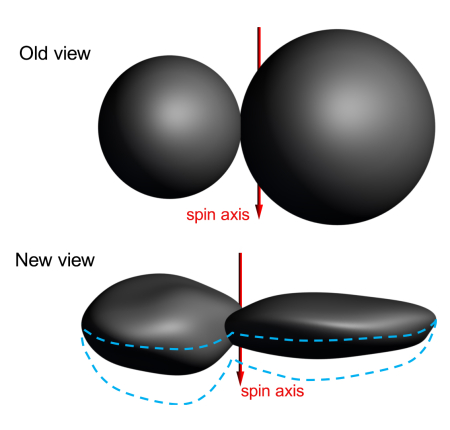
The first close-up images of Ultima Thule – with its two distinct and, apparently, spherical segments – had observers calling it a “snowman.” However, more analysis of approach images and these new departure images have changed that view, in part by revealing an outline of the portion of the KBO that was not illuminated by the Sun, but could be “traced out” as it blocked the view to background stars.

Stringing 14 of these images into a short departure movie, New Horizons scientists can confirm that the two sections (or “lobes”) of Ultima Thule are not spherical. The larger lobe, nicknamed “Ultima,” more closely resembles a giant pancake and the smaller lobe, nicknamed “Thule,” is shaped like a dented walnut.

The image on the right shows their preliminary guess at Ultima Thule’s overall shape, as suggested by these new images.

The spacecraft has still not sent back the images it took during its closest approach, so there are likely more surprises coming.

New image of Ultima Thule

Ultima Thule

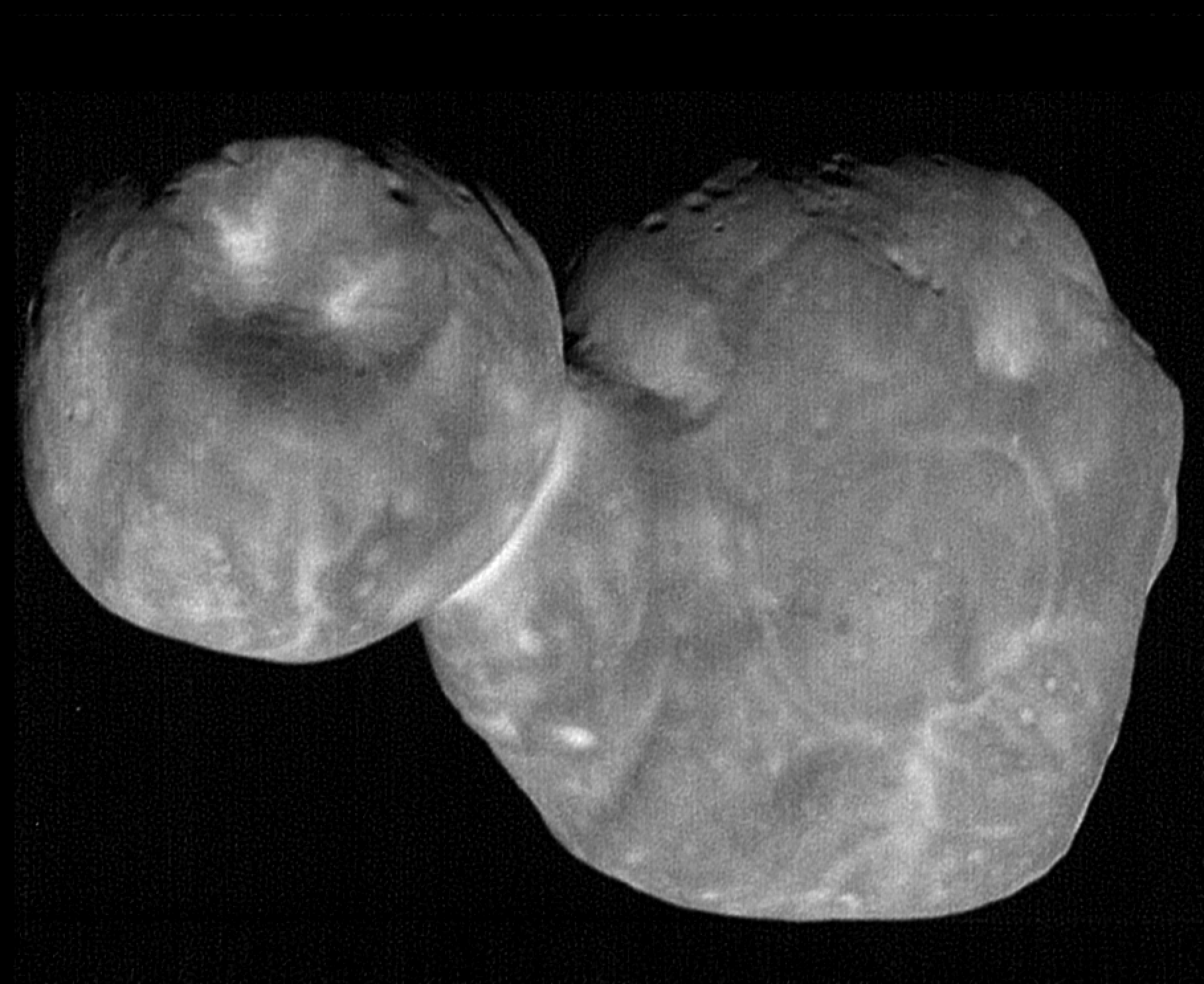
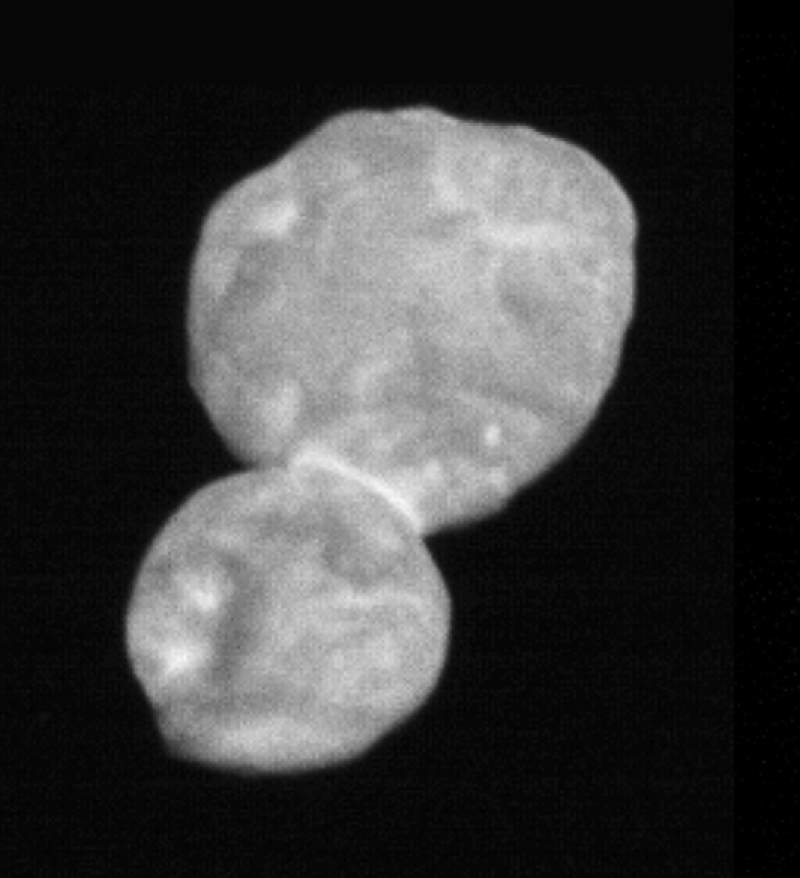
The New Horizons science team today released the newest and highest quality image yet of the Kuiper Belt object Ultima Thule. The image can be seen by clicking on the slightly reduced and cropped to the right.

Obtained with the wide-angle Multicolor Visible Imaging Camera (MVIC) component of New Horizons’ Ralph instrument, this image was taken when the KBO was 4,200 miles (6,700 kilometers) from the spacecraft, at 05:26 UT (12:26 a.m. EST) on Jan. 1 – just seven minutes before closest approach. With an original resolution of 440 feet (135 meters) per pixel, the image was stored in the spacecraft’s data memory and transmitted to Earth on Jan. 18-19. Scientists then sharpened the image to enhance fine detail. (This process – known as deconvolution – also amplifies the graininess of the image when viewed at high contrast.)

The oblique lighting of this image reveals new topographic details along the day/night boundary, or terminator, near the top. These details include numerous small pits up to about 0.4 miles (0.7 kilometers) in diameter. The large circular feature, about 4 miles (7 kilometers) across, on the smaller of the two lobes, also appears to be a deep depression. Not clear is whether these pits are impact craters or features resulting from other processes, such as “collapse pits” or the ancient venting of volatile materials.

They have only begun downloading the best data and images, so expect better images in the future.

More results from New Horizons

Today’s press conference did not release any significantly new images. In fact, they did not provide much new information at all. They noted that based on the data obtained so far, they have confirmed that Ultima Thule has no moons closer than 100 miles, or further than 500 miles, but they have not yet gotten the data that looks in that gap.

They created a stereoscopic image using two images produced thirty minutes apart. This helps tell us where the bumps and depressions are on the surface, something that cannot be clearly determined from the first image because the sun was shining directly on it, producing no shadows. From this it appears that the smaller lobe has a very significant bump. More data from New Horizons will have to be downloaded to confirm this.

The reddish color of Ultima Thule places it in the center of a class of Kuiper Belt objects dubbed cold classical objects. This will help them better determine its make-up as more data arrives.

Overall, this press conference was mostly hype. They don’t yet have enough data from the spacecraft, and won’t have it for weeks. I’m therefore puzzled why they bothered today, unless they did it simply to keep the hype up about the mission so as to encourage funding to look for another object to fly past.

“We have a snow-man!”

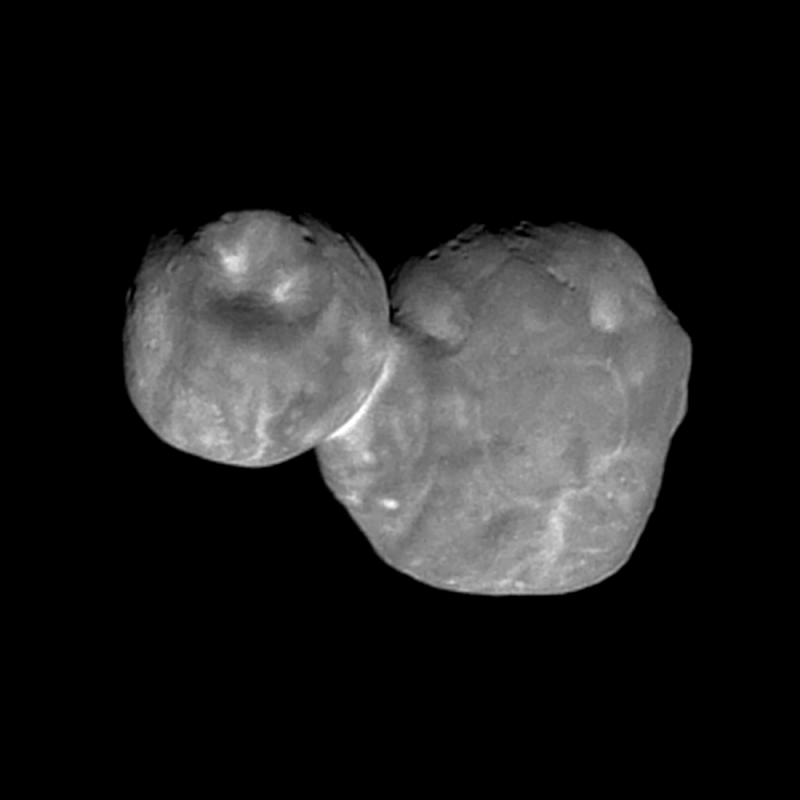
Ultima Thule, the snowman

The quote in the headline comes from Alan Stern, the principle scientist for New Horizons, during today’s press conference revealing the first high resolution images of Ultima Thule. The press release for this conference is now online. The image on the right is a reduced cropped version of the main release image today. If you click on it you can see the full resolution version.

The images reveal that Ultima Thule actually is two objects in contact with each other. In addition, the snowman description is apt, as it has a mottled appearance as if it was shaped roughly and somewhat gently over time. Tiny pebbles and rocks softly came together to form two snowballs that then eventually came to touch and join.

They describe this as the most primitive object ever observed. It is also dark, and red in color, like dark reddish dirt.

More images and data is still coming in, to be released in another press conference tomorrow.

Another image of Ultima Thule

Ultima Thule again

The image on the right was released during this morning’s first briefing outlining the successful confirmation of New Horizons’ fly-by of Ultima Thule (still on-going as I post this). It, along with other data, has provided an explanation for why the scientists have not detected a significant variation in brightness: Our view is looking down at the object’s poles

Images taken during the spacecraft’s approach — which brought New Horizons to within just 2,200 miles (3,500 kilometers) of Ultima at 12:33 a.m. EST — revealed that the Kuiper Belt object may have a shape similar to a bowling pin, spinning end over end, with dimensions of approximately 20 by 10 miles (32 by 16 kilometers). Another possibility is Ultima could be two objects orbiting each other. Flyby data have already solved one of Ultima’s mysteries, showing that the Kuiper Belt object is spinning like a propeller with the axis pointing approximately toward New Horizons. This explains why, in earlier images taken before Ultima was resolved, its brightness didn’t appear to vary as it rotated. The team has still not determined the rotation period.

They note that the highest resolution images will not arrive until February, though they do expect some good images by tomorrow.

“We have a healthy spacecraft.”

The words above were just announced in the control room for New Horizons. They have confirmation that the spacecraft survived the fly-by of Ultima Thule, and is now ready to begin downloading the data it obtained.

It will take literally a year to get all of that data. They will be holding a first press conference within an hour to outline in greater detail the spacecraft’s status, followed by another briefing at 2 pm Eastern where they will likely release the first images.

First faint image of Ultima Thule

Ultima Thule, first image

In anticipation of receiving data from the fly-by just past midnight last night, the New Horizons team has released the image above, taken 24 hours earlier.

Just over 24 hours before its closest approach to Kuiper Belt object Ultima Thule, the New Horizons spacecraft has sent back the first images that begin to reveal Ultima’s shape. The original images have a pixel size of 6 miles (10 kilometers), not much smaller than Ultima’s estimated size of 20 miles (30 kilometers), so Ultima is only about 3 pixels across (left panel). However, image-sharpening techniques combining multiple images show that it is elongated, perhaps twice as long as it is wide (right panel). This shape roughly matches the outline of Ultima’s shadow that was seen in observations of the object passing in front of a star made from Argentina in 2017 and Senegal in 2018.

This object is definitely strangely shaped.

New Horizons is traveling fast, which is why we won’t get good images until practically the instant the fly-by happens. And the first downloads from that fly-by are due to arrive within the next two hours. Keep your fingers crossed that the spacecraft operated as programmed and captured Ultima Thule in all its weird glory.

One point about the sad state of journalism these days. Numerous media publications posted stories last night celebrating that fly-by, as if they knew it was a success. This is bunk. We won’t know what happened until this morning. To imply we do is the hallmark of fake news.

Watching New Horizons’ flyby of Ultima Thule

NASA has announced that the partial government shutdown will no longer prevent full coverage by the agency of the New Horizons’ fly-by of Kuiper Belt object Ultima Thule just past midnight on January 1, 2019.

This entire shutdown is pure theater, and a joke. If the government was truly out of money, it would be impossible for NASA to suddenly obtain funds to finance a New Horizons’ fly-by broadcast. The problem is that legally the government should be out of money, as Congress has the power of the purse and has not approved funding. Unfortunately, we no longer obey the law, and so our government can now do whatever it wants, free from all legal constraints.

Meanwhile the article at the link provides some good information on watching the fly-by:

Though people can now continue to enjoy the coverage through NASA’s New Horizons twitter account and NASA TV, APL will continue providing coverage in their own YouTube channel, as well as with Stern’s personal twitter account and New Horizon’s account.

The twitter feeds will mostly be junk. I would focus on the streaming links.

No rotational light curve from Ultima Thule?

Data from New Horizons as it is quickly approaching Ultima Thule has found that even though the object is expected to be oblong or even two objects it has shown absolutely no variation in light as it rotates.

Even though scientists determined in 2017 that the Kuiper Belt object isn’t shaped like a sphere – that it is probably elongated or maybe even two objects – they haven’t seen the repeated pulsations in brightness that they’d expect from a rotating object of that shape. The periodic variation in brightness during every rotation produces what scientists refer to as a light curve.

“It’s really a puzzle,” said New Horizons Principal Investigator Alan Stern, of the Southwest Research Institute. “I call this Ultima’s first puzzle – why does it have such a tiny light curve that we can’t even detect it? I expect the detailed flyby images coming soon to give us many more mysteries, but I did not expect this, and so soon.”

They have several theories, all implausible, to explain this. It could be they are looking at the object’s pole. Or maybe a dust cloud or numerous tumbling moons surround the object and hide the light variation.

Fortunately, we shall have an answer to this mystery in less than two weeks, when New Horizons zips past.

New Horizons sees no hazards, will do closest fly-by of Ultima Thule

After three weeks of intense observations and seeing no significant objects orbiting close to the Kuiper Belt object Ultima Thule, the New Horizons team has decided to go for the closest fly-by on January 1, 2019.

After almost three weeks of sensitive searches for rings, small moons and other potential hazards around the object, New Horizons Principal Investigator Alan Stern gave the “all clear” for the spacecraft to remain on a path that takes it about 2,200 miles (3,500 kilometers) from Ultima, instead of a hazard-avoiding detour that would have pushed it three times farther out. With New Horizons blazing though space at some 31,500 miles (50,700 kilometers) per hour, a particle as small as a grain of rice could be lethal to the piano-sized probe.

We should begin to see more detailed images soon. Because of the speed in which New Horizons is traveling, it will not get very close until it is almost on top of Ultima Thule, so the best images will all occur over a very short span of time.

1 2 3 6