Paraguay becomes the 67th nation to sign Artemis Accords

Artemis program logo

Paraguay yesterday became the 67th nation to sign Artemis Accords, continued the flood of smaller third world nations that have signed up in the last few weeks following the completion of the Artemis-2 mission around the Moon.

The remarks of NASA administration Jared Isaacman in connection with this event I find most tantalizing:

“They join an ever-growing coalition of like-minded nations committed to the peaceful, transparent, and responsible exploration of space. Established by President Trump in his first term, the Artemis Accords provided the principles for how we explore the Moon, Mars, and beyond. Now, with his national space policy, we are putting the Artemis Accords into practice with our Moon Base. We are creating opportunities for all Artemis Accords signatories, including Paraguay, to join us on the lunar surface and advance our shared objectives in this next era of exploration.” [emphasis mine]

While that national space policy [pdf] accepts the Outer Space Treaty’s limitation on establishing American law on other worlds, including property rights, it also makes its first goal that of promoting private enterprise.
» Read more

Russia arrests Angara contractor for fraud

Fraud is a given when it comes to government operations, whether in the U.S. or Russia. A contractor doing work on the production facilities for Russia’s new Angara rocket has now been arrested for stealing more than $7 million.

In May 2026, Gazeta.ru, citing regional courts, reported an arrest of Dmitry Zolotarev, the Director General at OOO RST Genpodryad, which was involved in renovations and upgrades of facilities for serial production of Angara rockets at PO Polyot under a contract with GKNPTs Khrunichev.

Zolotarev and his accomplices were accused of stealing 545 million rubles (approximately $7.3 million) during a period from 2022 to 2025, by submitting the Federal treasury agency in Moscow forged documents with an inflated purchase price of overhead cranes and pocketing the difference. According to Gazeta.ru, Zolotarev was suspected of other similar schemes and faced 10 years in prison if convicted.

Government routinely does a bad job in monitoring its spending, which thus creates an easy temptation for others to put their hands in the cookie jar and take what’s not theirs. We can see this same thing occurring now in the U.S. with many so-called “safety net” programs. Since Russia’s entire aerospace industry is government controlled, this kind of corruption therefore happens frequently within it.

Lockheed Martin fights request to ease 2018 restrictions on Northrop Grumman’s solid rocket business

A legal fight between Lockheed Martin and Northrop Grumman has broken out over Northrop Grumman’s recent request to the Federal Trade Commission (FTC) to ease a 2018 consent order that restricts Northrop Grumman’s ability to market its solid rocket motors (SRM).

On April 2, Northrop petitioned the Federal Trade Commission to drop a 2018 consent order helmed when Northrop acquired solid rocket motor maker Orbital ATK. The consent agreement requires Northrop to supply SRMs to its competitors in the missile market on a non-discriminatory basis and to firewall its SRM business away from its other operations.

At the time, the FTC believed the measure was necessary due to Northrop’s status as a prime contractor and Orbital ATK’s position as one of only two American makers of solid rocket motors.

Northrop is not a major manufacturer in the American missile space, which is dominated by Raytheon and Lockheed. However, if the order is dropped, Northrop will be able to vertically integrate its solid rocket motor business with any munitions the company designs in the future — including potentially prioritizing SRM supplies for Northrop over competitors, Lockheed stated in a response to the petition.

This consent order has prevented Northrop from marketing its solid-fueled rockets openly. Instead, it appears it forces the company to sell to its competitors, such as Lockheed, who then garners the big profits in marketing them. That order I think has also limited Northrop’s ability to use its boosters for other purposes, such as launching satellites.

Overall it appears this consent order has been very counter-productive, in hindering competition in the American solid-fueled rocket industry. At present there is a shortage of production capacity in the U.S., so much so that the Italian rocket company has moved in to market its own solid-fueled rockets here. In fact, it is selling its rockets to Lockheed and Raytheon, which suggests Northrop is entirely justified in asking to be released from this order.

The UK’s Sutherland spaceport now appears dead

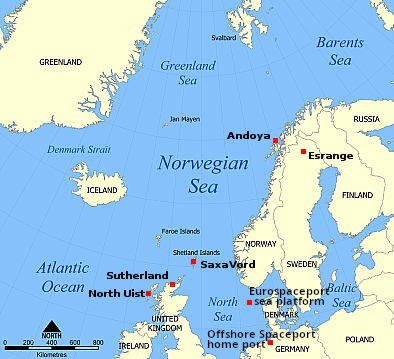
Proposed or active spaceports in North Europe

In a news report yesterday about the failure of the United Kingdom’s rocket startup Orbex in February 2026, the following details about the Sutherland spaceport in Scotland suggests that spaceport is now defunct, with little chance of being revived.

Administrators say that one of Orbex’s key remaining assets is the Sutherland Spaceport site near Melness – although the only construction work undertaken at the site is some 600m of access road. The company responsible for it, Sutherland Spaceport Ltd (SSL), remains financially stable, according to administrators. This means the site could still be sold or potentially restarted, even though no launch activity is currently taking place.

The spaceport sits on land leased from local crofters under a long-term arrangement managed through Highlands and Islands Enterprise. SSL holds a 50-year sublease, with an option to extend for 25 years, and a break clause in 2027.

Orbex had originally intended to launch from Sutherland — close to the rocket factory it had built — but local opposition by billionaire Anders Holch Povlsen (who is a major owner in the competing Saxavord spaceport on the Shetland Islands) as well as endless bureaucratic delays from the UK’s Civil Aviation Authority made that impossible. The company attempted to switch its launches to Saxavord, but the cost and new licensing requirements were too much.

No other launch company has expressed any interest in using Sutherland, and it appears none will be forthcoming in the near future. The red tape in the UK, combined with that powerful local opposition, has made Sutherland a pariah to the smallsat rocket companies looking for launch sites.

Though the spaceport might say it is “financially stable”, without any customers I guarantee it is going to disappear at some point.

Two lawsuits against SpaceX, claiming company operations damage local homes

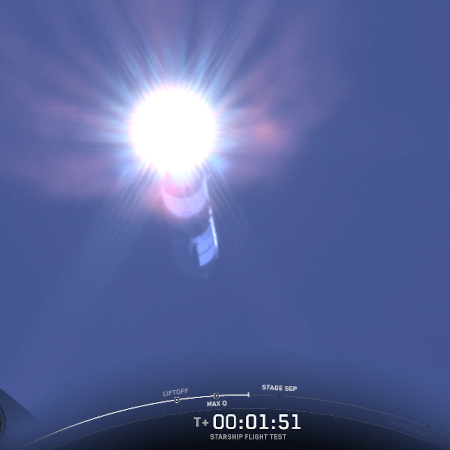
Starship and Superheavy during ascent
Starship and Superheavy ascending during October test flight.

SEE UPDATE BELOW for info on 2nd lawsuit.
—————————-
In what appears to be another frivolous lawsuit aimed at SpaceX, about 80 homeowners located from five to ten miles away from SpaceX’s Starbase launch site at Boca Chica have now sued the company, claiming Starship launches have damaged their homes.

The 53 homes are in small towns between 5 and 10 miles from SpaceX’s launch complex near Boca Chica Beach outside Brownsville with 43 in Port Isabel and the others in Laguna Vista, Laguna Heights and South Padre Island.

The lawsuit doesn’t describe the specific damage incurred by each homeowner, but there have been reports of houses shaking, items falling off shelves and broken windows after previous launches and landings of Starship, the world’s largest and most powerful rocket.

“SpaceX has repeatedly subjected the surrounding areas to extraordinary amounts of acoustic energy including noise, vibrations, and sonic booms,” it said of the flights, which can produce multiple sonic booms in addition to the sustained noise of launch, depending on the mission. Starship operations have subjected the plaintiffs’ homes “to repeated intense and damaging acoustic events,” the lawsuit said. [emphasis mine]

In other words, the launches are noisy, and might have caused some things to fall off shelves and might have broken windows. Note too that in Florida the safety zone around launches is three miles, and comparable rockets to Superheavy/Starship (Saturn-1B, Saturn-5, the Space Shuttle and SLS) have repeatedly launched there without causing any noticeable damage. I myself watched a shuttle launch from five miles away and found the sound of the launch actually disappointing. It certainly wasn’t going to cause damage to anything at that distance.

This lawsuit therefore appears simply to be a case of some lawyer trying to blackmail a big company for some ready cash. Its origin might also stem from the insane leftwing hate of Musk because he had to gall to support the election of Donald Trump in 2024. Note too that the author of the article at the link, Brandon Lingle, seems to be one of those insane anti-Musk haters, as he never has anything good to say about SpaceX, and treats all environmentalists like saints.

UPDATE: It appears the same law firm behind the lawsuit above has filed a second lawsuit for 80 other landowners in the vicinity of SpaceX’s MacGregor test site near Waco, claiming the static fire engine tests there are causing them unspecified problems as well. As with the lawsuit above, it appears the claims are mostly an attempt to squeeze money from SpaceX, with some of that effort fueled by anti-Musk hatred.

Malta signs Artemis Accords

On the same day (May 4th) Ireland officially signed the Artemis Accords (as announced on May 1st), Malta also signed the accords, becoming the 66th nation to join this American space alliance.

The Republic of Malta became the 65th signatory to the Artemis Accords on Monday during a ceremony in the town of Kalkara with NASA and U.S. Department of State officials present. … Malta’s Minister for Education, Youth, Sports, Research and Innovation Clifton Grima signed the Artemis Accords on behalf of the country. … U.S. Ambassador to Malta Somers W. Farkas and NASA Europe Representative Gregory Mann witnessed the signing together with Deputy Prime Minister and Minister for Foreign Affairs and Tourism Ian Borg.

As I predicted on April 30th, the success of the Artemis-2 mission has caused a lot of third world smaller nations to quickly jump on the bandwagon, with Latvia, Jordan, Morocco, Ireland, and now Malta all signing in just the past week.

The full list of nations in this American space alliance is as follows:

Angola, Argentina, Armenia, Australia, Austria, Bahrain, Bangladesh, Belgium, Brazil, Bulgaria, Canada, Chile, Colombia, Cyprus, Czech Republic, Denmark, Dominican Republic, Ecuador, Estonia, Finland, France, Germany, Greece, Hungary, Iceland, India, Ireland, Israel, Italy, Japan, Jordan, Latvia, Liechtenstein, Lithuania, Luxembourg, Malaysia, Malta, Mexico, Morocco, the Netherlands, New Zealand, Nigeria, Norway, Oman, Panama, Peru, Poland, Portugal, Romania, Rwanda, Saudi Arabia, Senegal, Singapore, Slovakia, Slovenia, South Korea, Spain, Sweden, Switzerland, Thailand, the Philippines, the United Kingdom, the United Arab Emirates, the Ukraine, the United States and Uruguay.

Expect more nations to sign on in the coming weeks.

China imposes extensive regulations on its pseudo-commercial space industry

China's communists to its citizens
China’s communists to its citizens “Nice business you got here.
Shame if something happened to it.”

As I predicted when China announced in the fall 2025 that it was creating a special agency to supervise the pseudo-companies in its faux commercial space industry, the Chinese government last week announced the release of what it calls its “Commercial spaceflight standards system,” covering all aspects of the operations its pseudo-private companies.

The standards cover six different areas, but the first best expresses the government’s overall goal:

‘Industry Governance Standards’ focuses on the sector’s characteristics of rapid development, agile response, and short delivery times, alongside space safety concerns such as debris mitigation and protection. With subcategories including market access, safety supervision, space environment governance, certification, energy conservation, and occupational health, it is intended to establish hard regulatory constraints as the compliance foundation for orderly commercial space development. [emphasis mine]

The screen capture from a Monty Python skit to the right says it all. The communists running China apparently did not like the chaotic free nature of this pseudo-industry, with the different companies coming up with many wild and innovative ideas, some of which were bound to fail. The communists also saw that some of these pseudo-companies were also making a lot of money that the communists weren’t getting.

And so, the government formed this agency, and it called the companies together to lay down the law.
» Read more

Who really was Jay Gould?

The life and legend of Jay Gould

To get to the point, right at the start, Jay Gould was not a “Robber Baron”, nor was he the worst “Robber Baron,” as many journalists of his time as well as many historians in the next century liked to slander him, implying he was unethical, cruel, and routinely used under-handed tactics to destroy others while making himself wealthy. In fact, he was no more a robber baron then the entire class of hard-nosed businessmen who in the 1800s became America’s first generation of today’s billionaires, using the free enterprise system to gather wealth to themselves while building vast industries that employed millions and made the lives of everyone better and more prosperous.

I have just finished reading Maury Klein’s 1997 fine biography of Jay Gould, the Life and Legend of Jay Gould, and was not surprised to learn that Gould was never the evil personification of worst sort of capitalist, as routinely portrayed by our leftist academia for the past century. Instead, I discovered he was no different then all the other leading businessmen of his time, hard-nosed and ruthless when it came to cutting deals, but strongly committed to making the businesses he ran profitable and successful, providing the public a useful product they would be eager to use.

You see, in a free capitalist society, you can’t succeed unless you are willing to be ruthless at times. This doesn’t necessarily mean you routinely use violence, or break the law, or go out of your way to hurt others, but it does mean you defend yourself from attack, and retaliate quickly using legal means when under attack. These rules apply today as they did in Gould’s time. Nothing has changed.

Gould was no different than Cornelius Vanderbilt (whose life I reviewed here). Nor does he differ from John D. Rockefeller, or Elon Musk, or Jeff Bezos, or any one of the thousands and thousands of American businessmen, who from the founding of this country used its free but legal framework to build a nation while enriching themselves.

Gould’s most famous area of success involved his ownership of many railroads, both in the American west as well as the first elevated subways in New York City. He also gained full control over Western Union, and for more than a decade ran a system that provided the entire country and even the world its first instantaneous method of communications. To gain control over these venues involved many battles, some of which required tactics that were harsh, even a bit under-handed, and clever. Sometimes it required payoffs to politicians, or tricky stock deals that once completed left many others sinking in the wake.

A typical anti-Gould newspaper cartoon from 1882

Gould’s tactics however were never much different than those of others of his ilk. And like those others, his overall good management of his companies he controlled, as well as the good treatment of the people who worked under him, garnered strong loyalty and support across these industries. Gould wanted control, but always when he had it he used it to make his product better and more useful.

When he died, it was the people who knew him who had good things to say about him, and it was the journalists who did not who continued to spread the slanders, because it made good copy and sold newspapers. And sadly, for the decades that followed, historians used those news reports — mostly wrong — as their primary sources of information, and thus the legend of an evil Gould was created.

Klein’s biography is a worthy effort to counter this bad history. More Americans should read it, if only to realize their past history was far more admirable than what they have been taught for the past few generations.

Gould’s tactics — and his success — were things he learned very earlier on in life, when he went out on his own.
» Read more

Propaganda vs reporting in describing the battle over NASA’s budget

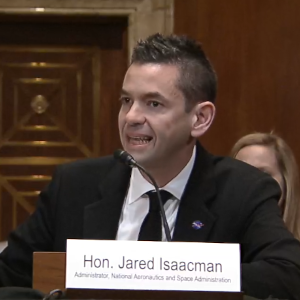
Jared Isaacman before the Senate

NASA administrator Jared Isaacman yesterday appeared before a subcommittee of the Senate Appropriations committee, and as happened last week when Isaacman appeared before a House committee, the reality of what happened at the hearing differed greatly from what most new sources reported.

The main topic of both hearings were the proposed $5.6 billion cut in NASA’s budget, proposed by President Trump. Isaacman has made it clear he does not oppose this cut, stating repeatedly in public that he has plenty of money to do what he wants, that there is much waste and needless spending at NASA that needs reform, and by trimming that out he will find the cash he needs.

As I noted in reporting about that House hearing, I was struck by the lack of hard opposition to those cuts. The Republicans generally made little of the issue, though they seemed generally opposed to the cuts. And though the Democrats as expected blasted the cuts, they did so in a generally subdued manner, only showing passion in noting the elimination to NASA STEM education office. Isaacman’s willingness to push back hard against more spending took the wind out of their demands for more money, and so they muted their protests.

Unfortunately, if you relied on our propaganda press for an honest report of this House hearing, you would have been misinformed. As shown below, that propaganda press distorted this reality to back big government spending without question.

The Senate hearing yesterday followed the exact same pattern. The questioning was generally friendly, and Isaacman aggressively pushed back at the demands for more spending by Democrats. This made their push for more spending more difficult, because Isaacman knows what he is talking about, supports an ambitious space program at NASA, and if he says he doesn’t need the extra money, they look foolish throwing it at him.

Yet, the propaganda press once again tried to spin the hearing to promote more spending. Though this hearing got less coverage, the following two stories were typical:

Only one news source (outside of my reporting here), R&D World, reporting this hearing accurately: Senate largely hearing splits on party lines over proposed $5.6 billion NASA cut

Now, I am not naive. I fully expect Congress to restore most of the proposed cuts to NASA’s budget. At the same time, both hearings suggest that Congress will also afford Isaacman more leeway on how he uses the money. He will be able to cut or reshape major projects. He will be able to shut down some offices that he considers wasteful or redundant. And above all, he will be given the freedom to reform NASA in ways no Congress has allowed in decades.

Rocket Factory Augsburg submits license application for a Saxavord launch window opening on July 1, 2026

Proposed or active spaceports in North Europe

The German rocket startup Rocket Factory Augsburg has now submitted a new marine license application to allow it to attempt the first launch of its RFA-1 rocket from the Saxavord spaceport on the Shetland Islands in Scotland, with a launch window opening on July 1, 2026.

Rocket Factory had hoped to do this launch in 2024, but lost the first stage mere weeks before launch when it exploded during a final static fire test on the launchpad. Since then the company has undergone a management shake-up and made major changes to operations and its rocket.

To do this launch, however, it needs a new launch license, and that is a major problem. The company’s announcement is filled with numerous vague qualifiers, as it knows getting the bureaucracies in the United Kingdom to move quickly in this matter is nigh on impossible.

This is a legally required step for planning, and a good sign of how far we’ve come – but it’s not a launch date just yet. We applied for this window because we’re working hard to be ready – and we’re getting closer every day.

So: the application means we’re entering a new phase of preparation. Still, as with any first-ever launch, there are uncertainties, and the schedule may evolve. Further specific details around launch timing will be released through the appropriate channels closer to the time. We’ll keep you posted!

In other words, the company will not be surprised if it doesn’t get its license in time for July, and is prepared for delays.

Another German rocket startup, Isar Aerospace, has been trying to launch its Spectrum rocket from Norway’s Andoya spaceport since January, with the launch scrubbed several times due to technical issues. Right now the launch its tentatively scheduled for May, which means the race to achieve the first orbital launch from Europe is tightening considerably.

If I had to place a bet, my money would be on Isar, not Rocket Factory, and the reason would be because I truly doubt the British bureaucracy will issue a license on time. Its track record has been abysmal, sometimes taking years to give an okay. In this case it might not take that long, since Saxavord has gotten all its own permits already (after years of waiting) but no one should be confident it will act with speed. And it is clear that the people at Rocket Factory are not.

California Coastal Commission settles SpaceX lawsuit by apologizing and conceding all points

Wants to be a dictator
Wanted to be a dictator; ended up being
a patsy.

SpaceX yesterday settled its lawsuit [pdf] with the California Coastal Commission when the commission agreed to apologize to the company and agree it has no authority to regulate any SpaceX launches at Vandenberg Space Force Base.

The Commission agrees that it may not consider irrelevant factors in performing its function and specifically agrees that it will not take into account the perceived political beliefs, political speech, or labor practices of SpaceX or its officers in considering any regulatory action concerning SpaceX. The Commission acknowledges that Commissioners made statements, including during their October 10, 2024, hearing on the Base’s Falcon 9 launch program, that showed political bias against SpaceX and its CEO and were improper. The Commission apologizes for those statements, as set forth in the signed letter attached as Exhibit C.

The commission also agreed that it has no authority to regulate SpaceX’s launch rate at its launchpads at Vandenberg, and will never again attempt to interfere with these operations.

The SpaceX lawsuit stemmed from the comments made by the commissioners at a meeting in October 2024 when then voted against the military’s plan to allow SpaceX to increase its launch rate at Vandenberg spaceport to up to 50 launches per year. In those comments, the commissioners made it clear that the main reason they were voting against the motion was because they were offended by Elon Musk and his political positions, not because the company was doing anything wrong.

While the settlement does not restrict the commission’s right to regulate off-base actions, or other aspects under its statutory authority, this settlement is a complete victory for SpaceX. The commission members were probably made aware that if they didn’t back down completely, they would be personally liable for a great deal of damages. As a result of this settlement, they are absolved of all liabilities.

FAA to begin taxing launches by payload weight

FAA logo

As per the provisions in last year’s reconciliation budget bill (dubbed for propaganda reasons by Trump the “One Big Beautiful Bill Act”), the FAA was authorized to begin charging fees (another word for taxes) on the mass of each launch payload. The agency last week announced it is now doing so.

More information here.

For 2026, that fee is 25 cents per pound of payload, capped at $30,000 per launch or reentry. The fees would fund work on improving integration of launches and reentries into the national airspace system directed by an FAA reauthorization act in 2024.

Though the amount per launch is small compared to the cost of the launch itself, this new tax is expected to provide ample funds to allow the FAA to expand its licensing operations to meet the growing launch industry. The real challenge will be whether the bureaucracy can stay focused on its main task of serving the public, or use the money to build a new bureaucratic empire aimed at garnering power over the private sector. History suggests we should be pessimistic, and expect the latter.

In the meantime, rocket companies are simply going to apply this new tax to the makers of their payloads, who in turn will have their customers pay the cost.

Starlink returns to Papua New Guinea after court ruling

SpaceX’s Starlink internet service will once again be available in Papua New Guinea after its court this week overturned a ban that had been imposed by a government bureaucracy.

In early 2024, the [Ombudsman] Commission blocked licensing efforts for Starlink, arguing that existing regulations may not be adequate to manage potential risks to public interest and safety.

But in her National Court ruling last week, Judge Susan Purdon-Sully strongly criticised the Ombudsman Commission for its move to halt Starlink’s license process. Finding no breach of PNG’s leadership code, nor evidence of corruption, the judge said the Ombudsman’s concerns were more administrative, meaning its directive to NICTA had been “an unconstitutional exercise of power”.

Meanwhile, the prime minister again urged Starlink to work collaboratively with state-owned Telikom PNG to “ensure a coordinated rollout that complements national infrastructure priorities”.

The article describes in detail several recent natural disasters where the lack of Starlink was a critical component in rescue and repair operations. The country also has large rural areas where Starlink is the only method for reaching the rest of the world quickly. There was thus apparently great political pressure to end this ban.

Trump fires the entire governing board of the National Science Foundation

In a move that should surprise no one at this point in Trump’s second term, yesterday President Trump informed all 24 members of the National Science Board, the committee that runs the National Science Foundation (NSF), that they have been fired.

“On behalf of President Donald J Trump, I am writing to inform you that your position as a member of the National Science Board is terminated, effective immediately,” reads a 24 April email from Mary Sprowls of the presidential personnel office to each NSB member. “Thank you for your service.”

The article at the link, from the journal Science, takes the typical one-sided propaganda press anti-Trump view, interviewing only those who oppose Trump and spending most of its time screaming “He’s destroying science!”

A wider view would ask this: Is there a reason that the president of the United States, elected by the American people, might have reasons to question the management of this board? At the moment the federal government is running a deficit that is back-breaking, and this board publicly criticized Trump’s effort to rein in spending when he proposed a 55% cut in NSF’s budget. If they are not going to cooperate with their boss, then maybe they should leave, and not let the door hit them as they head out.

The Science article also included this howler: “the mass firing is the latest indication that the White House is ignoring the board’s authority and dictating policies at NSF.” Um, who elected them? No one. In fact, they were appointed by the president himself, and he is the only one with the constitutional authority to decide these matters.

Expect court suits of course, with some lower level unelected judge somewhere attempting to take over running the executive branch by demanding these board members remain in power, defying the elected president of the U.S.

EU releases revised Space Act proposal, and it is as odious as the earlier drafts

The European Union
This label would be more accurate if it read
“NOT made in the European Union”

The Council of the European Union (EU) in Brussels at the end of March released [pdf] a revised draft of its proposed Space Act that would impose a single regulatory framework for all space activities across the entire EU.

I have just finished reading this odious 157-page monstrosity, and I can say without question if passed it will not only isolate Europe from all international space commercial activity, it will squelch any possibility that Europe will develop its own space industry.

The first draft of the law, first put forth in 2025, was routinely blasted by American officials, by think tanks in and out of Europe, and by industry representatives. It imposed byzantine regulations on Europe’s space industry while also demanding that non-European companies be required to follow these rules as well, national sovereignty be damned.

The newly released draft does the same, but now does so in a manner that is somewhat vague and unclear.

That lack of clarity includes what is required to comply with the regulations. “There are a lot of things where it says you need to do X. What counts as X? Who knows,” said Gabriel Swiney, director of the Office of Space Commerce’s policy, advocacy and international division. “It will probably be determined at some point by some European committee or standards body.”

“Without regulatory clarity with what the regulatory picture should be, it’s really going to have a stifling effect on what industry is striving to do,” said Janna Lewis, senior vice president of policy and general counsel for Astroscale U.S.

The first draft was delayed and apparently rejected because the member nations of the EU opposed it. It appears this new version, having done nothing to ease their concerns, might already be on its way to the dead letter office.

We shall see. If there is anything dear to the hearts of the EU bureaucrats in Brussels, it is imposing insane regulations on others. It appears those bureaucrats haven’t given up — despite opposition by numerous European governments — and are working hard to win that right in space.

The space agencies of Canada and Europe agree to exchange classified information

Canada:
Canada: “We let our government do it all!”

In what appears to be the increasing policy of the Canadian Liberal government to align its space program with Europe, the Canadian Space Agency this week signed an agreement with the European Space Agency that will make it possible for them to freely exchange classified information.

The European Space Agency (ESA) and Canada have signed a General Security of Information Agreement (GSOIA), which will establish a legally binding framework for the exchange of classified information. The agreement was signed on 14 April at the 41st Space Symposium in Colorado Springs, USA, by ESA Director General Josef Aschbacher and President of the Canadian Space Agency Lisa Campbell, on behalf of the Government of Canada.

The GSOIA will ensure that both parties uphold the highest standards of security while enabling the secure exchange of sensitive information entrusted to authorised institutions and industrial partners. It provides a robust foundation for cooperation in areas where the protection of classified information is essential. In particular, the agreement will facilitate closer collaboration in strategic domains such as space-based surveillance, disaster response and security-related technologies. It will also support the development of dual-use capabilities, including advanced sensing systems, secure communications and emerging space technologies.

Canada is the only country not in Europe that is a partner in ESA. This deal, plus Canada’s recent commitment to provide a half billion dollars of funding to ESA projects, illustrates the Liberal government’s policy to look to Europe more for its space effort, rather than the United States.

This appears also to be part of the Liberal government’s shift away from capitalism and towards a government-based space effort, a decision that is certain to produce few results while wasting a lot of money.

The space station startups: NASA’s new space station plan is mistaken

The American space stations under development

At a conference event this week officials from three of the five American space station startups expressed strong disagreement with NASA’s new space station plan.

The new plan would have NASA build and launch its own new core module, dock it with ISS, and have the new stations attach their first modules to it prior to flying freely. NASA proposed this plan because it does not believe there is enough market to sustain the stations independently and NASA doesn’t have the budget to fully fund them.

The officials repeatedly disagreed about the market issue.

“We believe not only we can be ready by 2030” when the International Space Station is slated to be retired, “but we also believe that we can be profitable on the current market, not waiting for the future market we all will develop and will be successful at,” said Max Haot, CEO of Vast [building the Haven-1 and Haven-2 stations].

…Haot and executives from Axiom Space and Starlab Space said their responses to NASA’s request for information — which were due April 8 — show otherwise. “We put in 390 pages of independent analysis, research studies, datas, contracts, those types of things,” said Marshall Smith, CEO of Starlab Space, which is targeting 2029 for its station to be on orbit. “We’re being very clear and what we can do and how that works.”

One prominent revenue stream the panelists pointed to is other space agencies and nations eager to send their astronauts and payloads to space. “We’ve flown 12 people to space that paid us money to do that,” said Jonathan Cirtain, CEO of Axiom Space, referring to the four private astronaut missions it’s conducted to ISS. “We’ve flown 166 payloads today. All of those are paying payloads that generate revenue for the company.” The Texas company plans to begin operating in 2028 when its first two station modules are slated to be in orbit, then gradually grow the station to five modules.

The officials also said the core module idea would actually slow things down. NASA would have to first build and launch it, and would be starting from scratch to do so. It takes years to build such a thing, and it will certainly not be ready by 2030, when ISS is presently supposed to be retired. Moreover, forcing them to dock to this module would force them all to completely change their own plans, something they all find counter-productive.

In announcing NASA’s core module plan, NASA administrator Jared Isaacman also stated that he was open to industry feedback. I suspect that his core module proposal is going to die, and be replaced with the more direct transition from ISS to these private stations, the approach these companies favor.

I should add that the three startups that spoke up at this conference are also the three that are in the lead to build their stations, according to my rankings below. As far as I can tell, they are all tied for first place, with their station development very robust and well financed.
» Read more

Latvia to sign Artemis Accords

NASA announced today that Latvia will be signing on to the Artemis Accords on April 20, 2026, becoming the 62nd nation to join this American alliance in space.

The Republic of Latvia will sign the Artemis Accords during a ceremony at 9 a.m. EDT Monday, April 20, at NASA Headquarters in Washington. NASA Administrator Jared Isaacman will host Dace Melbārde, Latvia’s minister for education and science; Jānis Beķeris, chargé d’affaires at the Embassy of the Republic of Latvia to the United States; and Jacob Helberg, under secretary of state for economic affairs at the U.S. Department of State.

With this signing, all three of the Baltic states that were once occupied and part of the Soviet Union have now joined this American alliance. So have the former Soviet provinces of the Ukraine and Armenia, as well as the nations of Bulgaria, Czech Republic, Slovakia, Hungary, Poland, Romania, and Slovenia, all of which were once part of the Soviet Bloc, behind the Iron Curtain. In fact, almost all of Russia’s neighbors in Europe have allied themselves with the U.S. Artemis space alliance. It does appear that Putin’s stupid effort to recapture the Ukraine has backfired badly, encouraging these nations to come to us out of fear of the aggressive tyrant on their borders. These nations also probably recognize that Russia’s space effort is a Potemkin Village, hollow and of little worth. If they want to go to space, they need to align themselves with American technology.

The full list of all signatories to this American space alliance:

Angola, Argentina, Armenia, Australia, Austria, Bahrain, Bangladesh, Belgium, Brazil, Bulgaria, Canada, Chile, Colombia, Cyprus, Czech Republic, Denmark, Dominican Republic, Ecuador, Estonia, Finland, France, Germany, Greece, Hungary, Iceland, India, Israel, Italy, Japan, Latvia, Liechtenstein, Lithuania, Luxembourg, Malaysia, Mexico, the Netherlands, New Zealand, Nigeria, Norway, Oman, Panama, Peru, Poland, Portugal, Romania, Rwanda, Saudi Arabia, Senegal, Singapore, Slovakia, Slovenia, South Korea, Spain, Sweden, Switzerland, Thailand, the Philippines, the United Kingdom, the United Arab Emirates, the Ukraine, the United States and Uruguay.

Saxavord spaceport faces new regulatory and financial issues

Proposed or active spaceports in North Europe

The long-delayed Saxavord spaceport on the Shetland Islands in Great Britain appears to now face two new problems that could block future launches, one regulatory and the second financial.

First the financial issue: The spaceport, which has lost about $7 million in both ’23 and ’24, appears to be in technical default of a loan of a bit more than $14.3 million. In this case, the lender is willing to ignore the technical issue, assuming the spaceport meets certain conditions presently being negotiated.

The regulatory issue however is more serious, and could block the spaceport’s expected first launch later this year by the rocket startup Rocket Factory Augsburg.

Despite claiming to be ready for launch, the spaceport has also been subject of a formal complaint to the SIC [Shetland Islands Council] over allegations that the facility has not yet been granted a completion certificate or approval for occupation. The complaint alleges that the fire detection and alarm systems appear not to have been installed and that the premises may be in use without adequate fire precautions. It asks the council to confirm whether the premises has been subject to regulatory oversight and whether it has undertaken an inspection of the site.

The SIC said in response: “Concerns have been raised with the council and these are being looked at by our building standards service. A site inspection is scheduled this week as part of the live building warrant process, including to establish the current position in relation to the building on the site that falls within the council’s building standards remit. Any further action will be considered in light of the findings of that inspection.”

In other words, if the local council finds the fire detection and alarm systems not installed and within its regulatory responsibility, it will deny Saxavord its launch permit.

Meanwhile, the spaceport has been trying for years to get other rocket companies interested in using Saxavord, to no avail. Rocket startups have enough difficulties. They quite rightly don’t need the added delays caused by the UK’s red tape, delays that contributed to the bankruptcy of two different rocket startups. For example, most of the regulatory delays — lasting years — have initially come from a variety of national agencies, with Great Britain’s Civil Aviation Authority leading the way. This new issue is local, an additional bureaucratic layer that must be satisfied.

Sweden’s space agency signs cooperative licensing agreement with the FAA

Proposed or active spaceports in North Europe

The Swedish Space Agency has signed a cooperative licensing agreement with the FAA to help facilitate orbital launches by American rocket companies from its Esrange spaceport.

While the Esrange Space Centre has been in operation since the 1960s, it has strictly been used for suborbital flights. In 2023, SSC Space, the commercial operator of the facility, inaugurated a new launch complex at Esrange to support orbital missions. While the facility has yet to host a launch, South Korea’s Perigee Aerospace and US launch provider Firefly Aerospace have both committed to using it in the future.

Sweden’s efforts to enable US rocket launches from Esrange took another step forward on 15 April 2026, as the Swedish National Space Agency signed an agreement with the FAA to coordinate the licensing of those missions. The agreement builds on a 2025 Technology Safeguards Agreement between the two countries, which laid the groundwork for US launch providers to export what the US government considers “advanced space technology” to Sweden.

Esrange’s interior location remains a problem, however. Any orbital launch is going to have to fly over other countries, either Finland, Russia, or Norway, and it remains unclear whether those countries will approve. Norway has already expressed opposition.

A military pilot’s perspective on downed pilot rescue in Iran Easter weekend

An evening pause: The details of the amazing search & rescue effort to recover a downed American pilot in Iran last weekend has been covered quite thoroughly in the media, especially the alternative press. This video gives us the compelling perspective of the men and women who made that rescue happen. Even if you oppose Trump’s present actions against Iran, Steeve’s reveals a fundamental aspect of the American way of war that illustrates again the best part of America. The key quote, “Will you be worth the trip?”

Hat tip Mike Nelson.

European Union to restructure its space bureaucracy

The European Union
This label would be more accurate if it read
“NOT made in the European Union”

The European Commission of the European Union (EU) announced earlier this week that it is renaming its “European Union Agency for the Space Programme” to the “European Union Space Services Agency (EUSPA)”, with the new agency aimed at running the EU’s various satellite projects, including its Galileo GPS-type constellation, its proposed communications constellations, and its various European security satellite projects.

The proposed regulatory document can be read here [pdf]. More details can be found here:

In the text of the draft regulation, the Commission says the agency is expected to play a crucial role in implementing Union space systems and wider space policy from 2028 to 2034 as part of the European Competitiveness Fund. That places the agency firmly inside the next generation of EU planning for satellite navigation, Earth observation, secure connectivity, space situational awareness and related civil and defence applications.

One of the clearest elements in the proposal is the agency’s planned renaming. The draft regulation states that the current European Union Agency for the Space Programme would become the European Union Space Services Agency. The Commission says this is meant to reflect more accurately the body’s current and future role as an operational actor supporting the delivery of Union space systems rather than simply administering a programme framework. That change in title is therefore intended to signal a broader institutional shift rather than a cosmetic rebranding.

The language above as well as the actual regulation itself I think illustrates well why the European Union is increasingly falling behind the rest of the world in space. The wording is obtuse, complex, and jargon-filled, often aimed at making things seem more significant than they really are.

The number of different bureaucracies involved is also a bad sign. On top is the EU. Under that is the European Commission. Below that is this new agency EUSPA. On the side is the European Space Agency, which though it will have a representative at all EUSPA meetings the division of responsibilities between it and EUSPA is very unclear.

All told, everything about this document and the government bureaucracies involved seems designed to do things slowly and in a manner guaranteed to cost more.

No wonder many member nations of the EU and ESA have decided to go their own way, even as they politely maintain membership in these organizations. Germany, France, Spain, and Italy are all now pushing the development of new commercial independent space companies within their borders, all attempting to launch similar space assets, but with the ability to eventually do it faster and cheaper.

I would expect those new private companies will soon eclipse anything proposed by EUSPA in the coming decade.

Saxavord spaceport lost about $7 million in both ’23 and ’24; Andoya launch scheduled for today

Proposed or active spaceports in North Europe

According to a report in the Times of London yesterday, the Saxavord spaceport on the Shetland Islands lost about $7 million in both ’23 and ’24.

Annual accounts for Shetland Space Centre, the SaxaVord operating company, show a near 32 per cent rise in revenue to £2.5 million for 2024. The document, recently lodged at Companies House, shows a £5.4 million [$7.25 million] pre-tax loss, compared to £5.1 million [$6.85 million] in 2023.

The spaceport is controlled by billionaire Anders Holch Povlsen, who had been instrumental in using the courts to block launches from the other proposed spaceport in Sutherland, Scotland. Saxavord meanwhile was first proposed about four years ago, but it has also not yet had its first launch. In both cases, the major obstacle has been the United Kingdom’s regulatory bureaucracy run by its Civil Aviation Authority, which has taken years to issue permits and licenses. Those delays have bankrupted two rocket companies, Virgin Orbit and Orbex, because they were unable to launch as scheduled.

Saxavord hopes its first launch will occur later this year, from the German rocket startup Rocket Factory Augsburg. That company had hoped to launch in 2024 — after more than a year delay due to red tape — but an explosion during the final static fire test of the first stage ended those plans.

Meanwhile, the first orbital launch from Norway’s Andoya spaceport is now expected later today by the German rocket startup Isar Aerospace. This will be the second launch of its Spectrum rocket, the first failing just after lift-off in 2025. This second attempt had been scrubbed in January and March, and is now scheduled for 1 pm (Pacific) today. I have embedded its live stream below.
» Read more

India’s second spaceport to be completed next year

The existing and proposed spaceports in India

According to officials in India, the nation’s second spaceport at Kulasekarapattinam is on schedule to be completed by next year, when it will become available for polar launches of the SSLV rocket as well as other commercial rocket launches.

India is moving ahead with plans to operationalise a new launch facility at Kulasekarapattinam in Tamil Nadu. It is expected to be commissioned during the 2026–27 financial year, according to information shared in the Lok Sabha by Jitendra Singh.

The new facility, officially called the Small Satellite Launch Vehicle (SSLV) Launch Complex, is being developed as the country’s second space launch site. The Kulasekarapattinam complex will primarily handle launches of SSLV missions to Sun-synchronous Polar Orbit, a trajectory widely used for Earth observation satellites.

The SSLV rocket is at present controlled by India’s space agency ISRO, though there has been an effort by the Modi government to transfer it to the private sector. It is not clear whether that effort has been successful. ISRO and India’s large space bureaucracy has been resistant. There have also been indications that this new spaceport will be made available to the handful of Indian rocket startups that are developing their own rockets.

The Sriharikota spaceport is ISRO’s main launch site. The Hope Island site is a proposed commercial and private spaceport, whose future remains very uncertain.

German rocket startup signs deal to launch from SaxaVord spaceport in Scotland

Proposed or active spaceports in North Europe

The German rocket startup HyImpulse yesterday signed a contract with the SaxaVord spaceport on the Shetland Islands in Scotland to do a suborbital test launch at SaxaVord later this year.

HyImpulse has agreed a launch deal with the Unst spaceport, with the aim of a suborbital launch in quarter three of 2026. It will be the second launch of the company’s SR75 suborbital launch vehicle following a successful lift-off in Australia in 2024, which used a hybrid propulsion system involving paraffin “candle wax” and liquid oxygen. HyImpulse said that initial launch, from Koonibba, showed the vehicle could demonstrate “stable flight validating system performance under operational conditions”.

Under the agreement, SaxaVord will provide launch infrastructure and operational support for the launch of the SR75.

HyImpulse is the second German rocket startup to sign a deal to launch from SaxaVord. Rocket Factory Augsburg plans its second attempt to do an orbital launch from there later this year. In 2024 it was gearing up to do that launch but an explosion during a full static fire test of the rocket’s first stage killed that plan.

Considering the red tape the United Kingdom has imposed on rocket companies, bankrupting two and delaying all launches for years from both SaxaVord and the other proposed spaceport in Sutherland, Scotland, I am surprised these two rocket companies have signed these deals. Maybe the UK’s Civil Aviation Authority (CAA) has been reformed and eased that red tape.

Or maybe HyImpulse will find its plans blocked by the CAA as that agency once again ponders at glacial pace the issuing of a new launch license. Stay tuned.

The new town of Starbase is canceling its May elections

Boy, Elon Musk sure is a FASCIST! Because no one filed to run against the mayor and two commissioners, the new town of Starbase is now about to cancel its May elections.

During an upcoming meeting, the Starbase City Commission is scheduled to consider an ordinance canceling the May 2, 2026 General Election, as all candidates for mayor and city commissioner are running unopposed.

Under Texas law, local governments may cancel elections when every race on the ballot is uncontested.

That means Starbase’s current leadership will remain in office without voters needing to cast ballots. The city’s inaugural mayor is Robert “Bobby” Peden, a SpaceX executive who serves as Vice President of Texas Test and Launch for the company. Two commissioners serve alongside him: Jordan Buss, a senior director of environmental health and safety at SpaceX, and Lois Wallace, an interim commissioner and Starbase resident.

Expect to see stupid mainstream stories suggesting no one filed because people were afraid to run against these SpaceX managers and thus threaten their job status. “Musk, that evil fascist, clearly threatened to send out hit men against anyone who filed! Opposition to Musk will not be allowed!”

What I think is really happening is twofold. First, no one at SpaceX is really interested in this boring administrative government work. They’d rather build cutting-edge rockets. Note that the two commissioners are not really rocket engineers, with one being the wife of a SpaceX employee and the other doing “environmental health and safety” work, likely related to making sure SpaceX meets government work regulations. The real engineers at SpaceX have better things to do.

Second, there really isn’t that much for these town officials to do anyway. The town was established mostly to ease SpaceX’s own regulatory red tape with the state, and once established the task is largely done. Why waste time running for a position that will only add to your work load, while accomplishing nothing of real substance?

Real change at the FCC?

Brendan Carr during Breitbart interview

FCC chairman Brendan Carr this week didn’t simply make a public statement yesterday against Amazon, as I reported earlier today. The day earlier, on March 10th, he did an hour-long interview with Breibart News, providing a more complete summary of the FCC’s overall agenda since the change of administrations from Joe Biden to Donald Trump.

You can watch that interview here. To put it mildly, the shift in policy and approach at the FCC is significant, and appears to be generally moving in the right direction.

To understand the context, we need to first review the FCC’s approach during the Biden administration. My regular readers will remember the many stories during that time describing the FCC’s aggressive effort to expand its regulatory power, in many cases in areas completely exceeding its fundamental statutory authority. For example, it proposed new regulations designed to tell satellite companies how and when to de-orbit their satellites. It also wanted to its own bureaucracy for imposing those regulations, and went ahead and created it without any congressional approval. It also under Biden attempted to limit satellite operations that the astronomy community opposed, an action that was once again outside its statute authority.

Overall, the goal of the FCC under Biden was to expand the power of the administrative state, in as many areas as possible. And though there was push back from Congress, as long as a Democrat was president it was clear that this power-grab was going to grow exponentially.

After the 2024 election, however a Democrat was no longer president. Trump quickly moved in 2025 to squash the FCC’s power grab, with a stated public goal to instead streamline FCC regulations and speed license approvals.

Carr’s interview earlier this week essentially gave us an update on that Trump policy, and it appears this new anti-regulatory policy is moving forward, with a goal to eliminate ten regulations for every one regulation added. According to Carr:
» Read more

FCC chairman blasts Amazon and its Leo satellite constellation

FCC logo

Brendan Carr, the chairman of the Federal Communications Commission, yesterday harshly criticized Amazon for filing papers opposing SpaceX’s application to place a million new satellites into orbit while failing to meet its own FCC license requirement to get 1,600 Amazon Leo satellites in orbit by July 2026.

Amazon should focus on the fact that it will fall roughly 1,000 satellites short of meeting its upcoming deployment milestone, rather than spending their time and resources filing petitions against companies that are putting thousands of satellites in orbit.

To put it mildly, Carr’s point is well taken. In legally protesting SpaceX’s proposed constellation while failing to launch on time as promised, Amazon is following what appears to be standard Jeff Bezos’ practice, epitomized by his rocket company Blue Origin. When customers begin favoring others because the Bezos company either submits a poor bid or fails to meet schedules, the Bezos companies routinely go to court in an attempt to squelch that better competition.

Carr is demanding Amazon stop this, and focus instead on getting its own job done for once. Carr is also signaling the FCC’s position on both SpaceX and Amazon. It is likely going to reject Amazon’s filing and give its okay to SpaceX’s million-satellite constellation, in one form or another.

Carr is also telling Amazon that it faces some push back for failing to launch the required number of Amazon Leo satellites on time. Though it is extremely unlikely the FCC will cancel Amazon’s Leo license, the FCC might fine it heavily. Or it could impose new limits on the constellation. Carr is also indicating the FCC will treat future Amazon license applications much more stringently.

The Senate cries “Uncle!” on SLS and big goverment with its latest NASA authorization bill

I usually pay relatively little attention to the NASA authorization bills that Congress passes periodically, because these bills are generally nothing more than opportunities for the loudmouths in Congress to use them as a bullhorn to puff themselves up to the public and press. Almost never do such bills really have any real impact on the future, or if they do, that impact is often unintended and negative, as Congress is by and large ignorant about these matters and has priorities counter-productive to getting anything substantive accomplished.

I pay even less attention to authorization bills that have only been approved by a committee, and have not yet been voted on by either house. Such bills are ephemeral and the stuff of fantasy. It is nice to know what’s in them, but until such bills are actually approved by both houses of Congress and signed by the president, their language is even more unworthy of serious attention.

Have the pigs in the Senate learned to stop gorging themselves?

Nonetheless, the NASA authorization bill that was just approved by the Senate Commerce committee is worth reviewing, but not for the reasons that has interested the rest of the mainstream and even the aerospace press.

True, the bill extends ISS until 2032. True, it fully supports the commercial private space stations being built to replace it. True, it endorses NASA administrator Jared Isaacman’s restructuring of the Artemis program. True, it rejects all of Trump’s proposed cuts to NASA’s science programs. And true, it strongly endorses a Moon base as a first step to colonizing Mars.

All of these facts are significant, but to focus on each specifically — as it appears the entire press has done — is to miss the forest for the trees.
» Read more

The United Kingdom’s Labor government to spend £500 million on space

The UK Space Agency, gone but not forgotten

My heart be still! The United Kingdom’s present Labor government yesterday announced it has allocated an additional £500 million ($665 million) on a wide range of space projects, all of which are either new government programs or facilities or direct subsidies to its failing space businesses.

Nowhere in this announcement did government officials address the choking regulations and burdensome licensing requirements that have essentially driven away all space business while bankrupting two different rocket startups, Virgin Orbit and Orbex.

In addition to the £1.7 billion committed to European Space Agency (ESA) programmes in November 2025, the government is allocating more than £500 million to national space programmes:

  • £105 million to develop civil capabilities for in-orbit servicing and manufacturing (ISAM) – an emerging market where the UK has a strong competitive edge and opportunities to deliver significant commercial returns and strengthen national resilience
  • £85 million to develop the National Space Operations Centre, including £40 million to build a new ground‑based sensing network, supporting the 24/7 requirement to protect satellites and manage an increasingly crowded space environment
  • £80 million to deliver the Connectivity in Low Earth Orbit (C-LEO) programme, including for a new £30m funding call opened today to support UK businesses developing smarter satellites, advanced hardware and AI‑enabled data delivery
  • £65 million for the National Space Innovation Programme to accelerate breakthrough technologies and boost commercialisation
  • £40 million for the Unlocking Space Programme to drive market demand for space technology, develop national security capabilities and attract private investment to support the scale up of UK firms
  • £37 million to develop space clusters, building on local strengths and ensuring the benefits of space reach every corner of the UK
  • £20 million to accelerate spaceport infrastructure development in Scotland

The announcement was made in connection with the decision by this Labor government to eliminate the UK Space Agency as a separate bureaucracy, consolidating it into the Department for Science, Innovation and Technology (DSIT). The consolidation was intended to save money and make the government more efficient, but this announcement suggests it is being used to funnel more cash into DSIT’s bureaucracy, simply under a different name.

None of this is going to do much to promote an independent space industry in Great Britain. As long as it continues to take years to get launch licenses, rocket companies are not going to launch from its spaceports. And without those launches, its space industry is going to be seriously handicapped. And dumping cash into these various government programs won’t do much either to promote competition or innovation. All the UK will get is more bureaucracy and government control.

1 2 3 258