
Russia launches classified military satellites

Russia today successfully launched a set of classified military satellites, its Angara-1.2 rocket lifting off from its Plesetsk spaceport in northeast Russia.

Russia’s state-run press provided no further information, not even confirming the number of satellites launched. The rocket’s path was north over the Arctic, to put the satellites in a polar orbit.

The leaders in the 2025 launch race:

154 SpaceX
73 China (a new record)
15 Rocket Lab
14 Russia

SpaceX still leads the rest of the world in successful launches, 154 to 122.

1 comment

First Soyuz-5 rocket arrives at Baikonur

According to Russia’s state-run press, the first Soyuz-5 rocket has arrived at the Baikonur spaceport in Kazakhstan, with a targeted maiden launch scheduled for December.

Soyuz-5 is designed to replace Russia’s soon-to-be retired Proton rocket, as well as the Ukrainian Zenit rocket that is no longer available because Russia invaded the Ukraine. It was first proposed in 2016, with its development proceeding in fits and starts since then. Part of the problems has been Kazakhstan, which demanded (and apparently received) a larger cut from Russia before it would allow Soyuz-5 to launch at the planned launchpad at Baikonur.

A larger factor in the delays has been a shortage of cash in Russia itself, as well the generally slow culture of its aging aerospace industry. However, in the case of Soyuz-5, it appears Russia managed to speed things up, as previous reports in 2024 suggested this first launch would be delayed until 2026.

7 comments

Roscosmos forced to replace next manned Soyuz capsule due to damage during test

Russia’s space agency Roscosmos has replaced the Soyuz capsule it was going to use in the next manned mission to ISS, scheduled for launch in late November, because of “major damage” the capsule experienced during normal pre-flight testing.

[D]uring routine post-production tests at ZEM’s Checkout and Test Facility, KIS, Vehicle No. 759 reportedly suffered major damage to its thermal protection system, which could not be repaired in time for the Expedition 74 launch at the end of 2025. According to one source, quoting an officer within the military certification service, Voennaya Priemka, which traditionally oversees quality control in the Russian rocket and space industry, the ship’s main thermal control heat shield, attached to the base of the Descent Module, was accidentally jettisoned, perhaps by a stray signal triggering the pyrotechnic bolts, connecting the Frisbee-shaped structure to the capsule. According to another source, the thermal layers of the shield peeled off, as a result of botched thermal tests.

That Russia can quickly swap capsules this late in the game speaks well of its Soyuz capsule manufacturing process. It doesn’t just build one or two capsules, it has an assembly line.

That the capsule was damaged during the test however once again raises questions about the overall quality control within the Russian space industry, as well as the reliability of its workforce. It has been building Soyuz capsules now for more than a half century, during which it has steadily implemented upgrades along the way. For there to be “a stray signal triggering the pyrotechnic bolts” during routine testing is disturbing. The circumstances are too similar to the earlier sabotage to both Progress and Soyuz capsules, where the evidence suggested someone on the ground had drilled holes in their hulls prior to launch, then patched them to hide their existence until later while in orbit.

Under Putin the living wages of Russian engineers has suffered. It remains a distinct possibility that there are more than a few malcontents within Roscosmos willing to do such stuff. That Roscosmos investigated the previous sabotage, claimed it identified the cause, but refused to release any information about its conclusions, suggests strongly that this is what what happened in those earlier cases. This new incident in turn raises the possibility now of further sabotage.

It once again is critical that the U.S. get out of its space station partnership with Russia as soon as possible. There are too many known and unknown risks.

1 comment

Russia claims to have successfully tested a low-flying nuclear-powered cruise missile

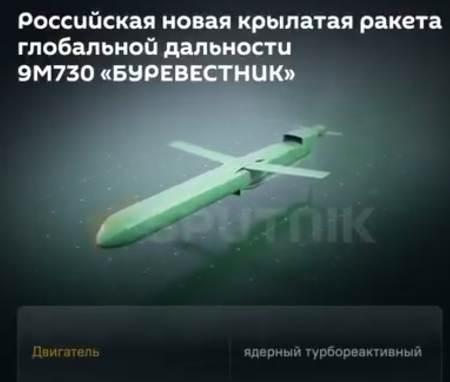
Burevestnik
Artist’s rendering of Burevestnik. Click for source.

According to claims coming from Russia’s state-run press yesterday, it has successfully tested a low-flying nuclear-powered cruise missile, dubbed Burevestnik (“Storm Petrel” in English), that uses a nuclear-powered rocket engine.

Few technical details have been released. The flight itself supposedly lasted fifteen hours during which the missile flew about 8,700 miles, making its average speed about 580 miles per hour. That speed is a little higher than the cruising speed of most airplanes. According to Russia’s state-run press, Burevestnik flies at an altitude of 80 to 300 feet and has an unlimited range.

It appears the missile captures air as it flies, compresses it and then sends it through the nuclear reactor to be heated, which when released as exhaust provides the thrust. If true, this missile is the equivalent of an autonomous airplane that can fly below radar detection anywhere on the globe, and thus a major threat to Russia’s enemies (which is essentially now the whole world).

At the same time, Russia’s ability to design, build and complete any high-tech project has been suspect for decades. Its government makes a lot of promises, but has almost never delivered.

Regardless, this technology bears watching. Expect the defense industry to use this story as a wedge with Congress to get more funding.

32 comments

Russia’s Bion-2 capsule returns to Earth after a month in space

After a month in space carrying a cargo of biological samples, including 1,500 fruit flies and 75 mice, Russia’s Bion-2 capsule was successfully recovered today after landing in southern Russia.

Following the landing, some mice was [sic] to be dissected at the site, followed by further dissections on the 1st, 5th, 15th and 30th days after landing to study the effects of space conditions on live organisms.

While resembling the commercial private returnable capsules, such as Varda’s, that are being developed, the difference is significant. Russia has been flying these capsules for decades, which is actually an upgrade from the very first Vostok capsule which it flew Yuri Gagarin in 1961. However, the research has always been focused not on producing a product for sale on Earth but related to Russia’s manned program. Thus, the results has always been somewhat dead end. Expect the same here.

1 comment

Russia further centralizes and consolidates its shrinking space sector

Roscosmos: a paper tiger

Russia’s state-run TASS press agency today announced that the operations of much of its space sector has now been moved to a newly completed centralized facility on the west side of Moscow.

Over 30 enterprises of Russia’s rocket and space industry, based in Moscow, will move their production sites to the newly created National Space Center, Roscosmos chief Dmitry Bakanov said. “We now have a single platform, where 35 enterprises will be concentrated in one area,” Bakanov said in the National Space Center, visited by Russian President Vladimir Putin on Saturday.

The National Space Center opened in Moscow on Saturday. A complex of building with the total area of 276,000 square meters, is located in the West of Moscow. It’s a joint project of the Moscow Government and Roscosmos.

Sounds neat, eh? In fact, this illustrates how Russia’s space sector is declining. First, Putin in the 2000s centralized the entire industry into a single corporation, Roscosmos, run by the government. That Soviet-style top-down structure eliminated competition and acted to block new companies from forming.

Second, when Russia invaded the Ukraine in 2022 Roscosmos lost billions in revenue when its international customer base cancelled all their contracts and boycotted the country.

Consolidating all these “companies”, which are simply divisions of Roscosmos, into this one facility might save money, but it prevents independent action and competition. It also indicates Russia’s lack of cash.

Most importantly, this move presages the eventually shutdown of many of Russia’s space operations when ISS is retired. Russia has said it is building a new station, but its ability to launch anything new has been abysmal in the 21st century. Routinely it announces new projects which never fly. There is no reason to expect its proposed space station to be anything different.

4 comments

Two launches in the past day

The beat goes on. Since yesterday afternoon there have been two more global rocket launches, by Russia and SpaceX.

First, Russia launched the sixth GPS-type satellite as part of its next generation Glonass constellation, its Soyuz-2 rocket lifting off from its Plesetsk spaceport in northeast Russia. The rocket’s lower stage fell several different drop zones in Russia. No word if they landed near any habitable areas.

Next, SpaceX this morning launched another 24 Starlink satellites into orbit, its Falcon 9 rocket lifting off from Vandenberg in California. The first stage completed its 28th flight, landing on a drone ship in the Pacific.

The leaders in the 2025 launch race:

117 SpaceX
53 China
13 Russia
12 Rocket Lab

SpaceX now leads the rest of the world in successful launches, 117 to 92.

As for the rankings for the most reuse by a rocket, this is the present leader board:

39 Discovery space shuttle
33 Atlantis space shuttle
30 Falcon 9 booster B1067
28 Columbia space shuttle
28 Falcon 9 booster B1071
27 Falcon 9 booster B1069
27 Falcon 9 booster B1063

Sources here and here.

8 comments

Russia launches Progress to ISS

Russia today successfully launched a Progress freighter to ISS, its Soyuz-2 rocket lifting off from the Baikonur spaceport in Kazakhstan.

The freighter will dock with the aft port of the Zvezda module in two days. When it does so, expect NASA to require its astronauts to close the hatch between the American and Russia parts of ISS. The agency has real concerns about the stress fractures in Zvezda’s hull that are the cause of the station’s air leaks, and fears it could at some point fail catastrophically during a docking. The odds of this happening are small, but they are larger than they should be.

The leaders in the 2025 launch race:

115 SpaceX
53 China
12 Rocket Lab
12 Russia

SpaceX still leads the rest of the world in successful launches, 115 to 91. The company has another launch scheduled for later today.

3 comments

Cargo Dragon completes test burn to raise ISS’s orbit

The cargo Dragon that docked with ISS in late August successfully completed yesterday an engine burn lasting more than five minutes to see if it could raise ISS’s orbit.

On Wednesday, Sept. 3, SpaceX’s Dragon completed an initial burn to test the spacecraft’s new capability to help maintain the altitude of the International Space Station. Two Draco engines located in the trunk of Dragon, which contains an independent propellant system, were used to adjust the space station’s orbit through a maneuver lasting five minutes, three seconds. The initial test burn increased the station’s altitude by around one mile at perigee, or low point of station’s orbit, leaving the station in an orbit of 260.9 x 256.3 miles. The new boost kit in Dragon will help sustain the orbiting lab’s altitude through a series of longer burns planned periodically throughout the fall of 2025.

The Dragon will remain docked with ISS until December. It is expected it will do additional test burns during that time.

NASA wishes to get this capability from its own spacecraft so as to no longer have to rely entirely on the Russians, who have traditionally done these orbital adjustments using its Progress cargo freighters. SpaceX likely also wants to do these tests as an adjunct to its contract to build the de-orbit vehicle that will bring ISS down, after it is retired.

4 comments

Russia launches classified military payload

Russia today successfully launched a classified military payload comprising “multiple military spacecraft”, its Angara-1 rocket lifting off from its Plesetsk spaceport in northeast Russia.

This was Russia’s second launch in two days, something it rarely does any longer. It was also the fifth launch of this version of Russia’s new family of Angara rockets, using a modular design that can be configured for different size payloads. Launched into a polar orbit, the lower stages crashed in the ocean in the Arctic and Pacific.

The leaders in the 2025 launch race:

101 SpaceX
47 China
11 Rocket Lab
11 Russia

SpaceX still leads the rest of the world in successful launches, 101 to 82.

0 comments

Russia launches returnable capsule for month-long biology research mission

Russia today successfully launched the first Bion-M returnable capsule in more than a dozen years, its Soyuz-2 rocket lifting off from the Baikonur spaceport in Kazakhstan.

The capsule will remain in orbit for about a month doing weightlessness and radiation experiments with a variety of biological samples, 1,500 fruit flies, and 75 mice. Though similar to the commercial capsules recently launched by Varda, Bion-M is different in that it appears the research has no marketability. As a government-run project by Russian Academy of Science, no effort was made to use weightlessness to produce a product for sale on Earth.

The leaders in the 2025 launch race:

101 SpaceX
47 China
11 Rocket Lab
10 Russia

SpaceX still leads the rest of the world in successful launches, 101 to 81.

1 comment

Kazakhstan looking for commercial rocket startups outside Russia to launch from Baikonur

The Kazakhstan government is now hoping to convert portions of its Baikonur spaceport not leased by Russia so that international rocket startups, or maybe its own commercial rocket startup, could launch from there.

While much of the site is still under Russian lease, Kazakhstan acquired the 100 km² Zenit launch site and assembly centre in 2018, and earlier this year took over the former “Gagarin” launch pad, which is now a tourist attraction. This opens the door for Astana [Kazakhstan’s capital] to negotiate directly with foreign operators.

… To give itself an edge and capitalise on the site’s potential, Kazakhstan plans to set up a special economic zone for “national space projects and foreign start-ups.” Kazakhstan’s Prime Minister Olzhas Bektenov has already confirmed talks with India’s Skyroot, China’s Deep Blue Aerospace, and several European firms. “We briefly discussed options for launch pads or joint grant applications,” confirmed Christian Schiemer, CEO of Germany’s HyImpulse. Other interested parties include Germany’s OHB and Rocket Factory Augsburg, as well as Airbus Defence & Space and Luxembourg’s SES.

China has also held talks about using Baikonur.

All of this however is very speculative, with sources expressing skepticism.

Kazakhstan however increasingly needs to do something to save Baikonur. At the moment the Russians have only one active launchpad, for its Soyuz-2 rocket. Two other launchpads for its Proton rocket are listed as active, but that rocket is largely retired. A fourth launchpad for Russia’s proposed new Soyuz-5 rocket remains unfinished, its future uncertain. With Russia increasingly shifting launches to its new Vostochny spaceport in the far east, it is very possible that it will eventually abandon Baikonur.

Kazakhstan has other reasons to make deals with foreign startups. Such deals will make it more independent from its untrustworthy neighbor to the north.

4 comments

Azerbaijan officials hold cooperation talks with SpaceX

In connection with the visit of Azerbaijan’s president to the United States, he and other officials held a meeting with SpaceX vice president Stephanie Bednarek to discuss possible areas of cooperation. From Azerbaijan’s state-run press:

At the meeting, we noted Azerbaijan’s economic potential, strategic development directions, and favorable investment climate. We discussed prospects for cooperation with SpaceX, including partnership opportunities in the application of innovative and space technologies, artificial intelligence solutions, and knowledge and experience transfer.

In plain language, Azerbaijan is considering buying services from SpaceX. That it is doing so underlines once again the negative consequences of Putin’s invasion of the Ukraine. Azerbaijan now fears Russia, and is looking elsewhere for aid. It also senses Russia’s increasing weakness, economically, technologically, and militarily, making it more willing to forge alliances with others.

11 comments

Sources suggest major job layoffs and salary cuts about to sweep Russia

According to various sources, major job layoffs and salary cuts are about to sweep Russia, affecting 800,000 people working for nine different large companies.

The cuts include layoffs, salary cuts, shortened work hours, and unpaid leave, with many involved in the aviation industry.

According to the tweet at the link, the blame goes to the Ukraine war and the collapse of the Russian economy because of it. That might or might not be true, but the speculation is certainly reasonable.

This collapse has been predicted now for several years. If it happens Putin’s future as head of Russia might finally be reaching its use-by date.

Hat tip BtB’s stringer Jay.

6 comments

Russia desperately lobbies the U.S. to continue and expand its space partnership

Roscosmos: a paper tiger

A string of short articles in Russia’s state-run press today, describing the meetings between the head of Roscosmos, Dmitry Bakanov, and interim NASA administrator Sean Duffy, suggest strongly that Russia is desperate to link itself with someone in order to continue its generally bankrupt space program.

Bakanov is making his first visit to the U.S. He and Duffy are also conducting the first face-to-face talks by the heads of their respective agencies in eight years. While the U.S. press has been entirely uninterested in these discussions, mostly because it knows little of substance will come of them other than an agreement to maintain the partnership at ISS through its planned retirement in 2030, the reaction by Russia’s press has been remarkably fawning, repeatedly proposing the U.S. and Russia expand their partnership beyond ISS:

Very clearly, Bakanov was trying to convince Duffy to consider a greater partnership, whereby Roscosmos and NASA do other space projects together. He might have even been offering to join NASA’s Artemis program to explore the Moon.

It appears from the other Russian state-run reports, however, that Duffy’s response was diplomatic but unenthused by such a proposal. All he apparently agreed to was to continue the ISS partnership, until the station’s retirement.
» Read more

27 comments

Russians: Air leak on ISS reduced but still on going

According to a report in Russia’s state-run press today, the repairs to the air leak in the Russian Zvezda module on ISS have reduced the rate of air lose significantly, but have failed to eliminate it.

Long-term observations have shown that the leak in the interstitial chamber of the Zvezda module of the International Space Station, which was reported to have been fixed in June, is still ongoing, though its rate has slowed significantly, Roscosmos Executive Director of Manned Space Programs, special presidential envoy for international space cooperation Sergey Krikalyov said.

“The leak is ongoing. We continue our efforts to find and fix it, with the recent repairs having seriously reduced the rate of air leakage. For some time we even thought that we had found the last crack and sealed it, though long-term observations have shown that it (air loss – TASS) continues,” he told a press conference ahead of the launch of the Crew Dragon Endeavour spacecraft carrying the Crew-11 mission crew.

Even if Russia succeeds eventually in sealing the leak entirely, this does not solve a more fundamental problem, the existence of stress fractures in the hull of Zvezda that have caused the leaks. That module, built in the 1990s and the second oldest module on ISS, remains at serious risk of catastrophic failure due to these fractures. That the leak has not yet been sealed suggests that new cracks are steadily forming even as Russian astronauts patch older cracks.

Though they do not say so, officials at both Roscosmos, NASA, and their partners in Europe and Japan are all praying that the station can last until 2030, when they plan to retire and de-orbit it. They all know however that there is a great risk that Zvezda will not cooperate, and cause an unplanned shut down much earlier.

7 comments

Russia launches two weather satellites

Russia today successfully placed two weather satellites into orbit, its Soyuz-2 rocket lifting off from its Vostochny spaceport in eastern Russia.

Video of the launch here. This was the second launch for this new constellation of satellites. The rocket flew north from Vostochny, crossing Russia with its lower stages and four strap-on boosters falling in designated drop zones inside Russia. No word if anything landed near habitable areas.

The leaders in the 2025 launch race:

91 SpaceX
37 China
10 Rocket Lab
9 Russia

SpaceX still leads the rest of the world in successful launches, 91 to 65.

1 comment

Russia: Commercial satellite constellations providing help to the Ukraine are now targets

Russia this week informed regulators at the International Telecommunications Union (ITU) that it now considers all European and American private satellite constellations “legitimate targets to be destroyed” if they provide any help to the Ukraine.

Russia tells ITU that GPS/Galileo/GNSS nav & commercial broadcast sats helping Ukraine militarily should expect interference. Same for EutelsatGroup, OneWeb, Starlink constellations, which Russia has said are ‘legitimate targets to be destroyed.

There is more at the full article, but that is behind a subscription paywall.

Russia’s announcement here is probably in response to Trump’s more bellicose statements recently about Putin and Russia.

It is hard to predict what will happen, especially when you have a dictator like Putin in power where rational thinking can never be relied on and no laws apply. For example, destroying any orbiting satellites in low Earth orbit will create space junk that will threaten ISS, and a situation NOT beneficial to Russia.

I suspect Russia will begin by trying to jam these constellations. Let us hope it does not go farther than that.

Hat tip to BtB’s stringer Jay.

10 comments

Two Russian satellites are maneuvering toward an American military satellite

Two Russian “inspector” satellites, launched together in 2022 but now separated, appear to be maneuvering toward an American military satellite and are about to position themselves to within 30 and 50 miles respectively every four days.

[O]n June 26, 2025, a new object was apparently ejected from the main satellite at a separation speed of just around 10 kilometers per hour, according to an estimate by Jonathan McDowell.

By the end of June 2025, Object C (Full ID — 2022-089C), as the newly released satellite was identified in the US Space Force catalogue, was around 140 kilometers from its Kosmos-2558 “mother vehicle,” according to observations by Marco Langbroek. It was tracked in a 545 by 451-kilometer orbit, with an inclination 97.24 degrees toward the Equator. On July 3, 2025, at around 18:42 UTC, Object C made a sudden orbit-lowering maneuver descending to an altitude of around 435 kilometers, while Kosmos-2558 remained in its original orbit.

According to Nico Janssen, the newly formed orbit would put Object C within 81 kilometers from USA-326, on July 5, 2025, at around 00:54:20 UTC. In the meantime, Kosmos-2558 would pass at a minimum distance of nearly 49 kilometers from USA-326 on the same day, at around 09:40:50, Janssen predicted on the Seesat-L Internet message board on July 4, 2025.

Russia’s anti-satellite technology is based on tests several decades ago whereby it brought a killer satellite close to a target satellite and destroyed both by blowing up the killer satellite. These maneuvers now are not likely aimed at such a test, destroying the American classified military satellite. Instead, Russia likely wants to obtain close-up photography and data collection about it. The maneuvers however do prove once again that Russia’s anti-satellite technology is viable.

4 comments

Russia launches Progress freighter to ISS

Russia today (July 4th in Kazakhstan) successfully launched a new Progress freighter to ISS, its Soyuz-2 rocket lifting off from the Baikonur spaceport in Kazakhstan.

The freighter will dock to ISS in two days, bringing with it almost three tons of cargo and more than a half done of hardware and equipment. Expect NASA to order its astronauts to shut the hatch between the American and Russian sections of ISS due its fear that a docking to the Zvezda module could cause a catastrophic failure because of the stress fractures in that module’s hull. That docking will however not be directly to Zvezda, but to the Poisk module that is itself docked to Zvezda.

The lower stages and strap-on boosters crashed inside Kazakhstan in the normal drop zones that Russia has used for decades.

The leaders in the 2025 launch race:

84 SpaceX
36 China
10 Rocket Lab
8 Russia

SpaceX still leads the rest of the world in successful launches, 84 to 63.

Russia’s launch pace this year is its lowest pace in decades. At this rate Russia might only get about 15-17 launches off in 2025, a count more comparable to what it did in the very early 1960s. This decline can be directly linked to the Russian invasion of the Ukraine. That invasion caused Russia to lose billions in contracts in the international launch market. And it continues to prevent Russia from winning any new international contracts as well. Except for its government launches (which are limited due to government cash shortages), the only other missions Russia flies are those to ISS, and those number about four per year.

2 comments
1 2 3 4 5 80